
News
Ex-CID Director Shani answers PCoI questions from hospital bed

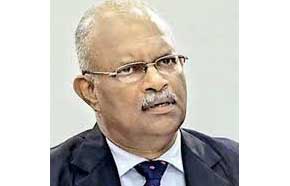
… says police grilled wrong suspect over killing of two cops at Vavunativu
By Rathindra Kuruwita
Former Director of the CID Shani Abeysekera yesterday told the PCoI investigating the Easter Sunday bombings that they had realised that the Islamic terrorists were responsible for the killing of two policemen in Vavunativu only after the Easter Sunday attacks.
Abeysekera, who is currently receiving treatment at Ward 42 of the National Hospital, Colombo, testified via Skype. He had earlier contracted COVID-19.
When Abeysekera began testifying, Attorney-at-Law, Upul Kumarapperuma, appearing for the witness told the Commission that it was doubtful whether his client had adequate time to refer to documents necessary to answer the questions. He also pointed out that Abeysekera was not currently in active service.
Abeysekera told the PCoI that he had received the relevant documents only at around 12 noon yesterday. Therefore, he said, he did not have enough time to study them.
Kumarapperuma then requested the Commission to obtain Abeysekera’s evidence laster. However, the Commissioners stated the term of the PCoI ended on 31 January and it was therefore impossible to postpone the evidence to another date. The commissioners informed Abeysekera to answer questions to the best of his ability and to refer to the documents when necessary.
The commission first asked the witness about the investigations he had carried out. The incidents included the suicide bomb attack on the then President Chandrika Bandaranaike Kumaratunga in 1999, the murder of Yvonne Jonsson at the Royal Park apartment complex in 2005, the murder of ten people in Udathalawinna, and the murder of six people in a car at Delkanda Junction, the murder of Bharatha Lakshman Premachandra, the incident where 27 inmates were killed at Welikada Prison, the shooting of three persons at Rathupaswala and the abduction of Journalist Prageeth Ekneligoda.
Abeysekera said that he had been appointed as the Director of the CID in 2017.
When Commissioners asked him about the murder of two Police officers in the Vavunathivu area on 30 November, 2018, Abeysekara said that the CID had taken over the investigation on the instructions of the then IGP Pujith Jayasundara. A former LTTE cadre had been questioned on detention orders in that regard, he said.
However, further investigations had revealed that the suspect was not involved in the incident. After 21 April, 2019, it had been revealed that the killing was carried out by a group on the instructions of National Thowheed Jamaat leader Zahran Hashim, Abeysekera said.


The Commission to Investigate Allegations of Bribery or Corruption (CIABOC) yesterday (17) recorded a statement from former President Gotabaya Rajapaksa on the allocation of a house for a maid working at the residence of the then Chief Justice Mohan Peiris, PC.
Gotabaya Rajapaksa, in his capacity as the Secretary to the Ministry Defence and Urban Development, allegedly authorised the allocation of the house on the recommendation of the CJ during President Mahinda Rajapaksa’s second term. The Rajapaksa government brought in Peiris as the Chief Justice after impeaching Dr. Shirani Bandaranayake in January 2013.
The allocation of the house was made by the Urban Development Authority (UDA), following the mandatory examination of the request, sources said, adding that during that time the government had launched several mega housing projects in Colombo and its suburbs to accommodate those living in shanties, etc.
CIABOC is expected to record a statement from ex-CJ Peiris who subsequently served as the country’s Permanent Representative to the United Nations in New York.
By Shamindra Ferdinando

As part of the assistance extended by the Government of India towards rehabilitation and reconstruction efforts in Sri Lanka in the aftermath of Cyclone Ditwah, a four-member technical delegation of health experts from Sri Lanka visited India recently.
The Indian HC said: “The delegation studied the Indian models of Medical Kiosks/Health ATMs, Mobile Diagnostic Laboratories and the telemedicine platform ‘eSanjeevani’ to explore replicating these initiatives in Sri Lanka in order to strengthen the local healthcare delivery system.
During the visit, the delegation participated in a series of technical sessions organized by premier Indian institutions like National Health Authority, Indian Council of Medical Research (ICMR) and Centre for Development of Advanced Computing (C-DAC). Visits were arranged for the delegation to Combined Hospital at Loni, Ghaziabad, and Civil Hospital, Sector 10, Gurugram as part of exposure to India’s digital health ecosystem. Demonstrations were conducted on Mobile Health Kiosks / Health ATMs, including basic diagnostics and their role in strengthening primary healthcare delivery. The Sri Lankan experts were also provided an overview of India’s highly successful Ayushman Bharat Digital Mission. A live teleconsultation through eSanjeevani was demonstrated, highlighting the integration of remote consultations with digital health records.
The initiative reflects the continued robust cooperation between India and Sri Lanka in strengthening healthcare delivery systems, particularly in vulnerable areas, and supporting recovery efforts among affected communities.”

Professor G.L. Peiris, former Foreign Minister of Sri Lanka, addressed a seminar on current international affairs and the peace process of Sri Lanka last week in the National University of Singapore. Organised by the Institute of South Asian Studies of Singapore University, the event was chaired by Professor Iqbal Singh Sevea, Director of the Institute.
Professor Peiris presented an analysis of far-reaching changes in the world today, with emphasis on the replacement of rules-based systems by unilateralism and impulse, scant regard being paid to legitimacy. Against the background of peace processes assuming heightened significance in many parts of the world, he dealt with the structure and dynamics of the peace process in his own country, examining its limited achievements and the reasons why it failed to achieve its broader objectives. While each situation has unique characteristics and successful initiatives cannot be mechanically applied in different contexts, he explained the value of the Sri Lankan experience from a comparative perspective.
A vigorous question and answer session followed.
The seminar was attended by academics, diplomats, and representatives of civil society.

CIABOC questions Ex-President GR on house for CJ’s maid

Post-Ditwah Indian recovery assistance to SL: health experts from here visited India

Professor G L Peiris addresses seminar at national university of singapore

New Zealand HC meets Defence Secretary

US paying the price for disregarding military advice

Lawmakers complain of insufficient fuel allocation

‘Dates have the highest sugar content to fight Coronavirus’

Sunday Island 27 December – Headlines

#SundayIsland 17th December – Headlines

Sunday Island – 28th March

Sunday Island Headlines – 21 March

Sunday Island – 21st February – Headlines
-

 News6 days ago
Historic address by BASL President at the Supreme Court of India
-

 Sports6 days ago
The 147th Royal–Thomian and 175 Years of the School by the Sea
-

 Life style3 days ago
From culture to empowerment: Indonesia’s vision for Sri Lanka
-
 News6 days ago
Power sector reforms jolted by 40% pay hike demand
-

 Business2 days ago
Browns EV launches fast-charging BAW E7 Pro at Rs. 5.8 million
-

 News4 days ago
Crypto loopholes funnel Lankan funds abroad
-

 Latest News3 days ago
QR code system will be implemented for fuel with effect from 06.00 a.m. today (15th)
-

 Sports3 days ago
Kirsten brings pedigree, but Sri Lanka must fix the system