
News
Energy Minister lashes out at international funding agencies


Criticism of Electricity Act Amendments:
Energy Minister Kumara Jayakody has lashed out at the Japan International Cooperation Agency (JICA), the Asian Development Bank (ADB), and the World Bank over their public criticism of amendments to the Electricity Act, accusing them of bypassing diplomatic channels and politicising the issue.
“This is not how it should be done. They can’t work with us like this,” Minister Jayakody said in a televised interview on Thursday. “They should have handled it more diplomatically instead of going public.”
His remarks follow a joint letter issued by the three development partners raising red flags over provisions in the Electricity Act 2024. The letter voiced concern over clauses mandating permanent state ownership of electricity entities, proposed restructuring of the National Transmission Network Service Provider (NTNSP), and regulatory control over tariffs.
The ADB, the JICA and the World Bank have written to the Energy Minister regarding several key issues concerning the Electricity Act 2024 Amendments published in the Gazette recently.
The World Bank, ADB and JICA have been the major development partners in the power sector of Sri Lanka. The three institutions coordinate closely on key policy issues, investments, and technical assistance.
In a letter addressed to Minister Jayakody recently, the institutions thanked the Ministry of Energy and the Power Sector Reforms Secretariat for their continued engagement over the past several months on this topic.
However, they highlight four issues in the version of the Amendments to the Electricity Act 2024 published in the Gazette and being proposed to Parliament for consideration, which they believe impede the original intent and spirit of the Act regarding sector efficiency, good governance, and financial sustainability, all with the ultimate objective of ensuring a high quality of service to consumers at affordable prices.
“We share these comments in the spirit of supporting the Government of Sri Lanka in the smooth implementation of the final version of the Act and ensuring a strong energy sector for the future,” said the letter, signed by the Country Manager of the World Bank and IFC, ADB Country Director and JICA’s Chief Representative of Sri Lanka Office.
The issues highlighted in the letter are as follows:
Permanent Government Ownership
Section 17 of the principal Act, subsection 2 is amended with entities denoted as (a), (e), (f), (g), and (h)(ii) will remain “permanently” owned by the Government (through Secretary to the Treasury). The rationale for maintaining 100% Government ownership for the NSO, NTNSP, and Pension Liabilities Company is understood. However, legislating permanent 100% Government ownership in the Act, will increase the burden on the state, limit any private investment or opportunities into the Generation Company and Distribution Company, and only hinder the Government’s options for development in a sector with large investment needs.
National Transmission Network Service Provider (NTNSP)
Clause 20, subclause 3: The preliminary transfer plan includes LTL Holdings under the NTNSP. LTL Holdings owns and operates over 1GW of generation assets in Sri Lanka and abroad. Additionally, LTL has multiple other businesses including transmission and distribution projects, transformer manufacturing and other engineering projects. In the same clause, the preliminary transfer plan also includes Sri Lanka Energies under the NTNSP. Sri Lanka Energies has approximately 15 MW of mini-hydro plants, and other businesses including manufacturing meter components.
Having both companies under NTNSP would in turn create a generation company owning approximately 20% of Sri Lanka’s generation assets as well as multiple other businesses, come under the responsibility of the NTNSP. Given the urgent need to upgrade the transmission network and the renewable energy integration needs, bundling businesses outside the core function of NTNSP will likely result in a deterioration in the operations of those businesses and a distraction from the core functions of NTNSP. It will also detract from the principal objective of separating the core functions of the CEB, in this case transmission vs generation, and introducing the necessary transparency and removal of conflicts of interest, which were one of the cornerstones of the reforms.
Distribution Company
Clause 20, subclause 4: The preliminary transfer plan assumes the Distribution Company will assume “the assets, liabilities and functions” of LECO. LECO has been operating as an independent company from CEB distribution divisions and has adopted operational efficiencies and innovations for its customers and employees. This proposal will imply that a distribution company/licensee is going to fully absorb another distribution company/licensee, without considering the commercial, operational and legal ramifications.
The creation of a large NTNSP and Distribution Company, combined with the removal of restrictions on a single entity or Government of Sri Lanka acquiring multiple unbundled entities (clause 15, subclause 3) leaves an opening to reverse the unbundling, and return to a system of operational inefficiencies, conflicts of interests, and poor governance, all at a cost to the consumer.
Role of the regulator in tariff setting
Section 29, subsection 3 is amended with the following language: “by the substitution for the words “in accordance with the national tariff policy”, of the words “in consultation with the Ministry of Finance” rather than “after consultation with Ministry of Finance”. We have noted in previous communications that while this was accepted as a reasonable compromise in theory, we want to reiterate that this could pose challenges when trying to implement the act as this language is unclear and open to interpretation and/or legal challenge since there is ambiguity on who has final authority and accountability on tariff setting.
These changes could undermine the overarching objectives of the Electricity Act and the commitments made by the Government under the Asian Development Bank’s Policy-based Loan and World Bank’s Development Policy Operation. It will also weaken the attractiveness of Sri Lanka for investors, contrary to the Government’s intentions. We urge the Government to consider the points stated in this letter and amend the clauses to ensure they align with the core objectives of the Electricity Act—good governance, competitive procurement, regulatory independence, and financial sustainability.






Investigations have revealed that the government’s controversial easing of environmental regulations appears closely aligned with the interests of a small but powerful coalition of politically connected investors, environmentalists have alleged.
The move weakens key Environmental Impact Assessment (EIA) requirements and accelerates approvals for high-risk projects, has triggered a storm of criticism from environmental scientists, civil society groups and even sections within the administration, they have claimed.
Environmental Scientist Hemantha Withanage, Executive Director of the Centre for Environmental Justice, told The Island that the policy reversal “bears the fingerprints of elite political financiers who view Sri Lanka’s natural assets as commodities to be carved up for profit.”
“This is not accidental. This is deliberate restructuring to favour a specific group of power brokers,” he told The Island. “The list of beneficiaries is clear: large-scale mineral extraction interests, luxury hotel developers targeting protected coastlines, politically backed hydropower operators, industrial agriculture companies seeking forest land, and quarry operators with direct political patronage.”
Information gathered through government insiders points to four clusters of projects that stand to gain substantially:
Several politically shielded operators have been lobbying for years to weaken environmental checks on silica sand mining, gem pit expansions, dolomite extraction and rock quarrying in the central and northwestern regions.
High-end tourism ventures — especially in coastal and wetland buffer zones — have repeatedly clashed with community opposition and EIA conditions. The rollback clears obstacles previously raised by environmental officers.
At least half a dozen mini-hydro proposals in protected catchments have stalled due to community objections and ecological concerns. The new rules are expected to greenlight them.
Plantation and agribusiness companies with political links are seeking access to forest-adjacent lands, especially in the North Central and Uva Provinces.
“These sectors have been pushing aggressively for deregulation,” a senior Ministry source confirmed. “Now they’ve got exactly what they wanted.”
Internal rifts within the Environment Ministry are widening. Several senior officers told The Island they were instructed not to “delay or complicate” approvals for projects endorsed by select political figures.
A senior officer, requesting anonymity, said:
“This is not policymaking — it’s political engineering. Officers who raise scientific concerns are sidelined.”
Another added:”There are files we cannot even question. The directive is clear: expedite.”
Opposition parliamentarians are preparing to demand a special parliamentary probe into what they call “environmental state capture” — the takeover of regulatory functions by those with political and financial leverage.
“This is governance for the few, not the many,” an Opposition MP told The Island. “The rollback benefits the government’s inner circle and their funders. The public gets the consequences: floods, landslides, water scarcity.”
Withanage issued a stark warning:
“When rivers dry up, when villages are buried in landslides, when wetlands vanish, these will not be natural disasters. These will be political crimes — caused by decisions made today under pressure from financiers.”
He said CEJ was already preparing legal and public campaigns to challenge the changes.
“We will expose the networks behind these decisions. We will not allow Sri Lanka’s environment to be traded for political loyalty.”
Civil society organisations, environmental lawyers and grassroots communities are mobilising for a nationwide protest and legal response. Several cases are expected to be filed in the coming weeks.
“This is only the beginning,” Withanage said firmly. “The fight to protect Sri Lanka’s environment is now a fight against political capture itself.”
By Ifham Nizam

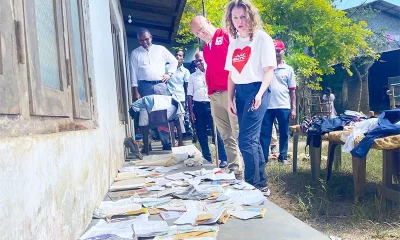
The UK has pledged £1 million (around $1.3 million) in aid to support victims of Cyclone Ditwah, following Acting High Commissioner Theresa O’Mahony’s visit to Sri Lanka Red Cross operations in Gampaha.
“This funding will help deliver emergency supplies and life-saving assistance to those who need it most,” the British High Commission said. The aid will be distributed through humanitarian partners.
During her visit, O’Mahony toured the Red Cross warehouse where UK relief supplies are being prepared, met volunteers coordinating relief efforts, and visited flood-affected areas to speak with families impacted by the cyclone.
“Our support is about helping people get back on their feet—safely and with dignity,” she said, adding that the UK stands “shoulder to shoulder with the people of Sri Lanka” and will continue collaborating with the government, the Red Cross, the UN, and local partners in recovery efforts.
She was accompanied by John Entwhistle, IFRC Head of South Asia, and Mahesh Gunasekara, Secretary General of the Sri Lanka Red Cross.

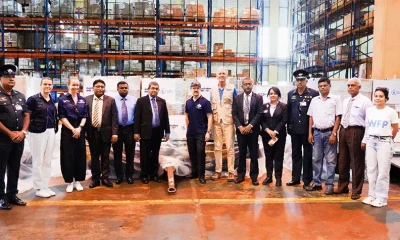
The United Nations World Food Programme (WFP) has scaled up its emergency response in Sri Lanka following the devastation caused by Cyclone Ditwah, thanks to a generous AUD 1.5 million contribution from the Government of Australia. This support is enabling WFP to deliver life-saving fortified food and provide cash assistance to families most affected by the disaster, Australian High Commission said in a release yesterday.
It said: The first airlift of fortified biscuits – 10 metric tonnes from WFP’s humanitarian hub in Dubai arrived in Sri Lanka, with upto 67 metric tonnes expected in the coming days. WFP has already dispatched fortified biscuits to Nuwara Eliya and Kegalle. Further deliveries are planned for Badulla and Kandy, among the hardest-hit districts.
“Australia stands with Sri Lanka at this devastating time. We are proud to work closely with our longstanding humanitarian partner the WFP, as well as with the Sri Lankan government and local authorities, to rapidly respond to meet the urgent needs of those affected communities,” said Australia’s High Commissioner to Sri Lanka, Matthew Duckworth.
WFP’s fortified biscuits provide a quick boost of energy and nutrition when families need it most.
“As rescue operations wind down, our priority is delivering life-saving fortified food to tackle immediate food needs of affected families, targeting especially those most at risk – children, older persons, pregnant and breastfeeding women, and people with disabilities, who often bear the brunt of such crises,” said Philip Ward, Representative and Country Director of the World Food Programme.
Australia’s contribution will also fund cash assistance programmes, complementing Government efforts to help families meet essential needs and rebuild their lives. WFP continues to appeal for additional donor support to sustain emergency operations and accelerate recovery for communities devastated by Cyclone Ditwah.

Showers will occur at times in the Northern, North-Central, Eastern, Central, and Uva provinces

Regulatory rollback tailored for “politically backed megaprojects”— Environmentalists

UK pledges £1 mn in aid for Ditwah victims

WFP scales up its emergency response in Sri Lanka

Opposition Leader discusses with Russian Ambassador more emergency relief

Heavy rainfall forecast for some places in Northern, North-Central and Eastern provinces today

‘Dates have the highest sugar content to fight Coronavirus’

Sunday Island 27 December – Headlines

#SundayIsland 17th December – Headlines

Sunday Island – 28th March

Sunday Island Headlines – 21 March

Sunday Island – 21st February – Headlines
-

 News3 days ago
Over 35,000 drug offenders nabbed in 36 days
-

 Business5 days ago
LOLC Finance Factoring powers business growth
-

 News2 days ago
Cyclone Ditwah leaves Sri Lanka’s biodiversity in ruins: Top scientist warns of unseen ecological disaster
-

 News5 days ago
CPC delegation meets JVP for talks on disaster response
-

 News5 days ago
A 6th Year Accolade: The Eternal Opulence of My Fair Lady
-

 Features1 day ago
Finally, Mahinda Yapa sets the record straight
-

 News3 days ago
Rising water level in Malwathu Oya triggers alert in Thanthirimale
-
 Features4 days ago
The Catastrophic Impact of Tropical Cyclone Ditwah on Sri Lanka: