
Features
Ending the Dispossession of Northern Fishers by Indian Trawlers

Prof. Oscar Amarasinghe and Dr. Ahilan Kadirgamar
(Chancellor of the Ocean University and Senior Lecturer, Jaffna University, they are also, President and Executive Committee member respectively, of the Sri Lanka Forum for Small Scale Fisheries – SLFSSF)
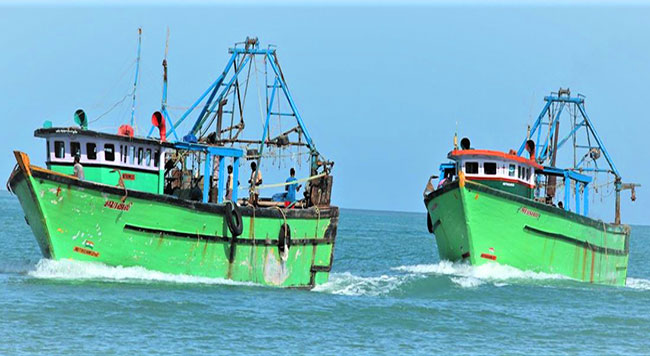
From the beginning of the early 1980s, trawlers, from Tamil Nadu, have been crossing the International Maritime Boundary Line (IMBL) and illegally fishing in the Palk Bay waters of northern Sri Lanka, damaging the ecosystem by bottom trawling, smuggling fisheries resources, belonging to the northern Sri Lankan fishers, damaging their fishing equipment, and undermining their livelihoods. Diverse types of interventions, by the two governments, dialogues between the fishers of the two countries, involvement of civil society actors, and others, have done little to prevent human suffering, economic losses and the volatile political situation disturbing the relations between two friendly countries that have emerged from this 40-year long story of resource piracy. The northern Sri Lankan fishers, who suffered 30 years of civil war have had enough and there is an urgent need to end this crisis.
Extracting and devastating resources
Both Sri Lankan and Indian fishers used to share the Palk Bay waters (historic waters) in the past, which they did in harmony. However, post-war developments saw radical changes in the structure and organisation in fisheries, the expansion of the market and the establishment of borders separating the Palk Bay region, all of which had tremendous influence on fisheries, especially on the type of technology employed (craft-gear combinations), target species, fishing pressure and area of operation. In this process of change, a tremendous increase in Indian trawlers was observed, which finally resulted in a serious decline of fisheries resources on the Indian side of the Palk Bay and crossing of the IMBL by the Indian trawl fleet to fish in Sri Lankan waters.
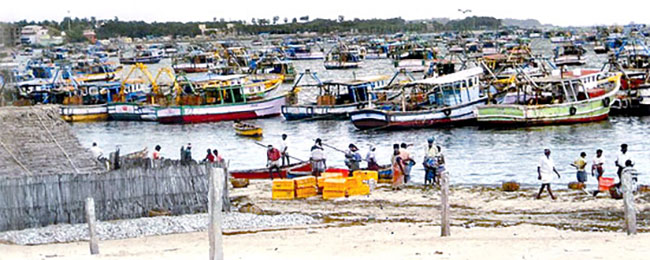
In northern Sri Lanka, over 37,000 fishers operate more than 11,650 boats, the majority of which are 18 feet FRP boats propelled by outboard engines of 8 to 25hp. Including post-harvest sector employment and dependents, about 200,000 people in the Northern Province are dependent on the sector. They don’t stand a chance against the 2500 odd 30-60 feet trawlers from Tamil Nadu propelled by 70-190hp outboard engines. Indian trawl boats are crossing the International Maritime Boundary Line (which was established in 1974 and 1976) to fish on the Sri Lankan side of the Palk Bay. These boats are poaching in Sri Lankan waters in large numbers as well as extracting and devastating the resources belonging to Sri Lankan fishers. Although the process of poaching commenced in a situation where Sri Lankan fishers in the North had limited fishing opportunities due to the civil war. Today the issue has become one of the most important economic and political issues in the country, because with the end of the war in 2009, the Sri Lankan fishers in the North has commenced fishing.
The Palk Bay Pirates
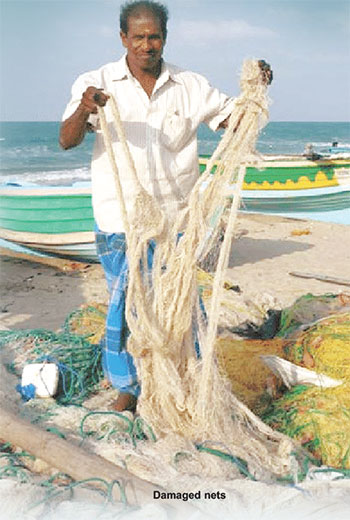
Trawlers come at night, three days a week, smuggle colossal amounts of fisheries resources, and damage Sri Lankan fishers’ nets, causing enormous financial losses. To avoid the trawlers, Sri Lankan fishers often stay at home instead of going out to sea, thus loosing valuable fishing time. They are forced to adopt less-profitable, near shore operations and/or resort to destructive fishing practices (trawling, wing nets, purse seining, dynamiting, etc.). The social institutions of the fishing communities, particularly fisheries co-operatives present in every village, have been weakened due to the long decline of fishing incomes, where a fraction of such incomes are normally contributed to run the co-operatives. Thus, participatory management and coastal support for fishing communities have been undermined. The long disruption of fisheries after the war has made it difficult for fishing communities to plan for the next season, and many are slowly moving out of the fishing sector to other forms of day wage labour.
In the early years, arrests of Indian trawlers for poaching were made for security reasons, because the Sri Lanka Navy, which was fighting a war, was less interested in fisheries issues. But since the cessation of the war, the Navy arrested the intruders for illegal entry into Sri Lankan territory. The arrests were made under the Foreign Fishing Boat Regulations Act No. 59 of 1979, Immigration Act of Sri Lanka and the Prevention of Terrorism Act. The impact of the arrests in preventing Indian trawl intrusion was neutralised by the arrests of Sri Lankan multiday fishers for poaching in Indian Territory, and detained in Indian prisons. Often, through the intervention of the embassies of the two countries, the Indian trawler fishers arrested and detained in Sri Lankan prisons were released in exchange for Sri Lankan fishers detained in India.
Early Interventions
In trying to deal with this escalating crisis, the two governments drew up an MOU in 2005, which made provision for the establishment of a Joint Working Group (JWG), which among other things, would deal with issues of poaching and arrests. Although several rounds of discussions were held since 2008, no significant developments were reported, other than agreeing that fishers in both countries should be able to pursue fishing activity in a safe, secure and sustainable manner. However, some progress was achieved in the front of fisher-fisher dialogues. Several such dialogues have taken place in the past, initially organised by ARIF (Alliance for the Release of Innocent Fishermen) and later with the active involvement of the two governments. The most important of such dialogues took place in August 2010, where the Indians agreed to stop mechanised trawl fishing in Sri Lankan waters within a period of one year, during which time, only 70 days of trawling were to be allowed. Unfortunately, the governments failed to back up these decisions, and the promises were not kept. Further dialogues took place under state patronage in March 2011 and January 2014, which did not produce any fruitful results.
Post-2015 developments
In April 2015, President Maithripala Sirisena convened a meeting with the various arms of the state and the northern fisher leaders on the request of the Tamil National Alliance (TNA). This high level meeting and continued engagement gave the fisher folk the confidence that their plight was a matter of serious concern to the Government, and initiated bipartisan engagement on the issue, leading to significant progress. The Parliamentary debate in October 2015 on the ecological and socio-economic damage by Indian trawlers, growing awareness through media coverage and the greater involvement of actors in Colombo, raised the fisheries conflict to the level of a national issue, rather than a problem confined to the North. Fisher leaders also took their issue to court and actively sought legal recourse towards prolonged confiscation of trawlers, and a ban of trawling in Sri Lanka. An Amendment to the Fisheries and Aquatic Resources Act banning bottom trawling in Sri Lanka was passed by Parliament in July 2017.
On another front, the Indian Government, in 2015, made unambiguous statements that Tamil Nadu trawlers should stop cross-border fishing. Furthermore, the increased media attention on the devastation caused to Northern Fishers exposed Tamil Nadu’s hypocrisy. The Tamil Nadu Government called for INR 1,520 crore (USD 225 million) package to convert the trawler fleet to deep sea vessels under the ‘Blue Revolution Scheme’., of which INR 450 crore (USD 66 million) was approved by the Government in Delhi, and the rest was to come from bank loans. By September 2019, close to 590 trawlers have applied for this facility. Although concerns were raised about whether such a conversion to deep sea fishing and buy back is realistic and sustainable, the engagement from Tamil Nadu pointed to an acknowledgement of the unsustainability of trawling and poaching.
An important development was the setting up of a Joint Working Group in November 2016 during ministerial talks held between India and Sri Lanka (revitalising what was formed in 2005), which would meet every three months and a meeting between the Ministers for Fisheries every six months.
The Terms of Reference for the Joint Working Group (JWG) included: i. expediting the transition towards ending the practice of bottom trawling at the earliest, ii. working out the modalities for the Standard Operating Procedures (SOPs) for handing over of apprehended fishermen, and iii. ascertaining possibilities for cooperation on patrolling. Both Governments agreed on setting up a hotline between the two Coast Guards. Agreement was also reached on the request by the Fishermen Associations that there should be no violence and no loss of life in the handling of fishermen by the Navies and Coast Guards of the two countries. They agreed to encourage the Fishermen Associations of the two countries to meet every six months to take further their dialogue. Yet, many of the decisions taken at the bilateral Ministerial talks were not followed through towards a permanent solution.
As a result of campaigns of small scale fishers from the North, the work of researchers and activists and engagement with the governments of the two countries, and more importantly, the enforcement of the Foreign Fishing Boat Regulations (amendment) Act, a significant reduction in the incidence of Indian trawlers illegally fishing in Sri Lankan waters was noticed by 2018. Yet, the Northern fishers did not even have a breathing space for a new beginning, because the country was hit by the Covid Pandemic in early 2020. Very little action was paid against the poachers and there has been a resurgence of the incidence of Indian trawlers poaching in Sri Lankan waters, drastically affecting fishing livelihoods, which were already being threatened by the pandemic. The aggravated current situation, continues to dispossess the small scale fishers of the North; they were devastated by the war until 2009, crippled by the Indian trawlers in the decade after the war and impoverished by market disruptions with the Covid-19 pandemic since March 2020.
Moving forward
The decision to arrest and retain trawlers that are crossing over the International Maritime Boundary Line (IMBL) by the Sri Lanka Navy, particularly since 2013, places significant pressure on the Tamil Nadu establishment. Yet, the lower levels of arrests over the last two years (71 vessels were arrested in 2017 while only nine were arrested in 2020) is in part due to fears of the Covid-19 virus spreading through arrests. Evidently, expanding deterrence is of paramount importance in dealing with the present crises, which needs strict enforcement of the Foreign Fishing Boats Regulations (Amendment) Act, No. 01 of 2018 to arrest foreign vessels in Sri Lankan EEZ which has provisions for imposing heavy fines on trawl owners ranging from Rs. 4 – 15 million. The Trawl Ban Act. No. 11 of 2017 should also be implemented. Given that Indo-Sri Lankan relations are currently of great importance, where the priorities for both governments are in furthering trade, investment and defence ties between the two countries, deterrence is to be employed carefully. There is the need for a broader strategy that asserts pressure at different levels to ensure that Tamil Nadu addresses the issue of poaching by their trawlers; particularly given that fisheries is a devolved subject in India. Pushing for joint patrolling operations by the Indian and Sri Lankan Navy could be strategic. The Indian side needs to be convinced to install vessel monitoring devices on their trawlers to track their location. However, these efforts will prove futile unless the incidence of Sri Lankan multiday boats violating Indian maritime boundaries is brought under control.
Raising the issue both by the Sri Lankan Government towards the Indian Government and the TNA and Tamil political actors towards Tamil Nadu would be strategic, given the political realities. Strong emphasis should be made on the devastating impact of resource smuggling on the livelihoods of Northern fishing populations of Sri Lanka. Strategies to work with the newly elected Government in Tamil Nadu in relation to the fishing conflict will be necessary. Engagement by the Tamil fishing community and community leaders from the North will prove important for challenging a change of stance by Tamil Nadu Government and its leaders.
Thousands of nets worth millions of Rupees have been lost in the past decade, with no single fisherman ever being compensated and with no insurance being available. Fishers now deserve financial reparations for their lost assets and for lost fishing days. Financial reparations can also be asked from the Tamil Nadu fishers, the Tamil Nadu government or the Indian government. If such demands, however, are not met in the short term, the Sri Lankan government itself may need to find the required funds. A campaign for reparations for northern Sri Lankan fishers will help consolidate the demand for a permanent solution to the fishing conflict.
The larger aim of interventions in the Palk Bay should be to establish a sustainable, comprehensive, and socially just fisheries. Current data on the state of fish stocks in this region are highly deficient. Similarly, very little scientific knowledge on the damage caused to the environment by trawling is currently available. There is an urgent need for NARA to intensify research in the Palk Bay. This can provide the foundation for developing a rational and legitimate framework for fisheries governance. Such research will also continue to weigh on the need for a permanent solution that ends bottom trawling in the Palk Bay.
While the fisher-to-fisher negotiations conducted in Chennai in 2010 were initially widely acknowledged as promising, the follow-up was poor. Similarly, the Ministerial level talks in November 2016 were significant and even led to considerable changes, however, again follow up was poor. There is a need to build on the tremendous gains of those talks, regardless of the change of Government.
At the current moment there should be a clear plan recognising the realities in Sri Lanka and India, including the political changes in Tamil Nadu and the Covid-19 pandemic to work through a process of consensus building, but with firm resolve to end bottom trawling. There should be no setback on issues agreed at the Ministerial level talks in November 2016, and calls for licensing cross border fishing should be rejected outright.
Concluding remarks
The measures suggested above will be important steps towards resolving the Palk Bay fisheries conflict. Such measures along with the recent national attention on fisheries can also lay the foundation to ensure sustainable governance and management of the natural resource base and the people who depend on it. The establishment of effective interactive platforms (e.g., strengthening fisher community organizations, co-management platforms) and clearly laid down rights and responsibilities of participating actors, along with consultation, collaboration and coordination of all concerned actors can lead to effective and sustainable policies. Indeed, sustaining small scale fisheries in addition to solving the Palk Bay fishing conflict will encompass dialogue among relevant actors, capacity development, law enforcement and empowerment of coastal communities.






Foreign Relations are all about “Control” particularly in the context of Relations between Major Powers such as the USA, China and India and small sovereign States such as Sri Lanka. While in the case of such relations, benefits to both parties are inevitable, the need to do so is invariably driven by the national interests of the Major Powers because their interests far outweigh those of small States. This mismatch of interests is what calls for “Control” of relations by Major Powers
The advice to Sri Lanka by Foreign Relations experts thus far has been to balance challenges arising from such Relations, not realising that the compulsions driven by the interests of Major Powers are such that balancing by itself does not have the needed capabilities to overcome the consequences arising from Major Power Rivalries; a fact evidenced by the recent Middle East war.
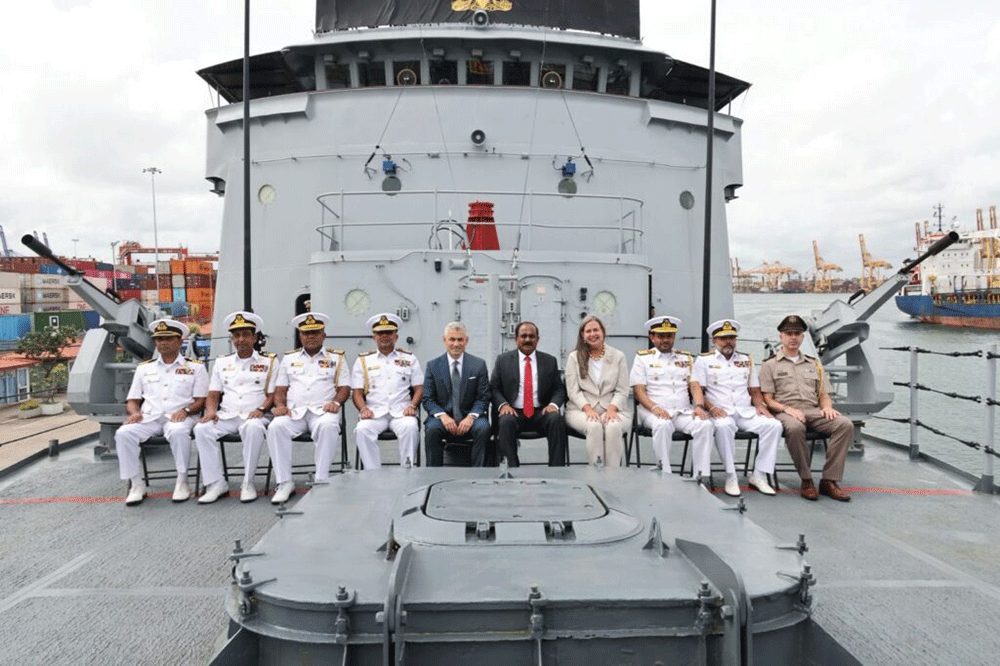
For instance, the need for the USA to strengthen the capabilities of the Sri Lankan Navy is driven by the strategic location of Sri Lanka since it is the gateway to the Indo-Pacific. Notwithstanding such motivations, it cannot be denied that the infrastructure provided to Sri Lanka’s Navy was handy to meet internal challenges as it was during the final stages of the Armed Conflict to destroy arsenals of the LTTE out at sea and the capacity to meet both external and internal threats to and within Sri Lanka.
Similarly, one of China’s primary interests is its Belt and Road Initiative. Towards this end, China has established a solid foot print in Sri Lanka by building and owning solid infrastructure projects for 99 years and more, if it is in China’s interest. However, although benefits from such projects cannot be denied, the open question is whether their scale was established to suit China’s interests or sought by Sri Lanka to suit Sri Lanka’s interests. For instance, the offer to build a 200,000 barrels a day Refinery by Sinopec of China has more to do with serving China’s interests, in view of the decision by the Sri Lankan Government to expand the Refinery at Sapugaskanda to 100,000 barrels a day.
In the case of India, the issues are more complex arising from Sri Lanka’s proximity to India, the cultural and historical heritage shared by both and the presence of the Tamil community in both countries. Consequently, India is extremely conscious of the need to keep a sharp eye and “Control” developments taking place in Sri Lanka in respect of Sri Lanka’s relations with Major Powers. This concern is driven by the notion that the territorial security of India is dependent on Sri Lanka’s Relations with Major Powers; a concern that arises from India’s past territorial history where the territory of India was transformed from a motley group of Princely States into one unified sub-continent and then partitioned into two Nation States under the British Raj. Consequently, the present territory of India has been in existence only since its independence from Colonial Rule in 1947. Hence, the fear of history repeating itself is driven by internal compulsions and by external interventions.
US – SRI LANKA RELATIONS
Against the background of Geopolitical interests presented above, Sri Lanka adopted the Policy of Neutrality in 2019 and this Government continues to exercise and live by its Internationally recognised principles, as it did when Sri Lanka denied landing rights to US Aircraft during the Middle East conflict. Sri Lanka’s Foreign Minister stated that Sri Lanka was “always neutral” when he met the US Assistant Secretary of State for South and Central Asian Affairs to convey Sri Lanka’s appreciation for the assistance rendered to procure fuel during the Middle East crisis and for the maritime vessels and aircraft gifted to Sri Lanka (Daily News, June 23, 2026).
In the meantime, The Island has reported that the “US declares SLN its Indo-Pacific Partner” (June 25, 2026). A statement issued by the US Embassy in Colombo quotes the Assistant Secretary of State as having stated: “Today, we announced the delivery of US satellite communication technology to the Sri Lankan Navy, our Indo-Pacific partner: This secure, real-time connection—representing a transformational upgrade for the Sri Lankan Navy-– will be available aboard their entire fleet of offshore patrol vessels…” (Ibid).
There is no doubt whatsoever that these assets would collectively boost the capabilities of the SL Navy to “strengthen maritime domain awareness, improve operational coordination, support emergency response, help interdict vessels engaged in illicit trafficking etc.” (Ibid). However, the unilateral declaration by US that the SL Navy is a “Indo-Pacific Partner” of the US has NO validity unless such a declaration has the approval of the SL Government. Furthermore, such an approval by the SL Government would compromise its Policy of Neutrality to which the country has pledged.
Therefore, the declaration should be accompanied with a caveat, that being, that the partnership should NOT extend to the entirety of the Indo-Pacific but be limited to Sri Lanka’s Exclusive Economic Zone (EEC). It is only then that the SL Government is Internationally entitled to exercise its rights as a Neutral State, namely, to protect its territory under the UN Law of the Sea. Furthermore, considering the extent of Sri Lanka’s EEC in relation to the extent of the Indian Ocean, the Partnership would be proportionate.
CHINA – SRI LANKA RELATIONS
China’s interest is to consolidate its interests in its Belt and Road Initiative. Towards this end it has attempted to exercise “Control” over Sri Lanka by offering infrastructure projects of a scale that benefits China rather than Sri Lanka as evidenced by the example of the offer by Sinopec Refinery cited above. This example demonstrate that Sri Lanka should be faulted for accepting projects offered without question and when questioned, based on local evaluations of scale to meet Sri Lankan needs as in the case of the existing Refinery at Sapugaskanda, the scale of projects become significantly less. The lesson to be learnt from this experience is that no project offered should be accepted without question in respect of its suitability to Sri Lanka in all respects, if Sri Lanka is not to become a victim of self-inflicted debt traps.
INDIA –SRI LANKA RELATIONS
How India “Controls” Sri Lanka is by making Sri Lanka politically and economically vulnerable and dependent on India, not only through physical connectivity, but also by being a handmaiden in internal political arrangements where power is devolved to Provinces that are a threat to Sri Lanka’s territorial integrity (13th Amendment) and also by focusing development that benefit the Tamil community in Sri Lanka. The end result is to keep relations between communities in Sri Lanka on the “boil”, much against the interests of Sri Lanka to function as a united Nation State.
The proposal to connect Sri Lanka with India with under-water pipelines to transfer petroleum products from the Middle East and Power Grids would make Sri Lanka vulnerable and dependent on India as Germany was with Natural Gas from Russia when Nord-Stream I and II were sabotaged. Similarly, the road access through a Land Bridge connecting India and Sri Lanka would legalize access between the two countries that today takes place illegally because of the disparity in wages and livelihoods.
Despite such possible outcomes, there is a concerted effort by individuals and a body of NGOs who are of the opinion that it is in the best interests of Sri Lanka for Sri Lanka to hitch its wagons to the rising star of India. Others are grateful to India as the first responder to Sri Lanka at times of need, mindless of the weekly destruction of Sri Lanka’s marine resources etc. caused by thousands of fishing boats from India resorting to illegal fishing practices whose value over the years are beyond assessment.
CONCLUSIION
The reason for the recent conflict in the Middle East is all about “Control” of Nation States by Major Powers in pursuit of their Geopolitical interests. The need to “Control” Sri Lanka by the US is because of Sri Lanka’s location to the Indo-Pacific and by China because Sri Lanka is a vital link to its Belt and Road Initiative. On the other hand, Relations with India are influenced and guided by India’s obsession with the sustainability of its territorial integrity because that is what makes India a Major Power. The survival of Sri Lanka in such a complex background depends on how astutely Sri Lanka protects its Policy of Neutrality.
By Neville Ladduwahetty

The word “Sir” is classically and linguistically associated with Great Britain and His Majesty’s English Language. As an esteemed prefix, it generally refers to a Knight, but very strictly speaking, that is perhaps a rather narrow and restricted synonym. While a Knight of the British Empire is the most common type of knight people encounter today, Great Britain actually has several different orders of knighthood, as well as an ancient rank that does not belong to any such order at all.
When someone is dubbed a knight in Britain and referred to as “Sir” X, Y or Z, they generally fall into one of three categories. The first is a Knight Bachelor, undoubtedly the oldest rank. This is the most common form of knighthood awarded for public service, arts, or science. In that context, one should think of Sir Elton John, Sir Paul McCartney, or Sir Ian McKellen. It is not a part of an explicit “Order”, like that of the British Empire. It is the oldest mechanical form of knighthood, dating back to the 13th century under King Henry III. The recipients are simply styled as Sir, followed by the first name, such as Sir Ian, without any post-nominal letters like KBE or OBE attached to the end of their name.
The second is a Knight Commander of the Most Excellent Order of the British Empire (KBE). This is a specific group, established relatively recently in 1917 by King George V, to fill a gap for rewarding civilian and military effort during World War I. To qualify to be called “Sir” within this specific order, a man must be appointed as a Knight Commander (KBE) or a Knight Grand Cross (GBE).
The third is a group of Chivalric Orders, the so-called Elite and Ancient Orders. Several highly exclusive, ancient orders of knighthood sit much higher in precedence than the Order of the British Empire. These include the Most Noble Order of the Garter, the pinnacle of British honours founded in 1348, and scrupulously limited to the Monarch, the Prince of Wales, and only 24 other companion members. Then there is the Most Ancient and Most Noble Order of the Thistle, the highest chivalric honour in Scotland. The last of this group is the Most Honourable Order of the Bath; typically awarded to high-ranking military officers and senior civil servants.
The Summary Rule of this entire scenario is that every Knight of the British Empire (KBE) is a British Knight, but not every British Knight is a Knight of the British Empire. If you see a modern British knight who does not have military or diplomatic ties, odds are high that they are actually a Knight Bachelor.
With reference to the title of this presentation, now for the flip side of this, as we see things in our region of the globe. In Great Britain, it is the standard form of address to refer to a Knight as Sir John, Sir Ian etc. However, in Sri Lanka, as well as in the Indian sub-continent, very often people use the word “Sir” as a suffix or a postfix to honour someone and frequently use “X Sir”; the name followed by the word “Sir” as a suffix or postfix.
It is a fascinating linguistic oddity, and Sri Lanka is definitely not alone in this, and most definitely, we are second to none in that outlook. While using “Sir” as a suffix or postfix (e. g., De Silva Sir, Nihal Sir) completely cartwheels over the standard British etiquette, where “Sir” must strictly prefix a first name. This charming practice of using it as a suffix is actually widespread across South Asia and parts of Southeast Asia. It is a classic example of dialectal crossbreeding, where local grammatical structures and cultural norms go to the extent of rewriting even the rules of the standard English as a language.
In a very broad sense, this phenomenon is very definitely seen in the Indian Subcontinent (E.g. Sri Lanka, India, Bangladesh, Nepal, Bhutan and Pakistan). This is arguably where the “Name + Sir” phenomenon is largest and perhaps even the strongest. Across Sri Lanka, India and Bangladesh, you will constantly hear people refer to superiors, teachers, or public figures as Karu Sir, Vijay Sir, Sachin Sir, Shahrukh Sir, or Ahmad Sir, etc.
Then there is the Indian “Ji” Factor: In Indian languages like Hindi or Punjabi, it is a strict cultural taboo to call an elder or a superior by their bare name. People naturally append the respectful suffix “Ji” (e. g., Gandhi-ji, Sharma-ji). It is then no surprise at all that when switching to English, the Indian mind seamlessly swaps the local suffix Ji for the English honorific Sir, thereby turning Vijay-ji into Vijay Sir.
In Hong Kong, a very specific variation of this exists within the police force and civil service. Influenced by decades of British administration, mixed with Cantonese naming customs, junior officers and the public address superiors by their surname followed by “Sir”, such as “Wong-Sir” or “Chan-Sir“. There is even a universal colloquial generic term, “Ah-Sir“, used commonly to address male police officers or teachers.
In the Philippines, while the syntax is slightly different, the sheer density of “Sir/Madam, Ma’am” usage matches that of Sri Lanka. Filipinos deeply value hierarchical courtesy. While they might say “Sir Jason“, it is incredibly common to use “Sir” almost like a pronoun or a mid-sentence suffix punctuation mark when addressing superiors, bosses, or clients, to ensure that respect is suitably maintained conscientiously.
The mismatch between British English and South/Southeast Asian English comes down to how different native cultures view status and intimacy. In South Asia, especially in Sri Lanka, there is the Linguistic Tradition of the suffix, where an extension in the nation’s own language is inserted into a word to enhance its status. In languages like Sinhala (-thuma / –mahathmaya), in Tamil (-ayyah / –avargal), and in Hindi (-ji), respect is always attached to the end of a name. It simply means that forcefully bringing a sleek word that implies social deference to the front, like Sir John, feels syntactically peculiar or even inappropriate to a native speaker of these local languages.
The “First Name Dilemma” is another type of rather quaint occurrence. In the West, calling your boss simply “John” is seen as a gesture that is egalitarian, free and open. In South Asia, calling an elder or superior by their first name feels somewhat jarringly rude. Conversely, using just “Mr Perera” can also feel too cold, official and even distant. “Perera Sir” or “Silva Sir” strikes the perfect culturally mitigatory concession, as it maintains a warm, personal connection by using the surname while also overtly and safely conveying a layer of professional public respect by adding the word “Sir” as a suffix or a postfix.
Yet for all that, it is worth noting that fundamentally, all languages are symbolic expressions of human thought and human intelligence. Whether expressed as spoken, written or sign language, all dialects are means of human communication. The type of words like “Sir” that we use in the English Language and the real context in which they are used indicate our thoughts in our human intellect. When they are used appropriately, they reflect our commitment to uninhibited respect and even admiration. While the British people and even their Monarch might feel quite a bit confused to hear someone called “Perera Sir”, right across Sri Lanka and its neighbouring nations. Yet for all that, it is simply the most natural and fusion technique to bridge and integrate traditional deference and admiration with modern expressive English.
by Dr B. J. C. Perera
Specialist Consultant Paediatrician and Honorary Senior Fellow,
Postgraduate Institute of Medicine, University of Colombo, Sri Lanka.
An independent freelance correspondent.

Tales of Mystery and Suspense – 8
The Murder Room gets its title from a room of that name in a museum dedicated to Victorian memorabilia, including famous murders, which are featured in that room. But the first murder in the story occurs outside, when one of the trustees, who had been against renewing the lease of the building – which would have meant the museum having to close – is set on fire when he comes to the museum late one evening to pick up the car in which he went away for weekends. This was a regular habit, and the murderer had obviously lain in wait, with a can of petrol, and set him on fire.
James
I took several books with me when I went to England earlier this year, but as usual I read hardly any of them, finding enough and more of interest in the shelves of those I stayed with. My first stop was at New College, where, as on several previous occasions I stayed in what is known as the Bishop’s Room, on the topmost storey of the Warden’s Lodgings. Sadly, I shall not stay there again, for my friend who has been Warden there for a decade now, Miles Young, retires this year.
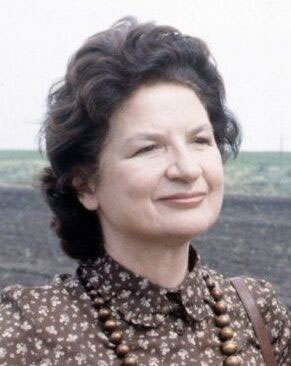
The bookshelves there have much of interest though on the last couple of occasions I have concentrated on the detective stories, which Miles says are not his, but came with the house. The second I read this time was by the generally workmanlike P. D. James, whose Adam Dalgliesh is in the long line of whimsical but efficient detectives that has Hercule Poirot at its head. Though I had not been impressed by the one novel I read, featuring James’ female detective, Dalgliesh, I liked it, and this novel confirmed my affection.
The Murder Room
gets its title from a room of that name in a museum dedicated to Victorian memorabilia, including famous murders, which are featured in that room. But the first murder in the story occurs outside, when one of the trustees, who had been against renewing the lease of the building – which would have meant the museum having to close – is set on fire when he comes to the museum late one evening to pick up the car in which he went away for weekends. This was a regular habit, and the murderer had obviously lain in wait, with a can of petrol, and set him on fire.
The other two trustees, his brother and his sister, obviously benefited from his death, for they promptly renewed the lease. The employees of the museum also clearly benefited, for they had all found some sort of refuge here. These included the caretaker/cleaner, who lived in a cottage on the premises, a manager who was unpaid but used the place for his research, the receptionist, who also looked after the flat at the museum which was used by the sister, and two volunteers plus a gardener’s boy.
The caretaker, Tally, came across the fire before discovery had been intended, for an evening class everyone knew she went to on Fridays had been cancelled. On her way in she was knocked off her bicycle by a speeding car, the driver of which stopped to make sure she was safe, before speeding off again. She manages then to summon everyone else, including Dalgliesh, who had visited the museum for the first time a few days earlier, brought by a friend who relished its strange attractions.
The museum has to be closed for a few days while investigations are carried out, but in the course of them the friend brings some transatlantic visitors, and when they are in the Murder Room a chest (in which a body had been supposed to have been hidden in Victorian times) is opened, and a body found there. That murder, the autopsy indicated, had taken place around the time of the first murder.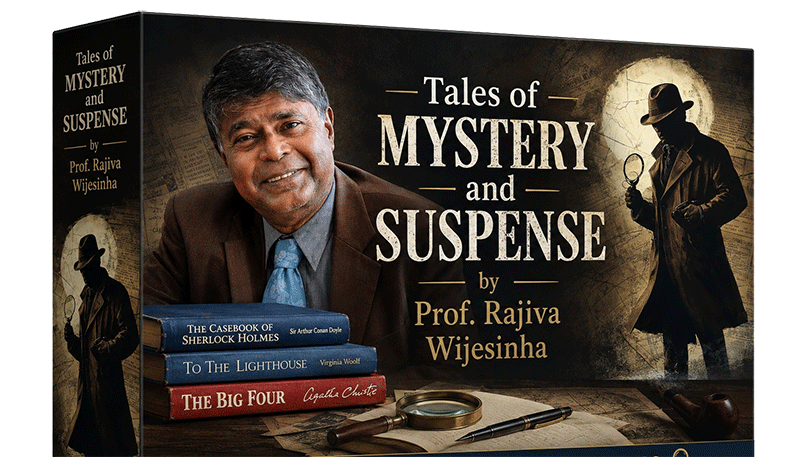
The body was that of a girl who had attended a finishing school part-owned by the Dupayne sister. When Tally, by chance, sees the man who had knocked her down, and identifies him as a Lord who was known for his philanthropy, Dalgliesh realises that there are wheels within wheels here. The Lord confesses that he belonged to a group that met for promiscuous sex in the flat, and that he had planned to meet the girl there but she had not turned up.
Lord Martlesham, when the girl failed to appear, thought he should get away after the fire broke out. It was then that he had bumped into Tally, and his stopping to make sure she was all right indicated that he could not have been the murderer. Dalgliesh then deduced that the murderer had seen the girl at the window of the murder room, from which she must have seen the preparations for the murder. That was why she too had been killed.
Dalgliesh then has a fair idea of who the murderer was, but in waiting for proof, he leaves room for yet another murder to happen. For Tally, who had been mulling over something said on the night of the murder, asking about the petrol that caused the fire, realized that she had not mentioned petrol herself. This happened on her way back to her cottage, and not having a phone herself she goes into the museum to call, and then gets back to her cottage and locks herself in.
But then she hears her cat howling and goes out to find him strung up. She cuts him down, but when she goes back to the cottage the murderer is waiting and knocks her down. That happens in the section called The Third Victim, but this is in fact a boy on a motorbike knocked down by the speeding car of the escaping murderer. So Dalgliesh is able to effect an arrest when he turns up as summoned, and fortunately is in time to resuscitate Tally and send her to hospital.
The reason for the murder and the identity of its perpetrator are then fairly straightforward, though the background to the second murder introduces an element of loose living that contrasts with the Victorian age, or at least the image it projected – undercut though that is by the murders highlighted in the Murder Room with their sexual overtones.
And there is another louche element in the adventures of the gardener’s boy, who lives with a Major who is homosexual, though he declares, truthfully it seems, that he was not attracted at all to the boy but had given him shelter because of his vulnerability. He is generally charming, but capable of rages, in one of which he knocked down the major, though he was forgiven. He had taken shelter with Tally, who was fond of him but decided she preferred to live alone, which was why she had sent him away the day before she was attacked.
The murdered brother was a psychiatrist, and it turns out that the mysterious weekends he spent away from his London home were spent at country inns, where he took long walks to clear his mind of the demons his practice kept bringing into it. His profession also contributed to his death, in addition to his standing in the way of the museum continuing to exist, for one of his patients, connected to the murderer, had set fire to herself.
Solid plotting, with all the loose ends tied up, of incidents and the bizarre cast of characters.

India A grow lead after Sai Sudharsan hits 168

Boys among men – Sooryavanshi joins Tendulkar, Aaqib and Hasan Raza

Brutal heat cancels Fourth of July events, from DC to Philadelphia

Arias sends Colombia into World Cup last-16 with 1-0 win over Ghana

Messi scores again but Argentina given World Cup upset fright by Cape Verde

Anguished families left to identify Venezuela quake victims at makeshift morgue

‘Dates have the highest sugar content to fight Coronavirus’

Sunday Island 27 December – Headlines

#SundayIsland 17th December – Headlines

Sunday Island – 28th March

Sunday Island Headlines – 21 March

Sunday Island – 21st February – Headlines
-

 News6 days ago
LAWASIA warns against ad hoc initiative to increase judges’ retirement ages
-
 Features5 days ago
Climate action to bring South Asia together
-
 News5 days ago
Chamuditha to seek removal of injunction on Youtube programme
-
 News21 hours ago
Freedom 250: US Embassy celebrates America’s 250th Independence Day through magic of American cinema
-

 Features7 days ago
People’s Bank expands digital banking network with 125th cheque deposit kiosk
-

 News2 days ago
CIABOC to question Harak Kata on Rs. 200 mn bribery allegation
-
 News2 days ago
SLAF conducts successful rescue mission under UN command in Central African Republic
-
 Midweek Review4 days ago
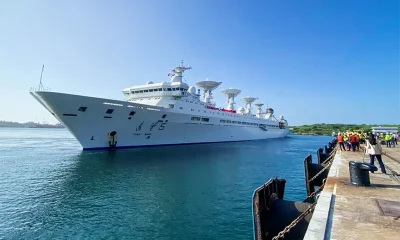
H’tota port’s strategic status remains focal point of geopolitical scrutiny