
News
Electoral system reforms, referendum ruse to postpone LG elections – IRES


by PRIYAN DE SILVA
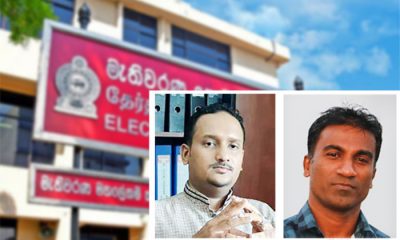
Executive Director of the Institute for Democratic Reforms and Electoral Studies (IRES) Manjula Gajanayake has said President Ranil Wickremesinghe’s undertaking to reduce the number of local government councillors, by 50%, appoint a parliamentary select committee (PSC) to come up with electoral reforms, and hold a referendum if the committee does not submit its proposals by July next year, was a ruse to delay holding the local government elections, which should be held before 20th March 2023.
Gajanayake said the report by a PSC to formulate electoral reforms had been presented to Parliament, by its Chairman Dinesh Gunawardena, on 22 June 2022, and there was no need to appoint another PSC.The four-year term of the local government authorities, which was to end in mid-March 2022, was extended by one year by the then Minister of Provincial Councils and Local Government, Janaka Bandara Tennakoon. The one-year extension ends on 19 March 2023 and, according to the Local Government Act, the LG elections could be held between 20 September 2022 and 20 March 2023. As no further extensions are possible, the power to hold the election is now with the Election Commission of Sri Lanka.
Gajanayake said that as an election observer, IRES expected the ECSL to exercise their power by holding the LG poll before 20 March 2023. Gajanayake said the Ministry of Local Government and Provincial Councils had reportedly prepared a new proposal to change the current electoral system and postpone holding the election as the outcome would be disadvantageous to the present regime.








Latest News
Dilki Wathsala Marambage appointed as Director General of the Department of Technical Education and Training

The Cabinet of Ministers granted approval to the proposal forwarded by the Prime Minister in her capacity as the Minister of Education, Higher Education and Vocational Education to appoint Mrs. Dilki Wathsala Marambage to the post of Director General of the Department of Technical Education and Training.
Nearly 1,500 acres of land in the Galgamuwa Divisional Secretariat Division of the Kurunegala District, have been used by a number of private businesses for economic crop cultivation, mineral extraction, and excavation of soil.
Several environmental organizations had filed a petition before the Supreme Court requesting the suspention of the activities, stating that environmental damages have been caused due to the forest clearings carried out there and that the human-elephant conflict in the North Western Province has been aggravated.
In delivering its judgment regarding the said petition, the Supreme Court has ordered that the entire area, including residual forest parts, incorporating the extent of 55 hectares of lands cleared in that manner, should be declared as a sanctuary or an elephant management reserve under Section 2(2) of the Fauna and Flora Protection Ordinance.
According to the said order, a joint survey conducted by the Survey Department and the Department of Wildlife Conservation has identified an extent of 682 hectares of land to
be declared as a wildlife sanctuary.
Accordingly, with the agreement of the Irrigation Department, the Cabinet has approved the resolution furnished by the Minister of Environment to declare the said land area of 682 hectares as the Naakolagane Sanctuary under the provisions of the Fauna and Flora Protection Ordinance, incorporating the maximum water limit of the nearby Palukadawala Tank.
News
Cabinet approves transfer and maintenance of selected roads presently under PC’s and Local Authorities to the RDA
Considering the proposals forwarded by the District Coordination Committees, approval has been granted at the cabinet meeting held on 20-07-2026 to appoint a committee under the chairmanship of an Additional Secretary of the Ministry of Transport, Highways, and Urban Development to take further steps and submit recommendations regarding taking over the roads that do not belong to the Road Development Authority and are currently maintained under Provincial Councils or Local Government Institutes.
Taking into account the recommendations submitted by the aforementioned committee, the Cabinet of Ministers has approved the resolution furnished by the Minister of Transport, Highways, and Urban Development to take further steps for upgrading the said roads and to declare them as national highways, after examining fundamental qualifications, technical potential, and relevant criteria.

Dilki Wathsala Marambage appointed as Director General of the Department of Technical Education and Training
Declaration of Naakolagane Sanctuary under the Fauna and Flora Protection Ordinance
Cabinet approves transfer and maintenance of selected roads presently under PC’s and Local Authorities to the RDA
Obtaining financial facilities for the Water Supply and Sanitation Improvement Program (Sub-program 2) from the ADB

Delegation from Korean Volunteer Association meet Secretary to the President

Imran Khan’s PTI braces to fight federal takeover of Khyber Pakhtunkhwa

‘Dates have the highest sugar content to fight Coronavirus’

Sunday Island 27 December – Headlines

#SundayIsland 17th December – Headlines

Sunday Island – 28th March

Sunday Island Headlines – 21 March

Sunday Island – 21st February – Headlines
-

 Features6 days ago
The Sri Lankan who made Scottish history
-

 Sports6 days ago
Nissanka absence opens door for Sri Lanka’s young guns
-

 News5 days ago
NDB fraud Rs 60mn more than reported
-

 News7 days ago
Gnansara Thera to be assigned to prison printing section: Officials
-

 News5 days ago
Removing monk’s robes matter for Sangha to decide: Mahanayake Theras
-
 News7 days ago
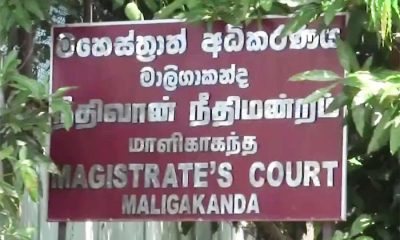
OIC of FCID summoned before Maligakanda Magistrate
-

 Features6 days ago
Future of Sri Lanka’s state university system: Should it be shut down and reopened?
-
 News6 days ago
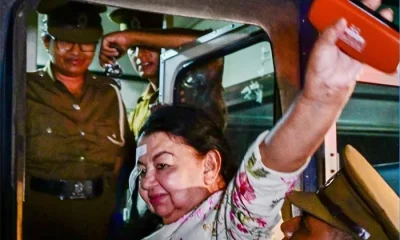
Shiranthi R remanded until 13 Oct.