
Business
Education equity in Sri Lanka: A pathway out of poverty

By Wimal Nanayakkara
Although Sri Lanka has provided universal free education since 1939, around one-fifth of poor children drop out of school after the age of 14 years and another-two thirds after the age of 16 years. Comparison of estimates based on the Household Income and Expenditure Survey (HIES)-2012/13 and HIES-2016, conducted by the Department of Census and Statistics (DCS), show only a marginal improvement.
With the closure of schools following the COVID-19 outbreak and the sudden shift to online learning, poor children with no access to e-learning opportunities risk falling even further behind. In this context, some proposals made in budget 2021 to improve the education system and reduce poverty will benefit poor children who have been disproportionately affected by the pandemic. This blog highlights some of the education-related difficulties faced by poor children in Sri Lanka based on HIES data and the recent budget proposals which could help them to overcome these difficulties.
Poor children out of school
 A large proportion of poor children are dropping out of school after 14 years, and the percentage of poor children (15-16 years) not attending school has declined only by 4.2, between the two survey periods. Among poor children aged between 17-18 years, this figure has remained almost unchanged at nearly 65%. The corresponding percentages for non-poor children are much lower (Table 1).
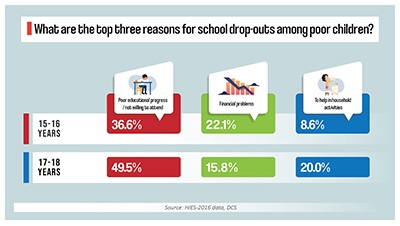
Out of the poor children (15-16 years) who leave the education system, more than 66% left mainly due to “poor educational progress/not willing to attend” (36.6%), “financial problems” (22.1%), or to “help in housekeeping /other activities of the household” (8.6%). The corresponding percentages of poor children (17-18 years) were 49.5, 15.8 and 20.0 respectively. One of the reasons for poor education progress could be inadequate nutritional intake. The HIES-2016 shows that the per capita energy consumption of poor households with children (5-18 years) is less than 75% [or 1513 kilo calories per capita a day (kcpcad)] of the recommended energy requirement (2030 kcpcad). The corresponding consumption of non-poor households is 2081 kcpcad, above the recommended requirement.
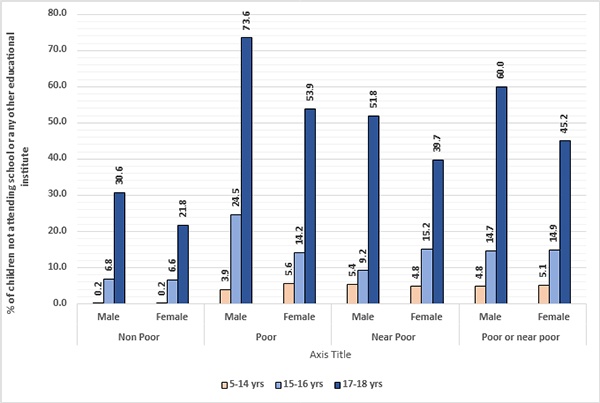
As there is a possibility for some of the near-poor children to slip into poverty, due to the effects of COVID-19, it is important to consider both poor and near-poor. Figure (1) shows the proportions of early school leavers are very high for poor and near-poor children compared to non-poor. There is also a significant gender gap, especially among the poor and near-poor.
For example, 73.6% of poor boys aged 17-18 years are out of school compared to 53.9% of poor girls in this age group. The corresponding percentages for the 15-16 age group are 24.5 and 14.2 respectively. A similar pattern is observed for near-poor children and even non-poor children, although the proportions are significantly low for non-poor.
Inadequacy of facilities for online learning
Inequality in education can be further widened as not all children have the necessary facilities for online learning during prolonged curfews, lockdowns or when schools are kept closed indefinitely. According to the Computer Literacy Survey –2019 (DCS), only 22.2% of the households in Sri Lanka own a desktop/laptop computer (Urban: 38.3%; Rural: 19.9% and Estate: 3.8%). According to the Telecommunications Regulatory Commission (TRC) of Sri Lanka, there were a total of 1.53 million fixed internet subscribers and 5.73 million mobile subscribers in 2018. However, the use of smartphones would be limited, especially in remote rural areas, where broadband internet facilities are weak and there is no information on the extent of smartphone users among the poor.
‘E-Thaksalawa’ the national e-learning portal of the Ministry of Education (MoE), is facilitating e-learning for students (Grade 1 to Advanced Level). But some children, cannot access them at present due to the lack of facilities or means. Broadband internet facilities, a computer/laptop or a smartphone and sufficient data are essential to download available study material.
 As highlighted in a previous IPS blog, the best option therefore would be to use television (TV) as 86% (HIES-2016) of households in the country own TVs (Urban: 88.9%; Rural: 86.1% and Estate: 81.2%). The ‘Guru Gedara’ distance learning programme of the MoE broadcast by Channel Eye/Nethra TV, ART TV and Ada Derana, for students from Grade 3 to GCE (A/L) are both in Sinhala and Tamil. The SLBC is also broadcasting these lessons for the benefit of children who do not have access even to a TV.
This is an excellent and innovative way for poor children to continue their studies in a stream of their choice, who may be leaving education prematurely due to lack of facilities, especially teachers, to teach science/ technology subjects, mathematics, languages, etc., in rural/estate schools and non-national schools.
Budget proposals
Budget 2021 has some proposals which, if implemented, could solve most of the issues highlighted above. They will benefit the poor and vulnerable children, who are facing difficulties in continuing their education, explained above. The proposals are also aimed at developing the entire education system with special emphasis on skills development, to meet the ever-increasing demand for high skills and also to provide necessary facilities.
A summary of some of the most important proposals are:
• ‘Gamata Sannivedanaya’ to provide 4G/Fiber broadband facilities to cover all Grama Niladhari divisions; internet facilities to all schools.
• ‘E-Thaksalawa’ learning portal to be strengthened further to minimise the difficulties faced by students in rural / estate and non-national schools.
• ‘Guru Gedara’ programme to be made available to all students, by providing TV sets to schools in difficult areas.
• Improving and expanding the opportunities for vocational/technical education, which will be extremely useful in developing the necessary skills in a rapidly changing environment.
The early implementation of these proposals could pave the way to breaking the vicious poverty trap through equitable education and ensuring that no child is left behind.
Link to original ‘Talking Economics’ blog: https://www.ips.lk/talkingeconomics/2020/12/28/education-equity-in-sri-lanka-a-pathway-out-of-poverty/
Wimal Nanayakkara is a Senior Visiting Fellow at the Institute of Policy Studies of Sri Lanka (IPS) with research interests in poverty, and is a specialist in sampling. He was previously engaged at the Department of Census and Statistics, where he functioned as the Director General for 12 years. He received his BSc in Mathematics and Physics from the University of Peradeniya and holds a Postgraduate Diploma in Applied Statistics from the University of Reading, UK. (Talk to Wimal – wimal@ips.lk)

Business
Sri Lanka’s apparel sector records 5.42% growth for January-November 2025: November slight dip


Sri Lanka’s apparel industry delivered a robust performance during the first eleven months of 2025, with cumulative exports reaching US$4,571.99 million marking a 5.42% increase over the same period last year, according to data released today by the Joint Apparel Association Forum (JAAF).
Sri Lanka’s total apparel exports for November 2025 reached US$367.60 million, representing a slight decrease of 1.96% compared to US$374.94 million in November 2024.
The monthly performance showed mixed results across key markets: United States: US$152.32 million (up 5.79% from US$143.98 million), European Union (excluding UK): US$119.61 million (up 3.35% from US$115.73 million), United Kingdom: US$43.63 million (down 13.83% from US$50.63 million), Other Markets: US$52.04 million (down 19.44% from US$64.60 million)
Strong cumulative performance: January-November 2025
Despite the November softness, cumulative apparel exports for the eleven-month period from January to November 2025 demonstrate solid growth, reaching US$4,571.99 million—a 5.42% increase over the corresponding period in 2024 (US$4,336.84 million).
Year-to-Date Performance by Market:
European Union (excluding UK): US$1,435.39 million (up 13.07%)
Other Markets: US$742.98 million (up 5.75%)
United States: US$1,769.08 million (up 1.73%)
United Kingdom: US$624.54 million (down 0.22%)
Commenting on the export data, JAAF stated “The 5.42% growth in our cumulative exports for the first eleven months of 2025 reflects the resilience and adaptability of Sri Lanka’s apparel sector in navigating a challenging global environment. While we experienced a modest 1.96% decline in November, this should be viewed within the broader context of our strong year-to-date performance.
“Particularly encouraging is our 13.07% growth in the European Union market, which demonstrates the success of our strategic focus on strengthening relationships with EU buyers and meeting their increasingly stringent sustainability and compliance requirements. Similarly, our continued growth in the US market, despite tighter margins, shows that Sri Lankan manufacturers remain competitive on quality, delivery, and ethical manufacturing standards”.
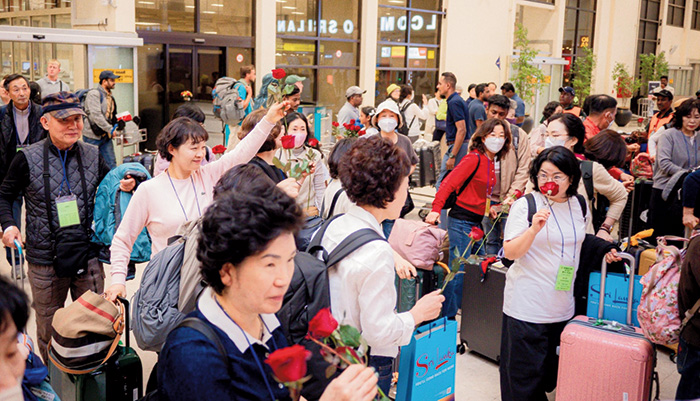
Sri Lanka Tourism, in collaboration with the Embassy of Sri Lanka to the Republic of Korea, is providing support for the two VVIP South Korean Buddhist delegations visiting the country, demonstrating solidarity and strengthening cultural and religious ties with Sri Lanka.
The first delegation included Anunayake thero of Jogye order , South Korean chief Buddhist monks and devotees arrived in Sri Lanka consisting of 120 , on 01st December 2025, with the intention of undertaking a pilgrimage tour and highlighting Sri Lanka’s importance as a major Buddhist attraction for Buddhists around the world.
As same as the first delegation, the second VVIP Buddhist delegation which arrived on the 10th of December, 2025, was also given warm and a colorful welcome at the Bandaranaike International Airport, complete with a Cultural Dance troupe and a group of Sri Lankan children to greet them upon their arrival, making them feel at home and happy to see such a sensational sight. Ms . Thanuja Muniweera , Deputy Director and also the officer in charge of the Korean Market , was there to welcome the much revered guests . The delegation consisted of 150 visitors including both priests and devotees.
Led by Ven . Hyeil, , Chief priest of Haeinsa Temple , the main purpose of this visit is to show Sri Lanka as a welcoming and culturally vibrant destination. This will be a great opportunity to show the importance of the Korean Market as an emerging market and also promote Buddhist and Pilgrimage Tourism. South Koreans are known to be travelling in large numbers, including December 2025. The South Korean Buddhist delegation is one such example.

Diversified conglomerate Sunshine Holdings PLC (CSE: SUN) has been included in the S&P Sri Lanka 20 Index, following the 2025 year-end index rebalance announced by the Colombo Stock Exchange (CSE) and S&P Dow Jones Indices. The inclusion takes effect from 22 December 2025, after market closing on 19 December 2025.
The S&P Sri Lanka 20 Index represents the 20 largest and most liquid companies listed on the CSE, selected based on stringent criteria including market capitalisation, liquidity, financial viability and sustained profitability. Constituents are weighted by float-adjusted market capitalisation, with a single-stock caps to ensure balanced representation.
Commenting on the milestone, Sunshine Holdings Group Chief Executive Officer, Shyam Sathasivam, said, “Our inclusion in the S&P Sri Lanka 20 is the result of more than five decades of collective effort and perseverance by our people, past and present, who have built Sunshine Holdings into the institution it is today. This recognition reflects the strength of our foundations, the discipline with which we have grown, and the consistency of our performance across business cycles. As we move forward, we remain focused on building resilient businesses, upholding strong governance standards and delivering sustainable long-term value to all stakeholders.”
The S&P Sri Lanka 20 Index is constructed in line with global index methodologies and international best practices, with all constituents classified under the Global Industry Classification Standard (GICS®). Eligibility requires a minimum float-adjusted market capitalisation of Rs. 500 million, a six-month median daily value traded of Rs. 250,000, and positive net income over the twelve months preceding the rebalancing reference date.
Sunshine Holdings’ inclusion in the S&P Sri Lanka 20 reflects the Group’s long-term capital markets journey, evolving from a closely held family enterprise into a widely held blue-chip listed company. Over the years, the Group has focused on building institutional credibility, strengthening governance standards and expanding its shareholder base, resulting in a current market capitalisation of approximately LKR 70 billion, underscoring its scale and relevance within the Colombo Stock Exchange.

Tri-Forces donate LKR. 372 million, a day’s pay of all ranks to ‘Rebuilding Sri Lanka’ Fund

Rabada to lead strong South Africa pace attack at T20 World Cup

Showes about 75 mm are likely at some places in the Eastern and Uva provinces and in Matale, Nuwara-Eliya and Polonnaruwa districts.

CEB demands 11.57 percent power tariff hike in first quarter

Health Minister sends letter of demand for one billion rupees in damages

One killed, two injured in shooting at Kaduwela

‘Dates have the highest sugar content to fight Coronavirus’

Sunday Island 27 December – Headlines

#SundayIsland 17th December – Headlines

Sunday Island – 28th March

Sunday Island Headlines – 21 March

Sunday Island – 21st February – Headlines
-

 Sports5 days ago
Gurusinha’s Boxing Day hundred celebrated in Melbourne
-
 News3 days ago
Leading the Nation’s Connectivity Recovery Amid Unprecedented Challenges
-

 Sports6 days ago
Time to close the Dickwella chapter
-

 Features4 days ago
It’s all over for Maxi Rozairo
-

 News6 days ago
Environmentalists warn Sri Lanka’s ecological safeguards are failing
-
 News4 days ago
Dr. Bellana: “I was removed as NHSL Deputy Director for exposing Rs. 900 mn fraud”
-
 News3 days ago
Dons on warpath over alleged undue interference in university governance
-
 Features6 days ago
Digambaram draws a broad brush canvas of SL’s existing political situation