
News
Duty on sugar to be kept at 25 cts. a kilo


Faced with shortage, govt. throws open sugar market to competition
By Shamindra Ferdinando
State Minister of Co-operative Services, Marketing Development and Consumer Protection Lasantha Alagiyawanne yesterday (01) said that the duty on white sugar would remain at 25 cents a kilo for the time being to ensure the control price remained the same.
The Lawmaker said so when The Island asked him whether the duty would be revised in the wake of the government lifting restrictions on the import of sugar as stocks diminished rapidly. The wholesale price of white sugar is at Rs 116 and retail Rs 122.
Responding to another query, the State Minister estimated the available stocks of white sugar and locally produced red sugar needed to be replenished quite urgently to ensure the red sugar is priced at Rs 125. According to the State Minister the stock available, included the white sugar variety used for other than domestic uses.
Asked whether it was fair to continue with 25 cents duty on a kilo of sugar at a time both government as well as Opposition lawmakers criticised the unprecedented duty slash, SLFPer Alagiyawanna emphasised that there was no basis for such criticism. The State Minister stressed that the position taken by the Committee on Public Finance (CoPF) as regards the duty reduction didn’t actually reflect the situation on the ground. The CoPE’s criticism was unfounded, the Gampaha District MP said.
CoPA Chairman Anura Priyadarshana Yapa is on record as having said that the duty reduction didn’t benefit the consumer at all. Lawmaker Yapa called for a report from the Finance Ministry in that regard.
MP Alagiyawanne said that price controls were imposed on sugar in the wake of kilo of sugar going beyond Rs 230 or 240 in the market. The State Minister said that the Finance Ministry had abolished the license system to enable any interested party to import sugar.
The Finance Ministry on Oct 13, 2020 issued a gazette notification pertaining to the much debated unprecedented duty reduction from Rs 50 to 25 cents a kilo.
Those who found fault with that didn’t realize how the price mechanism worked, the State Minister said, tangible measures were being taken to prevent shortage of sugar in the market.
The lawmaker said that revision of duty couldn’t be contemplated at the moment under any circumstances. According to the State Minister, as sugar hadn’t been imported into the country in the recent past the available stocks were diminishing quite rapidly.
President Gotabaya Rajapaksa, in terms of emergency regulations declared at midnight August 31, took tangible measures to ensure sufficient supply of rice, sugar and other essential items. The President also appointed Maj. Gen. Senarath Niwunhella as the Commissioner General of Essential Services (CGES) to work in unison with the Consumer Affairs Authority (CAA) to reign in the traders’ Mafia. In a series of recent raids, authorities seized nearly 30,000 tonnes of sugar imported by four companies.
However, the government has again opened up the sugar market close on the heels of rescinding the price controls on both paddy and rice.
Meanwhile, SJB lawmaker Mujibur Rahman said that contrary to government claims the whole supply system was in tatters. Declaring that the government couldn’t suppress the actual situation by media gimmicks, the former UNPer said milk powder, rice, sugar, cement, garlic and almost all essentials were in short supply. The top SJB spokesperson said that the government owed an explanation as to how it intended to sustain basic requirements as the national economy fast deteriorated.
The MP asked whether in spite of repeated threats directed at those accused of hoarding and manipulating the market, any action was initiated against them. The decision to rescind the gazette on the price of rice revealed the government lacked even basic strategy to ensure market stability, the MP said.






Independent trade unions cry foul
The government has launched a far-reaching overhaul of the electricity industry, breaking up the Ceylon Electricity Board (CEB) into six fully state-owned companies, claiming to rein in chronic losses and mounting debt.
Under the Preliminary Transfer Plan, the newly incorporated entities, namely, Electricity Generation Lanka (Pvt) Ltd (EGL), National Transmission Network Service Provider (Pvt) Ltd (NTNSP), National System Operator (Pvt) Ltd (NSO), Electricity Distribution Lanka (Pvt) Ltd (EDL), CEB Employees Funds (Pvt) Ltd (CEBEF) and Energy Ventures Lanka (Pvt) Ltd (EVL), will take over the assets, liabilities and operations of the CEB from the appointed date.
Independent trade unions have opposed the restructuring programme.
At the core of the new model is the creation of an independent National System Operator, which will handle power system planning and competitively procure electricity from Electricity Generation Lanka, Independent Power Producers and non-conventional renewable energy developers. Power will be wheeled through the national grid operated by the NTNSP and sold to distribution companies.
Explaining the economic rationale, Eng. Pubudu Niroshan Hedigallage said the separation of functions was critical to restoring cost discipline in the sector.
“Electricity planning and procurement will now be carried out independently, based on least-cost principles. That is essential if we are to control generation costs and ease the upward pressure on tariffs,” he said.
Electricity Generation Lanka, though a successor to the CEB, will compete with private and renewable energy producers for projects, a move expected to curb inefficiencies and end guaranteed returns enjoyed under earlier arrangements.
“There will be no automatic allocation of projects. EGL must compete in the market like any other generator,” Eng. Hedigallage said.
According to officials, the Preliminary Transfer Plan provides for one generation and one distribution company initially, with further unbundling planned under the Final Transfer Plan to introduce sharper financial accountability at operational level.
Economists note that the restructuring is closely watched by multilateral lenders and investors, who have repeatedly flagged the power sector as a major fiscal risk.
The government has insisted that the reforms do not amount to privatisation, stressing that all six entities remain 100 percent state-owned. However, independent trade unions are of the view that what the government has undertaken is divestiture in all but name.
By Ifham Nizam
News
India, Sri Lanka speakers discuss technology-driven parliamentary innovation, including AI-enabled systems
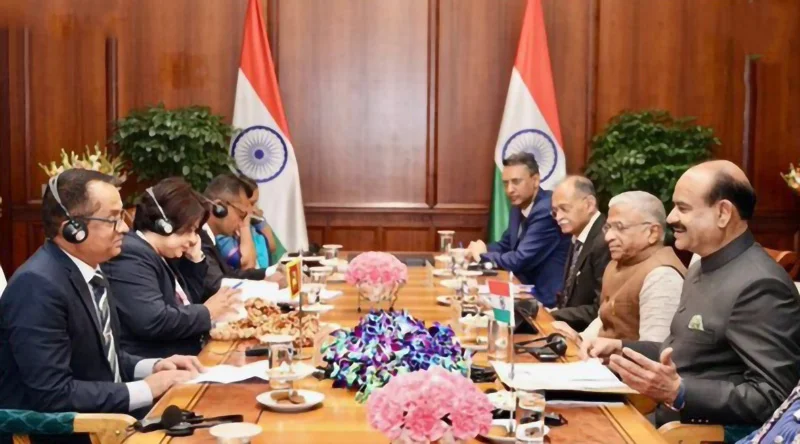
Speaker of Lok Sabha Om Birla and Sri Lankan Speaker (Dr.) Jagath Wickramaratne recently discussed the possibility of expanding parliamentary cooperation through regular exchanges, formation of friendship groups, collaboration in policy and programme design and deeper engagement in technology-driven parliamentary innovation, including AI-enabled systems, real-time multilingual translation, and capacity building through Parliamentary Research and Training Institute for Democracies (PRIDE).
The discussion took place on the sidelines of the 28th Conference of Speakers and Presiding Officers of the Commonwealth (CSPOC) held in New Delhi recently.
The following is the text of the statement issued by the Indian High Commission in Colombo: ” Speaker of the Parliament of Sri Lanka (Dr.) Jagath Wickramaratne concluded his visit to India from 14-18 January 2026, for participation in the 28th Conference of Speakers and Presiding Officers of the Commonwealth (CSPOC) held in New Delhi. This was his first visit to India after assuming office. He was accompanied by Secretary-General of Parliament Kushani Rohanadeera and Assistant Director, (Administration) of the Parliament of Sri Lanka Kanchana Ruchitha Herath. Following the 28th CSPOC from 14-16 January 2026, Speaker and his delegation visited Jaipur, Rajasthan as a part of a two-day tour for CSPOC delegates from 17-18 January 2026.
The 28th CSPOC was inaugurated by Prime Minister of India Narendra Modi on 15 January 2026 at the Central Hall of Samvidhan Sadan, Parliament House Complex, New Delhi. Welcoming parliamentary leaders from across the Commonwealth, Prime Minister Modi highlighted the success of Indian democracy in providing stability, speed, and scale. He shared India’s efforts at giving voice to the Global South and forging new paths of cooperation to co-develop innovation ecosystems. He underlined the use of Artificial Intelligence by the Parliament of India to attract youth to understand Parliament. Prime Minister expressed his confidence in the CSPOC platform for exploring ways to promote knowledge and understanding of parliamentary democracy.
The conference, chaired by Lok Sabha Speaker Om Birla, convened 44 Speakers and 15 Deputy Speakers from 41 Commonwealth countries, along with representatives of four semi-autonomous Parliaments. The theme of the conference was “Effective Delivery of Parliamentary Democracy.” During the conference, participants addressed the role of Speakers in reinforcing democratic institutions, the integration of artificial intelligence in Parliamentary functions, the influence of social media on Members, approaches to enhance public engagement with Parliament, and measures to ensure the security, health, and wellbeing of Members and Parliamentary staff.
The visit marked a significant milestone in the evolving parliamentary partnership between India and Sri Lanka. Last year, two Parliamentary Delegations visited India for Orientation Programmes in May 2025 and August 2025 respectively. These visits, in line with the intent of the India – Sri Lanka Joint Statement on ‘Fostering Partnerships for a Shared Future’, further reinforce the strong democratic ethos and enduring friendship shared between the two nations.”
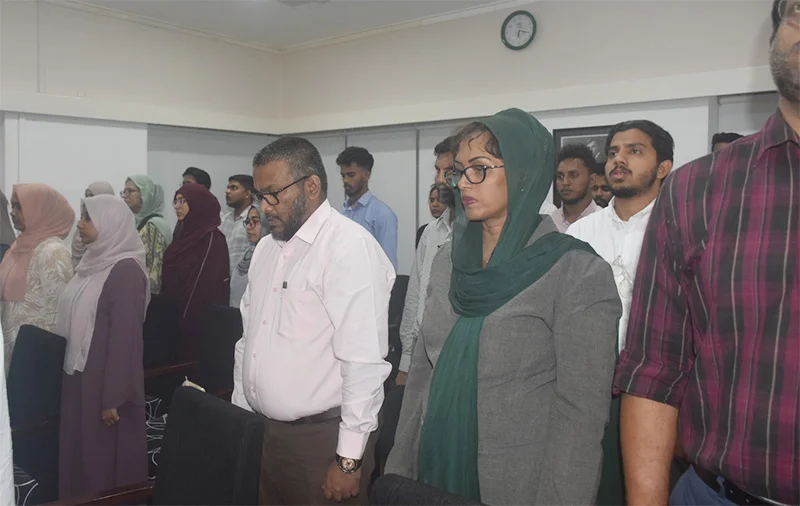
The High Commissioner of Pakistan in Sri Lanka hosted a special reception on Friday (16) for Sri Lankan alumni who have recently returned from their studies in Pakistan. The event, held at the Pakistan High Commission, celebrated the academic achievements of the graduates and reinforced the deep-rooted educational ties between the two nations.
The Allama Iqbal Scholarship Programme, a flagship initiative launched in 2019, has become a vital pillar of bilateral cooperation. The High Commissioner highlighted that Pakistan offers 1,000 fully funded scholarships at graduate, postgraduate, and PhD levels, with over 500 Sri Lankan students currently pursuing their education in Pakistan’s premier universities.
“Sri Lanka and Pakistan share an enduring friendship rooted in a shared history of mutual respect and culture,” the High Commissioner remarked during the address. “Education is the key to unlocking the success of your brilliant futures and creating bonds that extend well beyond the classroom”.
Addressing the alumni as “custodians” of a noble cause, the High Commissioner urged the alumni to act as brand ambassadors by sharing their knowledge to guide deserving students toward academic opportunities in Pakistan.
He emphasised their responsibility to mentor young minds, ensuring no capable student misses the chance for a promising future. Furthermore, the alumni were encouraged to take an active role in organising frequent educational and cultural engagements to inspire and enlighten others while strengthening the ties between the two nations.
The High Commissioner emphasized that each graduate serves as a “bridge” between the two countries, playing a meaningful role in uplifting Sri Lanka while further strengthening Pakistan–Sri Lanka relations. The alumni were invited to remain closely connected with the High Commission to facilitate future initiatives that strengthen people-to-people ties.
The evening concluded with a traditional Pakistani dinner, where the alumni shared stories of their academic growth and cultural experiences in Pakistan in a spirit of friendship and togetherness.

Red-hot Royal Challengers Bengaluru stay perfect ain 20nd march into playoffs

Zadran, Rasooli power Afghanistan to commanding win over West Indies

Italian fashion designer Valentino dies aged 93

U – 19 World Cup: Sri Lanka beat Ireland by 106 runs

U – 19 World Cup: Rowles, Bulbulia star in South Africa’s big win over Tanzania

U – 19 World Cup: Raza, Usman steer Pakistan to victory over Scotland

‘Dates have the highest sugar content to fight Coronavirus’

Sunday Island 27 December – Headlines

#SundayIsland 17th December – Headlines

Sunday Island – 28th March

Sunday Island Headlines – 21 March

Sunday Island – 21st February – Headlines
-

 Editorial2 days ago
Illusory rule of law
-

 News3 days ago
UNDP’s assessment confirms widespread economic fallout from Cyclone Ditwah
-

 Business5 days ago
Koaloo.Fi and Stredge forge strategic partnership to offer businesses sustainable supply chain solutions
-
 Editorial3 days ago
Crime and cops
-
 Features2 days ago
Daydreams on a winter’s day
-

 Editorial4 days ago
The Chakka Clash
-
 Features2 days ago
Surprise move of both the Minister and myself from Agriculture to Education
-

 Features1 day ago
Extended mind thesis:A Buddhist perspective