
News
Duty on sugar to be kept at 25 cts. a kilo


Faced with shortage, govt. throws open sugar market to competition
By Shamindra Ferdinando
State Minister of Co-operative Services, Marketing Development and Consumer Protection Lasantha Alagiyawanne yesterday (01) said that the duty on white sugar would remain at 25 cents a kilo for the time being to ensure the control price remained the same.
The Lawmaker said so when The Island asked him whether the duty would be revised in the wake of the government lifting restrictions on the import of sugar as stocks diminished rapidly. The wholesale price of white sugar is at Rs 116 and retail Rs 122.
Responding to another query, the State Minister estimated the available stocks of white sugar and locally produced red sugar needed to be replenished quite urgently to ensure the red sugar is priced at Rs 125. According to the State Minister the stock available, included the white sugar variety used for other than domestic uses.
Asked whether it was fair to continue with 25 cents duty on a kilo of sugar at a time both government as well as Opposition lawmakers criticised the unprecedented duty slash, SLFPer Alagiyawanna emphasised that there was no basis for such criticism. The State Minister stressed that the position taken by the Committee on Public Finance (CoPF) as regards the duty reduction didn’t actually reflect the situation on the ground. The CoPE’s criticism was unfounded, the Gampaha District MP said.
CoPA Chairman Anura Priyadarshana Yapa is on record as having said that the duty reduction didn’t benefit the consumer at all. Lawmaker Yapa called for a report from the Finance Ministry in that regard.
MP Alagiyawanne said that price controls were imposed on sugar in the wake of kilo of sugar going beyond Rs 230 or 240 in the market. The State Minister said that the Finance Ministry had abolished the license system to enable any interested party to import sugar.
The Finance Ministry on Oct 13, 2020 issued a gazette notification pertaining to the much debated unprecedented duty reduction from Rs 50 to 25 cents a kilo.
Those who found fault with that didn’t realize how the price mechanism worked, the State Minister said, tangible measures were being taken to prevent shortage of sugar in the market.
The lawmaker said that revision of duty couldn’t be contemplated at the moment under any circumstances. According to the State Minister, as sugar hadn’t been imported into the country in the recent past the available stocks were diminishing quite rapidly.
President Gotabaya Rajapaksa, in terms of emergency regulations declared at midnight August 31, took tangible measures to ensure sufficient supply of rice, sugar and other essential items. The President also appointed Maj. Gen. Senarath Niwunhella as the Commissioner General of Essential Services (CGES) to work in unison with the Consumer Affairs Authority (CAA) to reign in the traders’ Mafia. In a series of recent raids, authorities seized nearly 30,000 tonnes of sugar imported by four companies.
However, the government has again opened up the sugar market close on the heels of rescinding the price controls on both paddy and rice.
Meanwhile, SJB lawmaker Mujibur Rahman said that contrary to government claims the whole supply system was in tatters. Declaring that the government couldn’t suppress the actual situation by media gimmicks, the former UNPer said milk powder, rice, sugar, cement, garlic and almost all essentials were in short supply. The top SJB spokesperson said that the government owed an explanation as to how it intended to sustain basic requirements as the national economy fast deteriorated.
The MP asked whether in spite of repeated threats directed at those accused of hoarding and manipulating the market, any action was initiated against them. The decision to rescind the gazette on the price of rice revealed the government lacked even basic strategy to ensure market stability, the MP said.







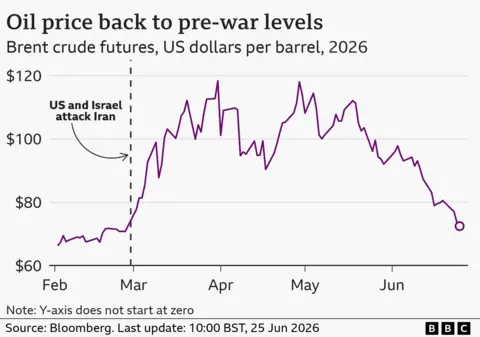
The price of oil has fallen to levels not seen since before the Iran war as traffic through the key Strait of Hormuz shipping route gradually resumes.
Global benchmark Brent crude briefly fell below $72.48 (£55) a barrel, the price it was at the day before the US and Israel launched attacks on Iran on 28 February, before edging up to $73.23.
Energy prices have been on a wild ride since Iran responded to the strikes by effectively closing the strait, a critical waterway for oil and gas shipments.
The cost of crude has been moving sharply lower since the US and Iran signed a Memorandum of Understanding (MOU) on 17 June which set out a 60-day period for negotiations on Tehran’s nuclear programme and other measures to end the war.
Representatives from the two sides met in Switzerland last weekend for talks to end the war, which resulted in the US partially lifting sanctions on Iranian oil exports.
The number of vessels crossing the Strait of Hormuz has risen significantly since the MOU was signed, according to maritime intelligence firm Kpler.
Its latest data suggests 284 vessels have made the transit from 18 June, the day after the deal was signed, although that is is still well below the pre-conflict average of some 138 crossings each day.
The ships passing through the waterway in recent days include those carrying crude oil, liquefied natural gas (LNG), fertiliser and other goods, Kpler told the BBC.
The US and Iran had also formed a “communication line” to prevent misunderstandings “with the aim of safe passage for commercial vessels through the Strait of Hormuz”, mediators Qatar and Pakistan said in a joint statement on Monday.
There has been a “tremendous shift” with far more ships using the strait in recent days, said Dimitris Maniatis, the chief executive of Marisks, a maritime risk advisory firm working with ships stuck in the region.
A limited number of ships can cross a northern passageway with the permission of Iranian authorities, he said.
The US navy has also provided guidance for vessels to travel through a southern route that is safe from mines and other obstacles that has been laid out since the war, Maniatis said.
But the number of ships crossing the strait is still below levels seen before the war, when it was used by more than 100 ships a day.
Hundreds of ships still appear to be waiting in the Gulf.
Fuel prices at the pump rose sharply when the Iran war began, and now the focus is on how quickly they will fall.
“On the back of the lowest oil price since before the Iran war started, drivers should see the average price of petrol fall below 150p [a litre] in the next week or so,” said Simon Williams, head of policy at UK motoring group the RAC. He added the price of diesel “ought to go back under 160p.
Petrol peaked at 159.53p a litre on 28 May, according to the RAC, while diesel has fallen from a high of 191.54p on 15 April.
The average price of regular gasoline in the US has dropped to around $3.93 a gallon after reaching $4 a gallon in April, its highest since 2022, but is still well above pre-war levels.
US President Donald Trump on Wednesday ordered an investigation into major energy companies, accusing Shell, ExxonMobil and other firms of “gouging” drivers by not reducing fuel prices even as oil costs fell.
“Oil prices have come down so much and we are not seeing anything at the pump by comparison the way they should be,” Trump told reporters in the Oval Office.
The American Petroleum Institute, which represents the oil and gas industry in the US, said fuel prices “don’t move in lockstep with crude oil”.
British energy firms have faced similar accusations of unfairly hiking petrol prices since the Iran war.
The UK competition watchdog said last month that there was no widespread evidence of this, adding that average profit margins were “broadly unchanged” between February and March
(BBC)

Representatives from the ’The Ceylon Chamber of Commerce’ met with Prime Minister Dr. Harini Amarasuriya on Wednesday [24th of June] at the Parliament premises.
During the meeting, discussions focused on the Sri Lanka Economic and Investment Summit 2026 (SLEIS 2026), which is scheduled to be held on 12 and 13 October 2026. Attention was also given to digitalization initiatives, the introduction of digital technologies in schools under new education reforms, and the transformative role of Artificial Intelligence (AI) in Sri Lanka’s education sector.
Representatives of the Chamber noted that the summit would serve as an important platform for encouraging both local and foreign investment, while also contributing to the shaping of the country’s future economic policies.
The meeting was attended by Krishan Balendra, Chairman of The Ceylon Chamber of Commerce; Vinod Hirdaramani, Deputy Vice Chairman; Shiran Fernando, Secretary General and Chief Executive Officer; Aliki Perera, Deputy Secretary General and Chief Operating Officer; and Anagi Rodrigo-Weerasekera, Chief Economist and Head of Economic Intelligence, along with several other representatives.
[Prime Minister’s Media Division]
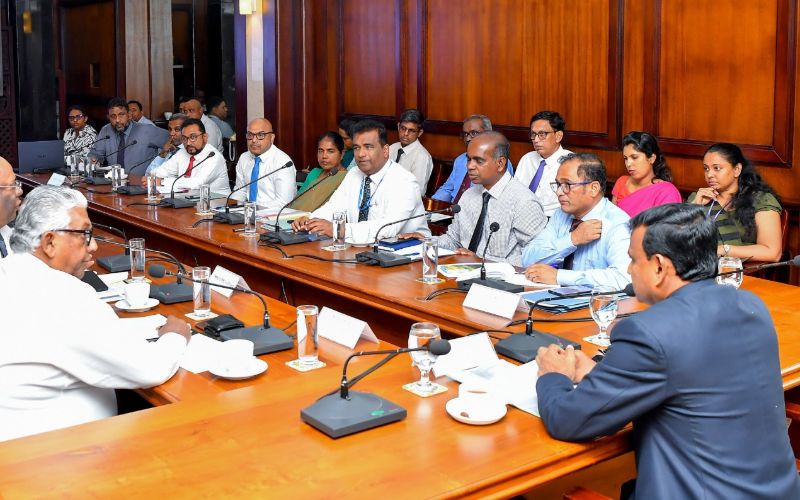
A discussion to review the progress of the housing project under which 4,700 houses are being constructed for the Malayagam community with Indian assistance was held this afternoon (24) at the Presidential Secretariat under the chairmanship of the Chief of Staff to the President, Prabath Chandrakeerthi.
Under this housing programme, 2,026 houses are to be provided to families identified by the National Building Research Institute (NBRI) as being at disaster risk. The remaining houses are expected to be allocated to eligible workers residing in the plantation sector.
Accordingly, the houses will be provided to Malayagam community families living on estates belonging to 22 Regional Plantation Companies, as well as estates under the State Plantations Corporation, Janawasama and Elkaduwa Plantations.
For the construction of each house, the Government of India has allocated Rs. 2.8 million, while the Government of Sri Lanka has contributed Rs. 400,000.
During the discussion, Chandrakeerthi instructed officials to ensure that the housing project is completed before the end of this year. He further directed that land identified for the construction of houses be released without delay and that the National Building Research Institute provide the necessary reports to identify suitable land for the project.
The housing project is being implemented jointly by the Ministry of Plantation and Community Infrastructure, the National Housing Development Authority, the State Engineering Corporation and the Plantation Human Development Trust.
Among those present were Additional Secretary (Development) of the Ministry of Plantation and Community Infrastructure, K. S. Wijayakeerthi; Director General (Engineering), N. D. N. Pushpakumara; Director General (Planning), W. A. K. S. Damayanthi; the Secretary General of the Planters’ Association; and officials from the National Housing Development Authority, the State Engineering Corporation, relevant institutions and plantation companies.
(PMD)

Sri Lanka seek big win against Scotland to keep semi-final hopes alive

Oil price falls back to pre-Iran war levels

Venezuela earthquakes: At least 164 dead, 971 injured as toll rises

Representatives from the Ceylon Chamber of Commerce meet PM

Progress of Housing Project for Malayagam Community families funded by India reviewed

South Africa stun South Korea to reach World Cup knockouts for the first time

‘Dates have the highest sugar content to fight Coronavirus’

Sunday Island 27 December – Headlines

#SundayIsland 17th December – Headlines

Sunday Island – 28th March

Sunday Island Headlines – 21 March

Sunday Island – 21st February – Headlines
-

 News7 days ago
Creditor receives USD 2.5 mn as Lankan public bears loss from theft of Treasury funds
-

 News6 days ago
Creditor not yet paid
-

 News6 days ago
Consumers bearing 22% tax burden despite 18% VAT claim: Dr. Harsha de Silva
-

 Features5 days ago
Nanda Pethiyagoda Wanasundara as three generations of family saw her
-

 Features4 days ago
Sri Lanka developing independent hydrographic capabilities
-

 Opinion7 days ago
SriLankan Airbus struck by lightning
-

 Editorial5 days ago
Fuel crisis: Beyond price debate
-

 Latest News4 days ago
Sooryavanshi thumps fastest List A fifty as India A win tri-series