
Life style
Durian prevent cancer and improve digestion

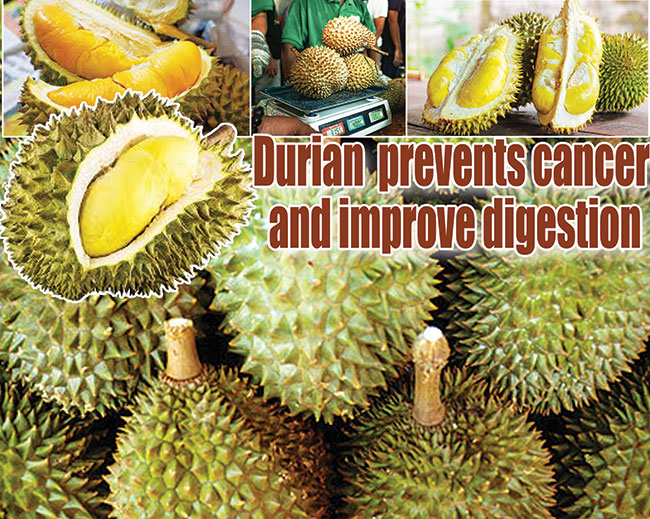
Durian is the fruit of several tree species belonging to the genus Durio. There are about 30 recognised Durio species, however, at least nine of which produce edible fruits. Durio zibethinus is the only species available in the international market: other species are sold in their local regions. Durio zibethinus or locally known as durian is belongs to the family of Bombacaceae, or by others in a broadly defined Malvaceae or by others in a smaller family of just seven genera Durionaceae. Durian is native to Southeast Asia. It is found wild or semi-wild in South Tenasserim, lower Burma and around villages in peninsular Malaysia. In addition, wild durian widely planted in Borneo and Sumatra. Borneo is the centre for diversity of Durio species. Durian is commonly cultivated along roads or in commercial orchards in Thailand, Laos, Vietnam, Malaysia, Brunei, Indonesia and Philippines. Apart from durian, this species also well-known with other common names such as Civet-Cat Fruit Tree, Civet fruit, Kampung Durian as called in English, Dian, Durian Puteh and Jatu called in Borneo, Liu Lian as called in Chinese, Dereyan called by Indonesian and etc .
Durian thrives in a hot, humid and wet climate
Durian grows best in a well-drained and fertile soil rich in organic matters that have a pH range from 5-6.5. Durian is intolerant of water logging which will cause destructive fungal root and trunk rot diseases. Furthermore, durian cannot withstand more than 0.02 % of salinity in the soil.
The durian tree can reach up to 27-40 m in height in tropical forests. Durian tree usually erect with short, straight, rough, peeling trunk to 1.2 m in diameter and have an umbrella-shaped canopy of rough branches and thin branchlets coated with coppery or gray scales when young. The evergreen, alternate leaves are oblong, elliptic or rounded at the base, abruptly pointed at the apex; leathery, dark-green and glossy above, silvery or pale-yellow, and densely covered with gray or reddish-brown, hairy scales on the underside. The fruits are ovoid or ovoid-oblong to nearly round and up to 8 kg in weight. The yellow or yellowish-green rind is thick, tough, semi-woody, and densely set with stout, sharply pointed spines, 3- to 7-sided at the base. Inside there are 5 compartments containing the creamy-white, yellowish, pinkish or orange-coloured flesh and 1 to 7 chestnut-like seeds .
Durian as a source of foods
Generally, durian is consumed fresh as fruit or food products such as candy, ice cream and durian puffs after certain cooking procedures. Traditionally, durian flesh is added into dishes such as “sayur” which is the Indonesian soup made from fresh water fish as an ingredient . Moreover, durian-based sauce is used to cook “Ikan brengkes“, a tradition dish in Sumatran islands, Indonesia. Overripe durian pulps are processed to become durian paste in Thailand while unripe durian may be cooked as a vegetable Beside the flesh, durian seeds are also valuable as they can be eaten after boiling or roasting and made into durian flour and chips (Agus, 2014). Furthermore, the young leaves and shoots of durian plant can be cooked as green vegetables.
Health benefits
Durian is widely celebrated for its long list of health benefits, which include the ability to boost immune system, prevent cancer and inhibit free radical activity, improve digestion, strengthen bones, improve signs of anaemia, prevent premature aging, lower blood pressure, and protect against cardiovascular diseases. Some of the more minor benefits of durian are to reduce inflammation of the joints, help thyroid health, reduce headaches, and lower symptoms of depression, anxiety, and stress. Most of the health benefits come from durian’s impressive vitamin and mineral content. Durian contains vitamins such as vitamin-C, folic acid, thiamin, riboflavin, niacin, B6 and vitamin A. Important minerals such as potassium, iron, calcium, magnesium, sodium, zinc, phosphorus are also found in durian. It also contains nutrients such as phytonutrients, water, protein and beneficial dietary fibre.
Relieves anaemia and promotes healthy pregnancy
Anaemia is a medical condition that reduces the level of haemoglobin on blood. Deficiency in haemoglobin can lead to fatigue, headache, insomnia and etc. In pregnant woman, anaemia can lead to abnormality and fatality of the foetus. Durian contains high amount of folate or folic acid which is essential in the production of haemoglobin. Besides that, low content of iron in durian aids in haemoglobin production alleviating condition of anaemia (Kevat, 2013). Furthermore, presence of folate in durian is important for pregnant woman as it promote regular tissue growth as well as protects the brain and spine in developing baby (Health benefits of durians, 2015).
Helps to maintain healthy bones
Durian contains a number of trace metals including calcium and potassium. Even calcium is present in low level in durian, but amount of potassium present in durian fulfils about 9 % of our body’s daily requirement. Potassium is required for the development of healthy bones. Even though the most abundant mineral of our bone is calcium, but potassium is crucial to regulate the distribution and deposition of the calcium in bones so that it is not dissolved or released into the blood excessively (Kevat, 2013).
Helps to alleviate depression and improves sleep
Durian contains amino acids known as tryptophan – a natural sleep inducing compounds. Tryptophan is required to increase the level of serotonin and melatonin. These two neuro-chemicals are required to manage our emotions. Serotonin is essential to relieve stress, sleeplessness, anxiousness, appetite as well as depression. In addition, these types of hormones help to manage sleeping function and could be utilized in the epilepsy cure (Kevat, 2013).
Fight cancer
Durian has a wealth of vitamins, nutrients, and organic chemicals that function as antioxidants. In the battle against cancer, free radicals are vitally important, because during cell metabolism, there are by-products created, called free radicals. These free radicals can destroy the DNA of regular cells and convert them into cancer cells, which can then metastasize or form fatal, tumorous growths. All of the antioxidants which reduce oxidative stress on the organs of the body are bonuses to the immune system, and durian is packed with them, including vitamin-C, vitamin-B complex, and vitamin E, as well as phytonutrients that battle cancerous cells (Health benefits of Durian, 2015).
Aids in digestion
Durian contains high levels of dietary fibre, which are important for the normal function of the digestive system. Fibre causes bowel movement to increase in bulk, which makes it easier for them to move through the intestinal tract. Fibre also stimulates peristaltic motion and the secretion of digestive and gastric juices, further easing the entire process. By reducing conditions like constipation and blockage in the intestines, conditions like bloating, excess flatulence, heartburn, cramps, and indigestion as well as colorectal cancer can be minimized. Much of the fibre in durian is insoluble fibre, which also lowers the frequency of diarrhea for people with loose stool. Fibre also helps to reduce the amount of cholesterol in the blood by scraping LDL cholesterol out of the body and quickly removing it before it can do any damage to the cardiovascular system (Health benefits of Durian, 2015).
1. Anti-aging
Durian has a wide variety of antioxidant properties stemming from its vitamin and organic chemical makeup that actively reduce the amount of free radicals in the body. Eating an excessive amount of durian can seriously boost your body’s ability to eliminate those free radicals, thereby reducing the chances of premature aging and delaying the appearance of symptoms such as wrinkles, age spots, macular degeneration, hair loss, tooth loosening, arthritis, cancer, and heart disease (Health benefits of Durian, 2015). In addition, the high water content of Durian is an added advantage along with its antioxidant content. Water keeps the skin hydrated, reduces dryness and alleviates the appearance of fine lines. It also nourishes skin for clear and smooth skin .
Increase and encourage fertility
Estrogen is a hormone which helps in conceiving. Most of the women who suffer from fertility usually have a low estrogen level in their body which is increased with pills, injections and supplements. Studies have shown that durian contains a high level of this hormone and can act as an herbal medicine (Kevat, 2013). Besides that, durian can produce intensified sexual libido and stamina, and also reduce the chances of infertility in men and women, and increase sperm motility .
Used as traditional medicine
According to traditional use, durian may have antibacterial, anti-inflammatory, and vasoconstrictor properties. Traditionally, durian leaves and roots are in Malaysia used to treat fever. The juice of fresh leaves is used as an ingredient in a lotion for fevers, and the juice from the bark is used as an antimalarial in Sumatra.
Other Uses
On the other hand, durian can be used for purposes other than foods and medicines. Durian husks which are usually thrown as wastes after the durian pulps are consumed can be dried to be used as fuel or fertilizers for tree (Utilization of durian, n.d.). It can also be used as an ingredient for making handmade paper like artistic paper with certain pattern (Agus, 2014). Due to the strong smell, durian husks can be used as the natural mosquitoes repellent. Dr. S. Kathiresan from AIMST University discovered that durian peel can be used as a mean to recover the oil spill at coastal areas (Lim, 2011). In this case, the durian peel powder is chemically modified and acts as the efficient oil absorbent to remove the oil from the water, solving the problem of oil spills which have caused adverse effects to living sea organisms and human economic activities.
REVIEW ON DURIAN CONSUMPTION
Durians are abundant in Asia during their season as Malaysia, Indonesia and Thailand are the world’s main durian producers. In this case, numerous surveys and reviews have been done on the nutritional values and health benefits of durian. Undeniably, durian has offered unlimited benefits to human health such as relieving anemia, alleviating depression and enhancing fertility (Health benefits of durian, 2015; Kevat, 2013). The Swiss Society of Food Science and Technology also discovered that the levels of antioxidants content in durian are higher as compared with other Asian fruits like mango, lychee and mangosteen of similar ripeness (Durians-‘Heaty’ or healthy, n.d.). However, overconsumption of durian can bring adverse effects to consumer especially pregnant women, diabetic patients as well as obese people. As mentioned by Dr. Patrick Chia, a fetal medicine specialist in Malaysia, it is safe for woman to consume durian during pregnancy but pregnant woman with gestational diabetes must avoid eating durian due to the high sugar content . Besides, consumption of durian during last trimester of pregnancy may result in overweight fetus with greater risk of childhood obesity as durian is high-glycaemic food . Apart from that, durian contains high amount of fat and triple amount of calories as compared to other fruits where obese people should avoid (Durians-‘Heaty’ or healthy, n.d.). From traditional Chinese medicine (TCM) perspective by Mr. Chew Hong Gian, a TCM physician at Raffles Chinese Medicine, durian is said to possess “warming” property whereby overindulgence in durians can induce sore throat, phlegmy cough and constipation of Raffles Medical reported that one’s body temperature may be increased slightly from eating durians but that does not lead to fever, coughs or respiratory infections.



By Ifham Nizam
Sri Lanka’s wildlife story has long been told through its giants — the stealth of the Sri Lankan leopard, the quiet power of the Asian elephant, and the ocean drama of the blue whale.
These icons have shaped the island’s global image, drawing travellers from across the world.
But as the sun slips below the horizon and the last safari jeeps return to camp, another Sri Lanka awakens — one that is far less known, yet just as extraordinary.
In the half-light of wetlands, along bunds of ancient irrigation tanks, and at the edges of village paddy fields, three elusive felines begin their nightly rounds. The Fishing Cat, the Jungle Cat, and the Rusty-spotted Cat — small, secretive, and largely overlooked — are now emerging as the island’s most intriguing untold wildlife story.
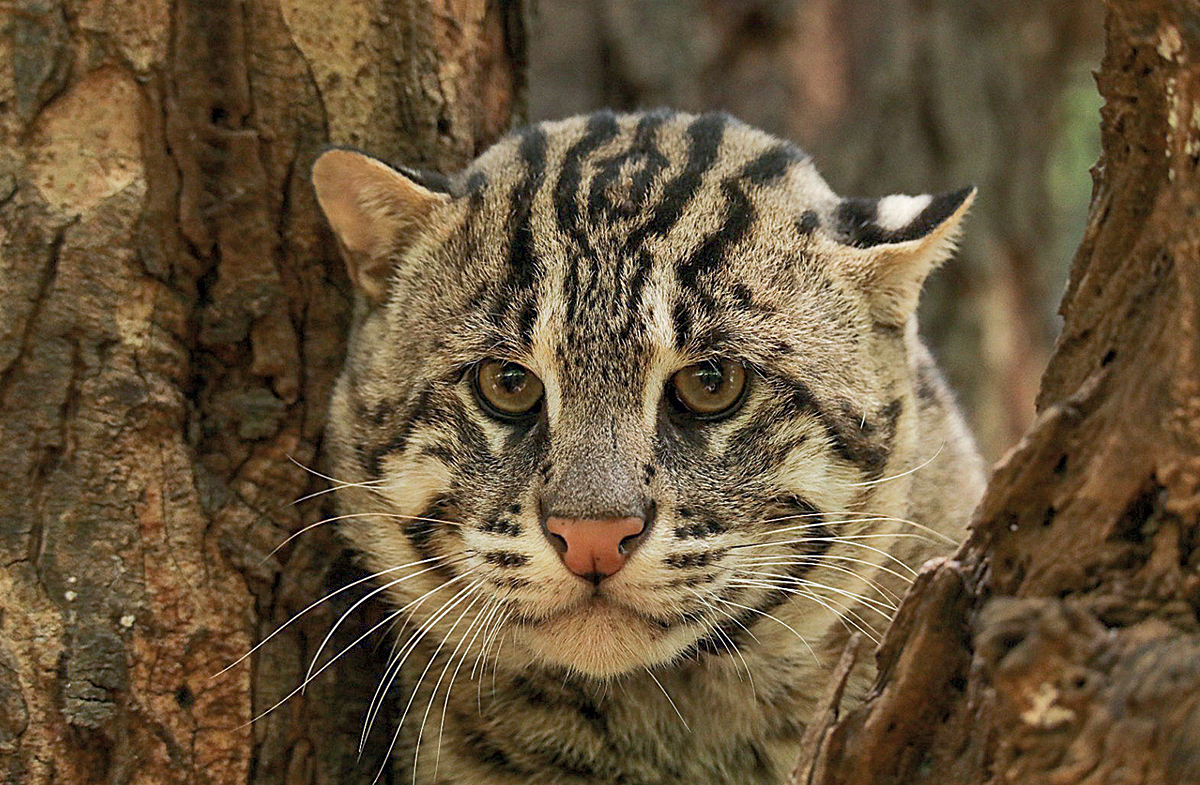
Fishing Cat
And according to researchers, their time in the spotlight may have finally come.
A Hidden World, Ready to Be Seen
“These cats have always been here — living quietly alongside us,” says Chaminda Jayasekara, a researcher and conservationist who has spent years studying Sri Lanka’s lesser-known carnivores.
“What is changing now is not the cats, but our awareness. We are beginning to understand that these species are not rare in the sense of being absent — they are rare because we have not been looking for them in the right way,” he said.
Jayasekara notes that all three species are distributed across wide swathes of the island — from the dry zone landscapes of the Cultural Triangle to the wetter lowlands and even human-dominated environments.
“The remarkable thing about the Fishing Cat and the Jungle Cat in particular is their adaptability. They are not confined to deep water. They use wetlands, paddy fields, scrublands — habitats that exist right next to where people live,” he explained.
-

- Jungle cat

-
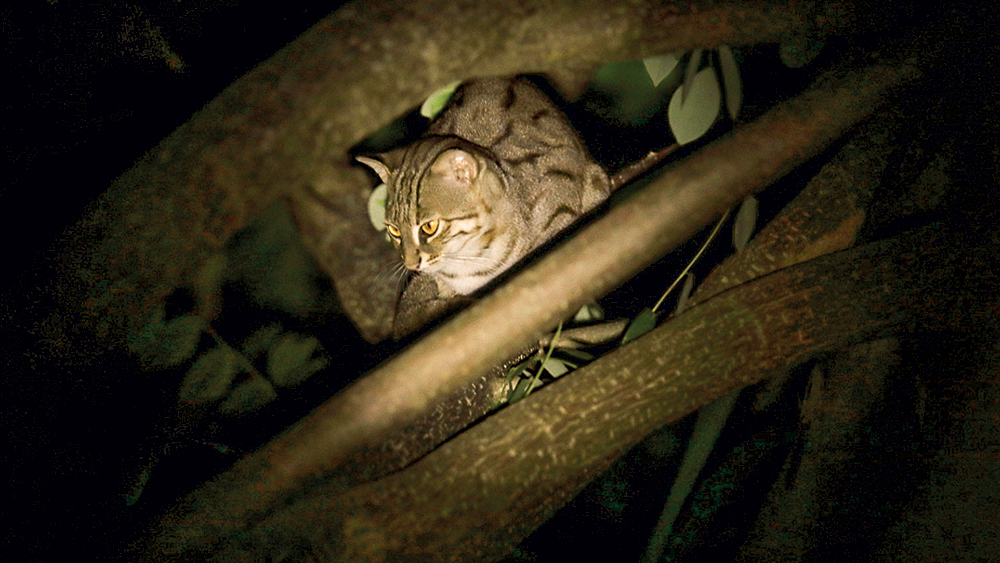
- Rusty-spotted cat

-

- Chaminda with wife Thilini Sandamali
Three Cats, Three Remarkable Stories
The largest of the trio, the Fishing Cat, is a wetland specialist — a muscular, spotted predator with partially webbed paws built for hunting in water. Across Sri Lanka’s vast network of tanks, marshes, and mangroves, it stalks fish with silent precision.
Globally listed as Vulnerable and considered endangered nationally, the species faces mounting pressure from wetland loss and pollution. Yet paradoxically, it is often found within sight of human settlements.
“Seeing a Fishing Cat hunting along a village tank is one of the most powerful wildlife experiences Sri Lanka can offer,” Jayasekara said. “It challenges everything people think they know about where wildlife belongs.”
The Jungle Cat, by contrast, is a creature of grass and scrub — long-legged, alert, and often active at dusk. It thrives in the margins where farmland meets wilderness, preying on rodents, birds, and reptiles.
Though not currently endangered, its habitat is steadily shrinking.
“These are landscapes we often dismiss as ‘empty’ or ‘degraded,’” Jayasekara noted. “But for the Jungle Cat, they are essential. Losing them means losing an entire ecological story.”
And then there is the smallest of them all — the
Rusty-spotted Cat.
Weighing little more than a kilogram, this tiny feline — found only in Sri Lanka, India, and Nepal — holds the distinction of being the world’s smallest wild cat. With its soft, rust-coloured coat and disproportionately large eyes adapted for night vision, it appears almost unreal in the wild.
“To encounter a Rusty-spotted Cat is something very few people in the world have experienced,” Jayasekara said. “It is not just a sighting — it is a moment of disbelief.”
A Tourism Opportunity After Dark
What makes these cats especially compelling is not just their rarity, but their accessibility.
Unlike the island’s larger, more famous wildlife, sightings do not always require long hours inside national parks. Instead, they can occur in carefully managed landscapes — wetlands, forest edges, and even within the grounds of eco-sensitive hotels.
One such example is Jetwing Vil Uyana, a property that has quietly demonstrated what is possible.
Located in the heart of the Cultural Triangle, the hotel sits within a restored wetland ecosystem where all three cat species have been recorded. Over more than a decade, guided night walks conducted by trained naturalists have offered guests rare glimpses into this hidden world.
“These experiences must be done with extreme care,” Jayasekara emphasised. “Low-impact lighting, small groups, and knowledgeable guides are critical. If done incorrectly, we risk disturbing the very species we are trying to protect.”
A Changing Global Audience
Sri Lanka’s tourism narrative has long revolved around its “big five” — elephants, leopards, sloth bears, blue whales and sperm whales. But global travel trends are shifting.
Today’s wildlife traveller is increasingly seeking intimate, lesser-known experiences — encounters that feel personal, rare, and authentic.
“For a visitor from Europe, where wild cats are virtually absent, the idea of seeing even one species is exciting,” Jayasekara said. “To potentially see three — in one country, in one journey — is extraordinary.”
He believes Sri Lanka is uniquely positioned to capitalise on this niche.
“This is not about replacing what we already have. It is about expanding the story — showing that Sri Lanka is not just about large animals, but also about the small, the secretive, and the scientifically fascinating.”
Conservation Through Experience
Beyond tourism, the implications are deeper.
The Fishing Cat continues to decline due to habitat destruction and human conflict. The Rusty-spotted Cat remains poorly studied, with significant gaps in scientific knowledge. Even the adaptable Jungle Cat is losing ground as grasslands disappear.
Jayasekara argues that responsible tourism can play a vital role in reversing these trends.
“When communities begin to see value in these animals — not as threats, but as assets — attitudes change,” he said. “A Fishing Cat alive in a wetland can generate far more long-term benefit than a wetland converted for short-term gain.”
Tourists, too, become part of the conservation chain.
“A single meaningful encounter can transform how a person sees the natural world. They go back, they share the story, and suddenly these small cats are no longer invisible.”
The Night Belongs to Sri Lanka
Across the island, as darkness settles over ancient reservoirs and forest edges, this quiet transformation is already underway.
A ripple disturbs the surface of a tank — a Fishing Cat at work. In the tall grass, a Jungle Cat pauses, ears alert. And somewhere in the shadows, almost impossibly small, a Rusty-spotted Cat watches with luminous eyes.
These are not distant, unreachable moments. They are unfolding now — in landscapes that millions pass every day.
Sri Lanka has long been celebrated for what it shows the world in daylight. But, as researchers and conservationists now suggest, its future may also lie in what it chooses to reveal after dark.
“The story is already here,” Jayasekara said. “We just need to tell it — carefully, responsibly, and with the respect these animals deserve.”

A destination wedding in Sri Lanka is not just an event,it is an experience that unfolds over days, sometimes even a week. From the golden shores of Bentota to the colonial charm of Galle Fort, and the cool romantic highlands of Nuwara Eliya, Sri Lanka offers a stunning diversity of settings for exotic weddings. Destination weddings are more than romantic celebrations, they are a dynamic driver of tourism, drawing high spending travellers, global attention, and long stay visitors. In Sri Lanka, these weddings seamlessly blend scenic beauty, culture and luxury promoting Sri Lanka on the world stage.
Sri Lanka is one of the most diverse destination wedding hubs in Asia – drawing couples from India, Europe and even Pakistan who are looking for something beyond the ordinary.
What makes Sri Lanka irrestible is its rare ability to offer multiple wedding backdrops within a few hours – from sun kissed beaches, misty mountains, colonial charm, and lush tropical landscapes, all seamlessly woven into one unforgettable celebration.
For many couples the dream begins by the sea. Along the southern and western coastlines, Sri Lanka offers a perfect beach wedding, with golden sunsets, and endless horizons.

Celebration of love in an elegant setting
For many Indian couples, in particular, Sri Lanka presents the perfect blend of proximity and exotic appeal. While the couples seeking cooler climes and a dramatic scenery, Sri Lanka’s hill country offers a dreamlike alternative. Nuwara Eliya, often called Little England, is loved by European couples. With its colonial bungalows, rose gardens and cool climate, it lends itself perfectly to elegant garden weddings, reminiscent of an English country affair.
What sets Sri Lanka apart is not just the beauty of these locations but how seamlessly everything comes together – food, culture and locations.
From décor and catering to cultural performances and legal formalities – ensure couples and their families to focus solely on the celebration itself without hassles.
-

- An ancient symbol of grace at a modern wedding
It is also the versatility that attracts a global clientale, Indian weddings find space for grandeur and tradition while European couples discover intimacy and charm. Some European couples are drawn to Sri Lanka’s tropical allure, heritage architecture, and a promise of a wedding that feels both intimate and extraordinary. Hotels and resorts across the island have elevated destination weddings into an art form.
Some of the hotels, such as Shangri-La Hambantota, Cinnamon Bentota Beach, Sheraton Kosgoda and Weligama offer bespoke wedding packages that go for beyond décor and dining.
Wedding planners curate menus, from floral themes, cultural performance to dining, ensuring each celebration reflects the couples story. Guests, too, are not left out, they find themselves embarking on wildlife safaris or indulge in Ayurvedic wellness retreats along the southern coast. Weddings becomes rich with memory making moments. Unlike Bali or Phuket, Sri Lanka offers five star venues, world class cuisine to the island’s ability to offer something deeply personal yet effortlessly luxurious.
In Sri Lanka, couples will never confined to a single venue. A beach ceremony can be followed by a hill country honeymoon or a cultural
celebration near Sigiriya can transition into a coastal after party and personalised service at a fraction of the cost, allowing couples to enjoy their ceremonies at a low cost. Culturally the island offers depths and colour. Kandyan dancers, traditional drummers, Poruwa ceremonies and vibrant local rituals add authencity and character.
The island’s year round tropical climate further enhances its appeal. Couples can host outdoor ceremonies under open skies. The exotic landscapes lend themselves beautifully to photography. Above all this, Sri Lanka offers warmth and the hospitality is genuine and deeply personal.
Sri Lanka stands out in a world where destination weddings are becoming increasingly extravagant.
Sri Lanka is a place where love is celebrated against a backdrop of nature, culture and timeless beauty. And perhaps that is why so many couples choose Sri Lanka to say ‘I do’ and to began their journey in a place that feels like home.
By Zanita Careem

at Cinnamon Grand
This Avurudu season, Cinnamon Grand Colombo invited guests to embrace the warmth, joy, and timeless traditions of the Sinhala and Tamil New Year with a thoughtfully curated series of festive experiences for the whole family.
Blending authentic Sri Lankan heritage with the hotel’s signature hospitality, the celebrations promise a memorable April filled with traditional flavours, lively entertainment, and meaningful moments of togetherness.
The festivities began with the Avurudu themed tea buffet, at the tea lounge, where guests savoured a delightful spread of seasonal sweets, festive treats, and local favourites inspired by Avurudu traditions.
During the season, Nuga Gama came alive with Happy Avurudu, featuring a charming traditional sweet table followed by an authentic Sri Lankan lunch buffet. Guests immersed themselves in the festive spirit with traditional Avurudu games, cultural celebrations, and special seasonal activities, recreating the joy of a classic Sri Lankan New Year gathering.
-

- Behind every celebration is a team of culinary artists

Swinging into elegance and unforgettable memories
As the celebrations continued into the evening, Nuga Gama presented the Sri Lankan New Year Dinner on 14th April, an indulgent dinner buffet showcasing cherished festive recipes and beloved Sri Lankan flavours.
The guests enjoyed a host of seasonal experiences across the hotel. Coffee Stop featured the Avurudu Kavili Pop up, offering an irresistible selection of traditional New Year sweets, while palms of beautifully curated festive hampers perfect for gifting family, friends, and colleagues.
Adding to the vibrant atmosphere, the Avurudu feast at the lobby brought the traditions of the season to life with live raban performances by traditional Sri Lankan ladies and live cooking stations serving freshly prepared local sweet treats, creating an immersive festive experience for guests and visitors alike.
For those looking to extend the celebrations, Cinnamon Grand Colombo also introduced a festive Avurudu stay, inviting guests to enjoy the season with an exclusive city escape. Guests booking with the promo code CGA26 enjoyed special benefits, including 15% off on all food and beverage, 10% off spa treatments, and a complimentary stay for one child, valid for stays until 30th April 2026. Reservations can be made via cinnamonhotels.com.
The celebrations continue later in the month with Baila Night at Nuga Gama on 24th April, featuring a lively performance by Sri Band SL, followed by a delicious dinner buffet in a festive village style setting.
Celebrate Avurudu season with unforgettable flavours, cherished traditions, and heartfelt hospitality at Cinnamon Grand Colombo, where every experience is designed to capture the true spirit of the season.

Compensation payments and reconstruction activities related to the Ditwah relief measures must be expedited with special attention at the district level – PM

South Korean fighter jets collided due to pilots taking pictures, report finds

Showers above 75 mm are likely at some places in the Western, Sabaragamuwa, Central, Uva and Southern provinces and in Ampara and Batticaloa districts

Parliament urged to probe questionable payment of USD 2.5 mn from Treasury

USD 2 mn bribe: CID ordered to arrest Shasheendra R, warrant issued against ex-SriLankan CEO’s wife

Lanka faces crisis of conscience over fate of animals: Call for compassion, law reform, and ethical responsibility

‘Dates have the highest sugar content to fight Coronavirus’

Sunday Island 27 December – Headlines

#SundayIsland 17th December – Headlines

Sunday Island – 28th March

Sunday Island Headlines – 21 March

Sunday Island – 21st February – Headlines
-

 News2 days ago
Rs 13 bn NDB fraud: Int’l forensic audit ordered
-

 Business5 days ago
Harnessing nature’s wisdom: Experts highlight “Resist–Align” path to resilience
-

 Opinion3 days ago
Shutting roof top solar panels – a crime
-

 News5 days ago
Gratiaen Trust announces longlist for the 33rd Annual Gratiaen Prize
-

 News4 days ago
From Nuwara Eliya to Dubai: Isha Holdings markets Agri products abroad
-
 Latest News7 days ago
Singapore Zoo’s first Sri Lankan leopard cubs make their public debut
-
 News5 days ago
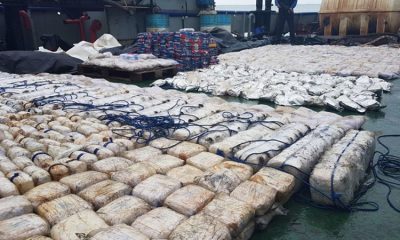
Heroin haul transported on 50-million-rupee contract
-

 News3 days ago
Church calls for Deputy Defence Minister’s removal, establishment of Independent Prosecutor’s Office