
News
Dr. Godahewa asks can individuals responsible for unprecedented economic crisis be architects of recovery

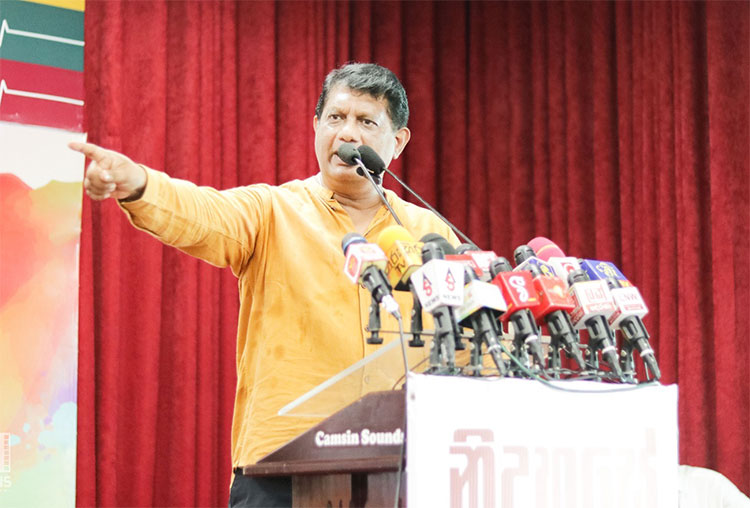
Former State Minister Dr. Nalaka Godahewa, MP, says that the ruling party politicians were labouring under the misconception that the very individuals responsible for the unprecedented economic crisis could be the architects of the economi recovery process.
The Gampaha District MP said that unless that notion was challenged and publicly disapproved it could lead the country down a perilous path and by the time the political leaders realised this grave error, it would be too late for a course correction.
The MP said so addressing a recent seminar organised by the Freedom People’s Congress in Matara.
“It’s no secret that Sri Lanka finds itself in a dire financial situation today. We stand at the precipice of bankruptcy, a situation that has evolved over time due to an unmanageable debt burden that came to a head in early 2022. But in this moment of reflection, I pose a question: How many of us truly understand the root causes of this crisis, and who bears the primary responsibility for leading our nation into this perilous debt trap?
The prevailing sentiment among many is to point the finger at former President Gotabhaya Rajapaksa, asserting that he could have paid off a substantial $6.7 billion debt in 2020 when he held office. Furthermore, it is argued that subsequent administrations were saddled with annual payments exceeding $5 billion, leading to the eventual declaration of bankruptcy.
However, it’s crucial to clarify that these loans were not secured during President Gotabaya Rajapaksa’s tenure. So, the question lingers: who exactly initiated this borrowing spree?
Our nation gained independence in 1948, and as of 2015, a staggering 67 years had passed. During this time, the total debt had mushroomed to a staggering 7,400 billion rupees when converted from local and foreign denominations. It’s important to recognize that many of the significant infrastructure projects we see today, including ports, airports, highways, railways, the Mahaweli project, irrigation systems, power plants, universities, schools, and hospitals, were financed through loans secured over these six decades.
In a surprising twist, the period between 2015 and 2019 witnessed a 75% increase in the country’s total debt, with no commensurate large-scale development projects to show for it. By the time the “good governance” government was replaced in 2019, the debt had soared from 7,400 billion to a staggering 13,000 billion rupees, including foreign debt exceeding $40 billion, with $11.05 billion in short-term commercial debt or sovereign bonds looming ominously.
This debt crisis, ultimately, was inherited by Gotabaya Rajapaksa, and the resulting shortages in oil, gas, and electricity in early 2022 caused public outrage, leading to his removal from office. However, it’s important to note that he was not the architect of this economic quagmire.
We must pause to reflect on who managed our nation’s economy during the years 2015-2019, a period that witnessed a decline in economic growth from 5.5% in 2015 to a mere 2.1% by 2019. During this same time frame, the total debt swelled from $54 billion to $74 billion, all while our national resources failed to see a corresponding increase.
Consider the parallels with the present day. In the past year, our debt has skyrocketed, reaching $96 billion by June 2023. The key difference now is that we are not servicing this debt, sparing us the queues for oil and gas, but it has not been offset by an increase in foreign income.
In 2022, our economy contracted by a staggering 7.8%, and the first quarter of 2023 saw an even more alarming contraction of 11.5%. The government has yet to reveal the full extent of the second-quarter decline, but early indications suggest a crisis of greater magnitude.
So, let us ask ourselves: Is it rational to believe that the individual held responsible for this crisis can simultaneously be its savior? This question may linger, but time may be running out for us to find the answer.
In the days ahead, the true origins of this crisis will become increasingly clear, but by then, it might be too late to reverse the course we are on. It is imperative that we scrutinize our leaders and policies closely, and work collectively to chart a path toward financial stability and prosperity for our beloved Sri Lanka.”





Appointment of committee eyewash, says UNP
The government is considering changes to prison regulations pertaining to the treatment of Buddhist monks serving jail terms, including their right to wear monastic robes when taken outside prison.
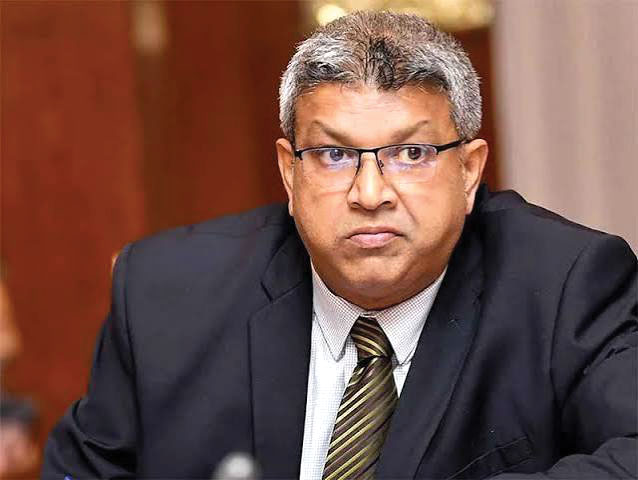
Justice and National Integration Minister Harshana Nanayakkara announced the proposed changes yesterday (14) following the submission of an interim report by a committee appointed to review the rules and procedures governing prisons.
The report was handed over to Secretary to the President Dr Nandika Sanath Kumanayake at the Presidential Secretariat.
One of the key recommendations is to amend Prison Standing Order 356 by introducing a new provision, 356(A). The proposed revision would require prison authorities to consult the Department of Buddhist Affairs on the removal of a monk’s robes upon admission to prison. The Commissioner of Prisons would be allowed 10 days to notify the department and take the necessary steps.
A separate amendment to Departmental Order 550 would allow Buddhist monks to wear their robes whenever they are taken outside prison, unless their respective Nikaya formally requests that the privilege be withdrawn.
The committee has also recommended extending similar arrangements, with suitable modifications, to members of other religious clergy who are imprisoned.
The proposals follow concerns raised over the treatment of Ven. Galagoda Aththe Gnanasara Thera after he was taken into custody. President Anura Kumara Dissanayake subsequently held discussions with representatives of the three main Buddhist Nikayas and appointed the committee to examine the existing legal framework.
Nanayakkara said the interim report had been forwarded to the Acting Commissioner General of Prisons, along with instructions to revise the relevant standing orders in accordance with its recommendations.
The proposed amendments have yet to be confirmed as formally implemented.
Meanwhile, the UNP yesterday criticised the government’s decision to appoint a committee to make recommendations on the attire to be worn by imprisoned Buddhist monks and other religious leaders when taken outside prison, describing the move as unnecessary.
In a statement issued yesterday (14), the UNP said the procedures governing the matter were already clearly set out in the Department of Prisons’ Standing Orders, making the appointment of a separate committee unwarranted.
The party cited remarks by Professor G.L. Peiris, Convenor of the Janathawadi Joint Opposition, who had described the committee’s appointment as a
“complete eyewash” and questioned the need for such a move.
Referring to Standing Order 550 of the Prisons Department, the UNP said convicted prisoners appearing before court for legal proceedings should not be required to wear prison uniforms.
It further stated that the regulations allowed prisoners to wear civilian clothing consistent with what they wore before imprisonment, including attire appropriate to their cultural and religious backgrounds.
The UNP accused the government of unnecessarily prolonging the issue by appointing a committee, despite the existence of regulations governing prisoners’ attire.
The party also called on the government to seek forgiveness from the Mahanayake Thera and the Sangha Council of the Kotte Sri Kalyani Samagri Dharma Maha Sangha Sabha of the Siyam Maha Nikaya over the decision concerning the religious attire of Ven. Galagoda Aththe Gnanasara Thera.
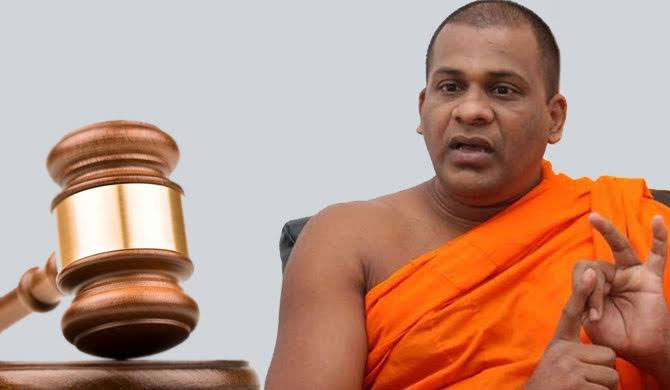
Court of Appeal President Justice Rohantha Abeysuriya yesterday withdrew from the bench hearing petitions challenging the decision by prison authorities to require Ven. Galagoda Aththe Gnanasara Thera to wear prison attire following his imprisonment.
The decision was announced when the petitions seeking to invalidate the prison authorities’ decision were taken up for consideration on October 14.
Following his withdrawal, a three-judge bench was appointed to hear the petitions.
The petitions relate to the prison authorities’ decision to require Gnanasara Thera to wear prison attire after he was taken into custody to serve the remainder of his sentence for contempt of court.
In September this year, the Supreme Court annulled the presidential pardon granted to Gnanasara Thera by former President Maithripala Sirisena in May 2019.
Following the ruling, the Court of Appeal directed the Commissioner General of Prisons to take the necessary steps to enforce the remainder of the monk’s prison sentence.
Gnanasara Thera had originally been sentenced to six years’ imprisonment for contempt of court but had served only around nine months before receiving the presidential pardon in 2019.
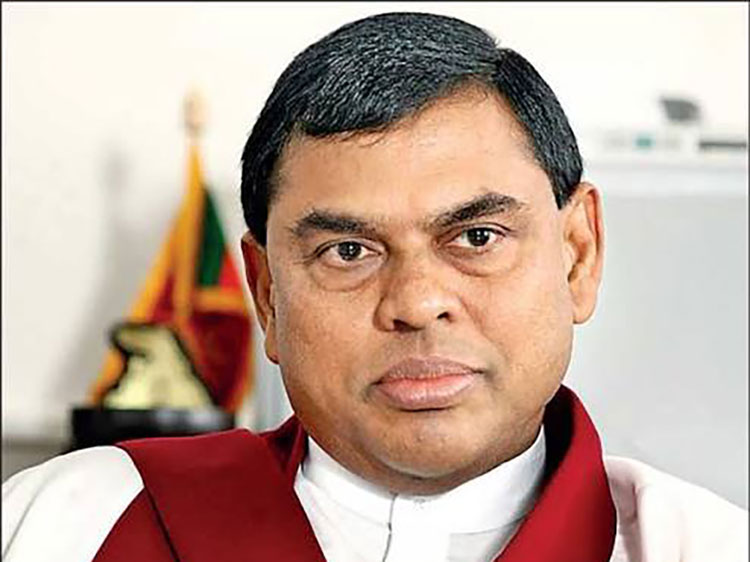
The Fort Magistrate’s Court yesterday issued an arrest warrant for former Minister Basil Rajapaksa over the alleged misuse of funds belonging to the Sri Lanka Tourism Promotion Bureau during the 2014 Uva Provincial Council election.
The Magistrate also directed the CID Illegal Assets Investigation Division to take necessary steps to obtain a Red Notice through Interpol.
The orders were issued following submissions made by the CID in connection with the alleged financial irregularities.
The CID’s Illegal Assets Investigation Unit informed the court that Rs. 7.8 million allocated to the Sri Lanka Tourism Promotion Bureau in 2014 had allegedly not been used for the Bureau’s promotional activities.
Instead, the funds had allegedly been used to provide 12,000 T-shirts during the Uva Provincial Council election, causing a financial loss to the government, the CID told court.

Showers or thundershowers will occur at most parts of the island

Prison rules to be revised over monks’ attire

AC President recuses himself from hearing prison attire case pertaining to Gnanasara Thera

Court orders steps to obtain INTERPOL Red Notice against Basil

CID informs Fort Magistrate’s Court investigation into money laundering case against Namal completed

No force used to make Gnanasara Thera wear prison garb – Prisons

‘Dates have the highest sugar content to fight Coronavirus’

Sunday Island 27 December – Headlines

#SundayIsland 17th December – Headlines

Sunday Island – 28th March

Sunday Island Headlines – 21 March

Sunday Island – 21st February – Headlines
-

 News6 days ago
NDB fraud Rs 60mn more than reported
-

 News6 days ago
Removing monk’s robes matter for Sangha to decide: Mahanayake Theras
-

 News4 days ago
Sri Lanka escalates anti-graft drive with Shiranthi’s jailing
-
 News5 days ago
NPP govt. reminded of its responsibilities as US warship leaves Colombo
-
 Latest News6 days ago
Farhan, Sadaqat help Pakistan ace 183 chase to go 1-0 up
-
 News6 days ago
BHC, Colombo: “LTTE remains a proscribed org. in the UK”
-

 Latest News3 days ago
Farhan and Sadaqat help Pakistan seal series in style
-

 News4 days ago
Iranian ships stranded, Lanka fears US sanctions