
Features
Democrat concerns about Biden’s candidacy deepens

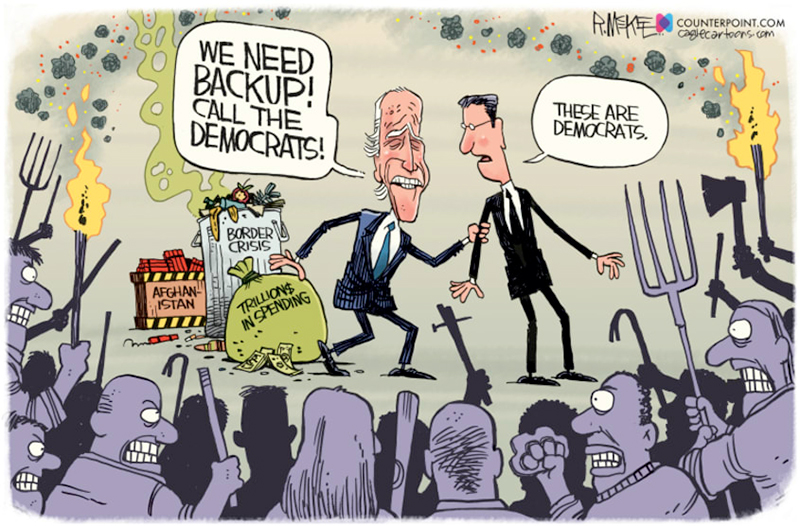
Project 2025 – Ominous mandate for Republican agenda
by Vijaya Chandrasoma
Two weeks have passed since the disastrous CNN debate on June 27, and the news cycle has been consumed with the controversy whether Biden should stay in the race for the presidency or whether his dismal performance was not a sign of a more serious malaise.
At least 17 Democratic Congressmen and one Senator (and counting, just about every hour), have called on him publicly to withdraw. There are many more private murmurings that it would be best if he does hand over the torch to a younger, more electable candidate. Even Speaker Pelosi sent a carefully worded, lukewarm statement about Biden’s chances in November. There are rumors that Pelosi and President Obama have been meeting privately to discuss this problem. After all, the basis of Biden’s run for the Presidency in 2020 was that he would be a one-term president to defeat Trump and provide a bridge to the leadership of the younger generation of the Party.
Another hit came last Wednesday, when Hollywood idol, George Clooney, who recently participated with President Obama and other celebrities in a star-studded Biden fund raiser which raised over $30 million, released an op-ed in the New York Times, urging the Democratic Party to choose a new nominee, after Biden’s dismal debate performance. The fact that even major Democratic donors like Clooney are falling off the cliff indicates that the Party will run into serious financial problems ere long.
Urging Democratic lawmakers not to wait and see if the dam breaks, Clooney says, “The dam has broken. We can put our heads in the sand and pray for a miracle in November, or we can speak the truth…. We are not going to win in November with this president. On top of that, we won’t win the House, and we’re going to lose the Senate. This isn’t only my opinion; it is the opinion of every senator and congress member and governor I’ve spoken with in private”.
Clooney’s comments were devastating. Mainly because they were true; there is little doubt that many more donors will follow his lead. Significantly, Clooney gave President Obama a heads-up before he submitted the op-ed to the New York Times. Sources familiar with the exchange say that while Obama did not encourage Clooney to write what he did, neither did he object to it.
Even those who support Biden in a public show of loyalty are known to have a sneaking lack of private enthusiasm. Many have expressed fears, confirmed by current polls, that Trump will win re-election handily in November, and the Republicans will also gain control of the House and the Senate. With the Supreme Court completely suppliant to the conservative cause, the Trumpian Party will reign totalitarian supreme for the foreseeable future.
This whole argument of whether to change the course of Democratic leadership seems to be a waste of valuable time, with the election just under four months away. The Democrats must concentrate on one objective only, that of keeping Donald Trump, who will destroy the democracy of the nation, away from the White House. As Senator Bernie Sanders said. “What we are talking about now is not a Grammy contest song for the best singer. Biden is old. He’s not as articulate as he once was. I wish he can jump up the stairs of Air Force One, but he can’t. What we have to focus now is on policy; whose policies have benefited, and will benefit, the vast majority of the people of this country”.
After the debacle of the debate, the short-term aim for the Democratic Party was to remove the indelible impression of an old man, unable to articulate two very simple messages. One, the remarkable achievements of the first term of his presidency, which transformed a failing, criminally mismanaged Trump first term on the cusp of recession to the most robust economy in the world today – a record of bipartisan legislative achievements unparalleled in recent history. Two, the existential danger that another Trump presidency will threaten the democracy and the rule of law of the nation.
What President Biden must emphasize is the obvious. That he is old. He is not the man he once was. He did have a terrible night during the debate where he made these facts painfully obvious to an audience of 51 million viewers, a spectacle of frailty, perhaps worse, which can never be unseen.
But Biden must remind the American voters of the temporary amnesia they seem to be suffering about how they fared during the four years of Trump’s first term. How he gave a tax cut of over $1 trillion which benefited mainly the super-wealthy and the corporations; how he mishandled the handling of the Covid pandemic, ignoring the advice of the greatest scientists in the world, which caused the avoidable deaths nearly a million Americans and tanked the economy to near recession; how he incited an insurrection that nearly brought down a democratically elected government; how he stole top-secret government documents to trade with the nation’s adversaries; the list is endless.
Trump’s mind has become exponentially unhinged, with outrageous comments in his campaign rants, the latest being the explanation of his energy policy at a recent rally in Las Vegas, where he argued that he would prefer being electrocuted in a boat powered by an electric battery rather than being eaten by some imaginary shark! In truth, so would I.
Biden gave a relatively energetic campaign rally speech in Raleigh, North Carolina the day after the disappointing debate, where he acknowledged that he was not a young man, but stated that his record and character prove that he’s still the man for the job. He also made a forceful speech at the 75th Anniversary of the North Atlantic Treaty Organization (NATO) Alliance in Washington DC, quoting Reagan, “If our fellow democracies are not secure, we cannot be secure. If you are threatened, we are threatened. And if you are not at peace, we cannot be at peace….”Reagan knew it then, and we know it now. Our nations will continue to keep faith with what we’ve pledged in the years to come”.
However, NATO leaders present at the meeting, are petrified at the prospect of the re-election of Donald Trump, who threatened to leave the Alliance during his first term, and has made no secret of his deep admiration for Russian strongman, Putin. They appeared to be distressed at how much more frail and aged Biden seemed, just a month after the G7 meeting in Italy.
Both the North Carolina and NATO were strong Biden speeches, with no gaffes, but they were both scripted and made with the use of teleprompters, which did little to achieve what was intended: to convince us that the presidential debate was a one-off disaster. He did make a mistake when he introduced President Zelensky at the end of the NATO conference as President Putin, but he caught himself within seconds and made a joke of it.
Thursday’s crucial press conference went off relatively well for President Biden. He made a scripted 20 minutes speech about the success of the recently concluded NATO Anniversary celebrations, and listed the reasons why he is the best person to defeat Donald Trump in November; stressing that “I am the most qualified to run for this job. I am not in this for my legacy. I am in this to finish the job I started”. He articulated clearly his grasp of the economic and societal problems facing the country, and certainly spoke like a different person than the man we saw at the presidential debate.
He then invited questions from the international press. He faced nearly an hour of probing questions, but started off badly right at the top. When asked about the qualifications of Vice-President Harris to do the job, he said, “Look, I wouldn’t have picked Vice-President Trump (!) if I were not sure she could do the job”. But he answered questions about his policies if he wins a second term in remarkable detail, especially questions on foreign policy, which were right in his wheelhouse. But for a couple of minor errors, mistaking names which, as every octogenarian will tell you, is a constant problem, he did as well as could be expected.
But the issues that have plagued him and caused all the doubts about a second term which make for his low poll ratings, and cause doubts among his Democratic colleagues, remained unchanged. He is too old, he is too frail, he is failing in cognitive acuity and physical health. And these problems will only keep getting worse with the passage of time.
The Heritage Foundation, the conservative think-tank with deep ties to the Republican Party, especially its Trumpian incarnation, released a 922-page document titled “Project 2025”, which outlines the far-right Republican agenda which the federal government will carry out immediately after Trump wins re-election. Project 2025 is authored by numerous officials of Trump’s first term, with contributions from conservative organizations intent on transforming the nation into a Christian white autocracy.
According to the website of the project, “It is not enough for conservatives to win elections. If we are to rescue the country from the grip of the radical Left, we need both a governing agenda and the right people in place, ready to carry this agenda out on Day One of the next conservative administration. This is the goal of the 2025 Presidential Transition Project”.
As The New Republic notes, “Project 2025 is a remarkably detailed guide to turning the United States to a fascists’ paradise….a Christian nationalist nation of the United States, one in which married heterosexuality is the only valid form of sexual expression and identity, all pregnancies would be carried to term, even if that requires coercion or death, and transgender and gender-nonconforming people do not exist”. And 90% of the poor and the immigrants, especially those from shithole countries, exist only to serve the wealthy, white 10%.
In a post on his Truth Social platform last week, Donald Trump attempted to distance himself from the extreme agenda of Project 2025. Although, if he had the ability to read, the text of the document, a carbon copy of his plans for America’s radical right, Christian white future, would have rewarded him with a wet dream of enormous pleasure.
The Republican National Committee Convention starts tomorrow in Milwaukee, Wisconsin, during the course of which Trump will be gloriously anointed as the Party nominee for the monarchy, as the presidency has recently been defined by the US Supreme Court. Trump will also likely announce his running mate next week, who will be selected on the basis of their answers to two vital questions:
Will you faithfully follow every command of His Republican Highness?
Will you agree to be hanged if you don’t?
So with four months to go, American voters are faced with the most important decision the nation has been threatened with in 250+ years.
We can only pray for one, even two more viable alternatives. Sure can’t do worse.

 by Kaushalya Perera
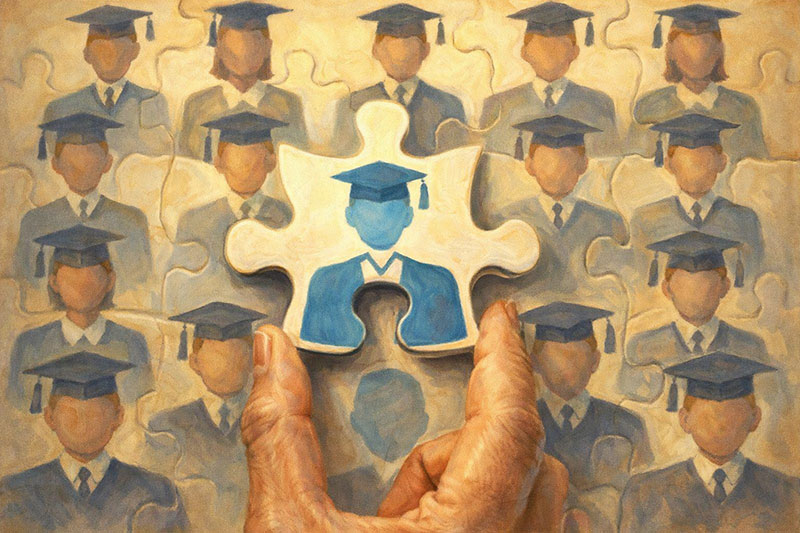
Time has, by and large, stood still in the business of academic staff recruitment to state universities. Qualifications have proliferated and evolved to be more interdisciplinary, but our selection processes and evaluation criteria are unchanged since at least the late 1990s. But before I delve into the problems, I will describe the existing processes and schemes of recruitment. The discussion is limited to UGC-governed state universities (and does not include recruitment to medical and engineering sectors) though the problems may be relevant to other higher education institutions (HEIs).
How recruitment happens currently in SL state universities
Academic ranks in Sri Lankan state universities can be divided into three tiers (subdivisions are not discussed).
* Lecturer (Probationary)
– recruited with a four-year undergraduate degree. A tiny step higher is the Lecturer (Unconfirmed), recruited with a postgraduate degree but no teaching experience.
* A Senior Lecturer can be recruited with certain postgraduate qualifications and some number of years of teaching and research.
* Above this is the professor (of four types), which can be left out of this discussion since only one of those (Chair Professor) is by application.
State universities cannot hire permanent academic staff as and when they wish. Prior to advertising a vacancy, approval to recruit is obtained through a mind-numbing and time-consuming process (months!) ending at the Department of Management Services. The call for applications must list all ranks up to Senior Lecturer. All eligible candidates for Probationary to Senior Lecturer are interviewed, e.g., if a Department wants someone with a doctoral degree, they must still advertise for and interview candidates for all ranks, not only candidates with a doctoral degree. In the evaluation criteria, the first degree is more important than the doctoral degree (more on this strange phenomenon later). All of this is only possible when universities are not under a ‘hiring freeze’, which governments declare regularly and generally lasts several years.
Problem type 1
– Archaic processes and evaluation criteria
Twenty-five years ago, as a probationary lecturer with a first degree, I was a typical hire. We would be recruited, work some years and obtain postgraduate degrees (ideally using the privilege of paid study leave to attend a reputed university in the first world). State universities are primarily undergraduate teaching spaces, and when doctoral degrees were scarce, hiring probationary lecturers may have been a practical solution. The path to a higher degree was through the academic job. Now, due to availability of candidates with postgraduate qualifications and the problems of retaining academics who find foreign postgraduate opportunities, preference for candidates applying with a postgraduate qualification is growing. The evaluation scheme, however, prioritises the first degree over the candidate’s postgraduate education. Were I to apply to a Faculty of Education, despite a PhD on language teaching and research in education, I may not even be interviewed since my undergraduate degree is not in education. The ‘first degree first’ phenomenon shows that universities essentially ignore the intellectual development of a person beyond their early twenties. It also ignores the breadth of disciplines and their overlap with other fields.
This can be helped (not solved) by a simple fix, which can also reduce brain drain: give precedence to the doctoral degree in the required field, regardless of the candidate’s first degree, effected by a UGC circular. The suggestion is not fool-proof. It is a first step, and offered with the understanding that any selection process, however well the evaluation criteria are articulated, will be beset by multiple issues, including that of bias. Like other Sri Lankan institutions, universities, too, have tribal tendencies, surfacing in the form of a preference for one’s own alumni. Nevertheless, there are other problems that are, arguably, more pressing as I discuss next. In relation to the evaluation criteria, a problem is the narrow interpretation of any regulation, e.g., deciding the degree’s suitability based on the title rather than considering courses in the transcript. Despite rhetoric promoting internationalising and inter-disciplinarity, decision-making administrative and academic bodies have very literal expectations of candidates’ qualifications, e.g., a candidate with knowledge of digital literacy should show this through the title of the degree!
Problem type 2 – The mess of badly regulated higher education
A direct consequence of the contemporary expansion of higher education is a large number of applicants with myriad qualifications. The diversity of degree programmes cited makes the responsibility of selecting a suitable candidate for the job a challenging but very important one. After all, the job is for life – it is very difficult to fire a permanent employer in the state sector.
Widely varying undergraduate degree programmes.
At present, Sri Lankan undergraduates bring qualifications (at times more than one) from multiple types of higher education institutions: a degree from a UGC-affiliated state university, a state university external to the UGC, a state institution that is not a university, a foreign university, or a private HEI aka ‘private university’. It could be a degree received by attending on-site, in Sri Lanka or abroad. It could be from a private HEI’s affiliated foreign university or an external degree from a state university or an online only degree from a private HEI that is ‘UGC-approved’ or ‘Ministry of Education approved’, i.e., never studied in a university setting. Needless to say, the diversity (and their differences in quality) are dizzying. Unfortunately, under the evaluation scheme all degrees ‘recognised’ by the UGC are assigned the same marks. The same goes for the candidates’ merits or distinctions, first classes, etc., regardless of how difficult or easy the degree programme may be and even when capabilities, exposure, input, etc are obviously different.
Similar issues are faced when we consider postgraduate qualifications, though to a lesser degree. In my discipline(s), at least, a postgraduate degree obtained on-site from a first-world university is preferable to one from a local university (which usually have weekend or evening classes similar to part-time study) or online from a foreign university. Elitist this may be, but even the best local postgraduate degrees cannot provide the experience and intellectual growth gained by being in a university that gives you access to six million books and teaching and supervision by internationally-recognised scholars. Unfortunately, in the evaluation schemes for recruitment, the worst postgraduate qualification you know of will receive the same marks as one from NUS, Harvard or Leiden.
The problem is clear but what about a solution?
Recruitment to state universities needs to change to meet contemporary needs. We need evaluation criteria that allows us to get rid of the dross as well as a more sophisticated institutional understanding of using them. Recruitment is key if we want our institutions (and our country) to progress. I reiterate here the recommendations proposed in ‘Considerations for Higher Education Reform’ circulated previously by Kuppi Collective:
* Change bond regulations to be more just, in order to retain better qualified academics.
* Update the schemes of recruitment to reflect present-day realities of inter-disciplinary and multi-disciplinary training in order to recruit suitably qualified candidates.
* Ensure recruitment processes are made transparent by university administrations.
Kaushalya Perera is a senior lecturer at the University of Colombo.
(Kuppi is a politics and pedagogy happening on the margins of the lecture hall that parodies, subverts, and simultaneously reaffirms social hierarchies.)
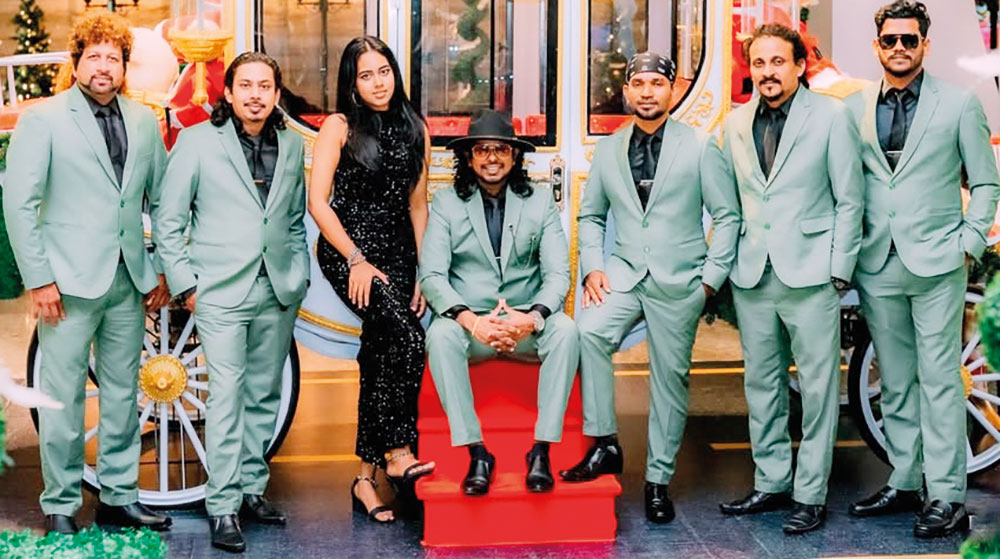
 This week, too, the spotlight is on an outfit that has gained popularity, mainly through social media.
Last week we had MISTER Band in our scene, and on 10th February, Yellow Beatz – both social media favourites.
Talento is a seven-piece band that plays all types of music, from the ‘60s to the modern tracks of today.
The band has reached many heights, since its inception in 2012, and has gained recognition as a leading wedding and dance band in the scene here.
The members that makeup the outfit have a solid musical background, which comes through years of hard work and dedication
Their portfolio of music contains a mix of both western and eastern songs and are carefully selected, they say, to match the requirements of the intended audience, occasion, or event.
Although the baila is a specialty, which is inherent to this group, that originates from Moratuwa, their repertoire is made up of a vast collection of love, classic, oldies and modern-day hits.
The musicians, who make up Talento, are:
Prabuddha Geetharuchi:

Geilee Fonseka: Dynamic and charismatic vocalist
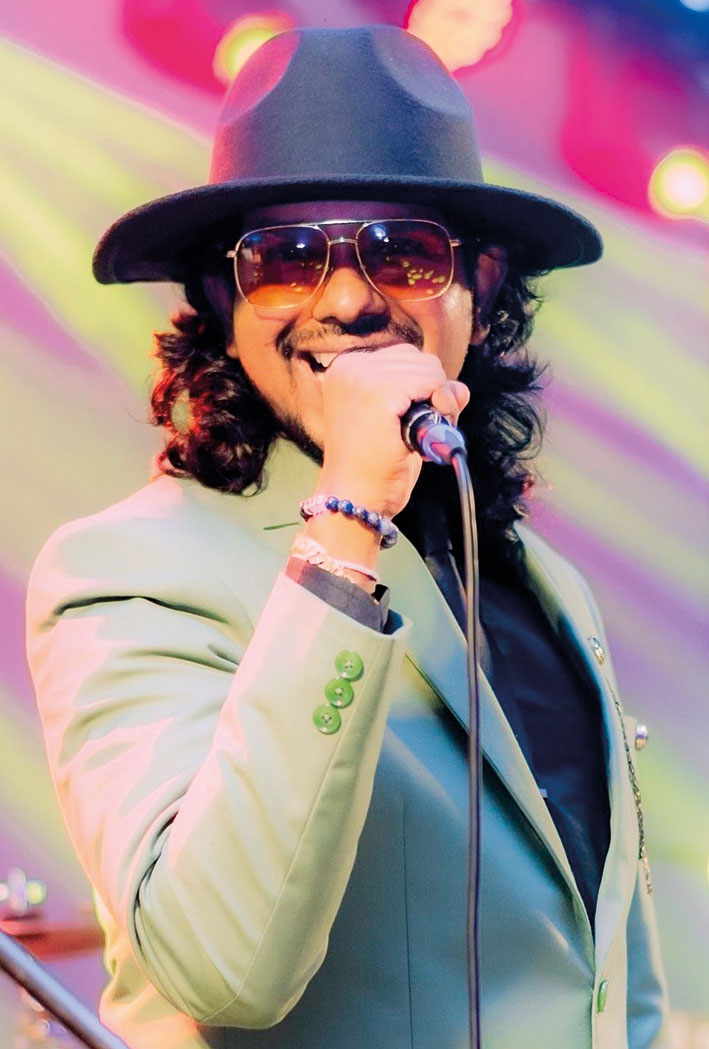
Prabuddha Geetharuchi: The main man behind the band Talento
(Vocalist/ Frontman). He is an avid music enthusiast and was mentored by a lot of famous musicians, and trainers, since he was a child. Growing up with them influenced him to take on western songs, as well as other music styles. A Peterite, he is the main man behind the band Talento and is a versatile singer/entertainer who never fails to get the crowd going.
Geilee Fonseka (Vocals):
A dynamic and charismatic vocalist whose vibrant stage presence, and powerful voice, bring a fresh spark to every performance. Young, energetic, and musically refined, she is an artiste who effortlessly blends passion with precision – captivating audiences from the very first note. Blessed with an immense vocal range, Geilee is a truly versatile singer, confidently delivering Western and Eastern music across multiple languages and genres.
Chandana Perera (Drummer):
His expertise and exceptional skills have earned him recognition as one of the finest acoustic drummers in Sri Lanka. With over 40 tours under his belt, Chandana has demonstrated his dedication and passion for music, embodying the essential role of a drummer as the heartbeat of any band.
Harsha Soysa:
(Bassist/Vocalist). He a chorister of the western choir of St. Sebastian’s College, Moratuwa, who began his musical education under famous voice trainers, as well as bass guitar trainers in Sri Lanka. He has also performed at events overseas. He acts as the second singer of the band
Udara Jayakody:
(Keyboardist). He is also a qualified pianist, adding technical flavour to Talento’s music. His singing and harmonising skills are an extra asset to the band. From his childhood he has been a part of a number of orchestras as a pianist. He has also previously performed with several famous western bands.
Aruna Madushanka:
(Saxophonist). His proficiciency in playing various instruments, including the saxophone, soprano saxophone, and western flute, showcases his versatility as a musician, and his musical repertoire is further enhanced by his remarkable singing ability.
Prashan Pramuditha:
(Lead guitar). He has the ability to play different styles, both oriental and western music, and he also creates unique tones and patterns with the guitar..
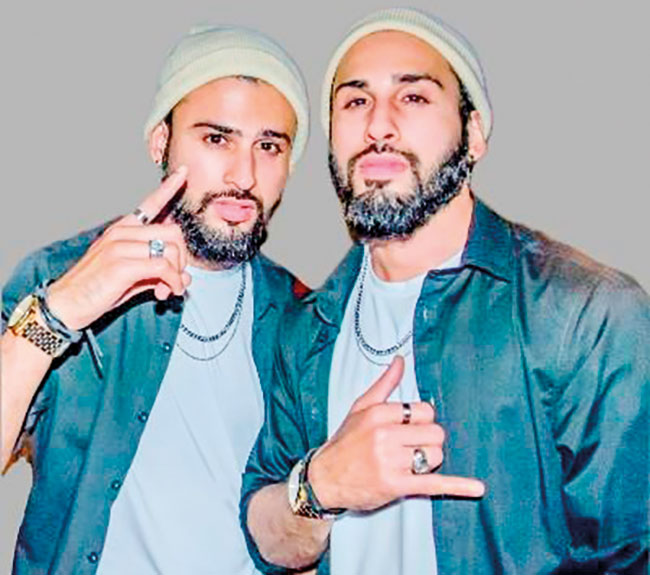
The JJ Twins, the Sri Lankan musical duo, performing in the Maldives, and known for blending R&B, Hip Hop, and Sri Lankan rhythms, thereby creating a unique sound, have come out with a brand-new single ‘Me Mawathe.’
In fact, it’s a very special milestone for the twin brothers, Julian and Jason Prins, as ‘Me Mawathe’ is their first ever Sinhala song!
‘Me Mawathe’ showcases a fresh new sound, while staying true to the signature harmony and emotion that their fans love.
This heartfelt track captures the beauty of love, journey, and connection, brought to life through powerful vocals and captivating melodies.
It marks an exciting new chapter for the JJ Twins as they expand their musical journey and connect with audiences in a whole new way.
Their recent album, ‘CONCLUDED,’ explores themes of love, heartbreak, and healing, and include hits like ‘Can’t Get You Off My Mind’ and ‘You Left Me Here to Die’ which showcase their emotional intensity.
Readers could stay connected and follow JJ Twins on social media for exclusive updates, behind-the-scenes moments, and upcoming releases:
Instagram: http://instagram.com/jjtwinsofficial
TikTok: http://tiktok.com/@jjtwinsmusic
Facebook: http://facebook.com/jjtwinssingers
YouTube: http://youtube.com/jjtwins
Six US soldiers killed in Iranian strike on Kuwait base

Israel attacks presidential office in Tehran as reported death toll in Iran rises to 787

Attorney At Law S K Sangakkara pasess away

SriLankan Airlines Update on Middle East Operations

Trump says Iran war projected to last 4 to 5 weeks, could go ‘far longer’

Qatar downs two Iranian fighter jets as conflict widens

‘Dates have the highest sugar content to fight Coronavirus’

Sunday Island 27 December – Headlines

#SundayIsland 17th December – Headlines

Sunday Island – 28th March

Sunday Island Headlines – 21 March

Sunday Island – 21st February – Headlines
-

 Opinion5 days ago
Jamming and re-setting the world: What is the role of Donald Trump?
-
 Features5 days ago
An innocent bystander or a passive onlooker?
-

 Features6 days ago
Ratmalana Airport: The Truth, The Whole Truth, And Nothing But The Truth
-
 Features2 days ago
Brilliant Navy officer no more
-

 Business7 days ago
Dialog partners with Xiaomi to introduce Redmi Note 15 5G Series in Sri Lanka
-
 Features7 days ago
Building on Sand: The Indian market trap
-
 Opinion7 days ago
Future must be won
-

 Opinion2 days ago
Sri Lanka – world’s worst facilities for cricket fans