
Features
Defining Oxygen Economy for sustaining life on Earth and growing intergenerational wealth

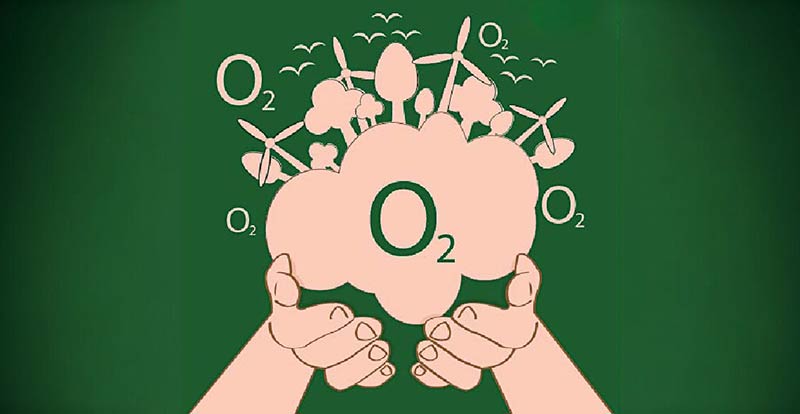
by Dr. Ranil Senanayake
The Oxygen that is present in the air that we breathe is the birth right of every organism that lives on this planet. It is free for everyone. However, the action of some to take out more than their share, without replacement, has created a condition, where the Global Commons of air is being rapidly degraded,
The most critical component of air is Oxygen. It surrounds us, filling our lungs with every breath we take. It is the invisible gift of nature that we take for granted. But this essential resource—the very foundation of life— is being constricted, because the volume of trees, plants, and photosynthetic organisms that produce oxygen is being lost across the planet. Further, there is no initiative for this generation capacity to be increased as a matter of urgency. exploited at present? Why couldn’t increasing the generation capacity of Oxygen have economic value? Could those who benefit most from using the resources of the Global Commons be required to contribute to its maintenance? This is the idea behind the Oxygen Economy, a bold and transformative concept that seeks to address environmental and social challenges in a way that is fair, sustainable, and forward-thinking beyond GDP value which measures the success of our societies today.
What Is the Oxygen Economy?
The Oxygen Economy is a financial framework, that recognises the value of the global stocks of Oxygen within the commons and records the deposition and consumption through economic activity.
The Oxygen Economy is a principled framework that recognises the stocks, transactions and deposits of Oxygen into the Global commons and assigns value to stocks from privately contracted production units, it stems from a growing recognition that Oxygen is a declining resource with an easy replenishment response.
Oxygen, considered a “free” resource. It is not. Much like oil and coal it is a ‘fossil’ resource that has been a part of the atmosphere for millions of years. It has been slowly declining, but is ‘topped up’ by a service provided by the earth’s ecosystems —particularly trees, plants, and other photosynthetic organisms. These organisms create molecular Oxygen through the process of photosynthesis, supporting life on earth and maintaining the balance of our atmosphere.
At its core, the Oxygen Economy aims to ensure that those who produce contracted and monitored oxygen, be it towns, farmlands, rural or forested lands, are fairly compensated for their efforts. It also holds industries and private-sector entities that benefit from oxygen consumption accountable in maintaining the sustainability of this resource.
What is the urgency to address oxygen as a depleting resource?
Other than the obvious fact of falling global stocks, the need of an Oxygen Economy arises from the urgency of addressing two critical challenges facing humanity: environmental degradation and economic inequality. Placing value on Oxygen production could effectively provide an effective response to both. For decades, efforts to combat climate change have focused primarily on carbon
sequestration. While important, the focus on Carbon sequestration often overlooks other vital ecosystem services, including oxygen production that can contribute towards a growing wealth paradigm. Oxygen, like water and food, is essential for life. However, unlike other resources, it has largely been treated as infinite and freely available, which it is not. In reality, the supply of Oxygen to the atmosphere is decreasing due to deforestation, while the consumption of Oxygen by space exploration, industrial production, war and transport are increasing. Today Oxygen levels have dropped by approximately 2%, raising concerns about the long- term sustainability of this critical resource.
How the Oxygen Economy works
The Oxygen Economy operates on the principles of private property being valued using financial tools such as valuation guarantees, stakeholder contracts and Insurances to monetise contractually produced oxygen as a financial product. This involves three key components:
1. Valuation guarantee:
Assigning an economic value to the oxygen produced by contracted and registered units in identified geographical areas of production is based on the researched, monitored and validated measurements of oxygen generation by trees / plants or photosynthetic organisms such as Cyanobacteria.
2. Deposition guarantee:
Issuance of certificates of completion and deposit of Oxygen into the global Commons Stakeholder Contracts and Compensation: Establishing formal agreements between oxygen consumers (e. g., corporations / Space exploration companies) and contracted oxygen producers (e.g., farmers, Local communities)
3. Policy and regulation: Introducing replicable legal frameworks at a regional scale to enforce accountability and prevent the uncontrolled exploitation of global oxygen resources.
Lessons from Sri Lanka
One country that is already exploring the potential of the Oxygen Economy is in the bioregional area of Sri Lanka. Known for its rich biodiversity and commitment to environmental stewardship, Sri Lanka has implemented initiatives that align with the principles of the Oxygen Economy. In one notable project, women from farming communities established and nurtured trees using contracts that measured and validated payments for photosynthetic biomass on an annually recurring basis for a period of four years. The stakeholders earning substantive income from this project were sensitised to the emerging Oxygen Economy while contributing their obligations to global environmental resilience. Over three years, these participants generated thousands of litres of oxygen, demonstrating that the concept is not only viable but also impactful.
Scaling the Oxygen Economy globally:
While Sri Lanka’s efforts are a promising start, the true potential of the Oxygen Economy
lies in its ability to scale globally. Imagine a world where farmers are compensated for the establishment of trees, where rural and even urban greenery projects could receive funding to expand their impact for this paradigm of business. Such a system would not only help combat climate change but also address economic inequalities of the current GDP paradigm, by together contracting the Oxygen economic asset tool to those who sustain the planet’s life-support systems.
Addressing potential challenges
Like any transformative idea, the Oxygen Economy faces potential challenges. Critics may argue that assigning a monetary value to Oxygen risks commodifying a natural resource that should remain freely accessible. Others may question the feasibility of measuring, validating and regulating oxygen production on a global scale. These concerns can be addressed by emphasising the ethical principles behind the Oxygen Economy. The goal is not to charge people for breathing but to ensure that those who contribute to its sustainability profit from financial contracts for Oxygen production. Additionally, such transparent systems for measuring and validating oxygen production will be crucial for building trust and ensuring fairness towards the vision of accounting for intergenerational wealth beyond the GDP framework that exists.
A vision for the future
The Oxygen Economy represents a paradigm shift in how we think about our relationship with the planet. It challenges us to move beyond the notion of nature as an infinite resource and to recognise the boundaries of our Global Commons. The true value of planet Earth is as an ecosystem that sustains life for all biota. By aligning economic practices with environmental stewardship, the Oxygen Economy offers a path towards a more equitable and sustainable future. It supports the foundations of intergenerational wealth that will be reflected in our contributions to the cycling atmospheric gasses of our Global Commons.
Imagine a world where the air we breathe is not taken for granted but is cherished and protected. Where farmers, communities, and ecosystems are rewarded for their contributions to the planet’s well-being. Where industries operate with a framework of accountability to prioritise the health of our shared environment. This is the vision of the Oxygen Economy—a vision that is within our reach if we act together, with urgency and determination, to lay well informed, solid foundations.


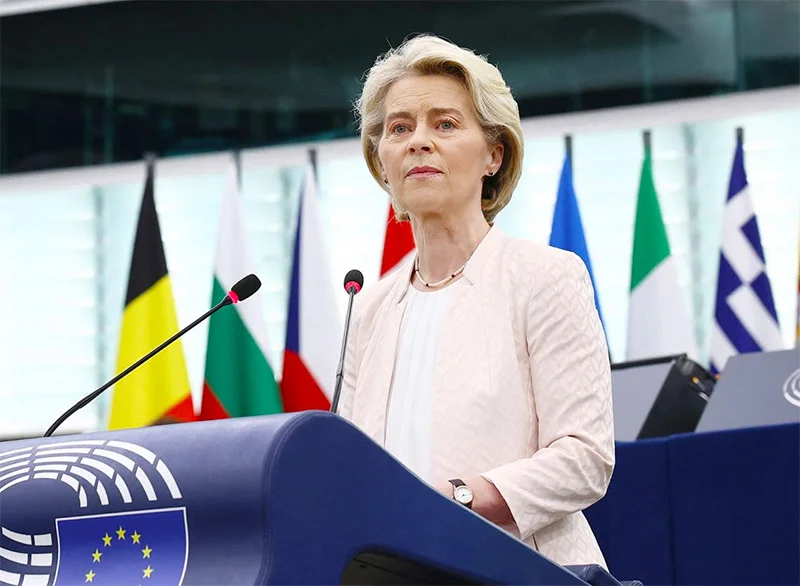
 European Commission President Ursula von der Leyen addressing the World Economic Forum in Davos, Switzerland on Tuesday put forward the EU’s viewpoint on current questions in international politics with a clarity, coherence and eloquence that was noteworthy. Essentially, she aimed to leave no one in doubt that a ‘new form of European independence’ had emerged and that European solidarity was at a peak.
These comments emerge against the backdrop of speculation in some international quarters that the Post-World War Two global political and economic order is unraveling. For example, if there was a general tacit presumption that US- Western European ties in particular were more or less rock-solid, that proposition apparently could no longer be taken for granted.
For instance, while US President Donald Trump is on record that he would bring Greenland under US administrative control even by using force against any opposition, if necessary, the EU Commission President was forthright that the EU stood for Greenland’s continued sovereignty and independence.
In fact at the time of writing, small military contingents from France, Germany, Sweden, Norway and the Netherlands are reportedly already in Greenland’s capital of Nook for what are described as limited reconnaissance operations. Such moves acquire added importance in view of a further comment by von der Leyen to the effect that the EU would be acting ‘in full solidarity with Greenland and Denmark’; the latter being the current governing entity of Greenland.
It is also of note that the EU Commission President went on to say that the ‘EU has an unwavering commitment to UK’s independence.’ The immediate backdrop to this observation was a UK decision to hand over administrative control over the strategically important Indian Ocean island of Diego Garcia to Mauritius in the face of opposition by the Trump administration. That is, European unity in the face of present controversial moves by the US with regard to Greenland and other matters of contention is an unshakable ‘given’.
It is probably the fact that some prominent EU members, who also hold membership of NATO, are firmly behind the EU in its current stand-offs with the US that is prompting the view that the Post-World War Two order is beginning to unravel. This is, however, a matter for the future. It will be in the interests of the contending quarters concerned and probably the world to ensure that the present tensions do not degenerate into an armed confrontation which would have implications for world peace.
However, it is quite some time since the Post-World War Two order began to face challenges. Observers need to take their minds back to the Balkan crisis and the subsequent US invasions of Afghanistan and Iraq in the immediate Post-Cold War years, for example, to trace the basic historic contours of how the challenges emerged. In the above developments the seeds of global ‘disorder’ were sown.
Such ‘disorder’ was further aggravated by the Russian invasion of Ukraine four years ago. Now it may seem that the world is reaping the proverbial whirlwind. It is relevant to also note that the EU Commission President was on record as pledging to extend material and financial support to Ukraine in its travails.
Currently, the international law and order situation is such that sections of the world cannot be faulted for seeing the Post World War Two international order as relentlessly unraveling, as it were. It will be in the interests of all concerned for negotiated solutions to be found to these global tangles. In fact von der Leyen has committed the EU to finding diplomatic solutions to the issues at hand, including the US-inspired tariff-related squabbles.
Given the apparent helplessness of the UN system, a pre-World War Two situation seems to be unfolding, with those states wielding the most armed might trying to mould international power relations in their favour. In the lead-up to the Second World War, the Hitlerian regime in Germany invaded unopposed one Eastern European country after another as the League of Nations stood idly by. World War Two was the result of the Allied Powers finally jerking themselves out of their complacency and taking on Germany and its allies in a full-blown world war.
However, unlike in the late thirties of the last century, the seeming number one aggressor, which is the US this time around, is not going unchallenged. The EU which has within its fold the foremost of Western democracies has done well to indicate to the US that its power games in Europe are not going unmonitored and unchecked. If the US’ designs to take control of Greenland and Denmark, for instance, are not defeated the world could very well be having on its hands, sooner rather than later, a pre-World War Two type situation.
Ironically, it is the ‘World’s Mightiest Democracy’ which is today allowing itself to be seen as the prime aggressor in the present round of global tensions. In the current confrontations, democratic opinion the world over is obliged to back the EU, since it has emerged as the principal opponent of the US, which is allowing itself to be seen as a fascist power.
Hopefully sane counsel would prevail among the chief antagonists in the present standoff growing, once again, out of uncontainable territorial ambitions. The EU is obliged to lead from the front in resolving the current crisis by diplomatic means since a region-wide armed conflict, for instance, could lead to unbearable ill-consequences for the world.
It does not follow that the UN has no role to play currently. Given the existing power realities within the UN Security Council, the UN cannot be faulted for coming to be seen as helpless in the face of the present tensions. However, it will need to continue with and build on its worldwide development activities since the global South in particular needs them very badly.
The UN needs to strive in the latter directions more than ever before since multi-billionaires are now in the seats of power in the principle state of the global North, the US. As the charity Oxfam has pointed out, such financially all-powerful persons and allied institutions are multiplying virtually incalculably. It follows from these realities that the poor of the world would suffer continuous neglect. The UN would need to redouble its efforts to help these needy sections before widespread poverty leads to hemispheric discontent.

 Hi! This week I’ve come up with tips to brighten up your skin.
* Turmeric and Yoghurt Face Pack:
You will need 01 teaspoon of turmeric powder and 02 tablespoons of fresh yoghurt.
Mix the turmeric and yoghurt into a smooth paste and apply evenly on clean skin. Leave it for 15–20 minutes and then rinse with lukewarm water
Benefits:
Reduces pigmentation, brightens dull skin and fights acne-causing bacteria.
* Lemon and Honey Glow Pack:
Mix 01teaspoon lemon juice and 01 tablespoon honey and apply it gently to the face. Leave for 10–15 minutes and then wash off with cool water.
Benefits:
Lightens dark spots, improves skin tone and deeply moisturises. By the way, use only 01–02 times a week and avoid sun exposure after use.
* Aloe Vera Gel Treatment:
All you need is fresh aloe vera gel which you can extract from an aloe leaf. Apply a thin layer, before bedtime, leave it overnight, and then wash face in the morning.
Benefits:
Repairs damaged skin, lightens pigmentation and adds natural glow.
* Rice Flour and Milk Scrub:
You will need 01 tablespoon rice flour and 02 tablespoons fresh milk.
Mix the rice flour and milk into a thick paste and then massage gently in circular motions. Leave for 10 minutes and then rinse with water.
Benefits:
Removes dead skin cells, improves complexion, and smoothens skin.
* Tomato Pulp Mask:
Apply the tomato pulp directly, leave for 15 minutes, and then rinse with cool water
Benefits:
Controls excess oil, reduces tan, and brightens skin naturally.

 That’s precisely what 25-year-old Hansana Balasuriya has in mind – shooting for the stars – when she was selected to represent Sri Lanka on the international stage at Miss Intercontinental 2025, in Sahl Hasheesh, Egypt.
The grand finale is next Thursday, 29th January, and Hansana is all geared up to make her presence felt in a big way.
Her journey is a testament to her fearless spirit and multifaceted talents … yes, her life is a whirlwind of passion, purpose, and pageantry.
Raised in a family of water babies (Director of The Deep End and Glory Swim Shop), Hansana’s love affair with swimming began in childhood and then she branched out to master the “art of 8 limbs” as a Muay Thai fighter, nailed Karate and Kickboxing (3-time black belt holder), and even threw herself into athletics (literally!), especially throwing events, and netball, as well.
A proud Bishop’s College alumna, Hansana’s leadership skills also shone bright as Senior Choir Leader.
She earned a BA (Hons) in Business Administration from Esoft Metropolitan University, and then the world became her playground.
Before long, modelling and pageantry also came into her scene.
She says she took to part-time modelling, as a hobby, and that led to pageants, grabbing 2nd Runner-up titles at Miss Nature Queen and Miss World Sri Lanka 2025.
When she’s not ruling the stage, or pool, Hansana’s belting tunes with Soul Sounds, Sri Lanka’s largest female ensemble.
What’s more, her artistry extends to drawing, and she loves hitting the open road for long drives, she says.
This water warrior is also on a mission – as Founder of Wave of Safety,
Hansana happens to be the youngest Executive Committee Member of the Sri Lanka Aquatic Sports Union (SLASU) and, as founder of Wave of Safety, she’s spreading water safety awareness and saving lives.
Today is Hansana’s ninth day in Egypt and the itinerary for today, says National Director for Sri Lanka, Brian Kerkoven, is ‘Jeep Safari and Sunset at the Desert.’
And … the all-important day at Miss Intercontinental 2025 is next Thursday, 29th January.
Well, good luck to Hansana.

Mechanism to be established involving university academics and experts for Education Reforms – President

New integrated framework to bring all stakeholders together to safeguard and rebuild Central highlands – President

ICC T20 World Cup Trophy tour in Sri Lanka launched under President’s patronage

Rasooli, Atal and Mujeeb seal Afghanistan series win

U – 19 World Cup: Afghanistan’s Nooristani Omarzai blows Tanzania away

U – 19 World Cup: Mayes’ 191 helps England crush Scotland

‘Dates have the highest sugar content to fight Coronavirus’

Sunday Island 27 December – Headlines

#SundayIsland 17th December – Headlines

Sunday Island – 28th March

Sunday Island Headlines – 21 March

Sunday Island – 21st February – Headlines
-

 Editorial4 days ago
Illusory rule of law
-

 News5 days ago
UNDP’s assessment confirms widespread economic fallout from Cyclone Ditwah
-
 Editorial5 days ago
Crime and cops
-
 Features4 days ago
Daydreams on a winter’s day
-

 Editorial6 days ago
The Chakka Clash
-
 Features4 days ago
Surprise move of both the Minister and myself from Agriculture to Education
-

 Features3 days ago
Extended mind thesis:A Buddhist perspective
-

 Features4 days ago
The Story of Furniture in Sri Lanka