
Business
Decline in labour force in 2020 first half- Part II


Extracts from the Central Bank of Sri Lanka report, ‘Recent Economic Developments: Highlights of 2020 and Prospects for 2021’
Continued from yesterday
* With a notable increase at the beginning of the year, prices of items in the Non-food category remained mostly unchanged during the period from April to June 2020, mainly due to the lower demand for non-essential goods and services and non-adjustment of administered prices such as transport fare, communication charges, electricity and water charges with the spread of the COVID-19 pandemic in the country. Similar to 2019, an increase in house. Rentals in Housing, Water, Electricity, Gas and other Fuels sub-category, which occupies the largest share in the Non-food category in both CPI baskets, took place in January 2020, yet at a comparatively lower magnitude. This increase at the beginning of the year was coupled with an increase in tuition fees for secondary education in the Education sub-category, and resulted in the highest increase observed in the Non-food category since January 2019. Moreover, an increase in payments to medical laboratories in the Health sub-category occurred in March 2020.
However, a decline in the same was recorded in August 2020, contributed to by the downward price revision of the Full Blood Count (FBC) laboratory test. Meanwhile, Lanka IOC (LIOC) revised petrol (92 octane) price downward from
Rs. 142 to Rs. 137 per litre from 06 April 2020, but increased back to the original price on 17 May 2020. However, LIOC reduced the price of petrol (92 octane) back to Rs. 137 with effect from 20 May 2020, tallying the price maintained by the Ceylon Petroleum Corporation (CPC). Prices of arrack, beer and cigarettes have remained unchanged thus far during the year, while prices of arecanuts and betel leaves increased significantly August 2020 onwards. Meanwhile, prices of items in the Non-food category followed an increasing trend from July 2020 onwards.
Consumer Price Indices
National Consumer Price Index
* The NCPI, which recorded 137.0 index points in January 2020, declined to 134.8 index points in April, before reaching 138.9 index points in September 2020. The increase observed in the NCPI in January 2020 was driven by the increases observed in prices of items in both Food and Non-food categories. Afterwards, the NCPI declined for two consecutive months in
March and April 2020 driven by the decrease in prices of items in the Food category. The NCPI demonstrated a reversal of its previous downward trend and increased thereafter till June 2020, while the prices of items in the Food category remained as the sole contributor towards this increasing momentum. However, the NCPI remained unchanged in both February and July 2020 since the decline of the prices of items in the Food category was nullified by the increase observed in the prices of items in the Non-food category. Further, the increase observed in the NCPI in both August and September 2020 was contributed by the increases of prices of items in the Food and Non-food categories.
Colombo Consumer Price Index
* The CCPI, which recorded 134.6 index points in January, reached 133.4 index points in March 2020 and increased to 136.3 index points in September 2020. The increase in January 2020 was supported by the movement of the prices of the items in both the Food and Non-food categories. Meanwhile, the movement of prices of items in the Food category contributedtowards the decline and the increase observed thereafter in March and April 2020, respectively.
Month-on-month increases demonstrated by the CCPI in the next three consecutive months until July 2020 and September 2020 were mainly due to the price increases of the items in both Food and Non-food categories.
Headline Inflation
* NCPI based year-on-year headline inflation remained above mid-single digit level during the period from January to September 2020.
The year-on-year headline inflation, which recorded 7.6 per cent in January, peaked at 8.1 per cent in February 2020, the highest since November 2017 and reached 6.4 per cent in September 2020. Meanwhile, NCPI based annual average inflation increased continuously from 4.1 per cent in January to 6.2 per cent in September 2020.
* CCPI based headline inflation remained mostly within the targeted range of 4-6 per cent during the period from January to September 2020. Accordingly, the year-on-year CCPI inflation increased from 5.7 per cent in January to 6.2 per cent in February 2020, moved on a declining trend afterwards until reaching 3.9 per cent in June and increased thereafter to 4.0 per cent in September 2020. Meanwhile, the annual average CCPI based inflation remained stable during the period from January to September 2020, in which it recorded 4.5 per cent in January and reached 4.7 per cent in September 2020.
Core Inflation
* Core inflation remained at stable levels yet notably lower than that of the previous year, driven by the statistical effect of the high base which prevailed throughout the previous year owing to the significant hike in house rentals observed at the beginning of 2019. Even though an upward revision in house rental occurred in January 2020, the effect was comparatively minimal. Accordingly, amidst monthly increases, the year-on-year NCPI based core inflation moved on a decreasing trend from 3.9 per cent in January to 3.2 per cent in March and remained unchanged in April before continuously increasing to reach 4.8 per cent in September 2020. Meanwhile, CCPI based year-on-year core inflation was at 3.0 per cent in January and recorded 2.9 per cent in September 2020.
Producer Price Inflation
* The producer price inflation measured by the year-on-year change in the Producer’s Price Index (PPI, 2013 Q4*100) increased initially to 5.6 per cent in January, peaked at 7.8 per cent in July and declined to 7.7 per cent in August 2020. The year-on-year producer price inflation of all three sub-sectors, namely, agriculture, manufacturing and electricity and water supply demonstrated overall increases during the first eight months of the year, yet recording notable fluctuations in between.
PRICES, WAGES, EMPLOYMENT AND PRODUCTIVITY
Inflation Expectations
* Inflation expectations of the corporate sector moved mostly within 4-6 per cent, however demonstrating mixed movements, during the period from January to September 2020, while inflation expectations of the household sector remained above the inflation expectations of the corporate sector. Short term inflation expectations of both the corporate sector and household sector remained above their longer term inflation expectations. Accordingly, disruptions to domestic production and supply chains along with containment measures taken to combat the spread of the COVID-19 pandemic, import restrictions imposed by the government, depreciation of the local currency, relaxed monetary policy stance and expected recovery in demand and economic activities with the ease of restrictions related to the COVID-19 pandemic emerged as main reasons for their high inflation expectations. Meanwhile, subdued demand and economic activities, and fall in international oil prices amidst the spread of the COVID-19 pandemic, upswing in home gardening, expected improvements in domestic production, expected relaxation of import restrictions and recovery of supply chains with the ease of the COVID-19 pandemic were cited by respondents as reasons for their low inflation expectations in the longer term.
Wages
* Nominal wages of public sector employees, as measured by the public sector wage rate index (2016*100), increased significantly by 11.1 per cent during the period from January to August 2020 compared to the same period of 2019. This increase was due to the introduction of a new non-pensionable monthly interim allowance of Rs. 2,500 with effect from
01 July 2019 to all public sector employees and the addition of final tranche of the special allowance and interim allowance to the basic salary of public sector employees, with effect from 01 January 2020. Accordingly, real wages of the public sector employees also increased by 4.3 per cent during the period from January to August 2020 compared to the corresponding period of the previous year.
* Nominal wages of the employees in the formal private sector, as measured by the minimum wage rate index (1978 December*100) of employees, whose wages are governed by the Wages Boards Trades, increased marginally by 0.2 per cent during the period from January to August 2020 compared to the same period of 2019. However, real wages of employees in the formal private sector declined by 4.4 per cent during the period from January to August 2020 compared to the corresponding period.

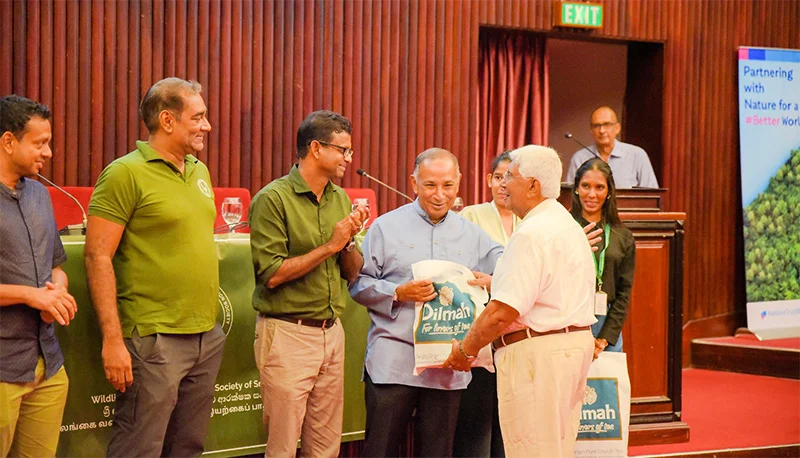
Environmental crises in Sri Lanka are no longer merely conservation issues but constitute an economic and corporate survival challenge that directly threatens the country’s water security, agriculture, exports and long-term business sustainability, speakers at the latest monthly lecture of the Wildlife and Nature Protection Society of Sri Lanka (WNPS) warned on Thursday.
At a time when climate shocks, biodiversity collapse and environmental degradation are beginning to impact supply chains, tourism, food production and investor confidence, the lecture titled “Conservation in Action: Driving Impact – Hill Country to Courtrooms: Science, Community and the Next Generation in Action” highlighted how conservation is increasingly becoming intertwined with economics, corporate governance and national resilience.
Held at the Bandaranaike Memorial International Conference Hall with support from Nations Trust Bank, the event drew leading corporate executives, conservationists, lawyers, architects, researchers and youth leaders.
Corporate leader and conservation advocate Sriyan de Silva Wijeyeratne delivered one of the strongest messages of the evening, stressing that Sri Lanka’s montane ecosystems were effectively the economic backbone of the nation.
“You block up the montane region, we lose our water, our agriculture and our exports, he said.
His remarks reflected a growing global shift where environmental protection is increasingly viewed not as philanthropy, but as a strategic investment linked directly to economic continuity and climate resilience.
Wijeyeratne explained how the WNPS-led “Plant” initiative has rapidly evolved into one of Sri Lanka’s most ambitious privately supported ecological restoration programmes, demonstrating how businesses can move beyond traditional corporate social responsibility into measurable environmental investment.
Within just five years, the initiative has begun restoring around 200 acres of degraded landscapes while establishing approximately 30 kilometres of ecological corridors in the central highlands.
Importantly, he said, the programme was designed not to centralise conservation under a single organisation but to create a scalable model for wider private-sector adoption.
“We are not trying to become the answer. Plant is meant to prove that private-sector-led restoration is possible and that businesses can actively participate in rebuilding ecosystems, he said.
The initiative already involves partnerships with multiple private-sector stakeholders investing in ecological restoration in the hill country — an area critical to tea, hydropower, water resources and downstream agriculture.
One of the clearest examples discussed during the lecture was the growing collaboration between conservationists and Sri Lanka’s architectural and urban planning sectors.
Following discussions initiated at the Geoffrey Bawa Trust, the prestigious Geoffrey Bawa architectural awards were restructured into the “Monamal Award,” recognising projects that integrate biodiversity, ecosystem restoration and environmentally sensitive design.
“This is about redefining what good development means, Wijeyeratne said.
“The future gold standard of architecture must be buildings and landscapes that embrace ecosystems rather than destroy them.”
The lecture also explored how climate change is reshaping social vulnerability and labour resilience — key concerns for businesses operating in agriculture, plantations and rural economies.
Wildlife photographer and conservationist Riaz Cader highlighted another emerging business concern — the growing interaction between wildlife and human-dominated production landscapes.
Supported by LOLC Holdings, the WNPS leopard conservation initiative has established research stations in Belihuloya and Kotagala to study leopards living within tea plantation regions.
Using community-based data collection, camera trap technology and local informer networks, researchers are mapping leopard movement, conflict zones and habitat fragmentation across estate landscapes.
Cader noted that increasing human pressure had altered leopard behaviour significantly.
“We have effectively pushed many of these leopards into nocturnal behaviour because of constant human activity, he said.
The research has major implications for plantation management, land-use planning and biodiversity compliance standards increasingly demanded by global markets and sustainability certification bodies.
Cader also pointed to encouraging signs emerging from restored habitats such as Budunwala, where camera traps recorded a mother leopard and cub moving freely during daylight hours — behaviour rarely observed in heavily disturbed environments.
Researchers have additionally documented elusive rusty-spotted cats and pangolins at restoration sites, reinforcing the ecological value of reconnecting fragmented landscapes.
Beyond biodiversity outcomes, the restoration programmes are generating direct socio-economic benefits.
The lecture further revealed how conservation organisations are increasingly engaging with law enforcement and governance systems to combat environmental crime — another growing risk area with economic implications.
WNPS recently launched a specialised police training programme at the Rodella Hill Club aimed at strengthening enforcement against illegal wildlife trade, snaring and poaching in the hill country.
Speakers warned that organised wildlife crime, habitat destruction and illegal exploitation of natural resources continue to undermine both biodiversity and sustainable economic development.
Questions from the audience also broadened the discussion into marine ecosystems and blue economy concerns, including the lingering environmental and economic fallout from the X-Press Pearl Disaster.
WNPS officials said their marine subcommittee was actively engaged in mangrove restoration, blue carbon ecosystem protection and marine conservation initiatives.
They noted that Sri Lanka’s mangrove restoration efforts had already received international recognition through UN-backed environmental awards.
Throughout the evening, speakers repeatedly stressed that conservation is no longer the exclusive responsibility of scientists or environmental activists.
By Ifham Nizam

Sri Lanka’s apparel exports recorded a softer performance in April 2026, with total exports declining by 4.72% to US$ 328.15 million, compared to US$ 344.40 million in April 2025. The decline was mainly seen across key traditional markets, with exports to the UK down 16.91%, the EU down 8.78%, and the USA down 3.46%. However, the 12.61% growth in other markets during April shows that there is still room to build momentum through greater market diversification.
For the period from January to April 2026, total apparel exports declined by 7.47% to US$ 1.53 billion, reflecting continued pressure across major export destinations. While this performance reflects challenging global demand conditions, it also reinforces the need for Sri Lanka to sharpen its competitiveness, improve cost structures, strengthen market access, and move faster into higher-value opportunities.
JAAF believes the industry’s long-term strength remains intact, but the path forward requires a more focused national effort. To move beyond current export levels and work towards breaking the US$ 5 billion barrier, Sri Lanka must support the sector with policy consistency, energy cost reforms, trade facilitation, skills development, and stronger positioning in both traditional and emerging markets. The apparel industry continues to be one of Sri Lanka’s most important foreign exchange earners, and its ability to recover and grow will be critical to the country’s broader export economy.

Recurring revenues reach 74% of total; Normalized EBITDA margin expands 17 percentage points
hSenid Business Solutions PLC (hSenidBiz) announced its financial results for the fourth quarter and full year ended 31 March 2026, delivering a significant turnaround in operational profitability, materially improving earnings quality, and achieving a key strategic milestone.
In the fourth quarter, total revenue reached LKR 522.2 million, up 5 percent year-on-year (YoY). The PeoplesHR Cloud segment delivered LKR 380 million, representing 20 percent YoY growth in LKR terms and 12 percent growth in USD constant currency terms, with subscription revenues comprising 87 percent of segment revenue. New deal closures recovered strongly to USD 843,395. The Company sustained profitability at the Profit Before Tax (PBT) level with LKR 7 million and a normalized EBITDA margin of 11 percent, while continuing to generate positive free cash flow.
For the full year, the Company delivered a substantial financial turnaround. Revenue grew 13 percent YoY to LKR 2.1 billion. Normalized EBITDA turned positive at LKR 200 million, with the margin expanding 17 percentage points to 10 percent. Profit Before Tax improved by LKR 313 million year-on-year, significantly reducing the loss from LKR 321 million in FY2025 to LKR 8 million. The Company also generated positive free cash flow for the year, a sharp reversal from negative free cash flow in the prior year and an annual improvement of over LKR 350 million. Exit Annualized Recurring Revenue (ARR) reached USD 5.5 million, growing 32 percent YoY, while recurring revenues strengthened to 77 percent of total revenue in the fourth quarter, underscoring the quality and resilience of the Company’s SaaS-led business model.
Dinesh Saparamadu, Founder and Chairman of hSenidBiz, commented: “FY2026 marks a clear inflection point for hSenidBiz. We have materially strengthened the quality and predictability of our revenue base while delivering meaningful operating leverage. These outcomes validate the scalability of our SaaS-led model and position the Company well for the next phase of disciplined, high-quality growth.”
Sampath Jayasundara, Chief Executive Officer, added: “The operational momentum achieved in FY2026 provides a strong foundation as we enter the next phase of growth. Our priorities for FY2027 are to accelerate customer acquisition in key markets, drive execution excellence across the sales organisation, and rapidly advance our AI-driven capabilities, particularly through Lexi Insights to deliver even greater value to enterprise customers across our markets.”

Patidar leads the way as Royal Challengers Bengaluru storm into second straight final

Kandy Royals sign Vijay Shankar for LPL 2026

Cabinet approves sale of Paddy stocks held by the Paddy Marketing Board
Amendment to the Promotion of Export Agriculture Act, No. 46 of 1992 to be gazatted
Ms. M.K.D.N. Madampe, appointed as Director General of the Department of Management Services

Cabinet approves collaboration agreement between Sri Lanka and Brazil for the implementation of the “Sugarcane Project in Sri Lanka”

‘Dates have the highest sugar content to fight Coronavirus’

Sunday Island 27 December – Headlines

#SundayIsland 17th December – Headlines

Sunday Island – 28th March

Sunday Island Headlines – 21 March

Sunday Island – 21st February – Headlines
-

 Features7 days ago
Octopus, Leech, and Snake: How Sri Lanka’s banks feast while the nation starves
-

 Sports7 days ago
Sri Lanka women’s volleyball team ready for Central Asian challenge
-
 Opinion6 days ago
Murder of Ehelepola family, Bogambara Wewa and Sightings of Wangediya
-

 Business5 days ago
Historic launch of CCWE Fashion Week & International Summit 2026
-
 News6 days ago
Steps underway to safeguard Sri Lanka’s maritime heritage
-

 News2 days ago
Police probe underway to ascertain links between criminals deported from UAE and local politicians
-

 Features3 days ago
The NPP’s pivot to the past
-

 News3 days ago
All-New GRAVITE launches at LKR 6.99 Mn