
Business
Debt restructuring talks with Ad Hoc Group of Bondholders back on track, thanks to IMF


By Sanath Nanayakkare
State Minister of Finance Shehan Semasinghe said on Saturday that the government is confident about the successful progression of debt restructuring talks with Sri Lanka’s private bondholders.The state minister’s comments on the matter followed recent reports which indicated that the IMF was currently assessing the latest proposal of the Ad Hoc Group of Bondholders whose earlier proposal was not accepted by the Sri Lankan authorities.
According to a report released by First Capital Research, Sri Lanka rejected international bondholders’ proposal on 15th April 2024 to restructure more than USD 12 billion in debt. Despite ‘constructive discussions’ with the Steering Committee members of the Ad Hoc Group of Bondholders and the two sides could not reach agreement on restructuring terms.
Some of the proposal’s ‘baseline’ assessments and a lack of a contingency option in the case of continued economic weakness were the two main reasons the deal was not agreed.
The negotiations primarily focused on the bondholders’ proposal, particularly concerning the introduction of a Macro-Linked Bond (MLB).
The March proposal suggested a 20% haircut on the nominal amount of existing bonds and the April proposal increased the haircut to 28% with no haircuts on Public Debt Interests (PDIs) in both March and April proposals.
However, significant disparities arose regarding baseline parameters, risk balance, trigger tests, and the allocation of additional value in various MLB scenarios. Following discussions, the bondholders revised their proposal in April 2024 to address some of the government’s concerns.
The IMF is currently assessing the latest proposal of the Ad Hoc Group of bondholders. Also, Sri Lanka has recommenced discussions with bondholders and is optimistic on achieving a resolution regarding debt restructuring by June 2024, the report by First Capital Research stated.
State Minister Semasinghe’s comments affirmed the above backdoor details when he said,” The Paris Club and our bilateral creditors have already given their consent to restructure our debt. Meanwhile, we are confident that we can arrive at an agreement with the Ad Hoc Private Bondholders group as the second round of discussions with them is about to commence. A problematic situation in this regard won’t arise because we are being transparent with all our debt holders in how we are proposing to restructure each category of debt. Also, this procedure is embedded with another key element. That is; the finally agreed upon debt restructuring terms won’t lead to the necessity of a second round of debt restructuring in the future. We treat this as very important.”
“It has only been 18 months since Sri Lanka has achieved a semblance of stability after the economy came to a grinding halt. The economic theory put forward by the Opposition boils down to one single fact. They want the government to print money and balance the budget deficit. Their views point to the requirement of changing laws of the new Central Bank Act and reverting to money printing. Sri Lanka has already experienced the consequences of money printing in the past two years with its debilitating impact on inflation, the value of Sri Lanka rupee, the exchange rate and so on. The new CBSL Act was introduced to avoid falling into that pitfall again. So, whatever arguments the Opposition would make, the government won’t agree to money printing under whatever circumstances,” he stated.
Meanwhile, Sri Lanka gross official reserves stood at US$ 5,438 mn as at end April 2024. This includes proceeds from the People’s Bank of China (PBOC) swap arrangement worth US$ 1,400 million, which is subject to conditionalities on usability. This would mean that the country now has usable foreign reserves of US$ 4,038. This number stood at a mere US$ 20 million in mid-April 2022.











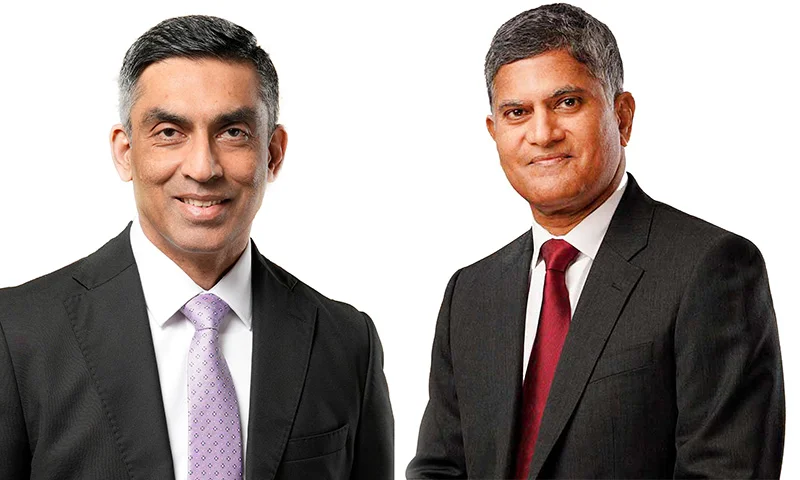
National Development Bank PLC (hereinafter ‘the Bank’) announced its results for the financial year ended December 31, 2025 to the Colombo Stock Exchange recently. Full year results tabled by the Bank showcase a strong growth across all business lines with Net Banking Revenue increasing by a 45.2% on a comparable basis.
Like most other peers, the Bank’s 2024 financial performance was positively impacted following the successful conclusion of the ISB debt restructure with a one-off impact on interest income, fee income and net impairments amounting to LKR 1.4 billion, LKR 0.7 billion and LKR 9.4 billion, respectively for the said year.
Fund based income
Net interest income (NII), which accounts for close to 75.0% of Bank’s total operating income, grew by 6.5% on a normalised basis. Despite pressure on interest-earning assets arising from the lower interest rate environment, the Bank’s disciplined margin management helped stabilise Net Interest Margin (NIM) at 4.0% for the year. On a comparable basis, excluding one-off exceptional items, NIM stood at 4.2%, compared to 4.3% for both scenarios in 2024. By the end of the year, the Bank had close to LKR 29.3 billion in Loans and Deposits under a special arrangement with its customer(s) with a netting-off feature (end 2024: LKR 19.6 billion).
Non-fund based income
Net fee and commission income reached LKR 8.1 billion for the year – representing a growth of 14.3% from LKR 7.1 billion in 2024 excluding ISB restructuring related fees. Key growth drivers for the current year were trade finance, credit and lending, digital banking and credit and debit cards.
Credit and operating costs
Credit costs for the year amounted to LKR 5.7 billion, reflecting a substantial reduction of 57.1% compared to LKR 13.2 billion in 2024, a testament to the Bank’s strong credit underwriting practices and focused efforts on collections and recoveries. The Bank’s success on account of the latter is best reflected in notably improved stage 2 and 3 loan stock which stood at 7.9% and 10.8% respectively at end 2025 as compared with 16.6% and 14.0% at end 2024. Stage 3 provision coverage also saw further improvement to 59.1% from 54.5% during 2024 showcasing the Bank’s prudent management of credit risk.
Operating expenses closed at LKR 19.0 billion for the year, marking a 13.1% YoY increase. This increase was primarily driven by routine staff-related increments and necessary market realignments, along with higher investments in IT infrastructure and business development undertaken during the year.(NDB)

PMF Finance PLC has announced the appointment of Ms. Nishani Perera as a Non-Executive Independent Director, further strengthening the Company’s strategic oversight, governance framework, and board-level expertise as it continues to advance its transformation and long-term growth agenda.
Ms. Perera is a Fellow Member of the Institute of Chartered Accountants of Sri Lanka and brings over 19 years of experience across audit, assurance, advisory, risk management, and corporate governance. She currently serves as Partner – Audit & Assurance at Moore Aiyar and as Director of Moore Consulting (Pvt) Ltd.
Over the course of her career, Ms. Perera has gained substantial exposure to listed companies, banks, finance companies, and other regulated entities. Her areas of expertise include financial reporting under SLFRS/LKAS, audit and risk oversight, regulatory compliance, and the implementation of quality management standards. She has worked closely with Boards of Directors and Audit Committees on matters relating to financial reporting integrity, internal control frameworks, enterprise risk governance, and adherence to evolving regulatory requirements.
Ms. Perera holds a Master of Laws (LL.M.) from Cardiff Metropolitan University in the United Kingdom and a Bachelor of Science in Business Administration (Special) from the University of Sri Jayewardenepura. She is also an Associate Member of ACCA and CMA Sri Lanka, and a Fellow Member of AAT Sri Lanka.
Business
Capital Alliance deepens capital market presence with third Closed-End Fund Listing at the CSE

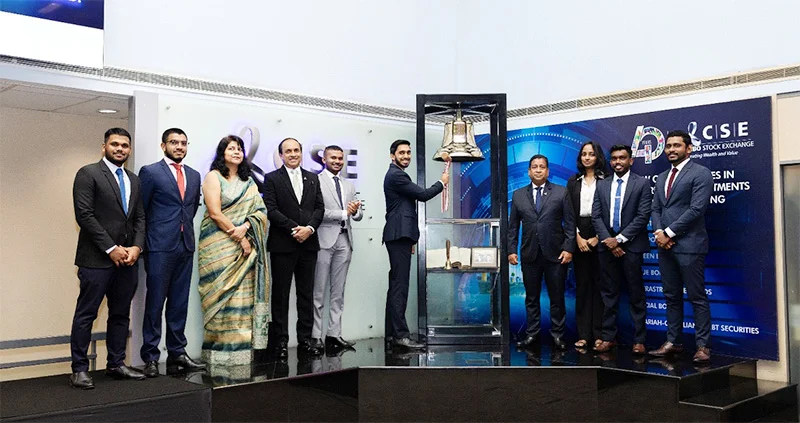
The units of the “CAL Three Year Closed End Fund” were officially listed on the Colombo Stock Exchange (CSE) recently. Accordingly, a total of 841,263,375 units of the ‘CAL Three Year Closed End Fund’ were listed by Capital Alliance Investments Ltd (CALI), a member of the Capital Alliance Ltd Group (CAL Group). The listing was commemorated by way of a special bell ringing ceremony on the CSE trading floor.
CSE CEO Rajeeva Bandaranaike speaking at the occasion remarked upon the rising demand for Unit Trusts: “When you look at funds, particularly unit trusts in today’s active capital market, we see a lot of domestic interest in the market with more investors entering. Funds, not only fixed income funds but also growth and balanced funds, can be the ideal vehicle through which new investors can enter the market. We see this interest reflected in the success of CAL’s Three Year Closed End Fund. More people are seeking to invest their money through professional fund managers.”

US and Iran hold talks seen as crucial to prevent conflict

Zimbabwe opt to bowl, include Maposa; Samson, Axar back for India

Markram, bowlers lead South Africa’s rout of West Indies

Samra, Airee headline Associates’ team of the tournament

Maharoof expects ‘some hard decisions’ after Sri Lanka’s T20 World Cup exit

Matthews’ century leads West Indies to six-wicket victory

‘Dates have the highest sugar content to fight Coronavirus’

Sunday Island 27 December – Headlines

#SundayIsland 17th December – Headlines

Sunday Island – 28th March

Sunday Island Headlines – 21 March

Sunday Island – 21st February – Headlines
-

 Features5 days ago
Why does the state threaten Its people with yet another anti-terror law?
-
 Features5 days ago
Reconciliation, Mood of the Nation and the NPP Government
-

 Features5 days ago
Victor Melder turns 90: Railwayman and bibliophile extraordinary
-

 Features4 days ago
LOVEABLE BUT LETHAL: When four-legged stars remind us of a silent killer
-
 Features5 days ago
Victor, the Friend of the Foreign Press
-

 Latest News6 days ago
New Zealand meet familiar opponents Pakistan at spin-friendly Premadasa
-

 Latest News6 days ago
Tariffs ruling is major blow to Trump’s second-term agenda
-

 Latest News6 days ago
ECB push back at Pakistan ‘shadow-ban’ reports ahead of Hundred auction