
Business
Credit Suisse share crisis sends tremors across global financial sector

By Hiran H. Senewiratne
The global financial sector is facing uncertainty with the slashing of shares of one of the largest banks in the world, Credit Suisse, this week, market analysts said.The Swiss Central Bank said it was ready to provide financial support to Credit Suisse, the beleaguered megabank, hoping to reassure investors that it had the necessary cash to stay afloat.
“This additional liquidity would support Credit Suisse’s core businesses as we take the necessary steps to create a simpler and more focused bank built around client needs, the bank said in a statement.
In addition to loans from the Central Bank, Credit Suisse said it repurchased billions of dollars of its own debt to manage its liabilities and interest payment expenses. The offer covers US $2.5 billion of US dollar bonds and €500 million ($529 million) of euro bonds.
This week Silicon Valley Bank, the 16th largest bank in America, the bank of choice for tech startups, also collapsed. This impacted the global banking sector, stock market analysts said.
Amid those developments both indices moved upwards. The All- Share Price Index went up by 8.76 points and S and P SL20 rose by 2.8 points. Turnover stood at Rs 1.2 billion without any crossings.
In the retail market top seven companies that mainly contributed to the turnover were; JKH Rs 124 million (862,000 shares traded), Dialog Rs 86.5 million (8.1 million shares traded), Hayleys Rs 69.1 million (865,000 shares traded), Expolanka Holdings Rs 63.3 million (435,000 shares traded), Access Engineering Rs 61.3 million (four million shares traded), Lanka Tiles Rs 51.3 million (947,000 shares traded) and Browns Investments Rs 45.7 million (7.1 million shares traded). During the day, 71.7 million share volumes changed hands in 17000 transactions.
The rupee closed around Rs 339 to the US dollar yesterday. Business was done at Rs 340 in spot and Rs. 337 to the dollar in the cash market, dealers said. Commercial banks were buying dollar telegraphic transfers at Rs. 335 and selling at Rs. 355.


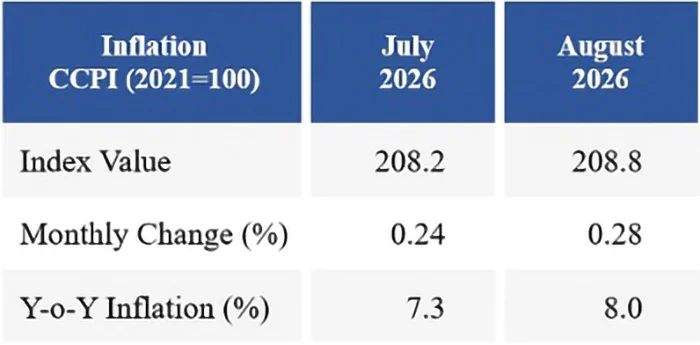
The Colombo Consumer Price Index (CCPI, 2021=100) based headline inflation (year-on-year, Y-o-Y) increased to 8.0% in August 2026 from 7.3% in July 2026, primarily due to the statistical base effect in food inflation. Meanwhile, food inflation (Y-o-Y) increased to 8.5% in August 2026 from 6.3% in July 2026, contributing mainly to the increase in headline inflation, while non-food inflation (Y-o-Y) decelerated to 7.7% in August 2026 from 7.8% in July 2026.
On a month-on-month basis, the CCPI increased by 0.28% in August 2026. This increase was mainly driven by the food category, which contributed 0.20 percentage point, largely owing to the increase in prices of Milk Powder, while the non-food category contributed a marginal 0.07 percentage point.
Meanwhile, core inflation (Y-o-Y) accelerated to 5.1% in August 2026 from 4.4% in July 2026.
According to the inflation projections made at the monetary policy round in July 2026, headline inflation is expected to remain above the target of 5% in the near term, before easing and stabilising around the target over the medium term, supported by appropriate policy measures. These projections are conditional, among other assumptions, on the expectation that the effects of the tensions in the Middle East and their spillovers will be temporary and gradually dissipate.

By Ifham Nizam
‘We cannot really talk about a resilient blue economy, we cannot really talk about a regenerative blue economy if we do not set the stage for regeneration and the maintenance of these ecosystem services.’
Prof. Terney Pradeep Kumara, Director General of the Coast Conservation and Coastal Resource Management Department, issued this cautionary message as experts from the government, financial, tourism, aquaculture and conservation sectors called for a fundamental rethink of how the country exploits its vast marine resources.
He made the remarks at a high-level panel discussion on ‘The Next Wave of Blue Growth: Private Sector Entry Points for Productive Investment, Conservation, CSR and Blue Finance’, held during ‘Biodiversity Sri Lanka’s Biodiversity Action Forum 2026’ at the Shangri-La, Colombo recently.
Kumara said the natural ecosystems underpinning the blue economy must be treated as the country’s productive infrastructure, rather than as resources that can be endlessly exploited.
The country’s more than 1,350-kilometre coastline and vast Exclusive Economic Zone encompass a remarkable mosaic of mangroves, mudflats, lagoons, sandy and rocky shores, coral reefs and seagrass ecosystems, he said.
‘These different ecosystems, with their unique service provision, are providing the infrastructure for blue growth, Kumara said, questioning whether the country was adequately protecting and maintaining that infrastructure.
He stressed that a genuinely regenerative blue economy could not be built by concentrating only on individual marine protected areas.
‘What we have are landscapes, reefscapes or seascapes where mosaics of ecosystems are interlinked together with the socio-economics of our own systems, he said.
Marine protected areas should therefore serve as cornerstones, while marine spatial planning and wider seascape management must determine how conservation, industry, fisheries, tourism and other activities can coexist.
Sivalingam Sivakanthan, Head of MIS, Strategic Planning and Sustainability at DFCC Bank, said the bank’s issuance of Sri Lanka’s first-ever blue bond in 2025, raising nearly Rs. 3 billion (USD 10 million), demonstrated that investors were willing to put money into sustainable marine and coastal initiatives.
But he warned that simply raising capital was not enough.
‘We don’t want to consider it merely as an instrument for finance. Instead, we want to essentially set the stage for something which is credible, Sivakanthan said.
A credible blue finance framework, he explained, requires a clear definition of eligible projects, a strong pipeline of investable initiatives, robust governance and, critically, the ability to demonstrate measurable environmental and social impacts.
Entrepreneur Shan Meemanage offered perhaps the clearest illustration of how conservation and commercial interests could converge.
‘I was not thinking anything about sustainability. All I was thinking was profits. That’s private sector, right? he told the forum.
He described how his company developed hatchery production, stocked reservoirs and established buy-back arrangements with fishermen, eventually expanding the model to more than 100 reservoirs.
The tourism sector, too, has substantial room to diversify its relationship with the ocean, said Harshini de Silva Pandithasekaran, Head of Sustainability at Aitken Spence Hotels.
She said the industry remained heavily dependent on the conventional “sun, sea and sand” tourism model despite the extraordinary diversity of Sri Lanka’s coastal landscapes and marine ecosystems.
Pandithasekaran noted that international visitors often appreciated the geographical and ecological character of destinations — including bays, coastal formations and other natural features — providing opportunities to develop more diversified and nature-based tourism experiences.
From CSR to long-term conservation partnerships
Moderated by Dr. Sandun Perera, Programme Coordinator of IUCN Sri Lanka and Director of Biodiversity Sri Lanka, the session sought to move the conversation beyond conventional corporate social responsibility towards long-term conservation partnerships that deliver measurable outcomes.

By Hiran H. Senewiratne
The CSE’s benchmark All Share Price Index moved down 0.08 percent yesterday due to selling pressure, marking an uneventful start to September.
The ASPI was down 20.38 points while the more liquid S&P SL20 was down 0.34 percent, or 20.36 points.
Market turnover was Rs 2.32 billion with five crossings but Food, Beverage & Tobacco led turnover with Rs 400.53 million. Those crossings were: JKH 20.7 million shares crossed to the tune of Rs 408 million; its shares traded at Rs 19.70, Watawala Plantations one million shares crossed to the tune of Rs 42.5 million; its shares traded at Rs 42.50, Sampath Bank 200,000 shares crossed for Rs 28 million; its shares traded at Rs 138.50, Three Acre Farm 42000 shares crossed for Rs 26 million; its shares sold at Rs 620 and CCS 170,000 shares crossed for Rs 20 million; its shares traded at Rs 120.50.
In the retail market companies that mainly contributed to the turnover were; Dialog Axiata Rs 245 million (5.3 million shares traded), JKH Rs 157 million (8 million shares traded), Commercial Credit and Finance Rs 146 million (1.3 million shares traded), CCS Rs 136 million (1.1 million shares traded), Asia Siyaka Rs 86 million (5.8 million shares traded), Brown’s Investments Rs 74 million (13 million shares traded) and Haycarb Rs 65 million (334,000 shares traded). During the day 97 million share volumes changed hands in 17683 transactions.
Positive contributors to the ASPI were; Browns Investments (up 7.55 percent at Rs 5.70), Vallibel One (up 2.03 percent at Rs 90.30), Singer (Sri Lanka) (up 2.78 percent at Rs 81.20 ), Access Engineering (up 0.94 percent at Rs 75.10 ) and Ceylon Cold Stores (up 1.25 percent at Rs 121.75).
JKH (down 2.01 percent at Rs 19.50 ), DFCC Bank (down 1.76 percent at Rs 125.75 ), Dialog Axiata (down 0.86 percent at Rs 46.00), and Aitken Spence (down 1.41 percent at Rs 140.00) were top negative contributors.
It is said that manufacturing sector counters, especially JKH and plantations related sectors, especially Watawela Plantations, Asian Siyaka and Tree Acres farms performed well at the floor.
Meanwhile, Kapruka Holdings disclosed a proposed variation in the application of its IPO funds.
The company’s management concluded that launching a personal cargo market place was not commercially viable and recommended reallocating Rs 50 million of unutilized IPO proceeds toward working capital requirements, subject to shareholder approval at the upcoming AGM.
Kapruka Holdings shares closed up 1.07 percent at Rs 18.90.
Renuka Holdings announced a first and final scrip dividend of Rs 0.212 per voting and non-voting share for the financial year ended March 31, 2026, subject to shareholder approval at its Annual General Meeting on September 24, 2026.Renuka Holdings shares were trading down 6.84 percent at Rs 42.20.
Yesterday the rupee was quoted at Rs 327.90/328.05 to the US dollar in the spot market, stronger from Rs 328.10/30 the previous day, while bond yields were down particularly on the belly end of the actively quoted tenors, dealers said.

CCPI-based headline inflation accelerates in August 2026

The ‘Ice’ Avalanche

SSP Amarasinghe new Director CID

Experts urge business to turn blue growth into conservation-driven investment

Pillayan others further remanded

ASPI in noted dip after Monday’s climb

‘Dates have the highest sugar content to fight Coronavirus’

Sunday Island 27 December – Headlines

#SundayIsland 17th December – Headlines

Sunday Island – 28th March

Sunday Island Headlines – 21 March

Sunday Island – 21st February – Headlines
-

 News5 days ago
Eight politicians in drug kingpin probe
-

 Features3 days ago
“Wrap Me Up in My Blazer”— A Gentlemanly Bradby Reminiscence
-

 Business5 days ago
Sri Lanka opens up: A new season of direct connectivity
-

 Features5 days ago
Redefining ageing in Sri Lanka
-

 Latest News6 days ago
Nepal-Tibet floods: What happened, what caused them and who is missing?
-

 Editorial7 days ago
Warning of power cuts: El Niño and corruption
-

 Features7 days ago
Export diversification: Missing the wood for the trees – Part I
-
Editorial6 days ago
Unfolding El Niño and burning issues