

Connect with us

News

Country fast running out of dons to keep universities ticking

Published

on

By Rathindra Kuruwita

Sri Lankan universities need about 11,900 academics to function optimally, but, however, only 6,300 lecturers were available by the beginning of the year, Prof. Barana Jayawardana, Department of Animal Science, University of Peradeniya, and the head of the Federation of University Teachers Associations (FUTA), said.

Prof. Jayawardena added that the number could be as low as 5,900 now, given the exodus of lecturers during the past few months.

In 2017, there were about 30,000 students in state universities. By 2022, the number has increased to about 43,000. This is about a 50 percent increase in the student population, he said.

“However, the number of lecturers have reduced. Usually, we take in students who have a first or second upper class as probationary lecturers. They must get their postgraduate degree within eight years and to be made a senior lecturer at a university. Those who complete PhDs at top universities often leave the country. These are people between the ages of 35 and 40, and they become demotivated because of the status of the country, the opportunity cost, and the high taxes that have made life hard here,” he said.

Professor Jayawardana added that probationary lecturers, who have had opportunities to leave the country for higher education, are also leaving in large numbers. They often resign from their jobs at the university and leave.

“To retain the job, while they study abroad, the probationary lecturers have to sign a bond with the university. You need two guarantors for the bond, too. This has become a large bond because of the devaluation of the rupee, and it is hard to find people to be guarantors. The bond can range from five to 10 million. So the probationary lecturers forget about retaining the job, quit, and leave,” he said.


Continue Reading
Advertisement
Click to comment

Leave a Reply

Your email address will not be published. Required fields are marked *

News

Legal avenues explored to bring back Mahendran, aka Harjan Alexander

Published

on

Authorities are examining available legal avenues to bring former Central Bank Governor Arjuna Mahendran back to Sri Lanka after efforts to extradite him from Singapore encountered a legal barrier, Public Security Minister Ananda Wijepala has said.

Speaking during a television programme earlier this week, Wijepala said Mahendran, who is now a Singapore citizen, was residing in Singapore and had changed his name.

“There is a legal barrier in extraditing him to this country,” the Minister said, adding that authorities were exploring other available legal avenues.

Proceedings relating to the Central Bank bond case were continuing, Wijepala said.

According to information received by the Criminal Investigation Department (CID), Mahendran changed his name to Harjan Alexander after the CID sought an Interpol Red Notice for his arrest.

Singapore had previously rejected Sri Lanka’s extradition request for Mahendran, stating that the request did not meet the legal requirements under Singapore’s Extradition Act.

Mahendran, who served as Central Bank Governor from January 2015 to June 2016, is wanted in connection with legal proceedings arising from the Central Bank bond transactions. He was indicted in June 2019 before the Permanent High Court at Bar for allegedly causing losses of more than US$11 million to the State.

Wijepala also said authorities had secured 236 Interpol Red Notices in efforts to bring wanted suspects back to Sri Lanka. Of these, 110 had been obtained since the present Government assumed office.

He said 66 wanted individuals had been brought back to Sri Lanka, while investigations into another 97 were continuing. The whereabouts of 39 individuals had been identified, he added.

One more wanted suspect was expected to be brought back to Sri Lanka next week, the Minister said.

Continue Reading

News

Vijita Fernando, literary personality, dies months short of her 100th birthday

Published

on

Vijita Fernando

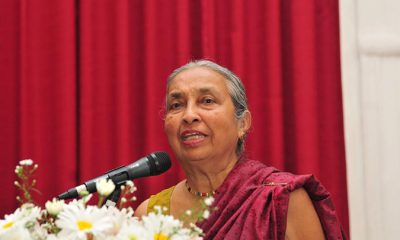
The death occurred on Thursday of Vijita Fernando, well known author and journalist, a few months short of her 100th birth anniversary. Her funeral was held at the General Cemetery, Colombo, on Saturday.

Born in Hikkaduwa in 1926, she at the time of her death was probably the oldest living graduate of the University of Ceylon.

One of the country’s most accomplished literary personalities, she long served as feature writer, women’s and children’s page editor as well as leader writer of the then Ceylon Daily News, won numerous State Literary Awards, the Gratiaen Prize in 2002 for her translation of creative Sinhala fiction into English and had a short story broadcast over the BBC World Service (including a Spanish translation on the Latin American Service). Several of her short stories were published abroad.

Her publications included a novel, Somewhere, in 2013 and two collections of short stories. She was one of finest translators from Sinhala to English of her generation and was the youngest sister of Mr. M. Chandrasoma, well known Civil Servant of yesteryear.

The wife on the late Bonnie Fernando, also a Lake House journalist, she leaves three daughters.

Continue Reading

News

How India changed Sri Lanka’s IMF story: Former FM reveals Sitharaman’s behind the scenes role

Published

on

Former Finance Minister Ali Sabry. Photograph: (AFP)

(WION) Former Finance Minister Ali Sabry has credited Indian Finance Minister Nirmala Sitharaman with turning the tide in Colombo’s favour during a crucial meeting with International Monetary Fund (IMF) representatives over Sri Lanka’s economic crisis.

Speaking about the negotiations that led to Sri Lanka’s IMF programme, Sabry said India’s support went beyond diplomatic goodwill. Sri Lanka was facing severe economic problems at the time, including foreign exchange shortages, high inflation and shortages of fuel and medicines.

India was among the first countries to provide emergency financial support to Sri Lanka during the 2022 crisis. It extended billions of dollars in credit lines to help the country meet essential import needs. Sabry said India’s early support sent a strong message to the international community about Colombo’s ability to pursue an economic recovery.

Sabry said he faced a difficult response when he travelled to Washington for discussions with IMF officials. He said the organisation’s regional directors remained doubtful about Sri Lanka’s ability to secure support.

“When I went to Washington, I had a meeting with the regional directors, and they were very negative about Sri Lanka. They said 16 times this has happened. I was disappointed. You know, for the first time, we are trying to tell different things. They were not willing to listen. I thought they lacked empathy,” he said.

Sabry was scheduled to meet IMF Managing Director Kristalina Georgieva and IMF Deputy Managing Director Gita Gopinath at 03.00 pm. Before that meeting, he met Sitharaman for lunch.

Sabry said he told Sitharaman that his discussions with IMF officials had not gone well. He said she then assured him that she would speak to Georgieva before his meeting.

“In between this meeting, something happened. I had lunch with Nirmala Sitharaman. She asked me, Minister, how did the meeting go? I said, not that great. I said they were kind of reluctant and had a lot of issues. She said Don’t worry, I will meet Kristalina Georgieva before you. I will put a word,” he said.

Sabry said the atmosphere changed significantly when he later met the IMF leadership.

“When I went for the meeting with the IMF Managing Director, which is one of the most crucial meetings for me, the tone, the approach, the environment, everything had changed. Kristalina Georgieva told me that she had just finished a meeting with Nirmala Sitharaman, and 70-80% of the meeting was not about India, but Sri Lanka, he said.

Sabry said the episode became an important foundation for Sri Lanka’s economic recovery.

Continue Reading

Trending