
News
COP27: Russian invasion of Ukraine released 8 mn MT of carbon till September – report

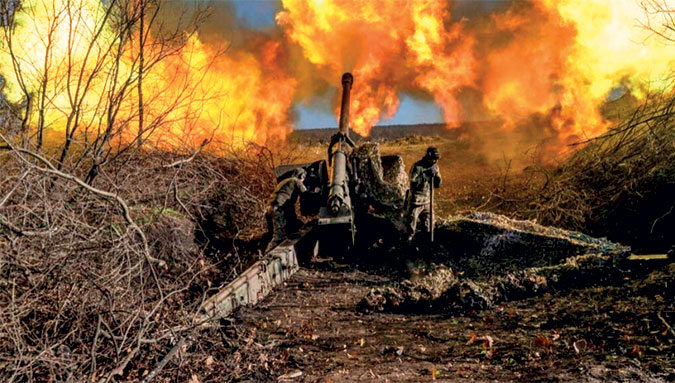
At least eight million tonnes carbon dioxide (CO2) equivalent have been emitted from February to September this year as a result of the Russian invasion of Ukraine, that started on February 24, 2022, a team of researchers announced at Sharm El-Sheikh November 9, 2022.The greenhouse gas impact of reconstruction efforts in the war-ravaged country is in the range of 48.7 million tonnes of carbon emissions equivalent, according to The Initiative of GHG Accounting of War.
The team consists of internationally renowned experts from various institutions and Ukrainians. It is led by Lennard De Klerk, a leading expert in greenhouse gas (GHG) accounting.The team presented its findings regarding GHG emissions released from military operations as a report during a side event, titled Dealing with military and conflict-related emissions under the UNFCCC.The report was released at a side event during the ongoing 27th Conference of Parties (COP27) to the United Nations Framework Convention on Climate Change (UNFCCC).
The GHG emissions were quantified in four areas: Movement of warfare, fires, movement of refugees, and civilian infrastructure.Climate policy and carbon expert Olga Gassan-zade, a representative of the initiative said: “We made a detailed analysis to the extent we possibly can of the GHG impact of the war and military action itself. This included troop movements, fuel consumption, and military aircraft and also impact of explosives and ammunition in Ukraine.”
At least 6,215 fires spread over a total area of 486,162 hectares were caused by the ammunition and bombs during the seven months of the study period or the first 214 days of the war.
The total number of fires increased by 112 times on 38 times the total area compared to the same period in 2021. Gassan-zade said: “In total, we estimate fires directly caused by military action accounted for 23 million tonnes of CO2 equivalent.”
At least 1.4 million tonnes of GHG emissions have been released due to the movement of refugees, both within Ukraine and to Europe, the findings said.
Damaged forests
A representative of the Ministry of Environmental Protection and Natural Resources of Ukraine said from February 24 onward, 224,956 explosive devices were fired by Russian troops. Some 2,130 aircraft bombs were neutralised and phosphorous shells banned by international law were regularly unleashed on Ukraine.This led to unprecedented amounts of air pollution, which translates to monetary losses amounting to 24.6 billion Euros in Ukraine, she said.The war caused widespread damage to forests in Ukraine; 450,000 hectares of forestland are occupied by troops and are considered to be part of the hostilities zone. Currently, 10 national parks, eight national reserves, and two biosphere reserves are under occupation too.
Some 2.9 million hectares of Emerald Network sites are under threat of destruction. The Emerald Network is an ecological network to conserve natural habitats and their biodiversity in Europe.Sixteen of Ukraine’s 50 Ramsar Sites, or wetlands of international importance, and 20 per cent of all protected areas are under threat, the official said in her brief. She added that permanent damage to Ukraine’s soil amounted to 11.4 billion Euros in losses.
However, 2.45 million hectares of forest and 27 forestry enterprises have been liberated from occupation, and need to be restored.The war also caused damage to 497 water management facilities in Ukraine. According to a World Bank assessment, it would cost 7.71 billion Euros for the restoration of irrigation, drainage, and hydro-technical structures over a 10-year period.Gassan-zade said: “Besides the humanitarian impact of war, little has been known about the environmental impact of the war. This is the first assessment so far and we will be continuously updating it till the war ends.”
“So far national accounting allows exclusion of military emissions due to confidentiality rules and significant parts of military emissions relate to international bunker (transport) fuels that are not covered by the Paris Agreement,” Axel Michaelowa, senior founding partner of the Perspectives Climate Group said.
“We would suggest that reporting for military and conflict-related emissions under the Paris Agreement be urgently included under the global stocktake for COP28, national inventory guidelines of the IPCC, and as a section for the 7th IPCC Assessment Report,” Michaelowa added. – Down to Earth


The Italian Naval Vessel ‘ITS Giuseppe Garibaldi’ departed the Port of Colombo today, 12 September 2026, after completing a replenishment stop for logistics and services.
During the ship’s stay, the Commanding Officer of ITS Giuseppe Garibaldi, Captain Marco GUERRIERO, called on the Commander Western Naval Area, Rear Admiral Harsha De Silva, at the Western Naval Command Headquarters.
Members of the visiting crew also toured several tourist attractions across the Colombo area during their port call.
News
Green Climate Fund (GCF) Regional Dialogue for East and South Asia will be held from 14 to 17 September 2026 at Cinnamon Life at City of Dreams Hotel, Colombo


The Green Climate Fund (GCF) Regional Dialogue for Eastern and Southern Asia is scheduled to be held from September 14 to 17, 2026, at Cinnamon Life at City of Dreams, Colombo.
The Dialogue is hosted by the Government of Sri Lanka. The Green Climate Fund is the world’s largest dedicated climate fund established under the United Nations Framework Convention on Climate Change to assist developing countries in responding to the challenges of climate change.
The Green Climate Fund aims to promote a paradigm shift towards low-emission and climate-resilient development
pathways by supporting developing countries in reducing their greenhouse gas emissions and adapting to the impacts of climate change.
The Ministry of Environment of Sri Lanka serves as the country’s National Designated Authority for the Green Climate Fund, playing a critical role in coordinating access to climate finance, nominating institutions for accreditation to the Green Climate Fund and approving funding proposals, and ensuring that activities supported by the Green Climate Fund are aligned with national development objectives.
More than 120 delegates from 10 countries are expected to participate. The participating countries are Bangladesh, Bhutan, China, India, the Maldives, Mongolia, Nepal, Pakistan, the Republic of Korea, and Sri Lanka.
Participants will include representatives of National Designated Authorities of the above countries, Direct Access Entities, Accredited Entities, civil society organizations, the private sector, development partners, and technical institutions across the region.
Sri Lanka’s delegation comprises Dr. Dammika Patabendi, Minister of Environment, Anton Jayakody, Deputy Minister of Environment, K.R. Uduwawala, Secretary, Ministry of Environment, and high-level government officials.
The Dialogue will provide a platform to:
Share challenges, experiences, and lessons learned from the implementation of climate change projects and programmes.
Strengthen regional cooperation and partnerships on climate finance.
Discuss the Green Climate Fund’s evolving strategies, policies, and approaches.
Identify opportunities to accelerate climate investments across East and South Asia.
Hosting the Regional Dialogue in Colombo will provide Sri Lanka with an important opportunity to engage with senior government officials, private-sector representatives, development partners, technical experts, and international climate finance institutions.
The event is expected to support Sri Lanka’s efforts to improve access to climate finance and international grants, showcase national climate action initiatives and achievements, and strengthen the country’s engagement with the global climate community.
The Dialogue will also offer a strategic platform for Sri Lankan institutions that have applied for direct accreditation to present their project concepts and engage directly with representatives of the Green Climate Fund. These engagements are expected to support the accreditation process and contribute to the expansion of Sri Lanka’s network of Direct Access Entities through stronger regional partnerships and increased cooperation on climate finance, the Regional Dialogue will
contribute to positioning Sri Lanka as a credible and reliable partner for climate investment.
Projects that Sri Lanka has received funding from this fund are:
• The main projects that Sri Lanka has received support from the Green Climate Fund at present include the Wevu Gam Pubuduwa Project (52.1 USD Million) and the GCF Knuckles Project (49 USD Million).
7.5 USD Million has been allocated from GCF for 5 National Designated Authority Readiness Projects (NDA Readiness Projects) and for the National Adaptation Plan Readiness Project (NAP Readiness Project).
Approval has also been obtained for 3 regional projects. (Cooling Facility Programme, Global Fund for Coral Reef Investment Window, PEEB COOL Programme)
Sri Lanka has also identified 5 project concepts as priority projects for the Green Climate Fund period 2024-2027 and has taken steps to submit those project concepts (Concept Notes) for
approval by the Green Climate Fund.
The “Climate-resilient Fisheries in Sri Lanka” project concept (USD 107.5 million) submitted by DFCC Bank has already received approval.

Former Minister and People’s Joint Opposition Convener Prof. G.L. Peiris has challenged the assertion that the Supreme Court’s determination on the 22nd Amendment to the Constitution would be based solely on law and not Buddhist teachings, arguing that such a position is inconsistent with Article 9 of the Constitution and established judicial precedent.
In a special statement, titled “Buddhist Doctrine as a Source of Law in Sri Lanka”, Prof. Peiris has said the issue had arisen during the 22nd Amendment determination proceedings when Ven. Balangoda Kassapa referred to the Buddha Dhamma in his submissions.
According to Prof. Peiris, the Chief Justice responded that the determination would be made on the basis of the law and not Buddhist teachings.
Describing this as a “cavalier dismissal” of the Buddha Dhamma. Prof. Peiris has said it is contrary to Article 9, which gives Buddhism the foremost place and requires the State to protect and foster the Buddha Sasana.
Full text of the statement: In the 22nd Amendment determination proceedings, Venerable Balangoda Kassapa, in his submissions, made reference to the Buddha Dhamma. His Lordship the Chief Justice, in reply, made the strong assertion that the determination would be made on the basis of the law and not Buddhist teachings. This cavalier dismissal of the Buddha Dhamma is totally inconsistent with Article 9 of the Constitution and its authoritative interpretation in judicial decisions.
I. Authoritative Sri Lankan Judicial Authority A few examples may be cited.
In the Antiquities Amendment Bill, the Supreme Court, in its determination, observed: “The expression Buddha Sasana is wider than Buddhism and includes the entire establishment, together with objects and places of religious practices and worship of Buddhists”.
In Re the Thirteenth Amendment to the Constitution and the Provincial Councils Bill, 1987 2 Sri Lanka LR 312, Wanasundera J, referring to the term Buddha Sasana, said that it was “a compendious term encompassing all ancient, historic and sacred objects and places which have from ancient times been associated with the religious practices and worship of Sinhala Buddhists”.
It is clear that the Buddha Sasana is not confined to matters of ritual or practice, but includes the substance of Buddhist teachings. This is borne out clearly in other judgments of the Supreme Court.
An explicit example is the determination of the Supreme Court in the Ayurveda Amendment Bill, SCSD, numbers 22-35/2023, where the Court declared: “We hold that Buddha Sasana in Article 9 of the Constitution includes the dhamma, principles and teachings of Buddhism, including in particular recognized and undisputed codifications of the teachings of Lord Buddha”.
There are several other passages in the judgment which offer strong authority on the point.
The Court declared: “We determine that the word Buddha Sasana in Article 9 is a compendious term and includes the entire establishment of Buddhism as defined above. We conclude that the Tripitaka, consisting of the Vinaya Pitaka, the Sutta Pitaka and the Abhidhamma Pitaka, falls within the word Buddha Sasana. Hence the State has a duty inter alia to protect and foster the Tripitaka”.
The Court was uncompromising in its declaration that “While retaining the word Buddhism to denote the religion to which foremost place has been accorded in the Republic, the word Buddha Sasana was used to impose a duty on the State to protect and foster the entire establishment of Buddhism”.
The Court’s approach is very clear from the following passage: “We must proceed to interpret Article 9 of the Constitution on the basis that this change was intentional on the part of the legislature. It was meant to cover an area wider than Buddhism”.
II. International Judicial Authority
There is valuable material in the jurisprudence of the International Court of Justice at The Hague.
Judge C. G. Weeramantry, in his dissenting opinion in the ICJ’s 1996 advisory opinion on the legality of the threat or use of nuclear weapons, said that Buddhism could provide an important humanitarian perspective when considering the legality of nuclear weapons. The judge cited as his source the work by Walpola Rahula, entitled What the Buddha Taught, 1959.
Similarly, Judge Weeramantry, in his separate opinion in the maritime delimitation in the area between Greenland and Jan Mayen case, 1993, commented on the international legal concept of equity. In this connection, he referred to “the elaborately researched concept of fairness and justice in Buddhism”.

ITS Giuseppe Garibaldi’ departs Colombo

Green Climate Fund (GCF) Regional Dialogue for East and South Asia will be held from 14 to 17 September 2026 at Cinnamon Life at City of Dreams Hotel, Colombo

Showers will occur in the Western, North-western and Sabaragamuwa provinces and in Kandy, Nuwara-Eliya, Galle and Matara districts

Prof. Pieris says Buddha Dhamma recognised as source of law under Constitution

GR leaves FCID after making statement over MiG deal

Dengue cases top 97,000 in 2026

‘Dates have the highest sugar content to fight Coronavirus’

Sunday Island 27 December – Headlines

#SundayIsland 17th December – Headlines

Sunday Island – 28th March

Sunday Island Headlines – 21 March

Sunday Island – 21st February – Headlines
-

 Sports2 days ago
DDS set to lose Test captaincy
-

 Latest News7 days ago
Tharanga creates history with Diamond League crown in Brussels
-

 Features6 days ago
After the parade: What a traffic OIC’s walk-out tells us
-

 News7 days ago
Dispute which triggered listed company director being detained at BIA resolved
-

 Editorial6 days ago
Arrests as theatre
-

 Latest News6 days ago
Harshitha’s composed knock seals Sri Lanka’s semi-final berth
-
 News5 days ago
Thailand shuts door on undesirables from Sri Lanka
-

 News6 days ago
‘Choka Malli’ slips out of country before travel ban