
Latest News
Constitutional Reforms: (Dr) Jayampathy Wickramaratne, sets the record straight

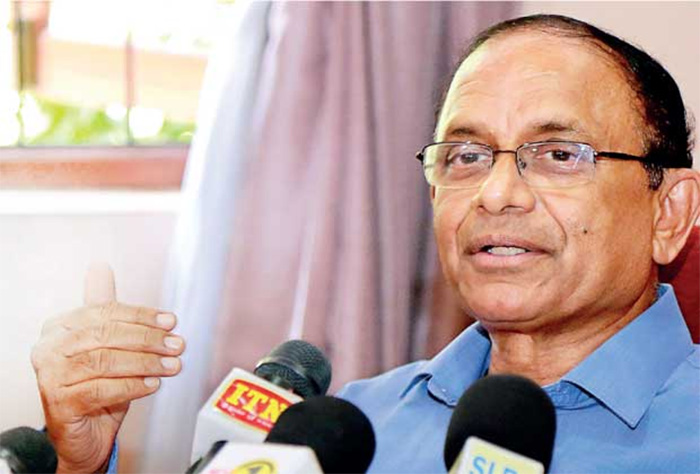
Former Member of the Cabinet sub Committee appointed to oversee the Nineteenth Amendment process (Dr) Jayampathy Wickramaratne, PC has issued a press release clarifying a statement made by President Ranil Wickremesinghe at the opening of the new court complex in Galle on Friday [19].
(Dr) Jayampathy Wickramaratne’s statement in full as received:
“The President stated in Galle on 19 July 2024 that not reducing the upper limit of the term of the President and Parliament from six to five years while preparing the Nineteenth Amendment to the Constitution was a lapse on my part due to my inexperience. I wish to set the record straight.
Presidential candidate Maithripala Sirisena signed a memorandum of understanding with a group of 49 political parties and organisations headed by the Venerable Maduluwawe Sobitha Nayaka Thero at Viharamaha Devi Park, in which he pledged to abolish the Executive Presidency altogether. However, the very next day, he signed another MOU with the Jathika Hela Urumaya, in which he pledged not to make any constitutional change requiring a Referendum. Mr Sirisena’s election manifesto also stated that no constitutional reform necessitating a Referendum would be initiated.
Soon after being sworn in, President Sirisena appointed Mr Ranil Wickremesinghe as Prime Minister. Constitutional affairs was Gazetted as a subject under Prime Minister Wickremesinghe. A Cabinet sub-committee headed by Premier Wickremesinghe was appointed to oversee the Nineteenth Amendment process. The five-member team that prepared the initial draft comprised three retired officials who had served in very senior positions in the Legal Draftsman’s Department, myself and another lawyer. The entire drafting process was carried out on the basis that the Bill should not be placed for approval at a referendum, in keeping with President Sirisena’s electoral pledge. While the terms of the President and Parliament were proposed to be reduced from six to five years, the upper limit of six years was not touched as that would require a Referendum. Article 83 of the Constitution mandates that a Bill that seeks to amend or is inconsistent with particular Articles listed or the said upper limits would be required to be passed by a two-thirds majority in Parliament and approved by the People at a Referendum. It is essential to note that Article 83 itself is included in the list of provisions requiring a Referendum.
The several drafts prepared were all shared and discussed with the Cabinet sub-committee. The draft finally approved by the Cabinet sub-committee was then sent to the Legal Draftsman, who took over as required by law and made some changes. It was then sent to the Attorney-General, who took the view that certain clauses, especially some that reduced the powers of the President, would require a Referendum. Prime Minister Wickremesinghe had several meetings with the Attorney General to discuss the matter. I participated in one such meeting. Several changes had to be made to the Bill because of the Attorney-General’s position.
Prime Minister Wickremesinghe presented the Bill to Parliament. When it was challenged in the Supreme Court, the Attorney-General argued on behalf of the Government that no provision required a Referendum. The clauses that the Supreme Court held to require a Referendum were either amended or withdrawn in Parliament.
In light of the above, I regret that President Wickremesinghe has thought it fit to place the entire blame on me for not reducing the upper limits of the President’s and Parliament’s terms. I reiterate that the entire amendment process was based on avoiding a Referendum following President Sirisena’s pledge at the Presidential election.”
(Dr) Jayampathy Wickramaratne, Presidents Counsel
20 July 2024.





Latest News
Advisory for Heavy Rain issued for the Central, Uva and Sabaragamuwa provinces and in the Ampara, Batticaloa and Polonnaruwa districts
Advisory for Heavy Rain Issued by the Natural Hazards Early Warning Centre at 12.00 noon on 21 February 2026 valid for the period until 08.30 a.m. 22 February 2026
Due to the low level atmospheric disturbance in the vicinity of Sri Lanka, Heavy showers above 100 mm are likely at some places in the Central, Uva and Sabaragamuwa provinces and in the Ampara, Batticaloa and Polonnaruwa districts and fairly heavy showers above 75 mm are likely at some places elsewhere.
Therefore, the general public is advised to take adequate precautions to minimize damages caused by heavy rain, strong winds and lightning during thundershowers.

Sri Lanka took a 1-0 lead in the ODI series with a tense ten-run win over West Indies, thanks largely to a match-defining performance from Inoka Ranaweera.
After being asked to bat, Sri Lanka posted 240 for 6, built on half-centuries from Hasini Perera (61 off 86) and Harshitha Samarawickrema (66 off 105). Captain Chamari Athapaththu made 27, while useful middle-order contributions from Nilakshika Silva and Kavisha Dilhari kept the innings moving at a controlled rate. A late cameo from Dewmi Vihanga, who struck 14 off six balls, ensured Sri Lanka pushed towards a competitive total in St George’s in Grenada.
But it was Ranaweera who tilted the contest. The experienced left-arm spinner returned figures of 4 for 44 from her ten overs. She removed the No. 3 Shemaine Campbelle cheaply, dismissed Chinelle Henry soon after, and then returned to break the dangerous stand of 89 between Stefanie Taylor and Jannillea Glasgow in the 40th over, just as West Indies were threatening to surge ahead. Ranaweera also accounted for Shawnisha Hector at the death.
Taylor’s 66 off 83 balls and Glasgow’s 50 off 67 had revived West Indies from early setbacks, and with Aaliyah Alleyne in the middle, the chase remained alive deep into the game. West Indies needed 18 from the last two overs, and 12 from the last six balls. However, Sri Lanka’s spinners held firm, with Dilhari finishing with three wickets, including two in the final over, to complement Ranaweera’s starring role.
West Indies were eventually bowled out for 230 in 49.4 overs. Sri Lanka have now won four of their last five ODIs against West Indies since 2017.
Brief scores:
Sri Lanka Women 240 for 6 in 50 overs (Harshitha Samarawickrama 66, Hasini Perera 61; Hayley Matthews 2-46, Karishma Ramharak 2-57) beat West Indies Women 230 in 49.4 overs (Stefanie Taylor 66, Jannillea Glasgow 50; Inoka Ranaweera 4-44, Kavish Dilhari 3-49) by ten runs
[Cricinfo]
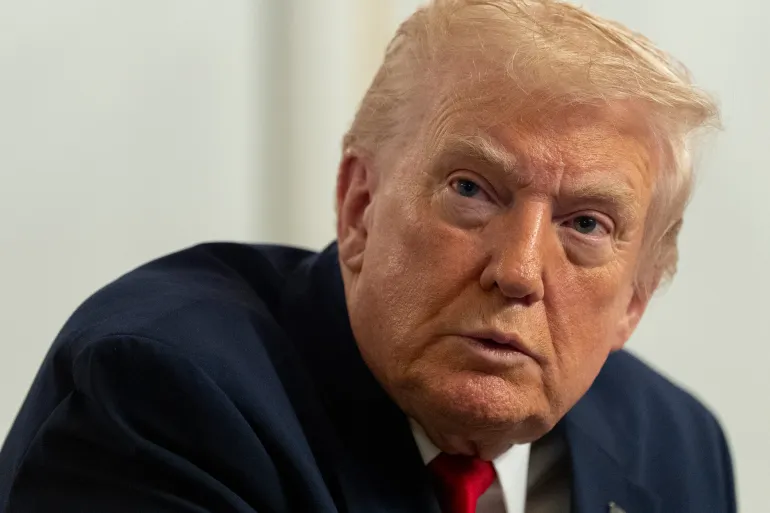
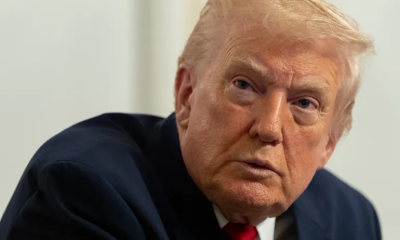
US President Donald Trump has imposed a new 10% global tariff to replace ones struck down by the Supreme Court, calling the ruling “terrible” and lambasting the justices who rejected his trade policy as “fools”.
The president unveiled the plan shortly after the justices outlawed most of the global tariffs the White House announced last year.
In a 6-3 decision, the court held that the president had overstepped his powers.
The decision was a major victory for businesses and US states that had challenged the duties, opening the door to potentially billions of dollars in tariff refunds, while also injecting new uncertainty into the global trade landscape.
Speaking from the White House on Friday, Trump indicated that refunds would not come without a legal battle, saying he expected the matter to be tied up in court for years.
He also said he would turn to other laws to press ahead with his tariffs, which he has argued encourage investment and manufacturing in the US.
“We have alternatives – great alternatives and we’ll be a lot stronger for it,” he said.
The court battle was focused on import taxes that Trump unveiled last year on goods from nearly every country in the world.
The tariffs initially targeted Mexico, Canada and China, before expanding dramatically to dozens of trade partners on what the president billed as “Liberation Day” last April.
The White House had cited a 1977 law, the International Emergency Economic Powers Act (IEEPA), which gives the president power to “regulate” trade in response to an emergency.
But the measures sparked outcry at home and abroad from firms facing an abrupt rise in taxes on shipments entering the US, and fuelled worries that the levies would lead to higher prices.
Arguing before the court last year, lawyers for the challenging states and small businesses said that the law used by the president to impose the levies made no mention of the word “tariffs”.
They said that Congress did not intend to hand off its power to tax or give the president an “open-ended power to junk” other existing trade deals and tariff rules.
In his opinion, Chief Justice John Roberts, a conservative, sided with that view.
“When Congress has delegated its tariff powers, it has done so in explicit terms and subject to strict limits,” he wrote.
“Had Congress intended to convey the distinct and extraordinary power to impose tariffs, it would have done so expressly, as it consistently has in other tariff statutes.”
The decision to strike down the tariffs was joined by the court’s three liberal justices, as well as two justices nominated by Trump: Amy Coney Barrett and Neil Gorsuch.
Three conservative justices, Clarence Thomas, Brett Kavanaugh and Samuel Alito, dissented.
At the White House, Trump said he was “absolutely ashamed” of the Republican appointees on the court who voted against his trade policy.
He said they were “just being fools and lap dogs” and were “very unpatriotic and disloyal to our Constitution”.
Shares on Wall Street rose after the announcement, with the S&P 500 closing up about 0.7%, as businesses across the US cautiously welcomed the ruling.
“I feel… like a thousand-pound weight has been lifted off my chest,” said Beth Benike, the owner of Busy Baby products in Minnesota, which manufactures products in China.
Nik Holm, chief executive of Terry Precision Cycling, one of the small businesses involved in the case, called the ruling a “relief”.
“Though it will be many months before our supply chain is back up and running as normal, we look forward to the government’s refund of these improperly-collected duties,” he said.
The anticipated refunds and relief from tariff costs may prove elusive, however.
On Friday, Trump imposed the new 10% tariff under a never-used law known as Section 122, which gives the power to put in place tariffs up to 15% for 150 days, at which point Congress must step in.
Analysts expect the White House to consider other tools, such as Section 232 and Section 301, which allow import taxes to address national security risks and unfair trade practices.
Trump has previously used those tools for tariffs, including some announced last year on sectors such as steel, aluminium and cars. Those were untouched by the court ruling.
A White House official said countries that struck trade deals with the US, including the UK, India and the EU, will now face the global 10% tariff under Section 122 rather than the tariff rate they had previously negotiated.
The Trump administration expects those countries to keep abiding by the concessions they had agreed to under the trade deals, the official added.
“Things have only gotten more complicated and more messy today,” said Geoffrey Gertz, senior fellow at the Center for a New American Security in Washington.
Reaction by major trade partners was relatively muted.
“We take note of the ruling by the U.S. Supreme Court and are analysing it carefully,” European Commission spokesman Olof Gill wrote on social media.
The US has already collected at least $130bn in tariffs using the IEEPA law, according to the most recent government data.
In recent weeks, hundreds of firms, including retailer Costco, aluminium giant Alcoa and food importers like tuna fish brand Bumble Bee, have filed lawsuits contesting the tariffs, in a bid to get in line for a refund.
But the decision by the majority does not directly mention refunds, likely handing back the question of how that process might work to the Court of International Trade.
In his dissent, Justice Brett Kavanaugh warned the situation would be a “mess”.
Diane Swonk, chief economist at KPMG US, warned that the cost of litigation could make recouping funds difficult for smaller firms.
“Unfortunately, I’d say curb your enthusiasm, although I understand the desire for relief,” she said.
Steve Becker, head of the law firm Pillsbury, said the “best thing” for businesses would be if the government created a procedure that did not require filing a lawsuit.
[BBC]
“I think companies can be fairly confident that they’ll get their money back eventually,” he added. “How long it will take really is up to the government.”

Advisory for Heavy Rain issued for the Central, Uva and Sabaragamuwa provinces and in the Ampara, Batticaloa and Polonnaruwa districts

Ranaweera’s four-for leads Sri Lanka to tense win over West Indies

How photography helped the British empire classify India

Atmospheric conditions are favorable for thundershowers over most parts of the island

Trump brings in new 10% tariff as Supreme Court rejects his global import taxes

Ravi demands full disclosure on Lanka’s usable reserves, flags forex leakages

‘Dates have the highest sugar content to fight Coronavirus’

Sunday Island 27 December – Headlines

#SundayIsland 17th December – Headlines

Sunday Island – 28th March

Sunday Island Headlines – 21 March

Sunday Island – 21st February – Headlines
-
 Life style7 days ago
Marriot new GM Suranga
-

 Business6 days ago
Ministry of Brands to launch Sri Lanka’s first off-price retail destination
-

 Features7 days ago
Monks’ march, in America and Sri Lanka
-
 Features7 days ago
The Rise of Takaichi
-

 Features7 days ago
Wetlands of Sri Lanka:
-
 News7 days ago
Thailand to recruit 10,000 Lankans under new labour pact
-
 Latest News1 day ago
New Zealand meet familiar opponents Pakistan at spin-friendly Premadasa
-
 Latest News1 day ago
Tariffs ruling is major blow to Trump’s second-term agenda