
Opinion
Chira takes his ‘final flight west’

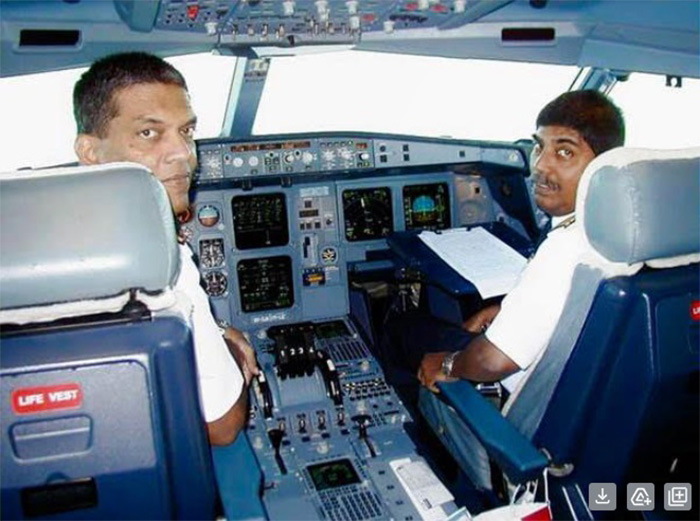
by Roger Thiedeman
On Friday, September 27, 2024, Sri Lanka lost its longest-surviving, most versatile and experienced aviator. That was the day Capt. Chira Fernando, a former military, commercial and recreational pilot, took his ‘final flight west’ (to paraphrase an unknown aviation writer); a flight all pilots must take for their ‘final check’.
Hemendra Chirananda Fernando , better known as ‘Chira’ or ‘Captain Chira’, was born on October 22, 1946 to Hector Francis Campbell Fernando and his wife Merlyn Anne Catherine née Fonseka. He was the fourth of their five children. Hector was an optician of renown, while his wife taught in the Lower School at S. Thomas’ College, Mt. Lavinia.
Indeed, it was at S. Thomas’ College (STC), where Chira and his older and younger brothers, Eksith and Gihan, respectively, received their primary and secondary education.
The aviation bug bit Chira at an early age when his godfather presented him with a flimsy cardboard-and-balsa-wood Spitfire model powered by a wound-up rubber band. With encouragement from their father, the Fernando boys progressed to building and flying more sophisticated model airplanes with miniature working engines, some designed by Chira himself. They also enjoyed reading tales of aerial warfare in Air Ace Picture Library and ‘Battler Britton’ comic books. Most weekends saw Chira and a group of likeminded friends flying their homebuilt models at STC’s Small Club sports ground.
Although Eksith was caught up in the flying fervour with his two brothers, it was youngest sibling Gihan who became as single-mindedly enthusiastic as Chira about all things aeronautical. Almost inevitably ‘GAF’ followed his next older brother into life as a flyer, albeit via a different ‘flight path’, forging a long and successful career as an airline pilot until retirement as a senior Captain with SriLankan Airlines at the compulsory age of 65 in 2014.
Reverting to Chira, he passed his GCE Advanced Level examinations and had only just commenced a General Science course at the University of Colombo when he was selected to join the then Royal Ceylon Air Force (RCyAF) in 1965 for training as an Officer Cadet at the prestigious and historic Royal Air Force (RAF) Cranwell College in England.
But first he had to undergo the physical training challenges of parade ground drills, battle courses and night marches at the RCyAF’s primary ground combat training base in Diyatalawa. On completion of that rigorous programme Chira left for the UK by ship in February 1966.
During his RAF officer training, while participating in a two-week ‘escape and evasion’ training exercise at Gütersloh, Germany in September 1968, Chira fell and badly injured a knee. Following treatment, he was sent to RAF Headley Court at Loughborough, England for convalescence.
That unfortunate accident turned out be a life-changing blessing in disguise for Chira. Because he had missed six weeks of his officer cadet training course, Chira was informed by his Flight Commander that he would have to start afresh with the next intake of cadets. Alternatively, he could join the General Duties (Pilot) Branch for testing and selection as a trainee pilot. The decision was a no-brainer for flying fanatic Chira … and the rest is history.
He was sent to RAF Biggin Hill for a flying aptitude test, which he passed. Leaving Headley Court as a Flight Cadet in the 94th entry of RAF College Cranwell, Chira commenced training on the Hunting Percival Jet Provost.
Soloing for the first time in a Jet Provost Mk.4 on October 11, 1967, and following further training, Flight Cadet Chira Fernando was eventually awarded his pilot’s wings by the RAF on August 2, 1968; becoming, as it turned out, the last Ceylonese flight cadet to graduate from Cranwell College.
Returning to Ceylon, Chira was commissioned as a Pilot Officer in the RCyAF. He was posted to No. 4 Helicopter Flight of No. 2 Squadron, commencing ground and flight studies on the Westland (Sikorsky) WS-51 Dragonfly helicopter under the supervision of Flt. Lt. Milroy de Zoysa. This was Chira’s first introduction to rotary-wing aircraft, which would stand him in good stead as his air force career progressed through other helicopter types, as well as a wide variety of fixed-wing aeroplanes small, large, and everything in between.
On September 3, 1970, Chira was certified as a Qualified Flight Instructor (QFI) to conduct flying training at China Bay, Trincomalee on the British-built de Havilland Canada DHC-1 Chipmunk T.10 two-seat trainer. This appointment, at age 24, earned Chira a further distinction as the RCyAF’s youngest flight instructor at that time. A rating (endorsement to fly) on the de Havilland Heron four-engine transport followed.
When the JVP uprising began on April 5, 1971, Chira’s RCyAF flying duties shifted into high gear. In Bell 206 JetRangers and the Bell OH-13 Sioux, a British militarised and armed version of the famous US-built Bell 47G helicopter, Chira flew numerous sorties, not just for reconnaissance but on offensive missions too. Covering territory in such areas as Elpitiya, Anuradhapura, Potuhera and Kegalle he saw the ugly face of that bloody rebellion.
Another writer has said that “the gritty realism of the senseless struggle had a profound effect on Chira”, especially while on patrol in a JetRanger he watched helplessly as a Jet Provost flown by Sgt. Pilot Ranjith Wijetunga lost power on approach to China Bay and crashed on land near Thampalagamam Bay. Wijetunga failed to eject from the falling aircraft, so Chira immediately headed for the crash site and landed close to the wreckage. Pulling Wijetunga off the ejection seat, Chira dragged him out of the mangled Jet Provost and airlifted the gravely wounded airman to China Bay. But in vain, as Wijetunga soon succumbed to his injuries.
When the insurgency petered out, Chira returned to flight instructor duties at China Bay. On December 10, 1971, he added the de Havilland Dove, a twin-engine transport, to his growing list of type endorsements.
Ceylon achieved republic status in 1972 and the country’s name was changed to Sri Lanka. Concurrently the RCyAF became the Sri Lanka Air Force (SLAF). The same year six Cessna 150 and four Cessna 337 Skymaster airplanes were donated to the SLAF by the US government. With the 150s replacing the Chipmunk as the air force’s basic trainer at China Bay, the new Cessnas gave Chira the opportunity to add these types to his logbook while teaching new pilots to fly them.
In 1974 Chira was endorsed on the SLAF’s Soviet-built MiG-15 and MiG-17 jet fighters. Posted as Commanding Officer of No. 6 MiG Squadron at Katunayake – he was the youngest CO of a SLAF squadron at the time – Chira took every opportunity to fly alongside his fellow MiG pilots as often as the squadron’s meagre fuel allocation allowed. He even formed a MiG aerobatic team with Nihal Tudugalle, Shan Vadivel, Cecil Marambe and Fahir Wahab, for the primary purpose of maintaining their jet-flying skills.
With SLAF jet activity at a low ebb in 1975, Chira took advantage of the downtime to study for and pass the examination for the UK’s Airline Transport Pilots Licence (ATPL). To satisfy the practical component of that civil qualification he took his flight test in the SLAF’s Convair 440 twin-engine transport. That led to, at the instigation of SLAF Commander Air Vice-Marshal (AVM) ‘Paddy’ Mendis, Chira being seconded to fly the Air Maldives Convair 440 on commercial services between Colombo and Malé, a welcome diversion which lasted from 1975 to 1977.
During that period Chira converted to other types in the SLAF’s inventory, ranging from the SIAI-Marchetti SF.260, the venerable Douglas DC-3 Dakota (taken over from Air Ceylon), through to the Riley Heron (an upgraded version of the standard Heron). Various postings and promotions followed in 1977 and 1978 before Chira left the air force with the rank of Squadron Leader in June 1981, having qualified on 20 different fixed-wing and helicopter types during his 16 years of service as a pilot in the RAF and RCyAF/SLAF.
No longer a military flyer, in December 1981 Chira turned his attention to civil aviation and flight training. In partnership with another retired air force officer he founded a private flight training school, Air Taxi Ltd, at Ratmalana airport. A subsidiary of the Capital Maharaja Group, the company trained pilots on a variety of Cessna and Piper single- and twin-engine airplanes. Chira also found time to add to his logbook the Lake Buccaneer LA-4-200 single-engine amphibian, a type he flew to various parts of the island on behalf of its owner Consolidated Marine Engineering of Colombo.
A major move in Chira’s career occurred when he joined Air Lanka (precursor of SriLankan Airlines) in June 1982. Qualifying as a First Officer on the Lockheed L-1011 TriStar, after five years he was promoted to Captain and, later still, Line Training Captain and L-1011 ‘Synthetic’ Flight Instructor. Meanwhile he continued to train aspiring private pilots at Ratmalana in addition to serving as an examiner and consultant to the Civil Aviation Authority-Sri Lanka (CAASL).
In 1987, Chira and his future wife Asankthi (‘Ashi’), herself a pilot, bought a Piper PA-28 in Dubai for their flying school and ferried it to Sri Lanka via Oman, Pakistan and India. Chira’s published account of that epic journey makes interesting, sometimes nerve-wracking, and amusing reading – especially his description of how he and Ashi coped with answering the number one of nature’s two calls during their long hours aloft in the cramped confines of the Piper’s cockpit!
Another marathon ferry flight followed in October 1991 when Chira and David Pieris piloted the latter’s newly acquired Beechcraft Baron 55 from Lisbon to Sri Lanka with stops en route at Athens, Luxor, Bahrain, and Mumbai.
In December 1992, a year after Chira was appointed as Air Lanka’s Manager-Flight Operations (MFO), the airline acquired the first of its Airbus A320s, followed in 1994 by the larger A340. Chira had the honour of ferrying both new types from Toulouse to Colombo. Not only was Air Lanka the first airline in South Asia and Far East to take delivery of the A340, Chira and his co-pilot Ravi Thampapillai were the first pilots to fly the four-engine jetliner in those regions.
In 1997, after successfully introducing employment of women pilots by Air Lanka, Chira left the national airline to join Gulf Air, with occasional postings to Philippine Airlines who were wet-leasing A340s from the Bahrain-based carrier.
However, this phase was short-lived, because in 1998 Chira was hired by Singapore Airlines as Captain on the A340. He subsequently served as a line instructor on the company’s Boeing 777 fleet and participated in its Operation Safety Group – while acquiring a Master of Technology degree from Swinburne University, Australia – until retirement from airline flying in October 2006.
But Chira was not yet done with the airline industry. He spent the next three years as an A320 instructor at Boeing’s Alteon simulator training facility in Singapore, before ST Aerospace Aviation in Singapore recruited him as its Head of Training. During the ensuing ten-year tenure Chira was instrumental in developing Singapore’s Multi-crew Pilot Licence (MPL) in collaboration with various government and private aviation entities including Singapore-based Tigerair (later merged into Scoot).
So much for Chira Fernando the aviator. What of his life away from the cockpit? On July 30, 1971 he married Violet Maurine de Silva with whom he had two sons and a daughter: Kamal Mututantri; Anouk Mututantri; and Chira Fernando Jr.
Chira and Violet were divorced in 1989, and on March 7, 1990 he married Menaka ‘Ashi’.
Not surprisingly, Chira’s aeronautical DNA was inherited by his eldest son Kamal, who, after employment with Singapore’s former Tigerair, is now a Captain with Qatar Airways.
Throughout his stellar military and commercial career and even afterward, Chira was actively associated, often with Ashi, an experienced flyer in her own right as his able lieutenant, in general aviation, sport flying, ab initio and advanced training, and private and recreational flying of homebuilt experimental light ’planes and rotorcraft.
Chira was always happy to share his passion for the air with other aviation enthusiasts, even those like this writer who was never a pilot. For example, on the morning of May 24, 1995, while I was holidaying in Sri Lanka and Chira phoned to ask if I would like to accompany him, in a few hours’ time, in David Pieris’s Beech Baron while he checked out David for his Instrument Rating renewal.
My decision was another no-brainer – just as Chira’s was when his Cranwell commander asked whether he wished to transfer from the Officer Cadet course to be trained as a pilot. Soon, I was seated enthralled in the back of the Baron, next to David’s wife Esther, as we took off from Ratmalana and headed for Katunayake. There, mixing it with big jets arriving at and departing from BIA, David executed two or three ILS touch-and-go approaches under Chira’s watchful eye and the sound of his calm, reassuring but firm instructor’s ‘patter’.
Another time, in Singapore in May 2010, at Chira’s invitation I sat in the left seat of an A320 simulator while he taught me how to carry out a few basic manoeuvres ‘in the air’ with the aid of autopilot and side-stick controller, plus deployment of flaps, airbrakes, etc. After a trainee pilot in the right seat performed the approach and landing, Chira talked me through taxiing to the gate with clever tips on how to ‘follow the line’. Again, his natural gift as an instructor made me feel I was already a taxiing expert, if not a taxi or (Air)bus driver!
Chira’s death, a month short of what would have been his 78th birthday, was mourned by loved ones and the multitude of his friends and colleagues within and outside the world of aviation, including enthusiasts like me who were in awe of Chira’s talents as an aviator and grateful for his, and Ashi’s, friendship.
At the conclusion of Chira’s funerary rites on Tuesday, October 1, a solitary Piper Tomahawk trainer flew over the Kanatte precinct in Chira’s honour. The flypast was unavoidably both brief and a low-profile event. But as his brother ‘GAF’ said later: “In a way it was good … He wouldn’t have wanted too much fanfare anyway.”
As mourners watched the Tomahawk bidding a final farewell to Capt. Chira Fernando, along with those of us viewing a video clip from afar, the following excerpted words of Anglo-American aviator and poet John Gillespie Magee, Jr never seemed more appropriate: “[he] slipped the surly bonds of Earth and danced the skies on laughter-silvered wings; sunward he climbed, and joined the tumbling mirth of sun-split clouds – and did a hundred things others have not dreamed of – wheeled and soared and swung high in the sunlit silence … Up, up the long delirious burning blue he topped the wind-swept heights with easy grace where never lark or even eagle flew.”
Rest in Peace, Chira!
(With acknowledgment to https://everipedia.org/wiki/lang_en/captain-chira-fernando )


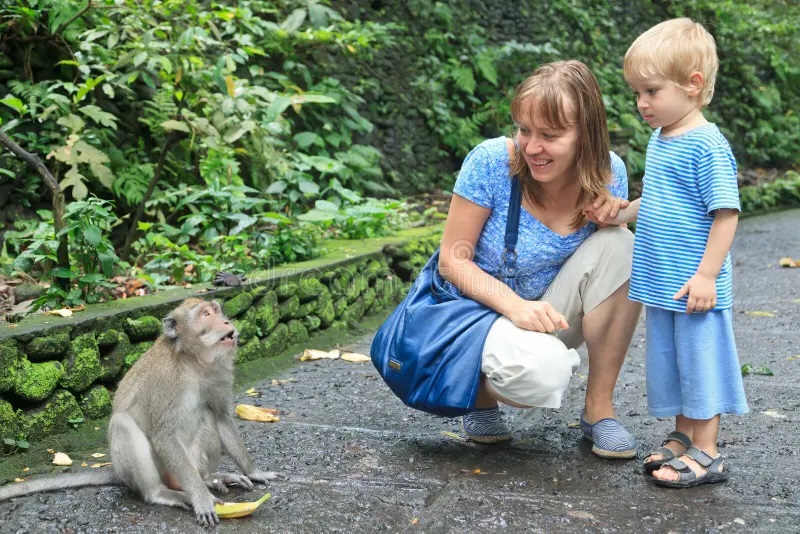
Being wildlife enthusiasts and bird watchers we took a river “safari” during a recent family trip to Bentota. We were dismayed to see that it seems to be the standard practice to feed the monkeys, I think they were the purple faced langurs, that were encountered on the river banks. Each boat that passed by stopped with boxed fruit, coconut and other odds and ends to feed them.
We managed to stop our guy from doing so but faced derision and laughter that we shouldn’t be afraid of monkeys. We tried to explain to him that this is a plague affecting Sri Lanka; elephants being fed on road sides and even in national parks, monkeys being fed from hotel balconies and apparently during river boat rides, birds being fed on hotel terraces etc.
This was met with further mockery and amused dismissal. An effort to make them understand that this was their livelihood that they were destroying it in this manner sailed over their heads. They even have a picture of a baby crocodile on the shoulders of a tourist on their billboard.
We need to consider the following:
Educate such tour operators about the importance of not interfering with the environment and the behaviour of wild animals.
Include education and training in the hotel school, and in schools in tourist resort towns about their duty and responsibility to the environment and the ecosystem on which we all depend.
If it is not already the case such operators should have licenses that should be revoked and fined if found to be engaging in such destructive acts.
Tamara Nanayakkara
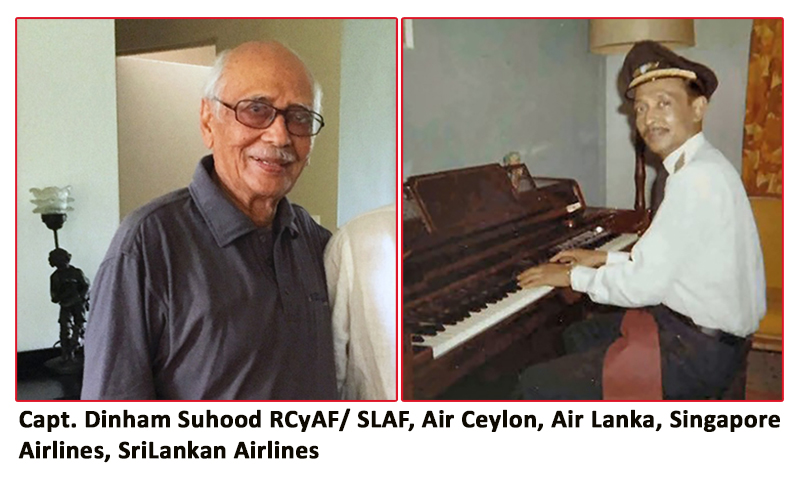
A few days ago, we heard the sad news of the passing on of Capt. Dinham Suhood. Born in 1929, he was the last surviving Air Ceylon Captain from the ‘old guard’.
He studied at St Joseph’s College, Colombo 10. He had his flying training in 1949 in Sydney, Australia and then joined Air Ceylon in late 1957. There he flew the DC3 (Dakota), HS748 (Avro), Nord 262 and the HS 121 (Trident).
I remember how he lent his large collection of ‘Airfix’ plastic aircraft models built to scale at S. Thomas’ College, exhibitions. That really inspired us schoolboys.
In 1971 he flew for a Singaporean Millionaire, a BAC One-Eleven and then later joined Air Siam where he flew Boeing B707 and the B747 before retiring and migrating to Australia in 1975.
Some of my captains had flown with him as First Officers. He was reputed to have been a true professional and always helpful to his colleagues.
He was an accomplished pianist and good dancer.
He passed on a few days short of his 97th birthday, after a brief illness.
May his soul rest in peace!
To fly west my friend is a test we must all take for a final check
Capt. Gihan A Fernando
RCyAF/ SLAF, Air Ceylon, Air Lanka, Singapore Airlines, SriLankan Airlines

The cause of global warming, they claim, is due to ever increasing levels of CO2. This is a by-product of burning fossil fuels like oil and gas, and of course coal. Environmentalists and other ‘green’ activists are worried about rising world atmospheric levels of CO2. Now they want to stop the whole world from burning fossil fuels, especially people who use cars powered by petrol and diesel oil, because burning petrol and oil are a major source of CO2 pollution. They are bringing forward the fateful day when oil and gas are scarce and can no longer be found and we have no choice but to travel by electricity-driven cars – or go by foot. They say we must save energy now, by walking and save the planet’s atmosphere.
THE DEMON COAL
But it is coal, above all, that is hated most by the ‘green’ lobby. It is coal that is first on their list for targeting above all the other fossil fuels. The eminently logical reason is that coal is the dirtiest polluter of all. In addition to adding CO2 to the atmosphere, it pollutes the air we breathe with fine particles of ash and poisonous chemicals which also make us ill. And some claim that coal-fired power stations produce more harmful radiation than an atomic reactor.
STOP THE COAL!
Halting the use of coal for generating electricity is a priority for them. It is an action high on the Green party list.
However, no-one talks of what we can use to fill the energy gap left by coal. Some experts publicly claim that unfortunately, energy from wind or solar panels, will not be enough and cannot satisfy our demand for instant power at all times of the day or night at a reasonable price.
THE ALTERNATIVES
It seems to be a taboo to talk about energy from nuclear power, but this is misguided. Going nuclear offers tried and tested alternatives to coal. The West has got generating energy from uranium down to a fine art, but it does involve some potentially dangerous problems, which are overcome by powerful engineering designs which then must be operated safely. But an additional factor when using URANIUM is that it produces long term radioactive waste. Relocating and storage of this waste is expensive and is a big problem.
Russia in November 2020, very kindly offered to help us with this continuous generating problem by offering standard Uranium modules for generating power. They offered to handle all aspects of the fuel cycle and its disposal. In hindsight this would have been an unbelievable bargain. It can be assumed that we could have also used Russian expertise in solving the power distribution flows throughout the grid.
THORIUM
But thankfully we are blessed with a second nuclear choice – that of the mildly radioactive THORIUM, a much cheaper and safer solution to our energy needs.
News last month (January 2026) told us of how China has built a container ship that can run on Thorium for ten years without refuelling. They must have solved the corrosion problem of the main fluoride mixing container walls. China has rare earths and can use AI computers to solve their metallurgical problems – fast!
Nevertheless, Russia can equally offer Sri Lanka Thorium- powered generating stations. Here the benefits are even more obviously evident. Thorium can be a quite cheap source of energy using locally mined material plus, so importantly, the radioactive waste remains dangerous for only a few hundred years, unlike uranium waste.
Because they are relatively small, only the size of a semi-detached house, such thorium generating stations can be located near the point of use, reducing the need for UNSIGHTLY towers and power grid distribution lines.
The design and supply of standard Thorium reactor machines may be more expensive but can be obtained from Russia itself, or China – our friends in our time of need.
Priyantha Hettige

Imran Khan to be moved to hospital amid rising health concerns

Fairly heavy showers are likely at some places in the Rathnapura, Kalutara, Galle and Matara districts

India vs Pakistan is finally here. Over to cricket now

“We Are Building a Stable, Transparent and Resilient Sri Lanka Ready for Sustainable Investment Partnerships” – PM

US military kills 3 in latest attack on boat in the Caribbean

Prez AKD congratulates BNP’s Tarique Rahman on B’desh election win

‘Dates have the highest sugar content to fight Coronavirus’

Sunday Island 27 December – Headlines

#SundayIsland 17th December – Headlines

Sunday Island – 28th March

Sunday Island Headlines – 21 March

Sunday Island – 21st February – Headlines
-
 Business4 days ago
Autodoc 360 relocates to reinforce commitment to premium auto care
-
 Midweek Review4 days ago
A question of national pride
-
 Opinion3 days ago
Will computers ever be intelligent?
-
 Midweek Review4 days ago
Theatre and Anthropocentrism in the age of Climate Emergency
-

 Editorial6 days ago
The JRJ syndrome
-
 Opinion4 days ago
The Walk for Peace in America a Sri Lankan initiative: A startling truth hidden by govt.
-

 Foreign News6 days ago
Portugal elects Socialist Party’s Seguro as president in landslide
-
 Opinion5 days ago
Beyond 4–5% recovery: Why Sri Lanka needs a real growth strategy