
Sports
Chinthana not ready to throw in the towel yet


by Reemus Fernando
It is 14 years since he first rose to fame winning an unprecedented gold in weightlifting at international level. Chinthana Vidanage who inspired a generation of athletes to take up weightlifting with his Commonwealth Games gold in Australia is not ready to throw in the towel yet.
Vidanage whose highest international success have been achieved at the Commonwealth Games said in an interview with The Island that his long-term plans run at least until 2022 Commonwealth Games.
“I have the 2022 Commonwealth Games in my long term plan. I can’t stop the initiatives I have taken without supporting as many as I could to take up this sport,” Vidanage said.
Vidanage who last enjoyed international success at the 2019 South Asian Games in Nepal was a member of the weightlifting team that competed at the 2018 Gold Coast Commonwealth Games where he finished fifth.
“Last year when I established two national records in the 81kg category I proved that I still have the ability to win at Commonwealth Games level. The Covid 19 pandemic has prevented me from accessing my current strength,” said Vidanage who will be 40 when he competes at the 2022 Birmingham Games.
“I consider it my responsibility to continue in this sport for as long as I can. Many Olympians have given up on their sport too early. An Olympian has a wealth of experience that he can give back to fellow athletes who are eager to achieve that top level. Take for example Manjula Kumara (high jump national record holder). He competed for many years. An Olympian like Manjula Kumara could have been an inspiration to many had he been here to guide budding athletes. At the time Manjula gave up athletics he was in his mid 30s. The younger generation even today are struggling to accomplish what he achieved nearly a decade ago. It is not totally about winning. It’s about what you can give back to the next generation of athletes for that particular sport to survive,” said the sailor of his contemporary who competed for nearly two decades as the country’s top high jumper.
Asked whether he has faith in the country’s sports authorities to obtain the knowledge of such Olympians for the betterment of the sport he said: “The Sports Minister himself is a sportsman and I firmly believe that he would take necessary steps to engage the services of veteran sportsmen and help top level athletes who are keen on continuing”
Commenting on the contribution he has made towards his sport as a veteran he said he was able to inspire many both during competition and training. “If you take top weightlifters who are doing well now I can be happy about the contribution I have made. If you take Indika Dissanayake and Palangasinghe, they all trained with me. You can not only give instructions on techniques when you have young people training with you but also one can help them on how to think like a champion.”
Asked for his comments on the impact the Covid 19 pandemic had on his training and preparation he said: “I don’t think that the Covid 19 pandemic had a big impact on training of the top level weightlifters. I did not stop training. I trained according to a plan where I could peak at any given time. In my training plan I don’t have an off season. If you relax you cannot achieve your targets. All top level athletes are training as hard as they can. What we greatly missed was competitions. In the economic front there are problems to many who are not coming under Sports Ministry’s supervision.”


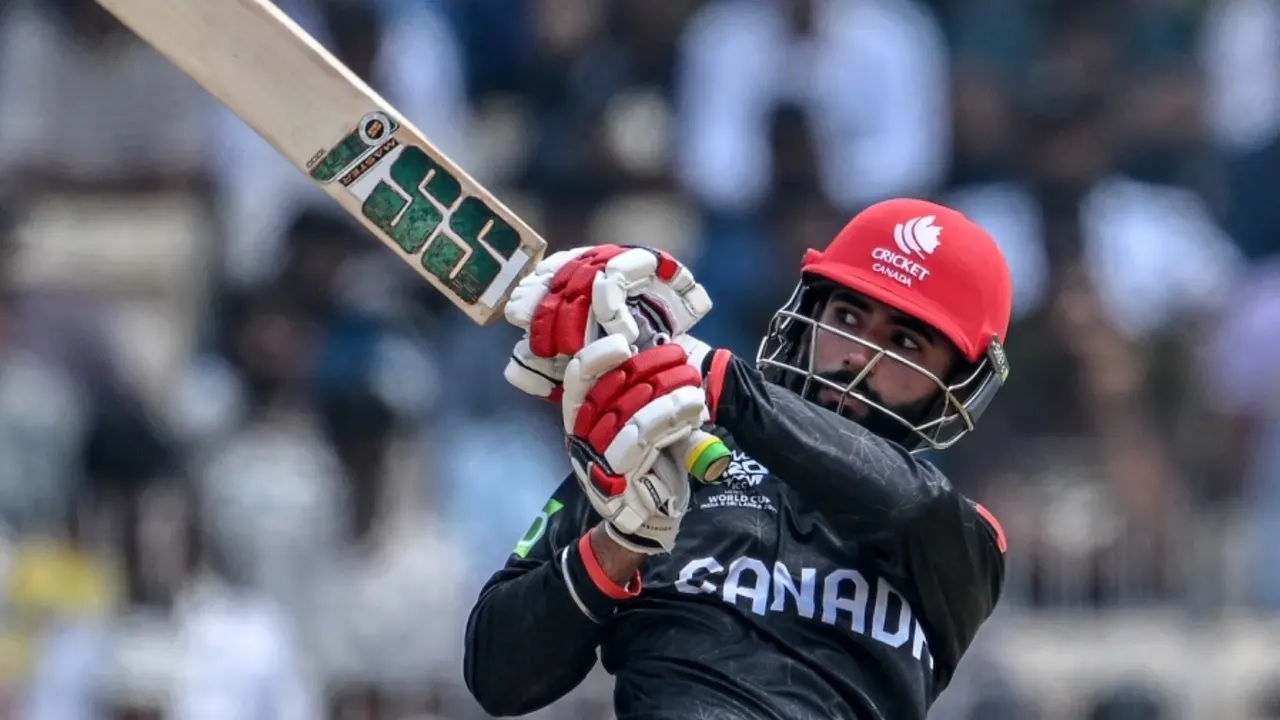
Yuraj Samra’s record-breaking hundred went in vain as New Zealand beat Canada by eight wickets in Chennai to qualify for the Super Eight stage of the 2026 T20 World Cup.
Batting first, Canada posted a competitive 173 for 4, thanks to Samra’s 110 off 65 balls, the highest score by an Associate batter against a Full Member in the tournament’s history. At 19 years and 141 days, the left-hand opener also became the youngest to cross 50 in a men’s T20 World Cup match.
Canada’s bowlers and fielders, though, let them down. They did send back Tim Seifert and Finn Allen inside the first four overs, but Glenn Phillips and Rachin Ravindra snatched the game away from them and ran away with it.
Phillips smashed 76 not out off 36 balls and Ravindra 59 not out off 39. The two added 146 off just 73 balls for the third wicket and took New Zealand home with 4.5 overs to spare.
Matt Henry started the proceedings with four dots to Samra but the opener got going with back-to-back fours off the last two deliveries. Samra faced only five balls in the next four overs but took James Neesham down in the final over of the powerplay. With Neesham operating from around the wicket, he pulled to fine leg, muscled over midwicket, drilled down the ground, and slashed over the covers after coming down the ground. The first three went for fours, the last carried all the way.
Samra kept the scoreboard ticking even after the powerplay. He smashed Kyle Jamieson’s slower ball through extra cover before pulling Cole McConchie for a flat six. Soon, he reached his fifty, off 36 balls.
Brief scores:
New Zealand 176 for 2 in 15.1 overs (Finn Allen 21, Glenn Phillips 76*, Rachin Ravindra 59*, Dilon Heyliger 1-42, Saad Bin Jaffar 1-29) beat Canada 173 for 4 in 20 overs (Yuraj Samra 110, Dilpreet Bajwa 36, Navneet Dhaliwal 10; Matt Henry 1-28, Jacob Duffy 1-25, Kyle Jamieson 1-41, James Neesham 1-38) by eight wickets
[Cricinfo]
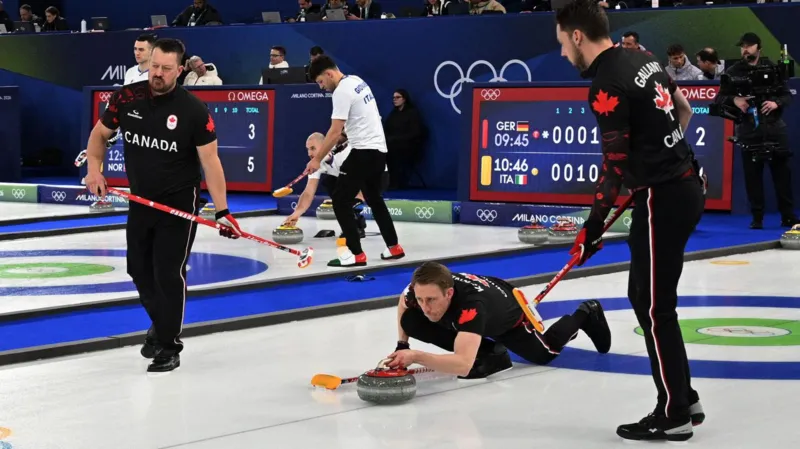
A scandal at the Winter Olympics has left the Canadian curling teams on the defensive and Canadians reeling over the crack in their country’s polite persona.
Over the weekend, Canadian curler Marc Kennedy had an expletive-filled outburst after Sweden accused him of cheating during a match, and later said his team might be the target of a “premeditated” attack by their rivals.
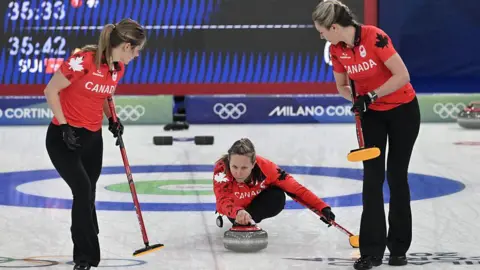
Kennedy was accused of “double-touching” – touching the stone a second time after initially releasing it down the ice. The next day, Canadian women’s captain Rachel Holman was accused of using the same move.
Both have denied the accusations, but Canada’s curling teams, who historically have dominated the sport, now face questions over their tactics.
While the curlers have shown their anger over the situation during matches, fans of the sport and Canadians have questioned whether the team acted in the spirit of curling.
“It’s a sad day for Canadian sport,” Tim Gray, from Alberta, told the BBC. “Integrity in the sport is important, even if you have to call it on yourself.”
An opinion piece in the Canadian news outlet, the Globe and Mail, pointed to some of the frustration: “These Canadian curling teams are not fun bad guys. They come off like the sort of competitors who need so desperately to win that they will do anything – even things that are pointless – in order to get there.”
Cathal Kelly, the writer of the opinion piece, continued: “There’s an easy way out of this – stop struggling. Stop acting like our curling reputation matters more than our national one. Be the bigger man and woman, even if you don’t think you did anything wrong.”
The controversy began on Friday when Swedish player Oskar Eriksson accused Kennedy of double-touching.
As the game continued, Kennedy and Eriksson got into a verbal back-and-forth that included expletives.
Their exchange quickly went viral as a video appearing to show Kennedy touching the stone on occasion.
Kennedy got a verbal warning from World Curling for using foul language, but he was not formally charged with cheating by the governing body.
The next day Kennedy said: “I probably could have handled it better. But we’re human out there and there’s a lot of emotions. I’m not going to apologise for defending my teammates and standing up for myself.”
“I’ve curled my whole life, never once with the intention of getting an advantage through cheating,” he added.
Then, Canadian curling had another instance of purported cheating.
Match officials accused the Canadian women’s team on Saturday of the same double-touch violation.
Rachel Homan who said there was a “zero percent chance” of the violation, as she and her teammates looked on frustratingly. The Canadians lost to the Swiss, 8-7.
On Sunday, Great Britain’s men’s team was accused of the same violation.
Both Homan and British men’s curler Bobby Lammie had stones removed from play due to alleged violations.
Homan later slammed the officials’ decision to remove her stone during a defeat to Switzerland, saying it was “insane”.
All of the incidents led World Curling to clarify that double-tapping is not allowed.
“During forward motion, touching the granite of the stone is not allowed. This will result in the stone being removed from play,” they said.
World Curling does not use video to review play, but they did send two officials to monitor how players released their stones in subsequent games.
“Following a meeting with representatives of the competing National Olympic Committees, an update in the stone monitoring protocol has been confirmed, beginning with the evening session on Sunday 15 February,” World Curling said in a statement.
“This change in protocol will see the two umpires who had previously been actively monitoring athlete deliveries remain available in the field of play, but will now only monitor athlete deliveries at the request of the competing teams.”
Reaction to the controversy in Canada has been mixed.
“Do I think the finger affects the rock, no I do not,” Ankara Leonard from the Royal Montreal Curling Club told the BBC. “Do I think we have to play within the rules? Yes.”
While curling columnist and Olympian Tomi Rantamaki, in an article for The Curling News, warned that Canada’s dominance in the world of curling means its players should be mindful of the influence they have.
“Young players in Finland, Korea, Italy, Sweden – everywhere – often copy what Canadian teams do. They copy the athlete’s delivery, the sweeping, the tactics, the communication,” Rantamaki wrote. “And they copy the behaviour.”
[BBC]
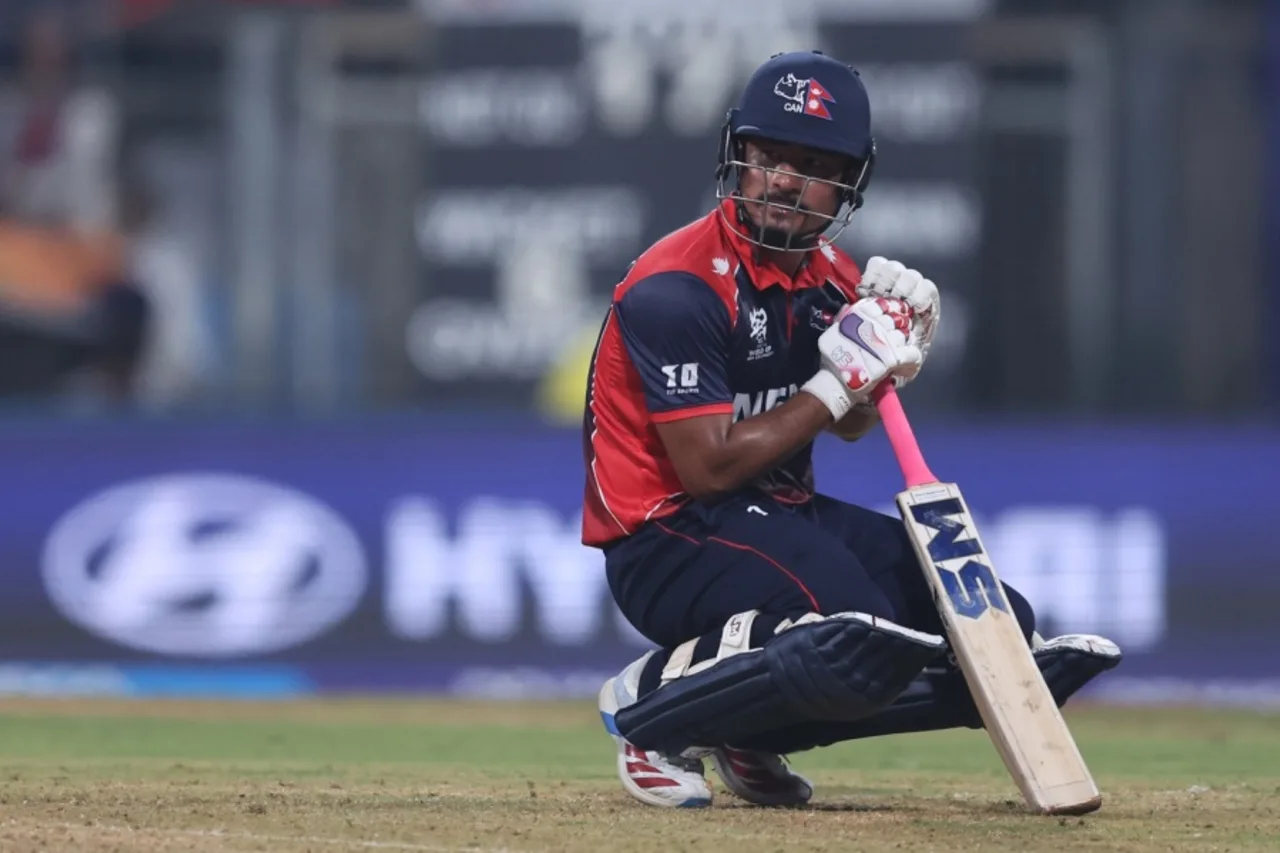
Regrets. Scotland and Nepal will have a few.
They arrived at the 2026 T20 World Cup with little to lose. Scotland’s 11th-hour entry after Bangladesh’s expulsion was an unexpected boost. Nepal, meanwhile, are a nation on the cusp of nailing the big time, and what better way to signal that intent by bloodying a few noses and perhaps even sneaking out of Group C?
And yet, both will go into their meeting in Mumbai wondering what could have been. Nepal were 11 runs from 8 balls away from victory in their opening against England, while Scotland spurned 30 runs in their innings against the same opponents, which might have afforded them more room to cash in the nerves they elicited in an ultimately unsuccessful defense of 152.
A comprehensive defeat to West Indies on Sunday closed all mathematical avenues for Nepal’s progression, before England’s second number on their Auld enemy was to come through another sketchy situation against Italy on Monday to secure their own Super Eights spot. And so, what might have been a genuine winner-takes-all bout is anything but. Regardless of the result, both teams will be heading home.
Of course, there is pride to play for, but perhaps a bit more on Nepal’s side of the ledger. Captain Rohit Paudel called for more opportunities against Full Member teams going forward, after making England sweat. Signing off with a maiden T20 World Cup win can further their push for more of a look-in. Their fans have made a compelling case in the stands.
The mullering at the hands of Italy felt like a blow to that cause, even though that should not be the case. It is counter-productive to pit Associate nations against one another to deem who is worthy of a bigger slice of pie, be that funding or opportunities against major sides, particularly when the deck is stacked against them on those grounds in the first place.
These are issues Scotland know plenty about, even if their surprise entry into this tournament is their sixth visit to a T20 World Cup. Between the 2024 T20 World Cup and this one, they had played just seven T20Is outside of qualification tournaments, and only three against a Full Member (a series against Australia in September 2024). They themselves have a statement to make on Tuesday.
Scotland’s initial three-match residence in Kolkata featured a 73-run win against Italy, as they became the first side at this World Cup to breach 200. That was sandwiched by losses to West Indies and England, though the latter did play out in front of a crowd of more than 40,000. This will be similarly well-attended.
One of these teams will take the lead after a 1-1 head-to-head established during a tri-series Scotland hosted and won last summer, with an emphatic win over Nepal. Their first meeting three days earlier was a low scoring shootout which Sandeep Lamichanne seized; the legspinner taking 4 for 11 then bagging the winning run off the penultimate delivery.
As such, there is plenty of familiarity on the ground for this encounter, which will been played out on what has been a game Wankhede track. Nepal’s three matches at this venue to Scotland’s none gives them a sizable advantage, but their batting has not come close to replicating the heights Kushal Bhurtel, Dipendra Singh Airee and Lokesh Bam threatened to take them to against England over a week ago.
They were tentative against Italy (who chased down 124 without loss and with ease) and overawed by Group C leaders West Indies. It spoke to the standards expected that consultant coach Nic Pothas used his pre-match press conference to lament the team for “not learning fast” and making familiar errors.
Scotland, too, have errors to learn from, particularly their leg-side missteps against England when it came to the sweep shot. “The nature of the wicket [at the Wankhede] probably looks even slower than Kolkata and might take more turn,” Tom Bruce said on Monday. We shall see.
It has been a peculiar tournament for Sandeep Lamichane. Nepal’s greatest cricketing export has just one wicket at an average of 94.00, with an economy rate of 9.4 – galling numbers for a seasoned wristspinner. The 25-year-old has shown no verve, and was bullied by Anthony Mosca in the defeat to Italy, with the opener carting him for three sixes, finishing with 28 off the 13 deliveries he faced from the leggie. As mentioned further up, Lamichanne has good recent form against Scotland which he could do with replicating to save what has otherwise been an abject tournament.
Mark Watt, meanwhile, will be keen to bounce back from the shellacking he received against England. His 0 for 43 from three overs contributed to Scotland’s inability to fully turn the screw against their neighbours to the south, hammered over the fence three times by Tom Banton in a first over that went for 22 – an exchange that got Banton out of a funk and on his way to a match-winning 63*. Watt is a canny enough operator to not let that aberration dull his shine.
Nepal have been relatively consistent with their selections, sticking by 10 players and shuffling between Sher Malla (offbreak), Lalit Rajbanshi (left arm orthodox) and Sompal Kami (medium-pace) for the final spot. The suggestion on the ground is they may go in unchanged from the West Indies match after Kami provided some handy but ultimately moot lower-order runs with an unbeaten 26. Should they err towards spin, Malla may get the nod over Rajbanshi, whose single over against Italy went for 19.
Nepal (probable): Aasif Sheikh (wk), Kushal Bhurtel, Rohit Paudel (capt), Dipendra Airee, Aarif Sheikh, Lokesh Bam, Gulsan Jha, Karan KC, Sompal Kami/Sher Malla, Nandan Yadav, Sandeep Lamichhane.
Scotland have called up seamer Jack Jarvis as a replacement for Safyaan Sharif, who has been nursing a groin strain picked up in training. But the sense is they will go in with the same XI they played against England.
Scotland (probable): George Munsey, Michael Jones, Brandon McMullen, Richie Berrington (capt), Tom Bruce, Michael Leask, Matthew Cross (wk), Mark Watt, Oliver Davidson, Brad Wheal, Brad Currie.
[Cricinfo]

Samra’s record 110 in vain as Phillips and Ravindra put New Zealand in Super Eights

Canada reacts as cheating row rocks curling superpower

Long queues and confusion mar first day of India’s landmark AI summit

Ancient bone may prove legendary war elephant crossing of Alps

Nepal, Scotland chase win to close out what-if tournament

How dark web agent spotted bedroom wall clue to rescue girl from years of harm

‘Dates have the highest sugar content to fight Coronavirus’

Sunday Island 27 December – Headlines

#SundayIsland 17th December – Headlines

Sunday Island – 28th March

Sunday Island Headlines – 21 March

Sunday Island – 21st February – Headlines
-

 Life style2 days ago
Marriot new GM Suranga
-

 Business1 day ago
Ministry of Brands to launch Sri Lanka’s first off-price retail destination
-

 Features2 days ago
Monks’ march, in America and Sri Lanka
-

 Midweek Review6 days ago
A question of national pride
-

 Business6 days ago
Autodoc 360 relocates to reinforce commitment to premium auto care
-
 Opinion5 days ago
Will computers ever be intelligent?
-

 Features2 days ago
The Rise of Takaichi
-

 Features2 days ago
Wetlands of Sri Lanka: