
Foreign News
Child damages €50m Rothko painting in Dutch museum


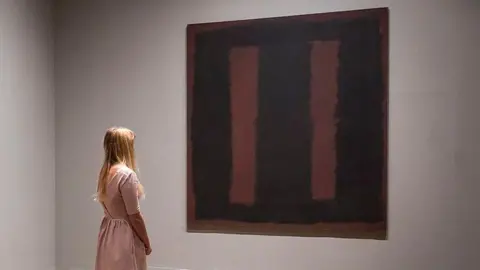
A child has damaged a painting worth millions of pounds by the American artist Mark Rothko at a museum in Rotterdam.
A spokesperson for the Museum Boijmans Van Beuningen said it was considering the “next steps” for the treatment of Rothko’s Grey, Orange on Maroon, No. 8.
The damage occurred during an “unguarded moment”, a museum spokesperson told the Dutch media outlet Algemeen Dagblad (AD) last week.
A spokesperson for the museum told the BBC the damage was “superficial”, adding: “Small scratches are visible in the unvarnished paint layer in the lower part of the painting”.
The abstract painting is estimated to be worth up to €50m (£42.5m), according to newspaper AD.
“Conservation expertise has been sought in the Netherlands and abroad. We are currently researching the next steps for the treatment of the painting”, the museum spokesperson told the BBC.
“We expect that the work will be able to be shown again in the future,” they added.
Sophie McAloone, the conservation manager at the Fine Art Restoration Company, said that “modern unvarnished” paintings like Rothko’s Grey, Orange on Maroon, No. 8 are “particularly susceptible to damage”.
This is “owing to a combination of their complex modern materials, lack of a traditional coating layer, and intensity of flat colour fields, which make even the smallest areas of damage instantly perceptible,” she said.
“In this case, scratching of the upper paint layers can have a significant impact on the viewing experience of the piece,” Ms McAloone said.
The Rothko painting was hanging in the museum’s Depot – a publicly accessible storage facility beside the main museum – as part of an exhibition displaying a selection of “public favourites” from the gallery’s collection.
Jonny Helm, a marketing manager at the art restoration service Plowden & Smith, said the incident had implications for UK institutions such as V&A East and the British Museum, which are considering “opening up the display of things that would otherwise be obscured in archives.”
“How will this event affect other UK institutions who are opening up their archives in the same way?” Mr Helm said.
Restoring a Rothko painting is a difficult task because “Rothko’s mixture of pigments and resins and glues were quite complex”, Mr Helm said.
He said the fact the painting is unvarnished – meaning it is “open to the environment” – will pose an additional challenge to conservators.
Conservators working to restore the painting will now likely be in the process of documenting the extent of the damage and researching “historic successful treatments” of Rothko paintings.
“Rothko works seem to have terrible luck – this isn’t the first damaged Rothko we’ve heard about,” Mr Helm said.
Rothko’s 1958 work, Black on Maroon, was deliberately vandalised by Wlodzimier Umanjec at London’s Tate Modern gallery in October 2012. Umaniec was sent to prison for two years and subsequently apologised for his actions.
During his trial, prosecuting barrister Gregor McKinley said the cost of repairing the work would be about £200,000. It took conservators 18 months to repair the painting.
Rachel Myrtle, Head of Specie and Fine Arts at Aon, a company that offers insurance broking to its clients, said fine art insurance policies typically cover “all risks associated with physical loss and damage to artwork”.
This includes “accidental damage caused by children or visitors, albeit with certain exclusions”, she said.
She said that when an artwork is damaged, a gallery’s insurer will appoint a specialist fine art loss adjuster to visit the museum.
The loss adjustor typically “reviews the damage to the artwork, examines any CCTV footage to determine the exact cause of the loss, and assesses conservation options”, Ms Myrtle said.
The museum did not comment on who will be held liable for the damage to the 1960 painting, which the gallery reportedly bought in the 1970s.
The Museum Boijmans Van Beuningen has previously billed visitors who have caused damage to artworks on display.
In 2011, the museum asked an unsuspecting tourist who stepped on Wim T. Schippers’ peanut butter floor artwork, called Pindakaasvloer, to pay for repairs to the work. Sharon Cohen, a spokesperson for the museum at the time, wax quoted by AD as saying “It is normal procedure for people to pay if they damage art.”
The Rothko painting is described by the museum as an example of colour field painting, a term used to describe art characterised by large blocks of flat, solid colour spread across a canvas.
Rothko’s Grey, Orange on Maroon, No. 8 painting is one of several works of modern art that have been damaged in the Netherlands in recent years.
In November 2024, multiple screen prints by the US pop artist Andy Warhol were damaged by thieves during an attempted robbery of the MPV art gallery in the town of Oisterwijk.
In another incident, a Dutch town hall admitted it most likely disposed of 46 artworks by accident – including an Andy Warhol print of the former Dutch queen – during renovation works last year.
Museums have different policies when responding to damage caused by children.
In August last year, a four year old boy accidentally smashed a 3,500 year old jar into pieces at the Hecht Museum in Israel. At the time, Hecht Museum worker Lihi Laszlo told the BBC the museum would not treat the incident “with severity” because “the jar was accidentally damaged by a young child”.
The family were invited back to the exhibition for an organised tour shortly after the incident occurred.
[BBC]


An eight-year-old Queensland girl has been killed after she was seriously injured in a snowmobile accident at a Japanese ski resort.
Chloe Jeffries, from the Gold Coast, was riding on a snowmobile with her mother in Hakuba Valley, Nagano prefecture, on Saturday when it overturned, trapping her underneath. She was airlifted to hospital but later died.
In a tribute from her netball club, Jeffries was remembered for her “beautiful nature” and “her cheeky, infectious smile”.
Tour operator Hakuba Lion Adventure said the vehicle flipped after going up an embankment along a forest road and that police were investigating. Jeffries is the fourth Australian to have died at a Japanese ski resort this year.

Prosecutors in Norway have charged the son of Norway’s crown princess with reckless behaviour and violating a restraining order a month after he went on trial for rape and dozens of other alleged offences.
Marius Borg Høiby was arrested the day before his trial began at the start of February, on suspicion of threats and violence against a woman in his flat in Oslo. Police remanded him in custody for the first four weeks of the trial.
Although allegations of bodily harm and knife threats have been dropped, prosecutors say the 29-year-old has admitted reckless behaviour and violating a restraining order.
He now faces a total of 40 charges and denies the most serious allegations.
Marius Borg Høiby is the son of Crown Princess Mette-Marit and grew up in the royal family, but he is not a member of Norway’s royal house. He was four when his mother married Crown-Prince Haakon in 2001.
He has admitted some of the 40 charges against him, but denies four counts of rape which all involve a woman who was either asleep or incapacitated after they had had intercourse.
The latest charges against him relate to a woman from the upmarket Frogner area of Oslo, who he was banned from contacting at the time.
He already admitted violating a restraining order relating to the same woman at the start of the trial and partially admits other allegations that date back to 2024.
Marius Borg Høiby was first arrested after a violent incident at the woman’s Frogner flat, and spoke at the time of suffering from mental issues for years.
Although it is unusual for further charges to be added during a trial, state prosecutor Sturla Henriksbø explained that this was possible if the defendant admitted the offences. Reckless behaviour can command a jail term of up to two years in prison.
By Tuesday the trial at Oslo District Court was 17 days into the 28 days allocated for the case, which is taking place amid tight restrictions requiring no images of either the defendant or the four women he is alleged to have raped.
The only woman who can be identified is a former girlfriend, Nora Haukland, who he denies abusing. She has already given evidence to the court that he kicked, punched and choked her during their relationship between 2022-23.
Last week an audio recording was played to the court of an argument in which Marius Borg Høiby could be heard hurling abuse at Ms Haukland, a Norwegian influencer with more than 100,000 followers on Instagram.
He denies being violent and his defence counsel says his ex-girlfriend did not in any way “live in a regime of fear”.
During Tuesday’s proceedings, the court heard from Nora Haukland’s former boyfriends, including one who spoke of their “peaceful break-up” and his respect for her, and another who described their relationship as turbulent.
If found guilty of the more serious charges he could spend at least 10 years in jail.
[BBC]

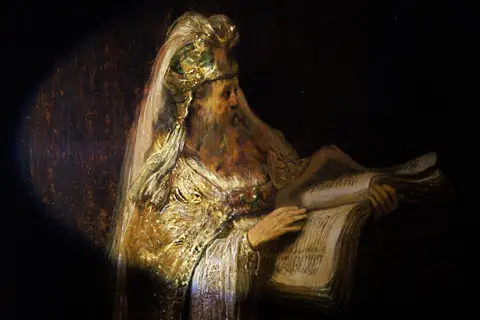
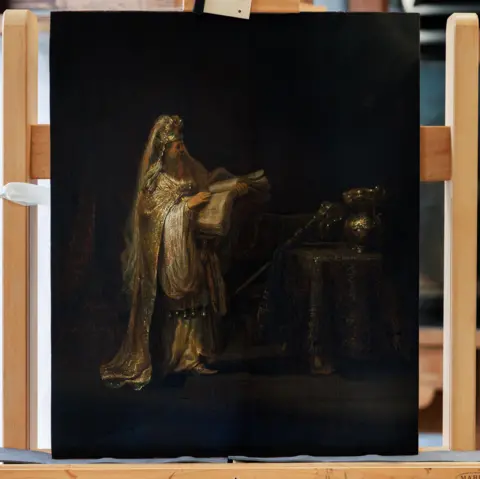
A long lost painting by Rembrandt has been rediscovered and authenticated by experts, after its whereabouts were unknown for decades.
Rembrandt’s Vision of Zacharias in the Temple, from 1633, was excluded from a list of the Dutch master’s works in 1960, and disappeared after being sold to a private collector the following year.
But it resurfaced when its owners presented it for tests at the Rijksmuseum in Amsterdam, which undertook a two-year examination.
“When I saw it in our studio when it was restored, I was immediately struck by the incredible power it has,” Rijksmuseum director Taco Dibbits said.
The Rijksmuseum receives many emails from people asking for information about paintings they have inherited or bought, Dibbits said. In this case, they knew it could be something special.
“It came to us via email and one of our curators thought, this is really an interesting image, we’ve known about the painting for over 100 years but we’ve never seen it.”
The museum confirmed the authenticity after studying the paints, which fit with those used by Rembrandt during that period, and the painting technique and build-up of layers, which are also comparable with his other early works.
The signature is original and the wooden panel dates from the correct period, the researchers said.
“Materials analysis, stylistic and thematic similarities, alterations made by Rembrandt, and the overall quality of the painting all support the conclusion that this painting is a genuine work,” the gallery said.
The painting has all the hallmarks of Rembrandt at the “peak” of the early part of his career, Dibbits said.
“It’s very high quality. Sometimes with Rembrandt’s portraits you feel that he’s producing in quantity, but with this painting you really feel that he dedicated his soul to it.”
The museum will put the painting on public view from Wednesday.
Its value is not known, but the world record auction price for a Rembrandt painting is £20m, set in 2009.
Other Rembrandt paintings to be sold in recent years include one for £8.6m in 2019, a self-portrait for £12.6m in 2020, and another once-lost Rembrandt work for £11m in 2023.
In 2015, a Rembrandt painting was given a price tag of £35m by the UK government after being sold privately.
Last month, a drawing of a lion by the artist sold for $18m (£13m).
[BBC]
Rembrandt was 27 when he created the painting, which depicts the Biblical scene when priest Zacharias is told by the Archangel Gabriel that despite their age, he and his wife will have a son, John the Baptist.
The museum said Rembrandt had given the Biblical story an innovative twist. Instead of depicting the Archangel Gabriel visibly, he only suggested his presence. In doing so, he departed from established visual traditions and introduced a new way of representing this subject.
Rembrandt deliberately chose the decisive moment, just before Gabriel reveals his true identity.
It is one of the few history paintings Rembrandt created during this period. At the time, he was primarily producing portraits, which were highly lucrative.
[BBC]

Cabinet nod to accept Japanese government grant of 08 used low floorboard buses

Payment of the financial subsidy for fertilizer to farmers cultivating paddy lands for the Yala season 2026.

Ministerial Committee appointed to submit recommendations on proposed program to mitigate loss of crops to wild animals

New Zealand elect to bowl first at Eden Gardens

Cabinet approves import of Maize to meet shortfall

Cabinet nod for the removal of Cess tax imposed on imported good

‘Dates have the highest sugar content to fight Coronavirus’

Sunday Island 27 December – Headlines

#SundayIsland 17th December – Headlines

Sunday Island – 28th March

Sunday Island Headlines – 21 March

Sunday Island – 21st February – Headlines
-

 Features3 days ago
Brilliant Navy officer no more
-

 Opinion6 days ago
Jamming and re-setting the world: What is the role of Donald Trump?
-

 Features6 days ago
An innocent bystander or a passive onlooker?
-

 Features7 days ago
Ratmalana Airport: The Truth, The Whole Truth, And Nothing But The Truth
-

 Opinion3 days ago
Sri Lanka – world’s worst facilities for cricket fans
-

 Business7 days ago
IRCSL transforms Sri Lanka’s insurance industry with first-ever Centralized Insurance Data Repository
-

 Business6 days ago
An efficacious strategy to boost exports of Sri Lanka in medium term
-
 Features4 days ago
Overseas visits to drum up foreign assistance for Sri Lanka