
Sports
Chetan Sharma resigns as India’s chairman of selectors after TV sting operation

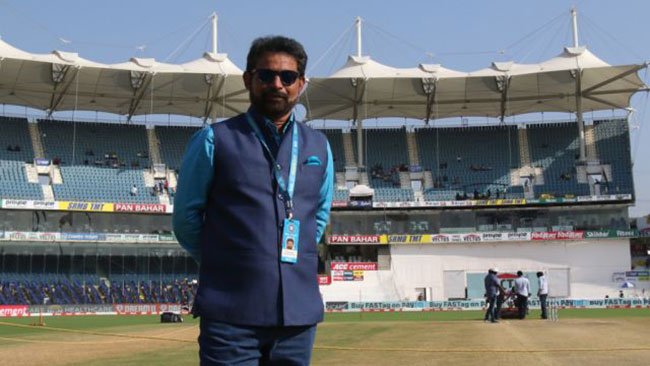
Chetan Sharma has resigned from his post as India’s chairman of selectors after being caught in an undercover TV sting operation. His resignation was accepted by BCCI secretary Jay Shah, according to an ANI report.
On February 14, an Indian TV news channel released video footage of Sharma talking about various matters relating to the national team, including alleged issues between Virat Kohli and former BCCI president Sourav Ganguly, and Jasprit Bumrah’s injury. It appears that Sharma did not know he was being filmed clandestinely at the time.
“Yes, Chetan has tendered his resignation to BCCI secretary Jay Shah and his resignation has been accepted. His position had become untenable after the sting operation,” a senior BCCI source told PTI. “He resigned voluntarily and wasn’t asked to resign.”
Sharma was reinstated as chief selector only in January, after the BCCI had removed the entire selection panel in November following India’s semi-final defeat from the 2022 T20 World Cup in Australia, and invited fresh applications. Sharma continued to function in his role until the new panel was appointed, with him once again as chairman.
His exit leaves India’s selection panel comprising Salil Ankola, SS Das, Subroto Banerjee and S Sharath, with the BCCI yet to appoint a new chairman.Sharma, 57, played 23 Test matches and 65 ODIs for India between 1984 and 1994.
(Cricinfo)


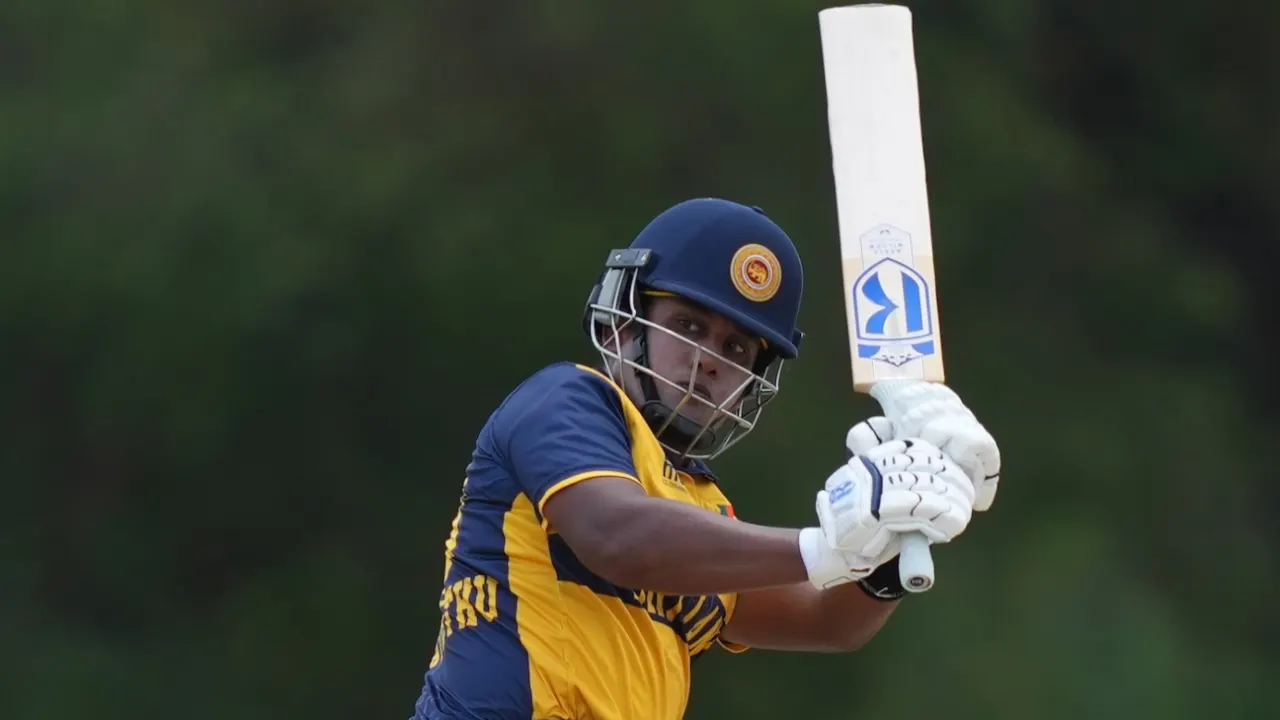
Chamari Athapaththu hit six sixes in an unbeaten 50-ball 83 to lead Sri Lanka into the final of the Asian Games Women’s Cricket Competition. Her innings helped Sri Lanka equal their highest total in a successful chase, after fifties from Shawaal Zulfiqar and Ayesha Zafar had helped Pakistan set them a target of 178.
Athapaththu was quiet at the start of her innings, and she could afford it because her opening partner Imesha Dulani gave Sri Lanka immediate impetus in their chase, hitting five fours in the first four overs before falling for a tone-setting 21-ball 27. At that point, Athapaththu was batting on 4 off 9. By the end of the powerplay, she had moved to 7 off 12, and hadn’t hit a single boundary.
The change of gear took place in a 20-run eighth over, in which she tonked Momina Riasat for 6, 4, 6, 4. The second six was a fortuitous one, a slog-sweep that Fatima Sana caught at deep midwicket only to step on the rope while attempting to toss the ball back into the field of play. A clean catch would have sent Athapaththu back for 18 off 19 balls.
Instead, the left-handed Athapaththu continued to take full toll of her match-up against left-arm spin, hitting two fours and a six off Nashra Sandhu in the 10th over to bring the equation down to 90 off 60 balls.
It was still far from straightforward, but Sri Lanka were unstoppable, with Hasini Perera catching up with her captain’s rate of scoring by hitting Tuba Hassan for two sixes and a four in the 13th over. Hasini fell at the end of the 14th over for a 26-ball 42, having put on 95 with Athapaththu in 56 balls.
When Hasini fell, Sri Lanka needed 47 off 36 balls; Athapaththu and Harshitha Samarawickrama needed just 23 of those balls to finish the job.
Sent in to bat, Pakistan posted their highest-ever T20I total against Sri Lanka, but they may have ended their innings feeling they had left a few runs out in the middle. Zulfiqar scored her second T20I half-century, but her 54 consumed as many as 50 balls. The impetus for Pakistan’s total came from Zafar, who came in at No. 4 and smacked 71 off just 40 balls, hitting nine fours and two sixes.
Zafar and Zulfiqar put on 115 for the third wicket in 70 balls, and nearly all the heavy hitting came from one end, with Zulfiqar contributing 37 off 30 to the partnership.
Scores:
Sri Lanka Women 178 for 2 in 17.5 overs (Imesha Dulani 27, Chamari Athapaththu 83*, Hasini Perera 42, Harshitha Samarawickrema 17*; Fatima Sana 1-24, Nashra Sandhu 1-38) beat Pakistan Women 177 for 4 ( Shawaal Zulfiqar 54, Saira Jabeen 17, Ayesha Zafar 71, Fatima Sana 20*; Sugandika Kumari 1-31, Chamari Athapaththu 1-30, Kavya Kavindi 1-13 ) by eight wickets
[Cricinfo]
by Rex Clementine
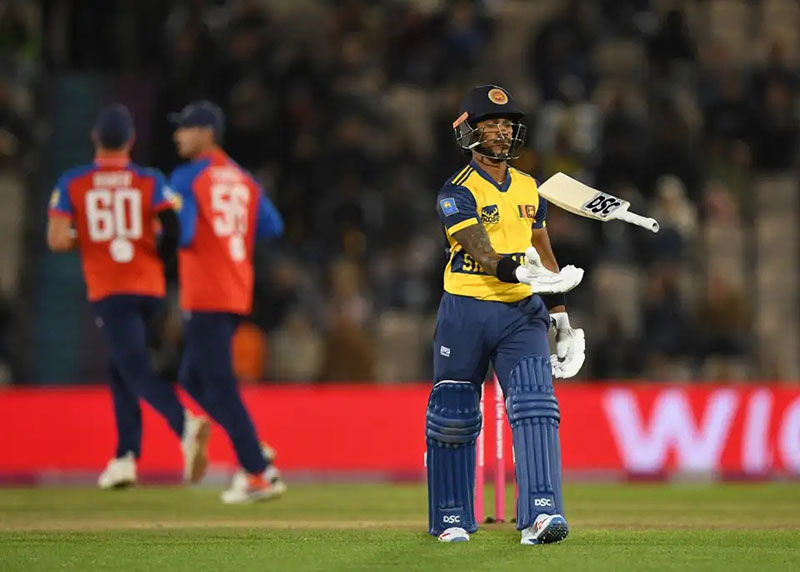
Sri Lanka have conceded an unassailable 2-0 lead to England in the three match T20I series and were staring down the barrel of a whitewash heading into Saturday’s final game at Old Trafford.
Despite travelling to the UK well in advance and playing warm up games to acclimatise to conditions, Sri Lanka have barely landed a punch. Both defeats have come by massive margins and more worryingly, they have exposed just how far the team has fallen behind the leading sides in T20 cricket.
The shortest format has been Sri Lanka’s Achilles heel for some time. Despite several players featuring in the IPL and other franchise leagues, not to mention having a domestic competition of our own in the LPL, the batting continues to lack the firepower required to consistently clear the ropes.
But the bigger concern is the lack of creativity. Sri Lankan cricket was once renowned for innovation and audacity although firepower was not our forte.
There was T.M. Dilshan, who turned conventional batting on its head by scooping the ball over the wicketkeeper and eventually had the shot named after him. Before him came Sanath Jayasuriya and Aravinda de Silva, two fearless stroke makers who destroyed bowling attacks and ended many an international career along the way.
Even Kumar Sangakkara, as he grew older, reinvented his white ball game, adding strokes and finding new scoring areas. It is therefore disappointing to see the current crop so reluctant to think outside the box. You wonder why Sri Lanka are no longer producing that kind of clever, inventive batsmanship.
One glaring issue is that Sri Lanka went into the World Cup with largely the same set of batsmen. It did not work. Yet the selectors have done precious little since to look beyond the established names and back someone who could provide a breath of fresh air.
If there is to be a change, the name being spoken about appears to be Niroshan Dickwella. At 33, however, that can hardly be described as a forward-thinking move. Dickwella has plenty of experience, but he is certainly not an investment for the future. The sooner the selectors recognise that, the better.
One man who appears to have slipped through the cracks is Avishka Fernando. He has been in red hot form for SSC in domestic cricket this season and crucially, he can play genuine pace and is capable of hitting quick bowlers back over their heads.
There may be concerns over his fitness, but if the skill is there, pick the player and get the coaches and trainers to work on the fitness. You cannot manufacture that ability to take on high class fast bowling quite so easily.
Sahan Arachchige and Pavan Rathnayake should also be part of the conversation. The selectors need to give serious thought to whether certain players should be specialists rather than trying to squeeze the same names into all three formats.
The harsh lesson from the England series is that Sri Lanka’s T20 cricket is miles behind the pace. We appear at least five years behind the leading teams. England, India, Australia and New Zealand are operating in a different league, and several other nations have also overtaken us.
That is the bitter truth this series has laid bare. There is little point sugar coating it. Sri Lanka need to bite the bullet, accept where they stand and take remedial measures.
Our approach to T20 cricket itself needs a rethink. The traditional Sri Lankan template seems to be to take a few risks during the six over Powerplay, with the loss of a couple of wickets considered acceptable, consolidate from overs seven to 15 and then launch at the death.
When everything clicks, that might get you 180.
For England, 180 is no longer the destination. They attack from ball one, keep attacking through the middle overs and when it comes off, threaten scores in the region of 230 or 240. There is no lengthy consolidation phase because their philosophy is built around relentless pressure on the bowling side.
Sri Lanka, meanwhile, are trying to play yesterday’s T20 cricket in today’s game.
That is why this series should be treated as a wake up call rather than simply another defeat overseas. The problem needs to be addressed head-on from selection and player development to power hitting, innovation and the very philosophy with which Sri Lanka approach the format.
Otherwise, reaching the semi-finals of a global white ball event could remain an unfulfilled ambition for a long time to come.
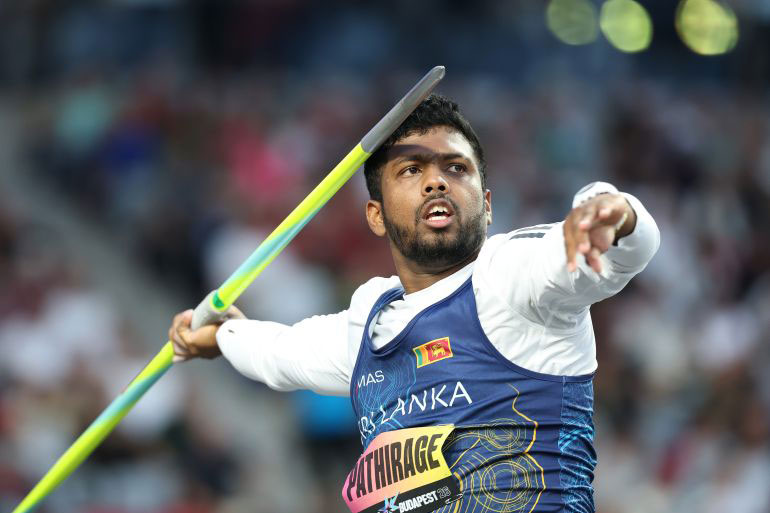
When Sri Lanka’s athletics contingent lines up in Nagoya later this week champion thrower Rumesh Tharanga will carry the nation’s hopes as the track and field team vie to better the records of the last edition.
The presence of the world number one ranked javelin thrower in their team is the biggest positive as the team try to fill the vacume created by the absence of Tharushi Karunaratne, the 800m runner who delivered the country’s first track and field gold in 21 years at Hangzhou 2022.
Tharushi’s absence leaves one man carrying an outsized share of Sri Lanka’s medal hopes.
There was a gold drought before Tharushi rewrote history at the last Asian Games.
Sri Lanka had gone without an athletics gold at the Asian Games since Damayanthi Dharsha’s 400m win in 2002.
Then, Karunaratne stunned a field that included an Olympic finalist to win the women’s 800m in Hangzhou, clocking 2:03.20 and setting off national celebrations. She also won an Asian Championships gold with a championship record in the 800m in 2023, becoming the face of Sri Lankan athletics’ modest but real resurgence.
Her absence this time not only leaves out a medal contender but the symbol of that resurgence. It puts real pressure on the rest of the team to prove Hangzhou wasn’t a one-off.
Tharanga, a genuine world-beater
Unlike most “hopes,” Tharanga’s case isn’t built on potential — it’s built on a season few Asian throwers have ever produced. He became the first Sri Lankan to clear 90m, hit a national record 92.62m at the Rome Diamond League, beat two-time Olympic medallist Neeraj Chopra to win both the Zurich Diamond League and the Commonwealth Games gold in Glasgow, and capped it with victory at the inaugural World Athletics Ultimate Championship in Budapest. He’s won 12 of 13 competitions in 2026, with his lone defeat a second-place finish in Rabat. Going into the Games, he’s ranked world No. 1.
Sri Lanka isn’t hoping for a surprise breakthrough this time, it’s expecting a coronation. Tharanga isn’t filling Karunaratne’s shoes as a plucky underdog story — he’s arriving as the outright favourite in his event, a status Karunaratne never carried into Hangzhou.
Tharanga’s build-up hasn’t been trouble-free. On his return flight from Budapest, five of his competition javelins — including the ones behind his three 90m-plus throws this year — arrived broken, reportedly at the hands of Turkish Airlines baggage handlers. His coach, Tony Prasanna, called it “a rude shock” and flagged the psychological toll of losing the exact equipment that produced a record-breaking season, just days before the Games.
Tharanga remains the clear favourite for javelin gold at Aichi-Nagoya.
For a small athletics program still building on Karunaratne’s breakthrough, Tharanga’s expected gold isn’t just another medal — it’s proof of continuity. A single stunning result in 2022 could be dismissed as a fluke; a dominant, world-class season from a different athlete in a different event, three years later, tells a different story: that Sri Lankan athletics is producing sustained international-level talent, not isolated miracles.
If Karunaratne’s Hangzhou gold announced that Sri Lanka could win at this level, Tharanga’s expected gold in Nagoya would confirm it wasn’t a one-time thing — at a Games where the team badly needs that reassurance in her absence.
Sri Lanka’s Track and Field Team
Rumesh Tharanga Pathirage – Men’s Javelin Throw
Kalinga Kumarage – Men’s 400m, Mixed 4 x 400m Relay, Men’s 4 x 400m Relay
Kalhara Idupa Silva
- Men’s 400m, Mixed 4 x 400m Relay,
Men’s 4 x 400m Relay
Sumedha Jagath Ranasinghe – Men’s Javelin Throw
Sadew Rajakaruna – Men’s 4 x 400m, Mixed 4 x 400m Relay
Omel Shashintha Silva
- Men’s 4 x 400m Relay
Pasindu Lakshan Kodikara – Men’s 4 x 400m Relay
Harsha Karunarathna
- Men’s 800m
Aruna Dharshana
- Men’s 4 x 400m Relay
Roshan Ranatunga
- Men’s 110m Hurdles
Ayomal Akalanka
-Men’s 400m Hurdle
Tharusha Dinushan Mendis – Men’s High Jump
J. H. Gayan Sampath
- Men’s Long Jump
Jithma Shenari Wijethunga
- Mixed 4 x 400m Relay, Women’s 4 x 400m Relay
Sayuri Lakshima Mendis
- Mixed 4 x 400m Relay, Women’s 4 x 400m Relay
L. G. Araliya Sathsarani
- Mixed 4 x 400m Relay,
Women’s 4 x 400m Relay
H. L. Nadheesha Dilhani Lekamge – Women’s Javelin Throw
Nethmika Madushani Herath – Women’s Triple Jump, Long Jump
Takshima Nuhansa Kodithuwakku – Women’s 800m
Nadeesha Ramanayaka
- Women’s 4x400m Relay
F. D. Chalith Piumal – Men’s 4x100m
Dineth Induwara Weeraratna
- Men’s 4x100m Relay
Merone Julian Wijesinghe – Men’s 4x100m Relay
Y. Chamod Mahinsasa Yodhasinghe
- Men’s 4x100m Relay

Chamari Athapaththu’s unbeaten 83 leads Sri Lanka into final

Showers expected in the Western, Uva, Sabaragamuwa and North-western provinces and in Galle, Matara, Kandy and Nuwara-Eliya Districts.

Namal Rajapaksa Buddhist gambit fails, bail denied

JR’s 17-year revolution transformed Lanka, says Ranil

Vehicle prices drop by up to Rs. 1 mn, says importers’ body

‘Dead’ man returns home nearly two months after his burial

‘Dates have the highest sugar content to fight Coronavirus’

Sunday Island 27 December – Headlines

#SundayIsland 17th December – Headlines

Sunday Island – 28th March

Sunday Island Headlines – 21 March

Sunday Island – 21st February – Headlines
-

 Opinion6 days ago
From Galkissa (Mount Lavinia) to Tambuttegama
-

 News3 days ago
US embassy won’t comment on IGP’s probe into joint drug raid
-

 Features5 days ago
The emptying university: why are academics leaving?
-

 Features6 days ago
Sri Lanka’s university crisis: Brain drain and union action demand urgent reform
-

 Business3 days ago
All-new Bolero MaXX unveiled in Sri Lanka
-

 Editorial6 days ago
Muscle flexing, astroturfing and dog-and-pony shows
-

 Opinion6 days ago
Ashraff: From the SLMC towards the National Unity Alliance
-

 News2 days ago
Bid for Basil’s extradition nears final stage: Police