
Latest News
Chapman, Abbas and Smith see off Pakistan challenge to give New Zealand 1-0 series lead

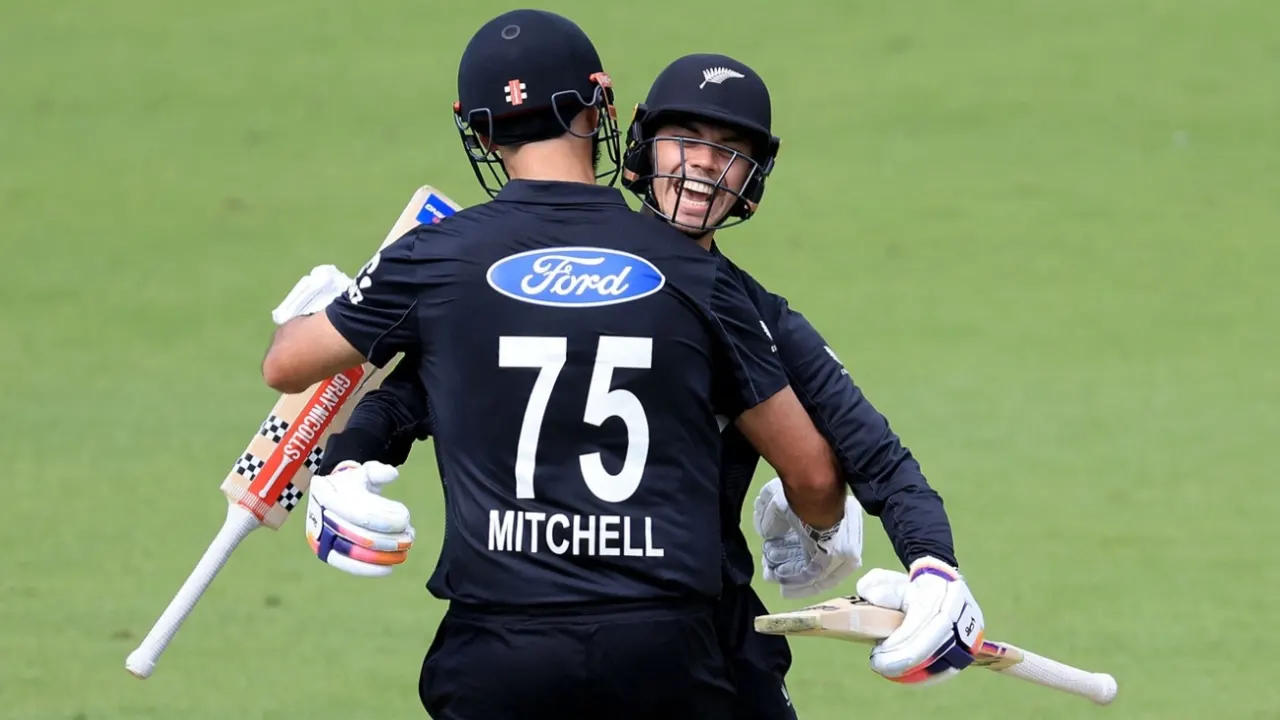
Mark Chapman inflicted misery upon his favourite opponents once more, a career-best 132 off 111 balls helping New Zealand to a 73-run victory in Napier. A strong start from Pakistan’s bowlers came undone by a 199-run fourth wicket partnership between Chapman and Daryl Mitchell, whose grittier 76 came in the slipstream of Chapman’s more regal knock. It was topped off by a cameo from Pakistan-born New Zealand debutant Muhammad Abbas, who scored the quickest 50 on debut in ODI history, taking 24-balls to get there as the hosts posted 344.
Pakistan’s response for large periods suggested they were well on course for victory. Fifties from Babar Azam and Salman Agha put Pakistan in pole position before Pakistan collapsed from 249 for 3 to 271 all out, losing three wickets for four runs as New Zealand turned the tables to seal a victory that was, for long periods, less comfortable than the final scorecard.
When Mohammad Rizwan won the toss and bowled first, it appeared a masterstroke. The seam bowlers were hooping it round corners, the life in the pitch presenting challenges New Zealand’s top order was finding insurmountable. Naseem Shah had Will Young nick off early while debutant Nick Kelly’s struggle of an innings came to an end when Akif Javed cleaned him up. Henry Nicholls perhaps looked the most uncomfortable of all, and when he miscued his umpteenth hook off Akif, there was almost relief at his misery coming to an end.
But New Zealand knew Pakistan were fielding just four bowlers, and as Chapman and Mitchell ground through the middle overs, they had to bring Salman Agha on at some stage. When they did, the hosts wasted little time putting him to the sword. A pair of backfoot sixes from Chapman in his third over made New Zealand’s intentions plain, and the stranglehold Pakistan had over them for the first half of the innings began to loosen.
With Chapman in irresistable touch, even Pakistan’s premier bowlers found it a struggle to contain him, and with Salman going for 67 in five overs, Irfan Khan, who had never before bowled a List A ball, was called upon. It was off him that Chapman brought him his hundred, a smite down the ground off a gentle medium pace producing four runs, as well as a roar and a dazzling smile from Chapman.
The wheels had come off Pakistan’s bowling effort completely by now. Even when Chapman and Mitchell fell, 21-year old Abbas had been given the perfect platform to showcase his power-hitting, which he duly did. He memorably took down Naseem at the death, a glorious six over cover a sign his talents extend beyond frenetic big hitting. He brought up his half-century off the innings penultimate ball; New Zealand had scored 166 in the final 15.
It was something of a miracle New Zealand didn’t take early wickets for how uncomfortable Usman Khan and Abdullah Shafique initially looked. While Shafique settled and began to show touches of the class that saw him feted upon his initial inclusion into Pakistan’s setup, Usman’s approach remained low-percentage and haphazard. His struggles against the short-ball were almost painful to see; however, by the time Nathan Smith goaded him into miscuing a pull, he’d amassed a handy 33-ball 39.
Shafique followed soon after miscuing a smear off Michael Bracewell, but Pakistan rebuilt with Babar and Rizwan. They kept the scoring ticking along and though the asking rate climbed during their 76-run partnership, it never quite spiralled out of control. It was Abbas who broke through when Rizwan edged him through for a sharp catch to the keeper, but that brought Agha – explosive form and all – out to the middle.
That stand appeared to have proved decisive. It was the one time New Zealand looked in disarray in the field as Babar and Agha picked off the bowlers at will. When Smith was slapped around for 21 in an over, punctuated by a majestic pull for six by Babar – who appeared to be motoring along to three figures, Pakistan had brought the asking rate to a shade above eight with just 96 runs to get.
It all turned on a dime, though, when Babar just couldn’t get enough power on a pull off O’Rourke. Mitchell was inches from touching the rope as he took the catch, but with Babar gone for 78, it all fell apart. A clumsy run-out and a first-ball duck for Irfan Niazi suddenly saw Naseem Shah and the tail out to the middle, and Pakistan realised there were far too many runs for Agha to get playing a lone hand.
Not that any serious attempt was ever made. Smith wound up the tail with applomb while Duffy stuck the dagger in when Agha holed out to leave the final pair at the crease. Akif slogged one last time at Smith and O’Rourke made no mistake. Pakistan, who had been ahead of New Zealand all through the chase, thought they were approaching the home stretch half an hour earlier. Instead, they fell off a cliff.
Brief scores:
New Zealand 344 for 9 in 50 overs (Mark Chapman 132, Daryl Mitchell 76, Muhammad Abbas 52; Akif Javed 2-53, Haris Rauf 2-38, Irfan Khan 3-51) beat Pakistan 271 in 444.1 overs (Abdullah Shafiqe 36, Usman Khan 39, Babar Azam 78, Mohammed Rizwan 30, Salman Agha 58; Jacob Duffy 2-57, Nathan Smith 4-60) by 73 runs
[Cricinfo]


Richie Berrington, the Scotland captain, called correctly as they elected to bowl against West Indies in a Group C fixture at Eden Gardens.
As part of their winter training, Scotland were scheduled to have a fitness test for all their players in Edinburgh on Saturday. Instead, here they are in Kolkata, having received an invitation less than two weeks earlier to participate in the T20 World Cup in place of Bangladesh.
“It’s a fantastic opportunity for us, it’s been a quick turnaround but everyone’e excited to be here,” Berrington said. “A lot of hard work has gone behind the scenes to get here. Since coming, we’ve had fantastic preparation in Bengaluru.”
Scotland have some wonderful memories of playing West Indies at the T20 World Cup – famously beating them by 42 runs in Hobart during the 2022 edition.
Talking of memories, it can’t get bigger than winning the T20 World Cup, which the West Indies did at this storied venue ten years ago when Carlos Brathwaite made everyone remember his name.
Their captain Shai Hope believes there’s a part of them that has confidence that they can start their campaign well. Johnson Charles is the only member from that April day to be a part of the current West Indies squad in a playing capacity; Darren Sammy, their captain then, is head coach.
Scotland: George Munsey, Matthew Cross(w), Brandon McMullen, Michael Jones, Tom Bruce, Richie Berrington(c), Michael Leask, Oliver Davidson, Mark Watt, Brad Currie, Safyaan Sharif
West Indies: Brandon King, Shai Hope(w/c), Shimron Hetmyer, Rovman Powell, Sherfane Rutherford, Jason Holder, Romario Shepherd, Akeal Hosein, Matthew Forde, Gudakesh Motie, Shamar Joseph
[Cricinfo]

The T20 World Cup started off with a heart stopper of a finish as Pakistan secured, then threw away, and finally clinched a thrilling last-over win, warding off a heroic Netherlands fightback. Faheem Ashraf was more saviour than hero, riding his luck to smash 24 in the game’s penultimate over having survived a dropped chance, and finishing the game off with three balls to go. The three-wicket win keeps them on course for qualification to the next round, even as it seemed nine balls earlier that they were destined for another early exit.
Pakistan were well on course for victory at the halfway mark of the chase, needing 50 in nine overs, before Paul van Meekeren struck with a double-wicket maiden, and Pakistan collapsed under the weight of the slightest pressure. Babar Azam, who needed only to anchor with the chase under a-run-a-ball, found himself slogging aimlessly and holing out to Roelof van der Merwe, and run-scoring amnesia took hold – just 21 were made in the seven overs between the 12th and the 19th, with five wickets falling.
But Logan van Beek, who had struck earlier to dismiss Shadab Khan, found his first ball disappearing over cow corner for six. He varied the pace and got Faheem to scoop it straight up to long-on. Max O’Dowd got underneath it and got both hands to it, only to find to his horror the ball popping back out and harmlessly to his side. Faheem plundered two more sixes and a boundary before the over was out, and Netherlands realised their chance had gone.
Netherlands began brightly with the bat, and continued to target the Pakistan bowlers without worrying about the fall of wickets. The 79 they put up in the first ten was comfortably their highest ten-over score against Pakistan. Michael Levitt, Bas de Leede, Colin Ackermann and Scott Edwards all chipped in with handy knocks as partnerships kept them ticking over. However, a poor final four overs cost them dear as they lost six wickets for 20 runs to finish 20 runs short of where they might have been.
Pakistan started as if they would make short work of the small chase. Saim Ayub flew out of the blocks, and once his cameo ended, Sahibzada Farhan followed in his footsteps. Netherlands appeared to have had the fight knocked out of them, and Pakistan’s win looked inevitably straightforward. Van Meekeren, and a heartbroken Netherlands side, made sure it was anything but.
Under unexpectedly bright skies, Netherlands, put in to bat by Salman Agha, who was surprised at the amount of grass on the pitch, put the pressure on Pakistan early. The first ball was dispatched by Michael Levitt for four, who hit the shot of the game with a glorious pulled six off Shaheen Shah Afridi in his following over. Netherlands are top heavy, with most of their destructive batting potential concentrated in the top five, but it didn’t stop them taking risks to keep their run rate as high as they possibly could.
Edwards said post-match that he thought Netherlands weren’t at their best in any of the three departments, but one of their routes to victory would have been Levitt producing a big knock to boost their total. He looked on course to do just that in the powerplay, and appeared to have connected cleanly when he slashed Mohammad Nawaz back over his head high.
It looked to be heading over the rope until Babar, seemingly out of nowhere, burst into frame and let the ball plant into his palms, before scooping it back up into the field of play a moment before he exited it. He had barely broken stride while Afridi, on the same wavelength, came across to complete the catch and make the game’s crucial early breakthrough.
So often a point of weakness for Pakistan, it was a sign of a flawless fielding and catching performance, one that didn’t give Netherlands an inch. And, as witnessed at the end, every inch did matter.
The fears of Netherlands tailing after the fall of the top five were well-founded, after all. Edwards dismissal meant the loss of Netherlands’ last proper attacking batter, leaving them denuded for power at the end. Abrar Ahmed was varying his pace and line superbly and kept building the pressure, while Saim Ayub, mysteriously held back and bowled just once, took two quick wickets in his only over. Salman Mirza and Afridi applied the coup de grace as the last six folded cheaply; Netherlands had gone from 127 for 4 to being dismissed for 147.
It is perhaps just as well for Pakistan that Faheem pulled a rabbit out of the hat, because they might have otherwise spent the rest of their careers explaining how this one slipped out of their fingers. Pakistan were the most prepared team of any at this tournament, having played 34 T20Is since the end of May, all engineered to ensure they were acclimatised to whatever situation a T20I could throw at them.
And this one wasn’t throwing much either. In 11 overs, they had cruised to 98 for 2, 50 away against a mismatched opponent having a poor day with the ball. But when 41-year-old van der Merwe galloped in from the deep to take a stunning catch diving forward, fear of failure seemed to take an iron hold on Pakistan. Two balls later, Usman Khan chopped on, and just when Pakistan might have wanted Babar to play the same sedate way he already was, he had a low-percentage hoick off van der Merwe to pick out long-off.
And all the while, runs suddenly became endangered species. Pakistan blocked and hacked in panic, getting nowhere as the asking rate piled up. Between the 11th and 18th overs, it had ballooned from just over five to just under 15. Few games have turned on such a dime with no discernible change in circumstances. Pakistan had Faheem, and perhaps O’Dowd, to thank that it twisted once more in their ultimate favour.
Brief scores:
Pakistan 148 for 7 in 19.3 overs (Shaibzada Farhan 47, Saim Aub 24, Salman Agha 12, Babar Azam 15, Faheem Ashraf 29*; Paul van Meekeren 2-20, Aryan Dutt 2-33, Logan van Beek 1-46, Kyle Klein 1-23, Roelof van der Merwe 1-13) beat Netherlands 147 in 19.5 overs (Michael Levitt 24, Scott Edwards 37, Bas de Leede 30, Colin Ackermann 20, Aryan Dutt 13; Shaeen Shah Afridi 1-2, Salman Mirza 3-24, Saim Ayub 2-07, Abrar Ahmed 2-23, Moammad Nawaz 2-38) by three wickets
[Cricinfo]

US President Donald Trump has signed an executive order threatening to impose additional tariffs on countries that continue to trade with Iran.
The order, issued on Friday, does not specify the rate that could be imposed, but uses 25% as an example. It says the tariff could apply to goods imported into the US from any nation that “directly or indirectly purchases, imports, or otherwise acquires any goods or services from Iran”.
Trump has not directly commented on the order but reiterated “no nuclear weapons” for Iran when speaking from Air Force One on Friday night.
It comes as talks continue between senior US and Iranian officials in Oman, following several weeks of threats from both sides.
Trump threatened a 25% tariff of countries doing business with Iran earlier this year, in a post to Truth Social.
On 12 January, he wrote: “Effective immediately, any country doing business with the Islamic Republic of Iran will pay a tariff of 25% on any and all business being done with the United States of America.”
At the time, no further detail was provided on how the tariffs would work in practice.
[BBC]

Colorado funeral home director sentenced to 40 years for corpse abuse

Scotland opt to field against West Indies

Faheem Ashraf drags unconvincing Pakistan over the line after big scare

Trump threatens tariffs for countries trading with Iran

Advisory for Severe Lightning for the Western and Sabaragamuwa provinces and Galle and Matara districts

Decisions and judgments of the Supreme Court are a reflection of justice in the country – PM

‘Dates have the highest sugar content to fight Coronavirus’

Sunday Island 27 December – Headlines

#SundayIsland 17th December – Headlines

Sunday Island – 28th March

Sunday Island Headlines – 21 March

Sunday Island – 21st February – Headlines
-

 Business5 days ago
SLIM-Kantar People’s Awards 2026 to recognise Sri Lanka’s most trusted brands and personalities
-

 Business7 days ago
Altair issues over 100+ title deeds post ownership change
-

 Business7 days ago
Sri Lanka opens first country pavilion at London exhibition
-

 Business6 days ago
All set for Global Synergy Awards 2026 at Waters Edge
-

 Business5 days ago
API-first card issuing and processing platform for Pan Asia Bank
-

 Business7 days ago
ESOFT UNI Kandy leads the charge in promoting rugby among private universities
-

 Editorial3 days ago
All’s not well that ends well?
-

 Features3 days ago
Phew! The heat …