
Latest News
Myanmar quake toll passes 1,600 as people dig for survivors with bare hands

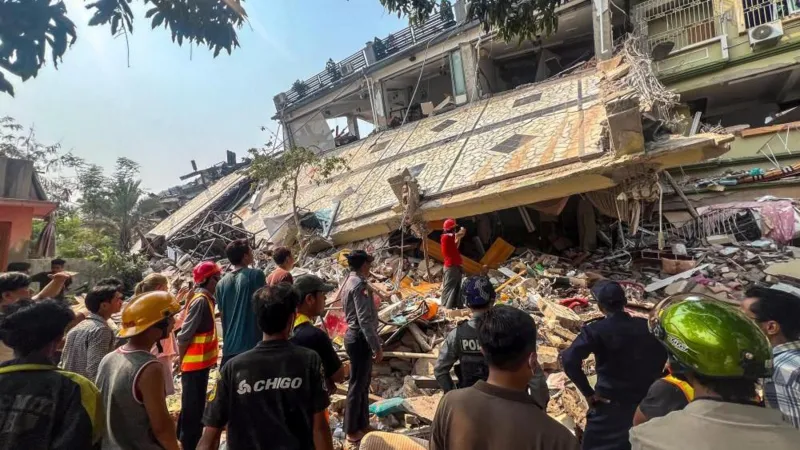
The number of people known to have died following the devastating earthquake in Myanmar has risen to more than 1,600, with people in some areas telling the BBC they had been left to dig through rubble for their loved ones with their bare hands.
An acute lack of equipment, patchy communication networks and wrecked roads and bridges were also hampering the search for survivors.
The quake has flattened much of Mandalay, the country’s second-largest city. There was applause when rescuers pulled a woman alive from the wreckage of a 12-storey apartment block some 30 hours after it collapsed, but the Red Cross says more than 90 people may still be trapped there.
In a nearby township, rescue workers found the bodies of 12 preschool children and a teacher under a building housing a kindergarten.
Cracks and surface distortions to the main highway between the biggest city Yangon, the capital Nay Pyi Taw and Mandalay had caused severe transport disruptions, UN humanitarian agency OCHA said.
There were also shortages of medical supplies including trauma kits, blood bags, anesthetics, essential medicines and tents for health workers, it said.
Although rescue teams have been at work since yesterday and international aid has begun to enter the country, help is yet to reach the worst-hit areas and ordinary people have been trying to dig survivors out by hand.
Widely shared footage shows two men moving rubble to pry out a young woman trapped between two concrete slabs.
The BBC has spoken to locals who said that people were screaming for help from under the debris.
Elsewhere, other rescue workers have been listening out for signs of life. ”We can only rescue people when we hear them,” one said.
Earlier on Saturday, a rescue team in the Sintkai township in Mandalay’s Kyaukse district pulled out a number of people trapped in the debris of a private school. Six of them – five females and one male – had died by the time the rescue teams arrived. Among the victims were students, teachers and school staff.
A lack of equipment is greatly slowing down the rescues, a worker told BBC Burmese: “We are making do with the equipment we have. We have been trying for hours to pull out a girl trapped under the collapsed school.”
Another worker in Mandalay told a BBC reporter in Yangon that communication had been near impossible.
“The main thing is that we don’t have internet lines, we don’t have phone lines, so it’s very difficult to connect with each other. The rescue team has arrived. But we don’t know where it will go, because the phone lines are down.”
A Mandalay resident said people were doing their best in the chaotic circumstances.
“There is no coordination in the rescue efforts, no one to lead them, or tell them what to do. Locals have had to fend for themselves. If they find dead bodies in the debris, they don’t even know where to send the bodies; hospitals are overwhelmed and unable to cope,” the resident said.
The junta has put the number of damaged buildings in the Mandalay region, the epicentre of the earthquake, at more than 1,500. Power outages have exacerbated the situation, and according to officials restoring power could take days.
Mandalay airport is not functional as the runways were damaged during the earthquake. The military council said that it had been working to resume operations and a temporary hospital, medical relief camp and shelter have been set up there.

Less than 25km (15 miles) from Mandalay in Sagaing, the older of two bridges connecting the regions has completely collapsed and the newer one has developed cracks, cutting off access for rescue teams.
“Right now, there are not enough people even for emergency rescue. We can’t pick up bodies, there are so many people trapped. We can’t cross either bridge, so we are all trapped in the rubble. Please help emergency rescuers come and rescue us,” a local resident told BBC Burmese.
The recently constructed capital Nay Pyi Taw, where the military junta is headquartered, has been hit by aftershocks and small tremors. The city has seen extensive damage with high numbers of casualties, collapsed buildings and buckled roads.
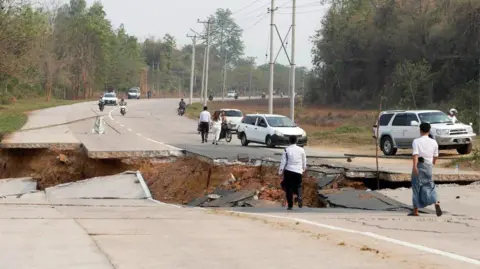
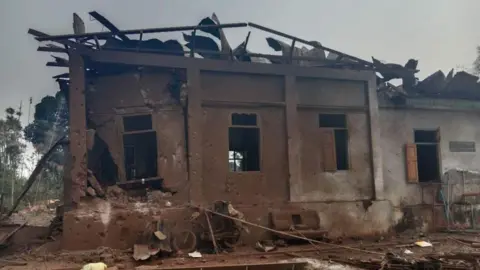
Meanwhile, even while the junta has made a rare international appeal for aid, it has continued air strikes and drone attacks against the ethnic armies and armed groups it has been fighting in the country’s four-year civil war.
BBC Burmese confirmed that seven people were killed in an air strike in Naungcho in northern Shan state. This strike took place around 15:30 local time, less than three hours after the quake struck.
Pro-democracy rebel groups fighting to remove the military from power have reported aerial bombings in Chang-U township in the central Sagaing region, the epicentre of the quake. There are also reports of airstrikes in regions near the Thai border.
The UN’s special rapporteur on human rights in Myanmar, Tom Andrews, urged the junta to cease bombing raids.
“The problem is that you still have military operations going on right now… Military strikes by the military junta,” he told the BBC.
“I’m calling upon the junta to just stop, stop any of its military operations. This is completely outrageous and unacceptable.”
[BBC]


There are heists, and then there are heists, and the one at Sabina Park on Sunday will live long in the memory of those who watched it. For 16 overs of the chase, Sri Lanka had looked in total control of their defence of 169. But in a frenzied finish, West Indies ransacked 60 runs off just 22 deliveries to complete the chase with two balls to spare.
Sherfane Rutherford was dropped twice on the way to an unbeaten 54 off 40, and he was part of the defining stand of the match – 81 off 53 with Rovman Powell. But despite their intervention, West Indies still needed more and it was the returning Jason Holder that delivered, smashing 21 off five balls to seal the win and the series.
The result stretched Sri Lanka’s wait for a T20I series win in the Caribbean, but more immediately, left them scratching their heads. In terms of planning, they could not have done much more, while the pitch was tailored to their strengths – namely the spin trio of Maheesh Theekshana, Wanidu Hasaranga and Dunith Wellalage.
The latter had even picked up skipper Shai Hope off just the second delivery of the innings, while Hasaranga snagged two through the middle. Theekshana, meanwhile overcame a tough 15-run opening over – courtesy Shimron Hetmyer. – to give away just 11 off his next three.
With the bat too, Sri Lanka had done seemingly enough, with Pathum Nissanka’s fast start supplemented by some helpful middle-order cameos and bookended by a coming-of-age 43 off 28 from Wellalage.
But at the key moments, it was West Indies, who held their nerve. Player-of-the-Match Shamar Joseph ended with career-best figures of 5 for 33, and did so bowling in the game’s most difficult periods – the last over of the powerplay and the final over of the innings.
And then when the game seemed over, West Indies’ fabled firepower belatedly came to the fore, as they came in clutch once more.
In the first game, West Indies struck 29 in the death overs. And in the second game, 27. With 60 needed in that same period in the decider, the odds weren’t exactly in their favour.
But across two Dushmantha Chameera overs, where the usually reliable quick struggled – searching fruitlessly for yorkers – West Indies pilfered 47 runs, and staged a comeback for the ages.
How they got there was modern West Indies cricket in a nutshell. Sri Lanka strangled the middle overs, with their trio of spinners all proving tough to get away. The powerplay had fetched a respectable 51 – much of it owing to Hetmyer’s 32 off 19 – but the middle overs turned as sluggish as the surface, with West Indies trudging to 110 for 4.
But having struggled to get Sri Lanka’s death bowling away for much of the series, they capitalised on the off-colour Chameera to secure an all-time smash and grab. The pacer’s third over went for 24, and then his last for 23. They were the 17th and 19th of the innings. From being on the verge of defeat at the end of the 16th, the game was over before the 20th had begun.
Sri Lanka, though, might wonder what might have been had they not grassed two straightforward chances from Rutherford when he was on 24 and 25.
Sri Lanka had started well in the powerplay in the earlier games, and that looked to be the case on Sunday night as well.
While Kusal Mendis was for once dismissed cheaply – a chipped leading edge plucked out of the air by Matthew Forde followed by a spicy send-off and heated words – Pathum Nissanka, who has had a quiet tour by his standards, belatedly took up the attacking mantle.
On a surface that was gripping from the very first delivery, Nissanka started patiently before gradually flexing his striking chops. His 26 off 17 including two fours and two sixes.
But just as he might have been settling in for a game-defining stint, Joseph induced a top-edge and followed it up with one that straightened down the line to completely bamboozle new batter Pavan Ratnayake. Two in two – echoing Holder’s powerplay heroics in the first game – and Sri Lanka were kept to 51 for 3, their lowest powerplay of the series.
Joseph would somehow better this outcome later on with a sublime triple-wicket final over to give the hosts some much-needed momentum into their chase.
Following Joseph’s double-strike, Sri Lanka were rightfully wary of losing any further wickets, which saw Kamindu Mendis join Kamil Mishara – who had got his eye in during the powerplay – out in the middle. The pair strung a stand of 21 off 22 to keep things ticking, and this trend continued with each successive partnership over the period.
Dasun Shanaka’s arrival brought some power to the proceedings, as he wasted little time in tearing into Roston Chase with a six over long-on. His stand with Kamindu was brief but effective as the pair managed 16 off seven, followed by one worth 23 off 21 with Wellalage.
On another day, Shanaka’s dismissal – cleverly bowled by Holder – might have signalled a drop in the scoring rate, but Wellalage – brought into the XI in the previous game to strengthen the lower-order batting – produced a knock that was a statement.
A slog sweep over deep square-leg off Chase signalled his early intent, but it was over the extra cover region that the left-hand batter truly prospered. Time and again, he was able to manufacture drives and scythes into that vacant – but generally tough to access – region in front of square on the off side.
And he was ably supported by Hasaranga, as the pair managed an innings-best stand of 49 off 28. By the time Wellalage fell in the final over – miscuing one off the impressive Joseph – he could walk off safe in the knowledge that he might have struck a potentially series clinching 43 off 28.
Sri Lanka’s target, having come to terms with the pitch midway through their innings, might have been in the region of 160-170. But while they managed 169 in their 20 overs, it’s likely they will feel like they left runs behind – particularly as they had 156 for 6 at the start of the penultimate over.
The West Indies fightback was triggered by a piece of magic from Rutherford at deep point, as he picked up and sent in an arrowed direct hit to find Hasaranga well short in trying to steal a second.
Then returned Joseph at the last, and he responded to a first-ball boundary by removing Wellalage next delivery and Chameera one ball later, capturing his second double of the evening. Joseph capped off proceedings with a searing final-ball yorker to dismiss Theekshana as the last man.
It meant West Indies had restricted Sri Lanka to just 15 off the last 12 deliveries, and kept themselves in the game – something that eventually proved even more crucial in the game’s frenetic closing moments.
Scores:
West Indies 170 for 5 in 19.4 overs (Brandon King 16, Shimron Hetmyer 32, Rovman Powell 33, Sherfane Rutherford 54*, Jason Holder 21*;Dunith Wellalage 1-23, Dushmantha Chameera 1-64, Maheesha Theekshan 1-36, Wanidu Hasaranga 2-17) beat Sri Lanka 169 in 20 overs (Pathum Nissanka 26, Kamil Mishara 28, Kamindu Mendis 20 Dasun Shanaka 16, Dunith Wellalage 43, Wanidu Hasaranga 21; Akeal Hosein 1-31, Matthew Forde 1-39, Jason Holder 1-33, Sharmar Joseph 5-33, Roston Chase 1-32) by five wickets
[Cricinfo]
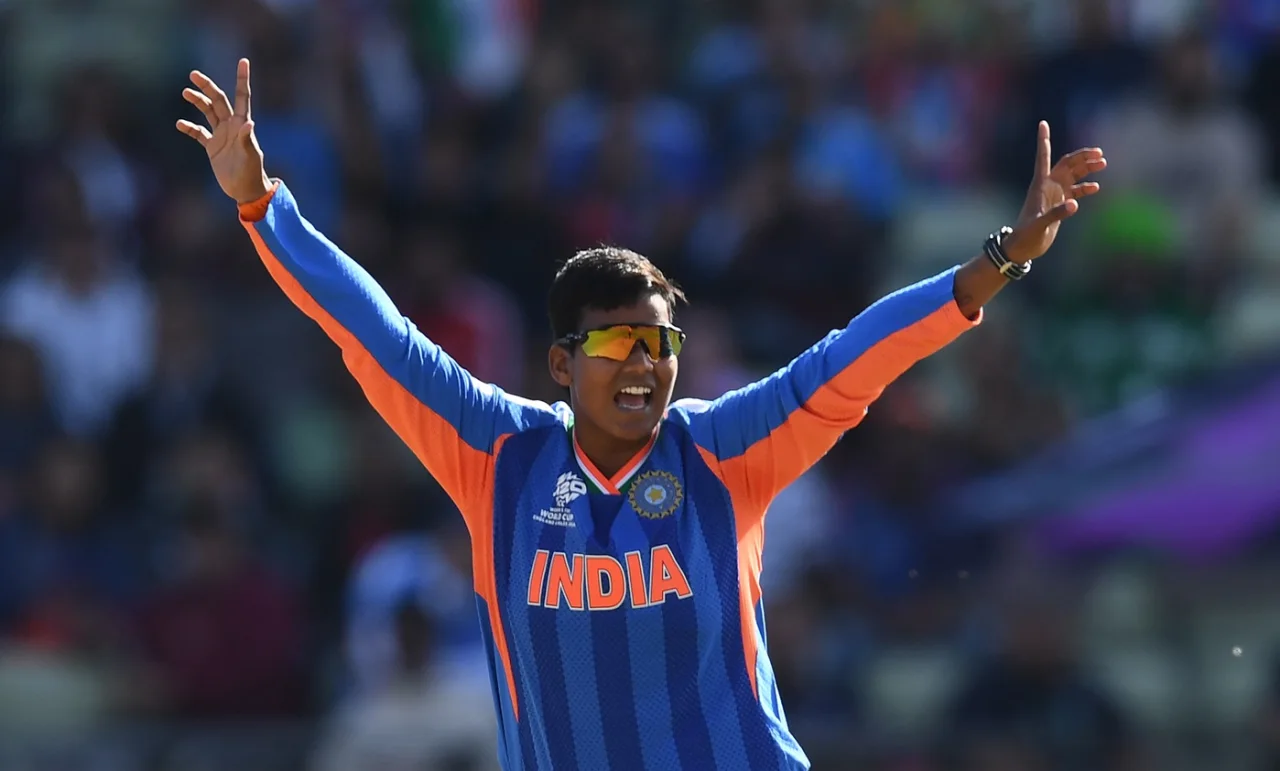
Smriti Mandhana and Deepti Sharma bailed India out with bat and ball respectively to fire them to an emphatic opening win over Pakistan in front of a sellout crowd in Birmingham on Sunday.
Mandhana top-scored with 68 to lift India from 18 for 2 to 170, their highest in a T20 World Cup against Pakistan. Then, Deepti struck twice in two overs after Pakistan’s openers rattled 38 in quick time.
Deepti’s blockbuster act, though, was a direct hit from short third to run out the dangerous Muneeba Ali for 41, triggering a collapse Pakistan didn’t quite recover from. They lost 5 for 26 through the middle phase as India’s spinners tightened their grip. They were eventually bowled out for 106, with Deepti finishing with 5 for 10 to become the highest wicket-taker in women’s T20Is.
In a match where both teams missed a number of opportunities on the field, the eventual difference was India’s death-overs lift. Richa Ghosh, who allayed fears of a form slump during the warm-ups last week, smashed 34 off 17. This included a sequence of four fours and a six off her last eight legal deliveries to help India muscle 60 off the last six overs when it seemed like they’d finish around 150.
That not only helped India finish on a high, but also gave them a massive net run rate cushion in what is being dubbed the group of death.
India looked to go hard early. Shafali Verma launched her first ball for six, but was caught behind four balls later off left-arm spinner Sadia Iqbal in trying to manufacture a boundary opportunity. Jemimah Rodrigues then played an uncharacteristic swipe to be taken at cover in the fourth over, giving left-arm seamer Tasmia Rubab a wicket off her second ball on World Cup debut. At 18 for 2, India needed to stem early damage.
Mandhana offset some of that early pressure by hitting two boundaries off spinner Rameem Shamim in the fifth over. Mandhana was on 27 when Aliya Riyaz dropped her running back from mid-off to deny Rubab a second wicket. At that stage, India were struggling for momentum at 44 for 2 in the 8th over.
Fatima Sana rustled through the middle overs with spin as Harmanpreet Kaur also took her time to settle in, scoring 5 off 10 at one stage. But the introduction of left-arm spinner Nashra Sandhu forced a slight change in approach as Harmanpreet hit her for two boundaries in her first over, and India scored 24 between overs 7-10.
Mandhana was particularly superb in stepping out and hitting inside-out over cover, one such boundary helped her raise a 34-ball half-century. Soon after, Saira Jabeen reprieved her for a second time at deep midwicket off Iqbal. You got the sense the floodgates had truly opened.
Mandhana holed out to long-on for 68 to give Pakistan a reprieve. That turned into double-delight three balls later when Bharti Fulmali was stumped, giving Iqbal the charge. When Harmanpreet flicked Fatima Sana to deep square, India had lost 3 for 14. India then went through a 21-ball period without a boundary before the runs came in a torrent in the last two overs.
Rubab, who came into her final overs with figures of 3-0-17-1, was then taken to the cleaners with Ghosh hitting her for a sequence of 4, 6, 4, 4 in a 23-run over. After displaying her brute force in the leg-side arc between mid-on and deep midwicket in the penultimate over, Ghosh’s deft touches helped pocket 15 off the final over to help India sign off with momentum on their side.
Muneeba should’ve been out in the second over when she jabbed at a sharp-turner from offie Shreyanka Patil, only for Ghosh to fluff an opportunity. Then in the fourth over, Shreyanka deceived her in flight to slice a drive to point where Arundhati Reddy put down a straightforward chance. In between that, Muneeba threw Kranti Gaud off her lengths by walking across to scoop. She was also quick to pick length and cut well as Pakistan raced to 37 for 0 in four overs.
Across the next six overs, Pakistan lost the cream of their middle order as India’s spinners tightened their grip, picking up 4 for 21. Deepti aside, Shree Charani, on T20 World Cup debut, gave an excellent account of herself, picking up 3 for 21 in the middle overs. Deepti then picked up three wickets in her fourth over to wrap up the game in the 17th, giving India a massive win and walking away with the Player of the Match award.
SCORES:
India Women 170 for 6 in 20 overs (Smriti Mandhana 68, Harmanpreet Kaur 36, Richa Ghosh 34, Deepti Sharma 12*; Sadia Iqbal 2-41, Fatima Sana 2-33, Tasmia Rubab 1-41, Rameem Shamim 1-30) beat Pakistan Women 106 in 17 overs (Muneeba Ali 41, Gull Feroza 12, Ayesha Zafar 12, Aliya Riyaz 18; Deepti Sharma 5-10, Shree Charani 3-21, Shafali Verma 1-22) by 64 runs
[Cricinfo]

Boualem Khoukhi scored an equalising goal on a header in the fourth minute of stoppage time, and Qatar spoiled a dominant day by Switzerland in a 1-1 draw in Group B of the World Cup.
Several of the Qatari players fell to the ground on Saturday in celebration of the late goal, as others ran to each other to embrace.
Breel Embolo scored for Switzerland from the penalty spot in the first half just over a week after being cleared to enter the US following a visa delay, but the Swiss failed to capitalise on multiple other scoring chances.
In the 13th minute, Embolo was fouled by Qatar goalkeeper Mahmoud Abunada, who received a yellow card on the play. Abunada lay face down and appeared motionless for a couple of minutes before he began to move his legs and was able to stand up again.
When Embolo calmly sent his penalty into the upper left corner in the 17th minute, it sent the red-clad Swiss fans into a dancing frenzy in the stands of San Francisco Bay Area Stadium.
The 29-year-old forward applied for an urgent visa at the United States embassy in Bern on June 3, one day after he was denied boarding the team’s flight to travel for his third World Cup because of a 2018 criminal conviction that was only finalised in April.
Switzerland dominated the possession game on an unseasonably warm June afternoon — with sprinklers running during a first-half break.

There were thousands of empty seats scattered throughout Levi’s Stadium, home of the NFL’s San Francisco 49ers. Brazil and Colombia drew 70,971 two years ago in a group match at the Copa America. The stadium in Santa Clara staged the Super Bowl only four months ago.
(Aljazeera)

Holder completes heist for West Indies after Joseph picks up five

Mandhana, Deepti, Ghosh star as India breeze past Pakistan

Showers will occur in the Western, Sabaragamuwa and North-western provinces and in Galle, Matara, Kandy and Nuwara-Eliya districts

Theft of USD 2.5 mn from Treasury: CoPF accused of complicity in NPP cover-up

Viral diseases on the rise

Ranil warns of another economic crisis, calls for Opposition unity

‘Dates have the highest sugar content to fight Coronavirus’

Sunday Island 27 December – Headlines

#SundayIsland 17th December – Headlines

Sunday Island – 28th March

Sunday Island Headlines – 21 March

Sunday Island – 21st February – Headlines
-
 News4 days ago
CIABOC summons Yoshitha over his participation in British Navy training programme
-

 News6 days ago
Local firms move millions of dollars overseas for phantom imports: Govt.
-
 Midweek Review6 days ago
July 09: An inexcusable overall security failure and exceptional contingency plan
-

 Opinion7 days ago
Could Sri Lanka once again face an economic crisis similar to 2022?
-

 News6 days ago
AI raises concerns over arrest of Sallay and rapper under PTA
-

 News3 days ago
Commonwealth lawyers urge Lanka to uphold rule of law
-
 News7 days ago
Sallay refuses to end hunger strike unless probe is taken out of CID led by Shani
-

 Features2 days ago
Politics of protected species