
News
Ceylon Chamber of Commerce entrusts over a century of business history to the National Archives

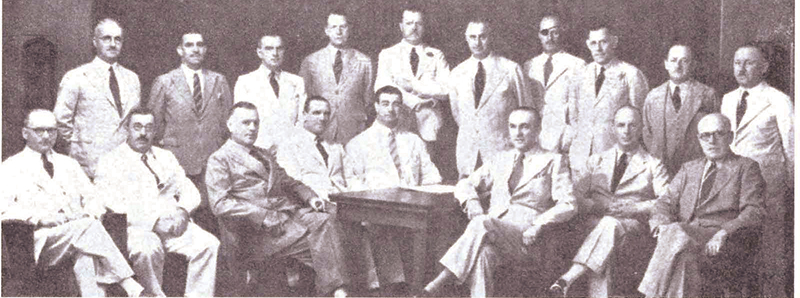
The Ceylon Chamber of Commerce has formally handed over its historical records to the National Archives Department of Sri Lanka, placing over a century of the nation’s commercial history into the care of the country’s official custodians of heritage.
The historical archive being handed over spans from the Chamber’s founding in 1839 to 1973, and includes correspondence, meeting minutes, reports, ledgers, and publications that chronicle the development of trade, enterprise, and industry in Sri Lanka. Together, these records provide a rare and detailed account of how the island’s economy evolved and how its business community helped shape national progress.
The Ceylon Chamber of Commerce was established on 25 March 1839 on the principle that the interests of commerce and trade are best advanced when merchants unite and cooperate in matters affecting the common good. At the time, Ceylon was among the earliest regions in Asia to establish a chamber of commerce, alongside counterparts in Bengal, Bombay, Madras, Canton, Penang, and Singapore.
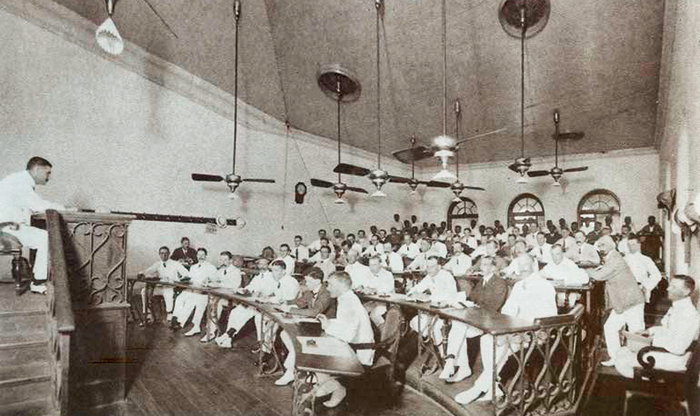
1883 First Public Tea Auction Held in Colombo

Chamber Office Bearers and Staff at the building in Lower Chatham Street, Fort shortly before the move to the new building at Navam Mawatha

Old CCC Building
From its earliest years, the Chamber played a central role in organising and guiding trade. It played a central role in establishing and growing the export economy built on commodities such as coffee, cinnamon, coconut oil, tea, and rubber, and hosted the island’s renowned tea and rubber auctions. It also developed rules and standards for trading practices, helping create an environment of trust and reliability that enabled Sri Lanka’s commerce to thrive.
Beyond facilitating trade, the Chamber was also instrumental in shaping the island’s infrastructure and connectivity. In 1858, it successfully urged the government to accept India’s proposal to link Ceylon to the Madras telegraph line, giving the island its first cable connection to the outside world. The Chamber also advocated for a government-owned Colombo–Kandy railway to connect the coast with the interior and continued to press for extensions stage by stage as the network expanded into the hill country and beyond.

Earliest dated record from 1839
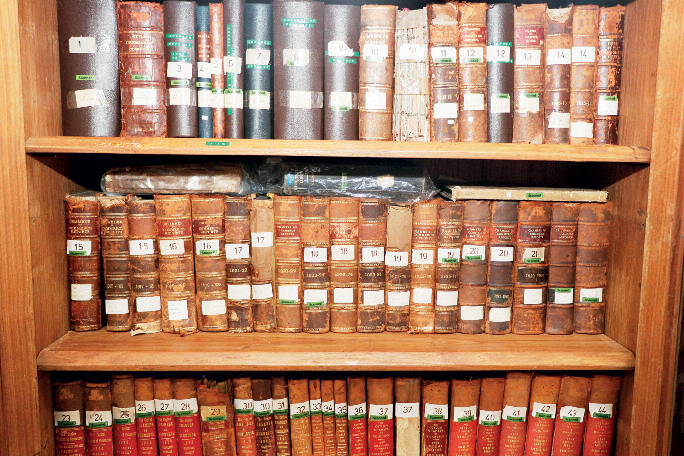
Historical Records
One of the Chamber’s most consequential interventions was in its advocacy to develop Colombo as the island’s principal port. At a time when the government was considering developing the Galle harbour, the Chamber argued strongly for Colombo instead, citing its larger cargo hinterland and the navigational hazards posed by rocks in the Galle harbour. It further recommended the construction of docks and a protective breakwater, proposals that ultimately led to Colombo emerging as one of the leading ports in the region.
Over the years, the Chamber also played a key role in establishing and supporting institutions that shaped Sri Lanka’s business environment. These include the Employers’ Federation of Ceylon, which helped structure industrial relations in the country, the Mercantile Service Provident Society, an early initiative promoting labour welfare, and the Sri Lanka Institute of Directors, which has contributed to strengthening corporate governance and leadership within the private sector.
It also established mechanisms to strengthen the broader business environment, including the CCC-ICLP Alternative Dispute Resolution Centre, created together with the Institute for the Development of Commercial Law and Practice, to provide arbitration and mediation services for commercial disputes. Earlier in its history, the Chamber also developed one of the country’s first codes of ethics to guide fair and responsible trading – standards of integrity that the Chamber continues to uphold to this day.
The records now entrusted to the National Archives document the debates, decisions, successes, and challenges that shaped generations of Sri Lanka’s business community. Through letters, reports, minutes, and accounts, the archive offers insight into the people, ideas, and enterprises that helped build the country’s economy.
At the symbolic handover of the archives to the Director General of the National Archives Department, Dr Nadeera Rupesinghe, Chairperson of the Ceylon Chamber, Mr Krishan Balendra noted that ‘today we are doing something that, at first glance, might look like simply passing on old documents and books. But in truth, we are passing on nearly two centuries of a nation’s commercial heartbeat. These records are the living memory of a nation’s trade, enterprise, and industry. By entrusting them to the National Archives Department, we are ensuring that researchers, students, and citizens will have access to this heritage, learning from the ingenuity, foresight, and courage of the people who came before us, and the legacy they left in every business, every trade route, every handshake that built this country.’
Accepting the handover, Dr Rupesinghe said, ‘the Department of National Archives hosts the memory of a nation, and we are very happy that historic records of the Ceylon Chamber, which denote the history of Sri Lanka’s business community is being entrusted to our care’.
The handover marks a significant moment in recognising the role of commerce in the story of Sri Lanka and safeguarding the institutional memory of one of the country’s oldest and most influential organisations.


The National Water Supply and Drainage Board (NWSDB) on Friday said the largest groundwater source discovered in Sri Lanka so far had been identified during tube-well drilling near the Pitabeddara Police Station.
Indrajith Gamage, geologist in charge of the Southern Province, said the source recorded a continuous flow of about 10,000 litres (10 cubic metres) per minute, marking the first instance in the country where a groundwater source of that magnitude had been found.
He noted that the previous largest groundwater source was discovered in the Madhu area, which recorded a flow of about 7,000 litres per minute.
According to the NWSDB, the tube well was drilled following geological studies of rock layers and the identification of underground water through fractures in rock strata using specialised technical instruments.
The Board said steps would be taken to distribute water from the newly discovered source to residents facing shortages in Pitabeddara, Morawaka and surrounding areas.

The Ceylon Chamber of Commerce has formally handed over its historical records to the National Archives Department, entrusting over a century of the nation’s commercial history to the country’s official custodians of heritage.
The archive, spanning from the CCC’s founding in 1839 to 1973, includes correspondence, meeting minutes, reports, ledgers, and publications that chronicle the development of trade, enterprise, and industry in Sri Lanka. Together, the records provide a rare and detailed account of the island’s economic evolution and the role of its business community in shaping national progress.

The Ministry of Defence said on Friday (13) that arrangements had been made to repatriate to Iran the bodies of 84 sailors who died aboard the IRIS Dena, which sank in the southern seas off Sri Lanka.
A special aircraft carrying the bodies departed from Mattala Rajapaksa International Airport on Friday, the Ministry said, adding that the repatriation was carried out in coordination with the Embassy of Iran in Sri Lanka.
The remains had been kept in two mobile cold-storage units at the Galle National Hospital before being transported to Mattala by lorry following a court order. Forty-five bodies were moved in the morning, while the remaining 39 were transported later in the day.
Earlier this month, the Iranian naval vessel suffered an incident about 40 nautical miles off Port of Galle while carrying around 180 personnel. Thirty-five rescued sailors were admitted to the Karapitiya Teaching Hospital, while 84 bodies were subsequently recovered.
Following the incident, Pete Hegseth confirmed that the Iranian vessel had been sunk in international waters by a torpedo fired from a submarine of the United States Navy.

Lanka discovers largest groundwater source

Lanka’s commercial legacy preserved in National Archives

Bodies of 84 Iranian sailors flown home

Kirsten brings pedigree, but Sri Lanka must fix the system

Barrels vs bombs

From culture to empowerment: Indonesia’s vision for Sri Lanka

‘Dates have the highest sugar content to fight Coronavirus’

Sunday Island 27 December – Headlines

#SundayIsland 17th December – Headlines

Sunday Island – 28th March

Sunday Island Headlines – 21 March

Sunday Island – 21st February – Headlines
-

 News6 days ago
Repatriation of Iranian naval personnel Sri Lanka’s call: Washington
-

 Features6 days ago
Winds of Change:Geopolitics at the crossroads of South and Southeast Asia
-

 News5 days ago
Prof. Dunusinghe warns Lanka at serious risk due to ME war
-

 Sports4 days ago
Royal start favourites in historic Battle of the Blues
-

 Sports3 days ago
The 147th Royal–Thomian and 175 Years of the School by the Sea
-

 News3 days ago
Historic address by BASL President at the Supreme Court of India
-

 News4 days ago
CEBEU warns of operational disruptions amid uncertainty over CEB restructuring
-

 Business4 days ago
BOI launches ‘Invest in Sri Lanka’ forum