
News
Ceylon Chamber of Commerce entrusts over a century of business history to the National Archives

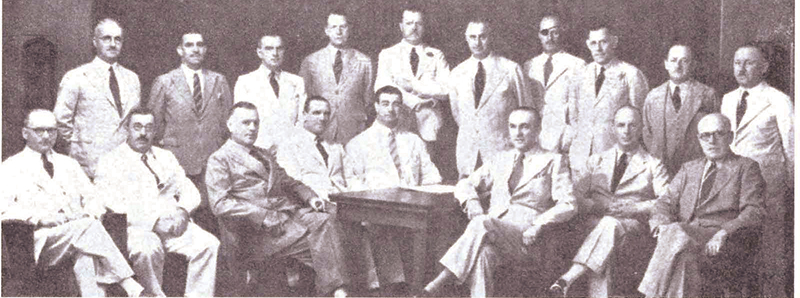
The Ceylon Chamber of Commerce has formally handed over its historical records to the National Archives Department of Sri Lanka, placing over a century of the nation’s commercial history into the care of the country’s official custodians of heritage.
The historical archive being handed over spans from the Chamber’s founding in 1839 to 1973, and includes correspondence, meeting minutes, reports, ledgers, and publications that chronicle the development of trade, enterprise, and industry in Sri Lanka. Together, these records provide a rare and detailed account of how the island’s economy evolved and how its business community helped shape national progress.
The Ceylon Chamber of Commerce was established on 25 March 1839 on the principle that the interests of commerce and trade are best advanced when merchants unite and cooperate in matters affecting the common good. At the time, Ceylon was among the earliest regions in Asia to establish a chamber of commerce, alongside counterparts in Bengal, Bombay, Madras, Canton, Penang, and Singapore.
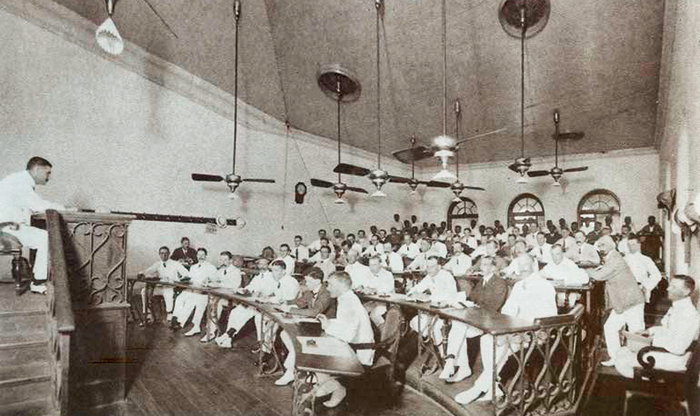
1883 First Public Tea Auction Held in Colombo

Chamber Office Bearers and Staff at the building in Lower Chatham Street, Fort shortly before the move to the new building at Navam Mawatha

Old CCC Building
From its earliest years, the Chamber played a central role in organising and guiding trade. It played a central role in establishing and growing the export economy built on commodities such as coffee, cinnamon, coconut oil, tea, and rubber, and hosted the island’s renowned tea and rubber auctions. It also developed rules and standards for trading practices, helping create an environment of trust and reliability that enabled Sri Lanka’s commerce to thrive.
Beyond facilitating trade, the Chamber was also instrumental in shaping the island’s infrastructure and connectivity. In 1858, it successfully urged the government to accept India’s proposal to link Ceylon to the Madras telegraph line, giving the island its first cable connection to the outside world. The Chamber also advocated for a government-owned Colombo–Kandy railway to connect the coast with the interior and continued to press for extensions stage by stage as the network expanded into the hill country and beyond.

Earliest dated record from 1839
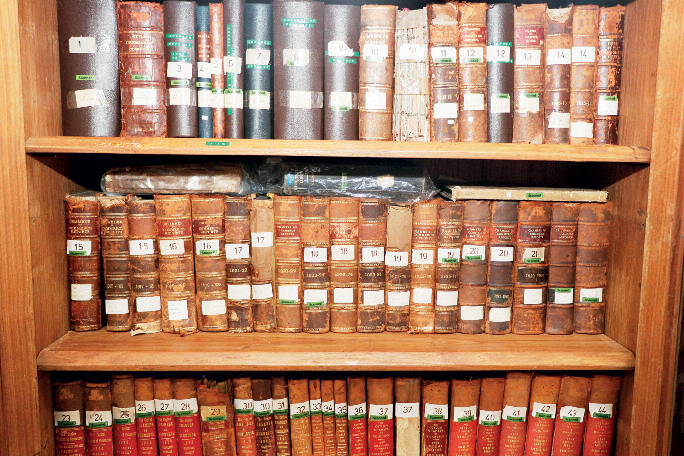
Historical Records
One of the Chamber’s most consequential interventions was in its advocacy to develop Colombo as the island’s principal port. At a time when the government was considering developing the Galle harbour, the Chamber argued strongly for Colombo instead, citing its larger cargo hinterland and the navigational hazards posed by rocks in the Galle harbour. It further recommended the construction of docks and a protective breakwater, proposals that ultimately led to Colombo emerging as one of the leading ports in the region.
Over the years, the Chamber also played a key role in establishing and supporting institutions that shaped Sri Lanka’s business environment. These include the Employers’ Federation of Ceylon, which helped structure industrial relations in the country, the Mercantile Service Provident Society, an early initiative promoting labour welfare, and the Sri Lanka Institute of Directors, which has contributed to strengthening corporate governance and leadership within the private sector.
It also established mechanisms to strengthen the broader business environment, including the CCC-ICLP Alternative Dispute Resolution Centre, created together with the Institute for the Development of Commercial Law and Practice, to provide arbitration and mediation services for commercial disputes. Earlier in its history, the Chamber also developed one of the country’s first codes of ethics to guide fair and responsible trading – standards of integrity that the Chamber continues to uphold to this day.
The records now entrusted to the National Archives document the debates, decisions, successes, and challenges that shaped generations of Sri Lanka’s business community. Through letters, reports, minutes, and accounts, the archive offers insight into the people, ideas, and enterprises that helped build the country’s economy.
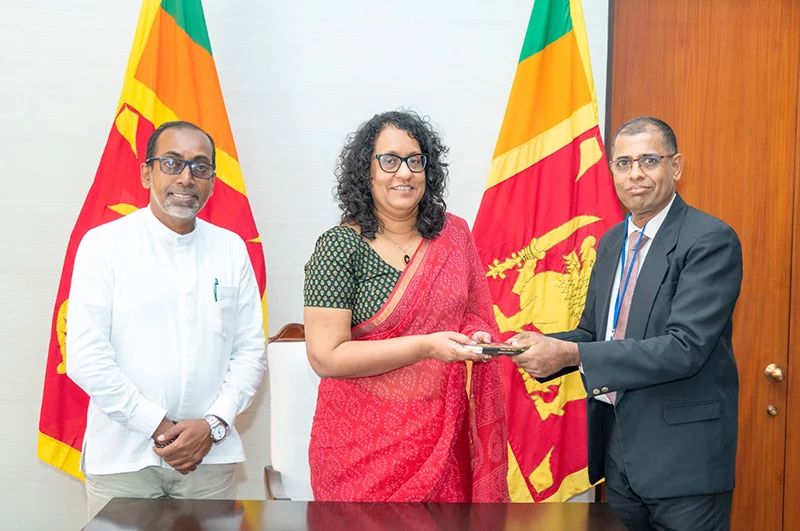
At the symbolic handover of the archives to the Director General of the National Archives Department, Dr Nadeera Rupesinghe, Chairperson of the Ceylon Chamber, Mr Krishan Balendra noted that ‘today we are doing something that, at first glance, might look like simply passing on old documents and books. But in truth, we are passing on nearly two centuries of a nation’s commercial heartbeat. These records are the living memory of a nation’s trade, enterprise, and industry. By entrusting them to the National Archives Department, we are ensuring that researchers, students, and citizens will have access to this heritage, learning from the ingenuity, foresight, and courage of the people who came before us, and the legacy they left in every business, every trade route, every handshake that built this country.’
Accepting the handover, Dr Rupesinghe said, ‘the Department of National Archives hosts the memory of a nation, and we are very happy that historic records of the Ceylon Chamber, which denote the history of Sri Lanka’s business community is being entrusted to our care’.
The handover marks a significant moment in recognising the role of commerce in the story of Sri Lanka and safeguarding the institutional memory of one of the country’s oldest and most influential organisations.


by Norman Palihawadane
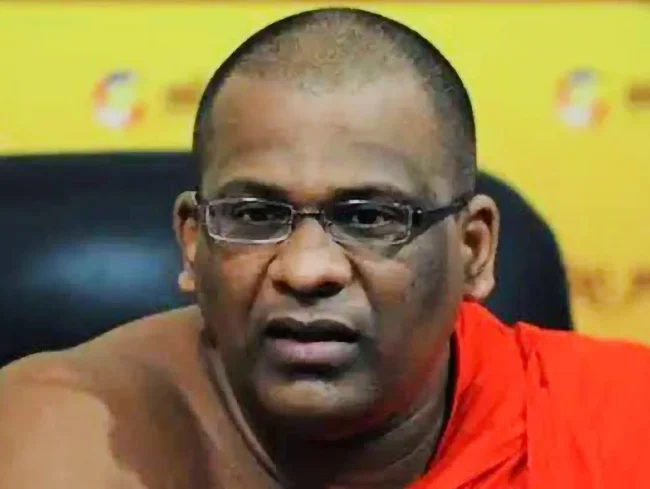
Bodu Bala Sena (BBS) General Secretary Ven. Galagoda Aththe Gnanasara Thera’s whereabouts have remained unknown since the Supreme Court, on Monday, annulled a presidential pardon granted to him in 2019.
Prison officers visited the Thera’s temple in Nawala, Rajagiriya, to take steps to return him to prison to serve the unexpired portion of his six-year sentence. However, monks at the temple had reportedly informed the officials that they were unaware of his whereabouts.
Police spokesman ASP F.U. Wootler said a separate court order was required for the police to trace the Thera, or assist in taking him into prison custody. No such order had been issued so far, he claimed.
Meanwhile, sources close to Gnanasara Thera said he was expected to attend a book launch in Colombo tomorrow (17),
The development follows the Supreme Court declaring the 2019 presidential pardon granted to Gnanasara Thera, by then President Maithripala Sirisena, null and void.
A three-member Supreme Court bench held that the pardon had been granted arbitrarily and violated public trust and principles of natural justice.
Gnanasara Thera had been serving a six-year prison sentence for contempt of court when the then President Sirisena granted him the pardon, in May, 2019. He had served only about nine months of the sentence at the time.
With the pardon annulled, the original sentence remains in force and the Thera is now required to serve the balance of his six-year term.
The Supreme Court ruling has raised questions over the procedure to be followed to return him to prison, with police and prison authorities yet to take custody of him.
Russian citizens residing or temporarily visiting Sri Lanka will have the opportunity to cast their ballots in the elections to the State Duma of the Federal Assembly of the Russian Federation on September 20.
The Embassy of the Russian Federation in Sri Lanka said polling would be held at polling station No. 8338 at the Russian Embassy, 404, Bauddhaloka Mawatha, Colombo 07.
The polling station will be open from 8 a.m. to 8 p.m. on September 20, according to the Embassy.
Russian citizens aged 18 and above, including those permanently residing in Sri Lanka and those temporarily visiting the country, are eligible to vote, the Embassy said.
Voters are required to visit the polling station during its operating hours and produce documents certifying their Russian citizenship.
The Embassy said prior registration was not required to participate in the voting.
The election will be held to elect deputies to the ninth convocation of the State Duma, the lower house of Russia’s Federal Assembly.
Plastic waste is a growing challenge for Sri Lanka’s food sector, yet important gaps remain in understanding where and how single-use plastics are used, how they move through food value chains, and where interventions could have the greatest impact.
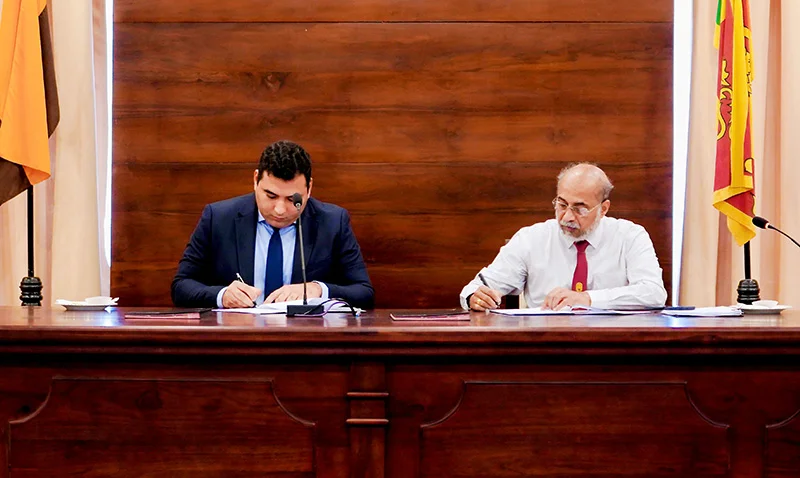
Through the European Union-funded CIRCULAR project, new research will help address these gaps by generating evidence to inform policy, business practices and more sustainable choices. Three research grants, totalling €Euro 110,000, will support university-led studies by research teams from the Faculty of Agriculture at the University of Ruhuna, and the Faculty of Medicine and Faculty of Computing at the University of Kelaniya.
Together, the studies will examine the use, flow and impacts of single-use plastics (SUPs) across selected food and beverage value chains in the Colombo and Galle Districts. The research will also seek to identify practical opportunities to reduce plastic use, promote more sustainable alternatives and strengthen circular economy practices.
At present, available data on plastic waste in Sri Lanka, particularly single-use plastics, do not provide sufficient detail on the sectors, sources and types of plastics involved. This limits the ability of policymakers, businesses and other stakeholders to pinpoint where plastic use can be reduced most effectively and to assess which interventions could deliver the greatest impact. The new research will help provide a more detailed understanding of these patterns, supporting more targeted and evidence-based action.
The three research teams will use a combination of data collection, waste-flow mapping, environmental and public health assessments, and life-cycle approaches to examine these challenges from different perspectives. The findings are expected to help identify opportunities to reduce plastic use, improve resource efficiency and promote more sustainable packaging and waste management practices.
The research grants are part of the CIRCULAR project’s broader efforts to support Sri Lanka’s transition towards more sustainable production and consumption in the food sector. Alongside research and evidence generation, the project works to raise awareness, encourage behaviour change and support approaches that move away from the traditional “take, make and dispose” model towards a more circular economy.
Circular Economy in the Food Sector (CIRCULAR) project is a three-year initiative focused on reducing food loss and food waste (FLW) and Single-use plastic (SUP) waste in the Food Sector in Sri Lanka. Funded by the European Union, and partially co-funded by the German Federal Ministry for Economic Cooperation and Development (BMZ), the project is jointly implemented by Expertise France (EF), the Food and Agriculture Organisation (FAO) and Deutsche Gesellschaft für Internationale Zusammenarbeit (GIZ) GmbH.
By strengthening the evidence base on single-use plastics, the research is expected to provide a stronger foundation for practical action, helping decision-makers, businesses and other stakeholders better understand where change is needed and how more sustainable solutions can be put into practice.

Showers about 75 mm are likely at some places in the Western, Sabaragamuwa, Central and Southern provinces

Brook, Buttler, Baker star as Sri Lanka slump to 119-run rout

Where is Gnanasara Thera?Police pass buck to court

Russian citizens in Lanka to vote in State Duma elections

Euro 110,000 research drive to tackle plastic waste in food sector

New SAU-RCSS pact to boost South Asian dialogue

‘Dates have the highest sugar content to fight Coronavirus’

Sunday Island 27 December – Headlines

#SundayIsland 17th December – Headlines

Sunday Island – 28th March

Sunday Island Headlines – 21 March

Sunday Island – 21st February – Headlines
-

 Sports5 days ago
DDS set to lose Test captaincy
-

 News5 days ago
Sri Lanka faces new grid challenge as rooftop solar surges: former CEB GM
-

 Latest News5 days ago
Shafali, Deepti power India into sixth T20 Asia Cup final
-

 Latest News4 days ago
Sri Lanka thwart Fatima Sana challenge to secure Asia Cup final spot
-

 News3 days ago
Gnanasara Thero absconding after SC ruling
-
 Features6 days ago
Lost for 90 years: Rare Goby resurfaces in Jaffna
-

 News4 days ago
Ammunition cache found in old Kandy bungalow
-

 Latest News7 days ago
Italian Naval Vessel ‘ITS Giuseppe Garibaldi’ arrives in Colombo