
Business
Cargills Food City opens its 500th outlet, affirms its commitment to revitalise local economy


* Sources fresh fruits and vegetables from a network of over 5,000 farmers
* Contributes over 14% of the national milk production
* Expanding network generates thousands of livelihood opportunities
by Sanath Nanayakkare
The home-grown Sri Lankan brand, Cargills Food City, marked another milestone yesterday with the opening of its 500th retail outlet in Akuregoda, Pelawatte.
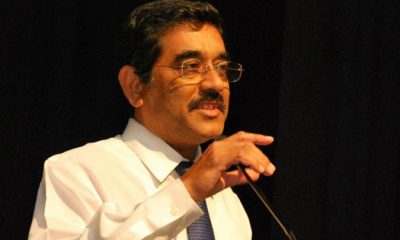
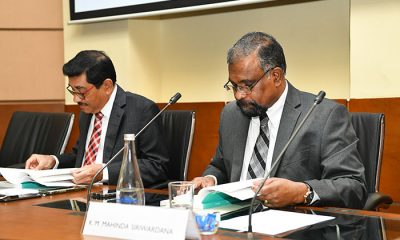
The unveiling of the large retail outlet was attended by Central Bank Governor Dr. Nandalal Weerasinghe (chief guest), Deputy Chairman of Cargills Group, Ranjit Page and a host of distinguished guests representing both public and private sectors.
Notably, a book illustrating the Company’s bold and dynamic 39-year journey was presented to the Central Bank Governor at the event.
By benchmarking itself against international supermarkets, Cargills FoodCity has set the bar high for others that follow in its footsteps, while its success served to attract more investors into the sector.
Being present in all 25 districts, Cargills Food City has introduced the supermarket experience to all Sri Lankans, beyond urban and beyond elite class.
To date, Cargills is the only supermarket to operate in the North and East being a sustenance for all Sri Lankans, offering the lowest prices in the country.
Cargills Early Childhood Education Programme has positively impacted over 8,000 children, giving them a stable foundation for their future.
The company recently stepped up its humanitarian efforts with their Community Meals Programme initiated in partnership with the Lasallian Community Education Services. This programme has already delivered over 3,300 nourishing meals to people in underprivileged urban areas.
Cargills Food City has encouraged entrepreneurship across the country by showcasing local brands, many of whom have up-scaled their businesses and are confident about the company’s backing. The Company has supported many small and medium enterprises and has helped them create new categories with innovations.
It ensures that the freshest and most hygienic products adhere to the highest quality benchmarks. Through this strategy, Cargills Food City has been able to support SMEs, which are the backbone of the economy.
A World Bank study also revealed that farmers working in the Cargills supply chain receive a higher price for their efforts, leading to its customers receiving a lower price. The Gates’ Foundation also declared Cargills’ value proposition being a model worth emulating, shining a light on efforts on a global scale.
Today, Cargills is the single largest collector of fresh produce, sourcing fresh fruits and vegetables from a network of over 5,000 farmers and contributes over 4% of the national production in fruits and vegetables – a percentage that continues to grow. It is also the largest collector of fresh milk in Sri Lanka and contributes over 14% of the national milk production. The company is also a leading contributor to the livestock, poultry and animal husbandry sectors.
This outlet expansion has extended direct and indirect employment to hundreds of youth and exposed employees from all districts across the country to good practices in food and nutrition.









Business
Earth Day warning: Environmental neglect risks undermining Sri Lanka’s economic stability — CEJ

By Ifham Nizam
Today, April 22, as the world marks Earth Day, the Centre for Environmental Justice (CEJ) warned that Sri Lanka’s fragile economic recovery could face serious setbacks if environmental degradation and climate vulnerabilities are not urgently addressed—framing sustainability as a core economic priority rather than a peripheral concern.
CEJ stressed that the country’s exposure to climate shocks—ranging from floods and droughts to coastal erosion—poses direct and escalating risks to key economic sectors including agriculture, water resources, fisheries, and infrastructure.
CEJ chairperson Hemantha Withanage stressed that Sri Lanka’s development trajectory remains dangerously disconnected from environmental realities.
He told The Island Financial Review:”Sri Lanka is highly vulnerable to climate change. Increasingly erratic weather patterns are already disrupting livelihoods, damaging crops, and straining water systems. If these risks are not integrated into economic planning, the cost to the national economy will be severe.”
The warning comes at a time when Sri Lanka is attempting to rebuild fiscal stability, attract investment, and strengthen export sectors. However, CEJ argues that environmental mismanagement—from unchecked pollution to poor land-use planning—continues to erode long-term economic resilience.
The organisation pointed out that climate-induced disasters not only incur immediate financial losses but also create cascading impacts across industries. Agricultural output declines, supply chains are disrupted, and public expenditure rises due to disaster response and infrastructure repairs—placing further pressure on an already constrained national budget.
CEJ also highlighted that unsustainable practices, including excessive plastic use and chemical pollution, carry hidden economic costs—ranging from healthcare burdens to ecosystem damage and loss of tourism appeal.
However, the group noted that policy interventions can yield measurable gains. It cited the government’s move to ban the distribution of polythene bags in supermarkets from November 2025, following a court ruling, as a step that has already contributed to a significant reduction in plastic usage.
“Policy consistency and enforcement are key. When strong environmental regulations are implemented, the benefits are not only ecological but also economic,” Withanage said.
Framing this year’s Earth Day theme, “Our Power, Our Planet,” CEJ called for a shift towards sustainable consumption patterns, green investment, and climate-resilient infrastructure.
“Environmental protection is no longer optional—it is central to economic survival and growth,” CEJ emphasised.

Sampath Bank PLC reported a solid financial performance for 2025, with earnings surpassing market expectations and reinforcing investor confidence in its medium-term growth trajectory, according to a recent equity research update by First Capital Holdings PLC.
The bank recorded a net profit of LKR 32.6 billion for the full year 2025, marking a 13.5% year-on-year increase. Fourth-quarter profit came in at LKR 9.4 billion, marginally down 2% from a year earlier, largely due to base effects stemming from a one-off impairment reversal in the corresponding period of 2024.
Core banking operations remained robust. Net interest income rose 8.1% year-on-year in the final quarter, supported by strong credit expansion, while fee and commission income grew 23.2%. Total other income surged 130%, aided by improved treasury performance, including a turnaround to a trading gain compared to a loss a year earlier.
A key highlight for investors was the sharp expansion in the loan book, which grew 32.6% year-on-year to reach LKR 1.2 trillion by end-2025. Growth was driven by import financing, leasing, and long-term lending. Deposit growth, while more moderate at 11.8%, was led by gains in savings accounts.
Asset quality also improved during the year, with the Stage 3 loan ratio declining to 3.31% from 4.69% a year earlier, reflecting stronger recoveries and improved repayment capacity among borrowers. The reinstatement of parate execution laws further supported recoveries.
Capital and liquidity positions remained well above regulatory thresholds, with total capital adequacy at 17.65% and liquidity coverage at nearly 240%, providing ample buffers to sustain lending growth.
Looking ahead, First Capital forecasts earnings to grow at a more moderate pace, projecting net profits of LKR 34.7 billion in 2026 and LKR 39.9 billion in 2027, as macroeconomic momentum is expected to ease.
Reflecting broader market re-rating trends, the bank’s estimated fair value for 2026 has been revised down to LKR 165 per share, though the stock still offers an expected total return of around 18%. A 2027 fair value of LKR 180 implies a potential return of 30%.
Despite near-term headwinds, the First Capital report maintains a “buy” recommendation on Sampath Bank, citing strong fundamentals, improving asset quality, and sustained credit growth as key drivers of long-term value.
By Sanath Nanayakkare
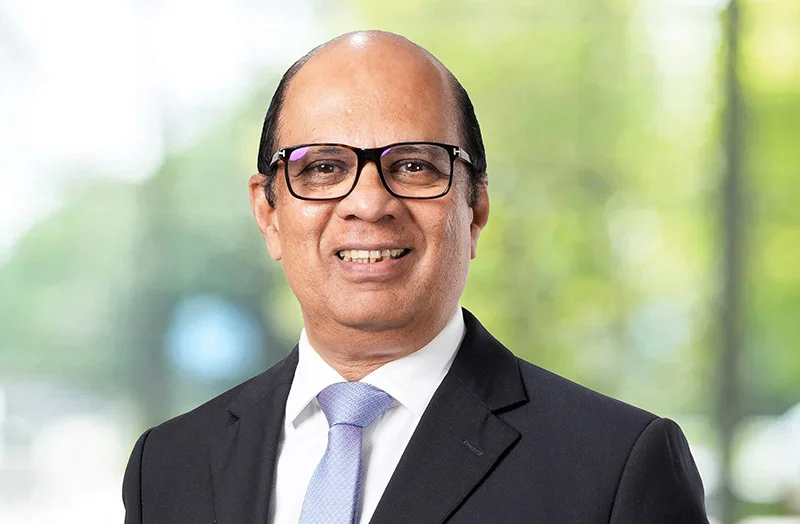
Dialog Axiata PLC, Sri Lanka’s #1 connectivity provider, announced the appointment of Mr. Arjuna Herath as an Independent Non-Executive Director, effective 1 May 2026. Herath brings extensive experience across consulting, corporate finance, investments, and regulatory governance.
“Arjuna brings a unique blend of private sector experience and public sector leadership, with deep exposure to regulatory and institutional environments. His insights will add meaningful value to the Board as we continue to strengthen governance and navigate an increasingly dynamic digital landscape,” said David Lau, Chairman of Dialog Axiata PLC.
Herath most recently served as Chairman of the Board of Investment of Sri Lanka, contributing to national investment promotion strategy. He was also the inaugural Chair of the Sri Lanka Data Protection Authority, where he led early regulatory efforts in digital privacy. Earlier, he served as Senior Partner and Head of Consulting at Ernst & Young (EY) Sri Lanka and Maldives, and held roles in corporate development at Ceylon Tobacco Company and Merchant Bank of Sri Lanka.
He has held several key regulatory roles, including as Commissioner of the Securities and Exchange Commission of Sri Lanka, Board Member of the Sri Lanka Accounting and Auditing Standards Monitoring Board, and Member of the Company Law Advisory Commission. He currently serves as a Director of the Colombo Stock Exchange.
Herath is a Fellow Member and a Past President of The Institute of Chartered Accountants of Sri Lanka and has contributed extensively to the global accountancy profession. He is the first Sri Lankan to chair a committee of the International Federation of Accountants (IFAC), where he led the Professional Accountancy Organisation Development Committee.

Abhishek’s 135 not out blows Delhi Capitals away

Trump announces Iran ceasefire extension but says blockade remains

Showers above 75 mm are likely at some places in the Western, Sabaragamuwa, Central, Uva and Southern provinces and in Ampara and Kurunegala districts

Cardinal: Presidents, IGPs and AG sabotaged Easter carnage probes before 2024 regime change

CIABOC asks Parliament not to transfer witness in case against Deputy Secy General

UN wants Sri Lanka to deliver concrete results in Easter Sunday bombing probe

‘Dates have the highest sugar content to fight Coronavirus’

Sunday Island 27 December – Headlines

#SundayIsland 17th December – Headlines

Sunday Island – 28th March

Sunday Island Headlines – 21 March

Sunday Island – 21st February – Headlines
-

 News1 day ago
Rs 13 bn NDB fraud: Int’l forensic audit ordered
-

 Business4 days ago
Harnessing nature’s wisdom: Experts highlight “Resist–Align” path to resilience
-

 News7 days ago
PNS TAIMUR & ASLAT set sail from Colombo
-

 News4 days ago
Gratiaen Trust announces longlist for the 33rd Annual Gratiaen Prize
-

 News3 days ago
From Nuwara Eliya to Dubai: Isha Holdings markets Agri products abroad
-

 Opinion2 days ago
Shutting roof top solar panels – a crime
-
 News4 days ago
Heroin haul transported on 50-million-rupee contract
-

 Latest News6 days ago
Singapore Zoo’s first Sri Lankan leopard cubs make their public debut