
Latest News
Carey, Marsh and Cummins lead thrilling chase of 279

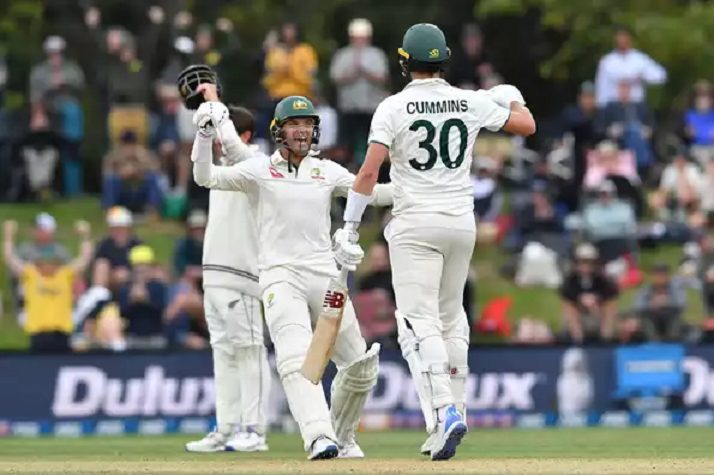
Alex Carey scored an unbeaten 98 and shared a 140-run stand with Mitchell Marsh (80) – the highest sixth-wicket partnership in a fourth-innings against New Zealand – as Australia chased down 279 to complete a 2-0 series sweep and extend their dominance over Tasman neighbours New Zealand in the format, a lopsided record that now reads just 1 win for the Black Caps in the last 31 years.
Australia went into the final day of the series, four down, on the edge and confronting a rare possibility of losing only a second Test match to their Tasman neighbours in three decades. They had slipped to 34/4 on the third evening and victory was a further 202 runs away at the start of the day’s play. They were made to wait as portentous rain washed away the first hour of the morning session. But soon enough the sun was shining on them, literally and metaphorically.
Mitchell Marsh was going to be their big ray of hope having counter-attacked his way to a run-a-ball 29 last night. This morning, he was the beneficiary of some Black Caps benevolence as his fierce cut shot in the second over of the day was put down by Rachin Ravindra at point off the bowling of Tim Southee. His overnight batting partner, Travis Head, wasn’t as lucky as a similar shot two balls later led to his downfall.
That early dismissal brought Carey to the middle. Under pressure to keep his place in the side with Josh Inglis pushing him, the keeper-bat began solidly, driving Southee down the ground and punching Matt Henry past backward point for boundaries. It was a feature of Australia’s chase that despite the pressure they were subjected to, they maintained a scoring rate in excess of 4 (4.32 at the end).
Carey endured a heart-in-mouth moment when he was ruled out LBW to a nip-backer from Henry but DRS projected the ball to be sliding down leg. Another close shave arrived when he had moved to 37. Scott Kuggeleijn appealed for a caught-behind and got his captain to use a review, which eventually came to nothing. Between those two moments, Carey and Marsh were largely untroubled and Southee’s attempts to rotate his four seamers and Glenn Phillips could not put a lid on the scoring. Marsh got to his half-century with a fierce pull shot and three overs later Carey got a 50 of his own with a pair of boundaries off Ben Sears. By Lunch, the pair had put on 94 and victory was only 105 runs away.
The 43-over-old ball was significantly easier to contend with and the start of the second session’s play saw runs arrive in a glut. Marsh cut Southee for a pair of boundaries, forcing the captain to turn to his pace ace for a breakthrough. As it turned out, Matt Henry’s first over back cost New Zealand 16 runs with Carey tickling a legside delivery for four before Marsh unveiled one of his patented pulls over deep square-leg for a six.
With the target down to 59, Southee summoned Ben Sears into the attack and New Zealand’s fading hopes were reignited once more by the debutant speedster. With his second delivery, he broke the partnership with a pacy, full ball that Marsh missed while attempting a flick. The very next ball, Mitchell Starc chipped a simple catch down mid-wicket’s throat to leave Australia seven down.
Just like that, the clouds rolled in, the flood lights were turned on and the Hagley Oval crowd found its voice. But in Cummins, Australia had a No.9 with proven pedigree in such nip and tuck situations. Only last year, in the Edgbaston Ashes Test, the Australian skipper had seen his side over the line in a similarly tense chase. That chase in Birmingham was Australia’s first successful chase of 279 or more in over 12 years. And Cummins brought all his experience to the fore once he survived the hat-trick ball, which he edged just past second slip for four.
Carey continued to play his shots, a lap off Sears and a pair of swept boundaries off Phillips took Australia close. He was left two short of a century with Australia needing an identical number of runs when the strike turned over. Cummins punched the ball square off the wicket for a boundary to polish off an excellent chase.
Brief scores:
New Zealand 162 and 372 lost to Australia 256 and 281/7 (Alex Carey 98*, Mitchell Marsh 80, Pat Cummins 32*; Ben Sears 4-90) by three wickets.










Sri Lanka won the toss and chose to bat first in the first T20I against Pakistan being played in Rawalpindi.
Sri Lanka XI: Kusal Mendis (capt & wk), Lahiru Udara (wk), Kamil Mishara, Kamindu Mendis, Sahan Arachchige, Dasun Shanaka, Dunith Wellalage, Maheesh Theekshana, Dushmantha Chameera, Eshan Malinga, Nuwan Thushara
Pakistan XI: Sahibzada Farhan (capt), Saim Ayub, Maaz Sadaqat, Fakhar Zaman, Hasan Nawaz, Khawaja Nafay (wk), Shadab Khan, Muhammed Imran, Razaullah, Naseem Shah, Abrar Ahmed
Latest News
Sutherland and Litchfield lead Australia to quick and convincing win in ODI series opener
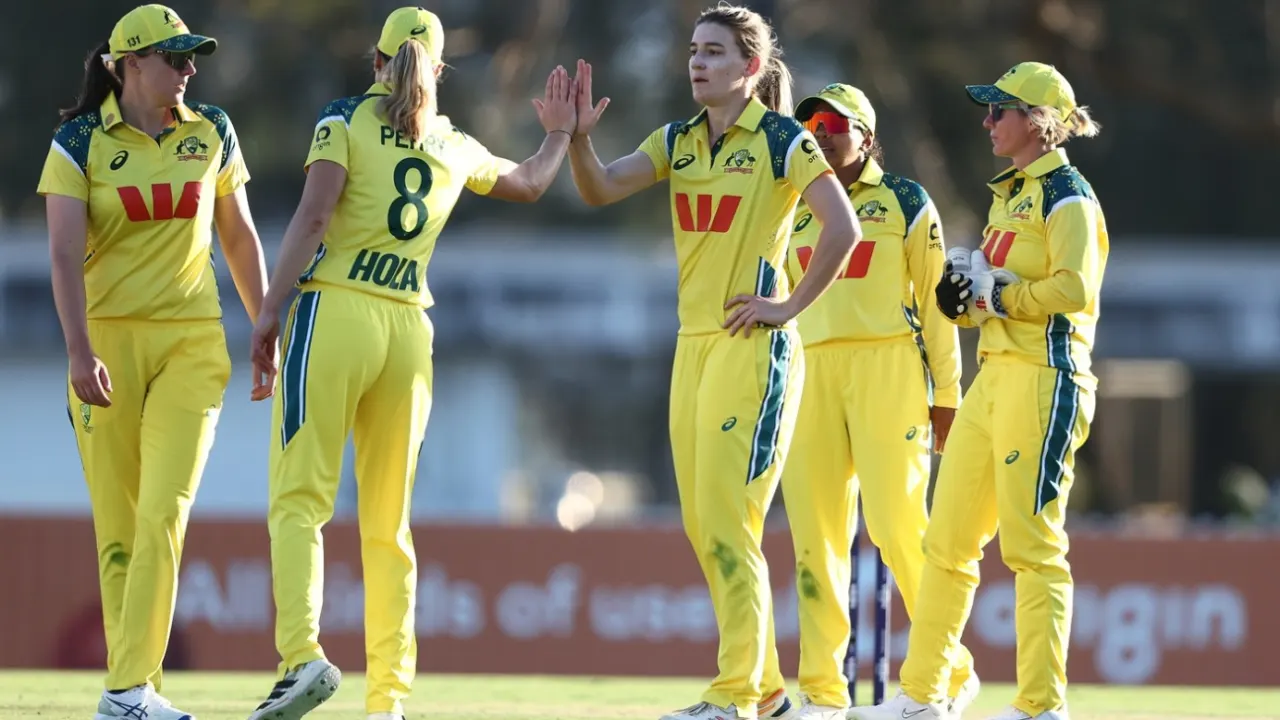
Bangladesh’s second visit to Australia and their first women’s ODI in the country began on a disappointing note as Australia ran out quick and convincing victors.
Annabel Sutherland showed why she is regarded as one of the most versatile fast-bowling allrounders in the world by taking 4 for 30. She kept the batters on their toes by varying the lengths and speeds as Bangladesh were bowled out for 166. Phoebe Litchfield’s swift 77 helped Australia canter home with 24.2 overs and seven wickets to spare to take a 1-0 lead in the three-match series.
The win meant Australia extended their unbeaten record in ODIs at the Allan Border Field in Brisbane to 22 games.
Bangladesh might have put up an even lower total if not for an intent-filled innings from Ritu Moni. Batting at No. 7, she hit two fours in her first four balls following a phase where Bangladesh scored only 35 in about 15 overs.
Asked to bat first, Bangladesh were stung first ball when Megan Schutt got one off a length to hoop in big to have Fargana Hoque caught at slip. In her next over, Schutt trapped the other opener Sarmin Sultana lbw to become only the third Australia woman to 150 ODI wickets.
When Sutherland’s bouncer cramped Sharmin Akhter for room, leaving her unable to get any control on the pull, Bangladesh were truly under the cosh, having lost three wickets inside the first powerplay.
That soon became 48 for 4, which prompted captain Nigar Sultana, perhaps Bangladesh’s best batter, to go into a shell. She hardly looked to score from that point and was happy to defend and merely prevent further wickets from falling.
The ploy was evident from the fact that Nigar didn’t put Sutherland under pressure when she bowled three successive no-balls in the 12th over. What’s more, unaware of the free hit on offer, she ducked under a short ball as well. Shorna Akter, too, curtailed her aggressive instincts to support her captain.
Bangladesh crawled at three runs per over through the middle phase before Tahlia McGrath had Nigar caught behind for 29 off 83 balls. Nigar perhaps half-referred to her own innings when, after the game, she said that Bangladesh “need to be cautious against the new ball and get the intent right”.
As soon as she fell, Moni and Shorna started to put back the pressure on Australia’s spinners. Moni fetched a couple of sweeps from outside off to hit them through midwicket. Shorna also used her feet more frequently.
Moni looked good to score her second half-century in ODIs but was hampered by cramps. That hindered her running, and eventually she was run-out for 45 off 63 balls. Sutherland was generous with her use of the back-of-the-hand slower ones from then on to keep the rest of the batters on a leash.
Australia were never going to be challenged in a paltry chase of 167, and Georgia Voll and Litchfield hit five fours in the first five overs of the chase to get them going.
That is when Bangladesh found another performer of note. Seventeen-year-old Habiba Islam, on ODI debut, bowled a sharp bouncer which got rid of Voll. Habiba, who made her T20I debut against India in 2024 as a 15-year-old, got the ball to nibble around at high pace. While her first spell was expensive, she returned in the middle overs to get Beth Mooney caught brilliantly at midwicket. She bowled the length ball outside leg and got it to move in late, and Mooney could only spoon it to Fargana, who ran in from the circle and completed a diving catch.
But between these two bits of celebration for Habiba and Bangladesh, Litchfield had almost killed the chase. She moved around the crease to hit Marufa Aklter for three successive fours in the seventh over of the chase, and then muscled Habiba over mid-on for the only six in the match.
She played her trademark reverse sweep off Nahida Akter and soon got to fifty off just 35 balls. Her second-wicket stand with Ellyse Perry was worth 89 off 67 balls with Perry contributing only 15 off 23. Until the time Litchfield stepped out and drove Rabeya Khan straight to cover, it looked as if she would complete a century even with so few runs to get.
Scores:
Australia Women 168 for 3 in 25.4 overs (Phoebe Litchfield 77, Ellyse Perry 26*, Annabel Sutherland 25*; Habiba Islam 2-36) beat Bangladesh Women 166 in 49.4 overs (Sharmin Akhter 24, Nigar Sultana 29, Shorna Akter 21, Ritu Moni 45; Megan Schutt 2-19, Ammabel Sutherland 4-30) by seven wickets
[Cricinfo]

The U.S. Navy ship USS Tulsa (LCS 16) set sail from the port of Colombo today, 09 October 2026.
On her departure, the Sri Lanka Navy extended a traditional naval farewell to the ship.
USS Tulsa, a Littoral Combat Ship, and arrived in the island on 7 October on a replenishment visit and departed the island on completion of intended purposes.

Sri Lanka chose to bat first in Rawalpindi

Sutherland and Litchfield lead Australia to quick and convincing win in ODI series opener

USS Tulsa departs Colombo

Appointments for 1,540 Grama Niladhari Officers

Trump says US will not strike Iran before midterm elections

2026 Nobel Peace Prize awarded to Navi Pillay

‘Dates have the highest sugar content to fight Coronavirus’

Sunday Island 27 December – Headlines

#SundayIsland 17th December – Headlines

Sunday Island – 28th March

Sunday Island Headlines – 21 March

Sunday Island – 21st February – Headlines
-

 Features6 days ago
The first woman in the foreign service or Ceylon Overseas Service it was then called
-

 News5 days ago
Geneva takes up Sallay’s case and govt. ignores opportunity to answer accusations
-

 Editorial7 days ago
Fuelling discontent and protest
-

 Foreign News6 days ago
Ten injured after car crashes into rugby supporters in Australia
-

 News6 days ago
Nearly 20 Iranian tankers stranded off Lanka amid US sanctions
-

 Latest News6 days ago
Tharindu Rathnayake, bowlers secure Asian Games Bronze for Sri Lanka
-

 Features5 days ago
Sri Lanka Cricket Bill: Governance reform is not yet a cricket strategy
-

 Features4 days ago
Preventing grievances from becoming communal