
News
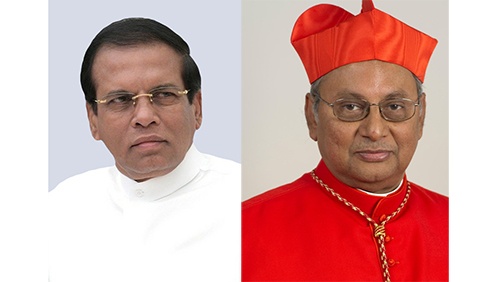
Cardinal’s counsel questions Sirisena on numerous calls with SIS head

by Rathindra Kuruwita
A 159-second telephone conversation took place between former President Maithripala Sirisena and former Director of the State Intelligence Service (SIS) SDIG Nilantha Jayawardena from 7.59 a.m. on April 21, 2019, prior to the Easter Sunday bombings, the Presidential Commission of Inquiry (PCoI) investigating the Easter Sunday attacks was informed on Saturday.
It was also revealed that another telephone conversation on April 20, 2019 at 6.16 pm had also taken place between the two. Earlier it was revealed that around 20 telephone conversations had taken place between Sirisena and Jayawardena from April 4 to 21, 2019.
April 04, 2019 was the day when Jayawardena received a warning of a possible terror attack from a foreign counterpart.
The details of the calls were revealed when the former President was cross-examined by President’s Counsel Shamil Perera, appearing for the Archbishop of Colombo, Malcolm Cardinal Ranjith.
Perera asked the witness whether he had been in constant contact with Jayawardena over the phone. In response Sirisena said that he would not agree that there had been frequent telephone conversations between him and Jayawardena.
Perera then showed the former president a list of calls that had been place between Jayewardena and the former President from January 01 to March 31, 2019. The list contained over 200 calls. Sirisena, after referring to the document, said he did not remember such a large number of conversations with the former SIS Director.
“I do not even use a mobile phone. So, this document should be examined further,” Sirisena said.
When asked if the document contained details of calls from six telephone numbers at the former President’s official residence on Paget Road, Sirisena answered in the affirmative.
The document showed that a total of 221 telephone calls had taken place between Sirisena and Jayawardena from January to April 2019. Sirisena said he probably had not received all those phone calls.
“These are records of calls to and from my official residence or to the Presidential Secretariat. But I don’t think I answered all these calls. I would not have answered these calls if I had been at Cabinet meetings and other events and I was attending such meetings,” Sirisena said.
“Do you, as a practice, consult the former SIS Director on your security and the threats you had to face?” the counsel asked. Sirisena said that there were occasions when such consultations were made.
Perera then asked Sirisena whether Jayewardena had given him a call around 6.16pm on 20 April. Sirisena said he had been receiving treatment in a Singaporean hospital at that time and not even his personal security officers had access to him on that day.
Perera then said that the telephone records clearly stated that Sirisena had called the former SIS Director around 7.59am on 21 April, 2019 before the Easter Sunday attacks. Sirisena had earlier said that he first contacted Jayewardena only after the bombings.
The President’s Counsel told the Commission that despite Sirisena’s statement the phone records showed that Sirisena had made a large number of telephone calls on April 21 morning.
“I don’t know what is mentioned in this report but I was in hospital on the morning of April 21. It was not possible for me to make phone calls while undergoing treatment. I came back to the hotel and then heard about the attacks.”
Perera also said about seven telephone calls had been exchanged between Sirisena and the SIS Director after the bombings. The counsel said that a 133- second telephone call had taken place between Sirisena and Jayawardena on 21 April at 8.58 am, a 184-second telephone call at 9.13 a.m., and a 688-second telephone call at 1.10 p.m.
Perera also asked Sirisena how he had made these calls if he was feeling extremely sick.
“I was still weak but this was a serious development. I made a series of calls and advised all including the Prime Minister, the Inspector General of Police and the Tri- forces Commanders, to take necessary action,” Sirisena said.
Perera also asked how Sirisena had returned to Sri Lanka on the same night if his medical condition had been so serious. In response, the former President said that the relevant medical reports could be submitted to the Commission.
Perera also questioned Sirisena on a statement made by the former Director of the SIS, before the Commission, that between 10,000 and 15,000 people knew about the foreign report that the State Intelligence Service (SIS) had received on April 04, 2019 about a possible terrorist attack. Jayawardena said that by April 09, former IGP Pujith Jayasundara had informed the STF and the STF had about 5,000 personnel. The officers that provide security to VIPs too were informed. There were about 800 such officers.
The police in the Western Province too had been informed and there were about 8,000 such personnel, he said. Jayawardena said he had conveyed information about the possible attack to a number of senior officials, including former Defence Secretary, Hemasiri Fernando and CNI Sisira Mendis. Jayasundara had also forwarded the report to SDIG of Western Province, Nandana Munasinghe, SDIG crimes and STF M.R. Latif, DIG special protection range Priyalal Dassanayake and Director of the Terrorism Investigation Division, Waruna Jayasundara.
Sirisena said that although it might be true, his Chief Security Officer, DIG Rohan Silva had been unaware of it.
President’s Counsel: You were the President and Minister of Defence, none of the 15, 000 security personnel and other senior officials told you about the attack?”
Witness- “No one informed me.”
When Sirisena took over as President and Defence Minister he had been entrusted with the responsibility for protecting the people of the country by providing them security. However the attack showed that he had clearly failed in his duties, Counsel Perera said.
“I do not accept that. Terrorist attacks took place when other Presidents were running the country. No one asked this question from them,” Sirisena said.
Perera then asked Sirisena if he accepted that he had endangered the Catholic people by neglecting his responsibilities and that he had been trying to evade responsibility by blaming others.
Earlier former IGP Pujith Jayasundara told the PCoI that President Maithripala Sirisena on April, 24, 2019, had told him that if he took the blame for the Easter Sunday bombings, Jayasundara would be given a pension and an ambassador’s post to a country of his choice.
“I am deeply shocked about what happened but I am not finding any scapegoats,” Sirisena said, adding that he not believe that the report of the Parliamentary Select Committee which investigated the bombings on Easter Sunday was independent or accurate. “When I was asked to appear before the PSC, I did not go and instead, I informed them to come to the Presidential Secretariat and asked them to meet me if necessary. They came and recorded a statement from me. Former Army Commander, Field Marshal Sarath Fonseka a member of the PSC harbours animosity towards me. The same can be said about some other members of the PSC. I, therefore, did not accept the proceedings of that PSC,” Sirisena added.



The Sri Lanka Navy successfully recovered its Fast Attack Craft P 4447 following a successful salvage operation, bringing a multi-stage emergency response to a close.
The craft, which ran into distress during a routine patrol on 15th August 2026 off Angulana, was brought to the surface on 11th September, from a depth of approximately 80 feet. It was
subsequently towed to the Colombo Dockyard premises.
The initial phase of the operation immediately following the incident focused on search and rescue. A joint effort involving the Navy, Air Force, Police, and local fishermen from Angulana
resulted in the rescue of 11 crew members. The search and rescue phase drew to a close with the recovery of the remains of the Second in Command of the craft, on 4th September.
Following the search and rescue phase, specialized Navy diving and salvage teams launched a dedicated recovery phase against rough sea conditions and underwater challenges, adhering to
strict safety protocols. The Navy’s marine, hull, electrical, and electronic engineering teams utilized specialized technical know-how and equipment to raise the vessel in stages.
Thus, the salvage operation marked an outstanding achievement attained through the professionalism, technical expertise of Navy divers, and coordinated contribution of all
engineering and technical branches of the Sri Lanka Navy. Technical support and specialized expertise were also extended by the Sri Lanka Ports Authority and Colombo Dockyard PLC.


By Shamindra Ferdinando
The Opposition should intensity its focus on the forthcoming selection of a member of the Commission to Investigate Allegations of Bribery or Corruption (CIABOC) and remain vigilant as Speaker Dr. Jagath Wickremaratne, MP, the head of the Constitutional Council (CC) tasked with making the relevant recommendation, is under investigation by the CIABOC, sources familiar with the ongoing inquiry told The Island.
Chethiya Goonasekara, PC, is expected to complete his three-year term on Dec 31, 2026. Sources pointed out that CIABOC Commissioners are appointed by the President on the recommendation made by the 10-member Constitutional Council.
The CIABOC initiated the investigation following a complaint lodged by suspended Chief of Staff and Deputy Secretary General of Parliament Chaminda Kularatne in early February this year. Sources said that as Goonasekera is scheduled to complete his term toward the end of 2026, the CC would have to call applications soon to choose the successor.
Goonasekara received his appointment from President Ranil Wickremesinghe in January 2024. A Justice W. M. N. P. Iddawala was appointed Chairman of the CIABOC. The other commissioner is K. Bernard Rajapakse.
Asked whether Iddawala and Rajapakse, too, would complete their terms soon, sources said that in terms of the Anti-Corruption Act No 09 of 2023, the Chairman of CIABOC would hold office for a period of five years, second commissioner (K. Bernard Rajapakse) for four years and the third commissioner (Chethiya Goonasekara) for a period of three years.
Sources said that the Opposition as well as civil society representatives in the CC should take up the issue of Speaker facing an investigation by the CIABOC taking part in the forthcoming selection process. Responding to queries, sources emphasized that the issue was whether in terms of Section 107 of the Anti-Corruption Act the participation of the Speaker in the selection process amounted to a violation of the Act itself.
The current members of the CC are Dr Jagath Wickramaratne, Speaker and Chairman of the Constitutional Council, Dr. Harini Amarasuriya, Prime Minister, Sajith Premadasa, Leader of the Opposition, Bimal Rathnayake, MP, Aboobucker Athambawa, MP, Ajith P. Perera, MP, Sivagnanam Shritharan, MP, Austin Fernando, Civil society representative, Prof. Wasantha Seneviratne, Civil society representative and Ranjith Ariyaratne, Civil society representative.
Sources pointed out that in spite of the sensitivity of the case, the CIABOC recorded Kularatne’s statement in the second week of August, six months after he lodged the complaint.
The CIABOC on 3, 8 and 10 Sept recorded the statements from the Transport Officer, Deputy Director, Administration and Assistant Director, Finance regarding the use of facilities by the Speaker, those assigned to his staff and other relevant matters.
The NPP named Dr. Wickramaratne as the Speaker after Asoka Ranwala resigned over controversy regarding his higher education qualifications.
SJB lawmaker Dayasiri Jayaskera has repeatedly raised the issues concerning the Speaker with the focus also on the Speaker using two government-managed residences, relevant staff in addition to expenditure on food, transport and fuel provided to the Speaker’s private secretary.
Political sources said that trouble erupted after the Parliamentary Staff Advisory Council in late January sacked Kularatne accusing him of providing false information to secure his appointment. Before being appointed as the Deputy Secretary-General of Parliament in 2023, Kularatne held several high-ranking positions, including Secretary to the Chief Government Whip, Additional Secretary to the President, Additional Secretary to the Prime Minister, and Additional Secretary to the Leader of the Opposition.
The SJB declared in Parliament that Ranwala should be brought back as the Speaker as they have no faith in Wickramaratne. MP Mujibur Rahuman jokingly told parliament that the Opposition wouldn’t raise Ranwala’s educational qualifications.

The Government Medical Officers’ Association (GMOA) has stressed the need to conduct a comprehensive countrywide cadre revision urgently.
GMOA spokesman Dr. Lasitha Dhammika told The Island that the failure on the part of successive governments to conduct cadre revision caused the deterioration of the public sector health services. Due to the absence of required statistics, they hadn’t been able to fully comprehend the situation on the ground and to ascertain the requirements of the public.
Dr. Dhammika pointed out the expansion of the services without supporting statistics and the need to initiate an immediate cadre revision. According to him, the GMOA had raised this issue with successive governments without success. The GMOA spokesman said that they also sought relevant information from the Health Ministry in terms of the Right to Information (RTI) Act two weeks ago but was yet to receive response.
(SF)

Fast Attack Craft P 4447 recovered in successful salvage operation

Showers above 100 mm are likely at some places in the Western, Central, Sabaragamuwa, Southern, North-central and North-western provinces

Shafali, Mandhana power India to eighth Asia Cup title

Tharanga wins Ultimate Javelin title

CIABOC member’s appointment: Controversy over Speaker under probe heading selection process

GMOA: Countrywide cadre revision not done since 2015

‘Dates have the highest sugar content to fight Coronavirus’

Sunday Island 27 December – Headlines

#SundayIsland 17th December – Headlines

Sunday Island – 28th March

Sunday Island Headlines – 21 March

Sunday Island – 21st February – Headlines
-

 Sports4 days ago
DDS set to lose Test captaincy
-
 News7 days ago
Thailand shuts door on undesirables from Sri Lanka
-

 News4 days ago
Sri Lanka faces new grid challenge as rooftop solar surges: former CEB GM
-
 Latest News4 days ago
Shafali, Deepti power India into sixth T20 Asia Cup final
-
 Business7 days ago
CEB successor company breaks into top three in competitive BESS tender
-

 Opinion6 days ago
Navigating Sri Lanka’s Israeli Dilemma
-
 Latest News3 days ago
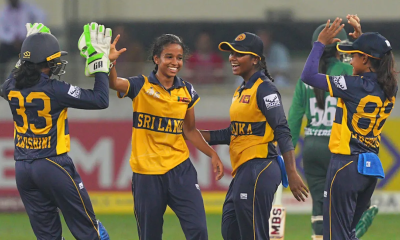
Sri Lanka thwart Fatima Sana challenge to secure Asia Cup final spot
-
 Features5 days ago
Lost for 90 years: Rare Goby resurfaces in Jaffna