
Latest News
Cabinet approval to publish draft bill on contempt of a court, a tribunal or an institution

The Cabinet of Ministers granted approval to the proposal submitted by the Minister of Justice, Prison Affairs and Constitutional Reforms for publishing the draft bill prepared by the Legal Draftsman which includes the clear and precise provisions and situational circumstances regarding the offense of ‘contempt of court’ , defense and easing the penalty as well as the procedure to follow when easing the penalty, in the government gazette and subsequently to be tabled in the Parliament for its concurrence.



While Sri Lankan cricket begins another cycle of seething introspection, there is still business to be concluded in Colombo and Pallekele. New Zealand helped turn the home crowd against their own on Wednesday night and will be looking to confirm their own passage to the semi-finals – for the fourth time in the last five T20 World Cups – when they return to Khettarama to take on England, who are already through.
Looking on anxiously will be Pakistan, who shared the points with New Zealand when their Super Eight encounter was washed out and must consequently cling to the possibility of England making it three wins from three and then making up the net run rate deficit in victory over Sri Lanka (with the results margin from both games cumulatively needing to be around 0 runs, assuming the team batting first makes 180).
England’s campaign so far has turned the phrase “winning ugly” into an art form; the two-wicket triumph over Pakistan that sealed their semi-final spot was so defiantly slapdash it might well end up being nominated for the Turner Prize. The quest for the “perfect game” continues. Certainly, there is no danger of them peaking too early.
If there is one unsettling blot on their copybook so far, it is the continuing travails of Jos Buttler. His haunted look after dismissal for a fourth single-innings score in a row against Pakistan told the story of a horror campaign, but there is no sense yet that England are ready to pull the rug on their greatest white-ball batter of all time.
New Zealand are more in need of the win – even if a close-fought loss might do – but, after a dip at the 2024 World Cup when they were edged out in the first group stage by Afghanistan, they look back to their best as a high-functioning tournament side that always makes the best of the resources available to them.
They came into this World Cup with several players battling injury and illness; Michael Bracewell, a key allrounder in subcontinental conditions, was then ruled out without playing a game. But they have won four out of five completed games with Bracewell’s replacement, the unheralded Cole McConchie, one of stars of their come-from-behind win over Sri Lanka – a game in which their five spin-bowling options trumped the four that England are able to call on (assuming the cut to Jacob Bethell’s bowling hand has healed).
No one should be surprised to see them get the job done again. A New Zealand win would put them top of the group, and also end the uncertainty around the semi-final venues, with Mumbai and Kolkata locked in. Pakistan will be hoping desperately it’s not that straightforward.
While Buttler’s lack of form remains the main talking point, Harry Brook did everything he could to make sure the headlines were about him against Pakistan. At the prompting of Brendon McCullum, Brook elevated himself to No. 3 in the order – having dropped down to No. 5 before the World Cup – and the immediate results were spectacular. Having only done the job a handful of times before for Yorkshire and Northern Superchargers, and never at international level, he made full use of the opportunity for a fast start during the powerplay and was consequently more settled when it came to navigating middle-overs spin (his T20 weak spot). A maiden T20I hundred, from just 50 balls, suggests he should be locked in at first drop for the foreseeable.
Kiwis are all about the collective, with handy performance so far sprinkled around, but one area that might be cause for a smidge of concern is the New Zealand middle order. Partly that is down to the top four being so effective – openers Tim Seifert and Finn Allen are their leading run-scorers, closely followed by Glenn Phillips – and partly the abandoned game against Pakistan, which meant they went eight days without playing. Daryl Mitchell and Mark Chapman have both batted three times and missed the chance for middle time against Sri Lanka, before Mitchell Santner and McConchie produced the vital rescue act. New Zealand have discussed pushing Santner higher, but will likely stick with the incumbents in the expectation they will come good (or not be needed).
England have played the same XI five games in a row and – unless they were to suddenly change their thinking on Buttler, and parachute Ben Duckett in to open – seem likely to stick with that formula. Rehan Ahmed, Josh Tongue and Luke Wood are in the wings, in the event that they wish to test their bench strength.
England: (probable) Phil Salt, Jos Buttler (wk), Harry Brook (capt), Jacob Bethell, Tom Banton, Sam Curran, Will Jacks, Jamie Overton, Liam Dawson, Jofra Archer, Adil Rashid.
After adapting on the fly to seal such a comprehensive win over the home side, New Zealand are also expected to keep the same balance, with the two quicks and five spin options at their disposal. Jimmy Neesham could return if conditions demand another seam option.
New Zealand: (probable) Tim Seifert (wk), Finn Allen, Rachin Ravindra, Glenn Phillips, Daryl Mitchell, Mark Chapman, Mitchell Santner (capt), Cole McConchie, Matt Henry, Ish Sodhi, Lockie Ferguson.

India set up a virtual quarter-final against West Indies on Sunday with a comfortable win against Zimbabwe on a night that Abhishek Sharma scored his maiden World Cup fifty and India made a small tweak in their batting combination to unleash the second-highest total in T20 World Cups, going two past the 254 Zimbabwe conceded in their last match. Six men batted for India, their innings lasted 15 to 30 balls, and their strike rates ranged from 158.33 to 275. In all, they hit 17 sixes, the most for India in a single T20 World Cup innings.
Zimbabwe asked India to bat first expecting help for fast bowlers. Their reading of conditions was accurate, but the execution was much better from the much more experienced India bowlers, who kept them to 33 in five overs, post which there was hardly any way back.
Zimbabwe, now out of the tournament, dropped two costly catches, taking their tally in Super Eight to five in two matches after having missed just one in the whole first round. A defiant unbeaten 97 from Brian Bennett was the only consolation for them.
Samson breaks up left-hand cluster
India finally admitted their cluster of three left-hand batters at the top was giving offspinners a match-up to exploit, that Suryakumar Yadav was not going to be promoted to No. 3, and sacrificed some lower-order hitting of Rinku Singh to bring in Sanju Samson. Zimbabwe were anyway looking to open with their tall fast bowlers, both of whom Samson hit for sixes down the ground off the back foot in the first two overs. He eventually fell for just 24 off 15, but he was part of India’s biggest opening stand this tournament: 48 off 3.4 overs.
Unlike earlier matches, Abhishek neither charged at the quick bowlers nor gave away his stumps. It took him only three balls to unveil an inside-out drive over extra cover for four. It turned out to be a no-ball as well, and he sent the free hit for a straight four. Abhishek got to 33 off 13 in the powerplay as Zimbabwe refrained from using spin before the field spread out.
As soon as the powerplay ended, Sikandar Raza and Brian Bennett bowled two overs without a boundary to Abhishek and Ishan Kishan. Neither of them panicked, Ishan used power, Abhishek his feet, and both got past the hurdle.
It took only his 26 balls but Abhishek’s maiden World Cup fifty was the second-slowest of his 11 scores of 50 or above in T20Is.
Dropped catches hurt Zimbabwe
Had Zimbabwe held on two pretty straightforward chances, Kishan would have been dismissed for 26 off 19 and Suryakumar for eight off four. The duo ended up with 38 off 24 and 33 off 13. The innings was set up beautifully for Hardik Pandya and Tilak Varma to finish off.
The finishing kick
Hardik Pandya and Tilak Varma added an unbeaten 84 off 31 balls, hitting four sixes each, almost racing each other. Hardik was the only one that ended up with a fifty, but he had a headstart of 12 runs when Tilak came out to bat. Tilak was the quicker one, striking cleanly from the first ball, using space both in front of and behind square. Hardik mainly used power to go down the ground, and caught up with and went past Tilak with two sixes off the last two balls of the innings.
Early movement makes it a bridge too far for Zimbabwe
Arshdeep Singh conceded just one boundary in his first two overs, Hardik extracted appreciable seam movement with the new ball, and at 25 for 0 in four overs, Zimbabwe were looking at 14.5 per over to stay alive in the tournament.
Spinners strike
Axar Patel, left out for the last match because of an abundance of left-hand batters, took two balls to get a wicket, that of the left-hand batter Tadiwanashe Marumani. Varun Chakravarthy took to 19 his streak of taking at least one wicket in a T20I with the wicket of Dion Myers.
Bennett shines, cause for concern for India
In the end, India were comfortable victors by 72 runs, but they will not like that Varun went for 35 runs, conceding three sixes, and that their sixth bowler Shivam Dube had a terrible night out with 46 off two overs. Thanks to South Africa’s win over West Indies earlier in the day, India were under no pressure to secure a big win so they did experiment more than they usually would have.
Zimbabwe ended up getting 184 thanks largely to Bennett, who showed he had a higher gear in him after he went the first round scoring in the 130s without a single six. Here he hit six sixes and scored at 164.4. As the hundred approached, though, Arshdeep shut Zimbabwe out with three wickets in two overs, which also meant Bennett was starved of strike in the end. Arshdeep went past Jasprit Bumrah as India’s leading wicket-taker in T20 World Cups.
Brief scores:
India 256 for 4 in 20 overs (Sanju Samson 24, Abhishek Sharma 55, Ishan Kishan 38, Suryakumar Yadav 33, Hardik Pandya 50*, Tilak Varma 44*; Richard Ngarava 1-62, Blessing Muzarabani 1-42, Tinotenda Maposa 1-40, Sikandar Raza 1-29) beat Zimbabwe 184 for 6 in 20 overs (Brian Bennett 97*, Tadiwanashe Marumani 20, Sikandar Raza 31, Tony Munyonga 11; Arshdeep Singh 3-24, Varun Chakravarthy 1-35, Axar Patel 1-35, Shivam Dube 1-46) by 72 runs
[Cricinfo]
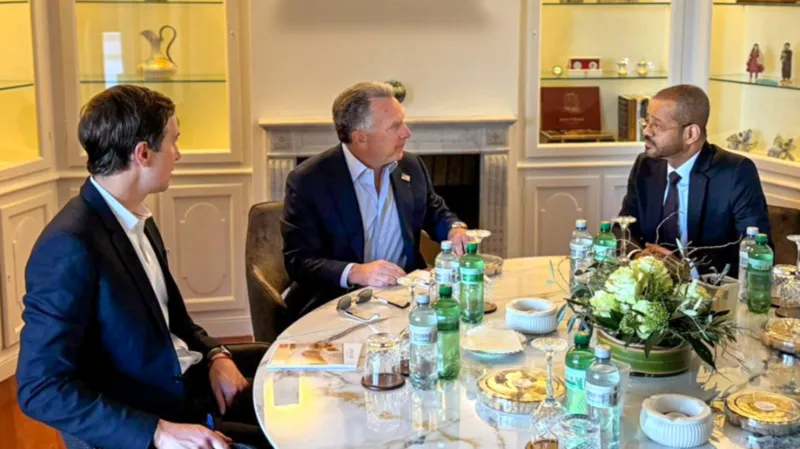
US and Iranian officials have met in Geneva for a third round of indirect talks seen as crucial to averting conflict, with President Donald Trump threatening to strike Iran if a nuclear deal is not reached.
The discussions come amid the largest US military build-up in the Middle East since the US-led invasion of Iraq in 2003, and with Iran vowing to respond to an attack with force.
Thursday’s talks were adjourned after three hours. Oman’s Foreign Minister Badr Albusaidi, who is acting as the mediator, said negotiators had exchanged “creative and positive ideas” and would return after taking a break. “We hope to make more progress,” he added.
But the chances of an agreement remain unclear.
While Trump has said he prefers to solve the crisis through diplomacy, he has also said he is considering a limited strike on Iran to pressure its leaders to accept a deal.
The president, however, has done little to explain what he is demanding in the negotiations and why there could be the need to take military action now, eight months after the US bombed Iranian nuclear facilities during a war between Israel and Iran.
Iran has rejected the US demand to stop the enrichment of uranium in its territory, but there have been indications that it is prepared to offer some concessions about its nuclear programme.
As in the previous two rounds of discussions earlier this month, the Iranian delegation is being led by Foreign Minister Abbas Araghchi, while the US is represented by special envoy Steve Witkoff and Trump’s son-in-law, Jared Kushner.
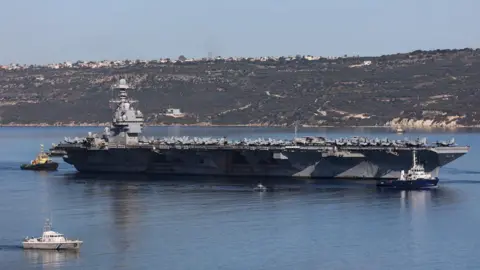
In recent weeks, the US has sent thousands of troops and what Trump has described as an “armada” to the region, including two aircraft carriers along with other warships, as well as fighter jets and refuelling aircraft.
Trump first threatened to bomb Iran last month as security forces brutally repressed anti-government protests, killing thousands of people. But since then, his focus has turned to Iran’s nuclear programme, which has been at the centre of a long-running dispute with the West.
For decades, the US and Israel have accused Iran of trying to secretly develop a nuclear weapon. Iran insists its programme is only for peaceful purposes, though the country is the only non-nuclear-armed state to have enriched uranium at near weapons-grade level.

In his State of the Union speech to Congress on Tuesday, Trump briefly and vaguely talked about the tensions with Iran, without clearly laying out the case for strikes.
He said Iran was working to build missiles that would “soon” be capable of reaching the US, without giving details. He also accused the country of trying to “start all over again” with a nuclear weapons programme following last year’s strikes, and said he could not allow the “world’s number one sponsor of terror… to have a nuclear weapon”.
The US struck three nuclear sites in Iran last June, as it joined Israel in its bombing campaign. At the time, Trump said the facilities had been “obliterated”.
Iran says its enrichment activity stopped after the attacks, although it has not allowed the International Atomic Energy Agency’s inspectors to access the damaged sites.
“They want to make a deal,” Trump said, “but we haven’t heard those secret words: ‘We will never have a nuclear weapon’.”
Hours before the speech, however, the Iranian foreign minister posted on social media that Iran would “under no circumstances ever develop a nuclear weapon”. Araghchi also said there was an “historic opportunity to strike an unprecedented agreement that addresses mutual concerns and achieves mutual interests”.
Reacting to Trump’s address, an Iranian foreign ministry spokesman accused the US of repeating “big lies” regarding its nuclear programme, ballistic missiles and the number of protesters killed in the crackdown.

Iran’s proposals have not been made public, but the discussions in Geneva could include the creation of a regional consortium for uranium enrichment, which has been raised in previous negotiations, as well as ideas about what to do with Iran’s roughly 400kg (880lb) stockpile of highly enriched uranium and verification and monitoring mechanisms.
In return, Iran expects the lifting of sanctions that have crippled its economy. Opponents of the regime say any relief would give the clerical rulers a lifeline.
But it remains unclear which conditions Trump could find acceptable for a deal. Iran has already rejected discussing limits to the country’s ballistic missile programme and ending its support for proxies in the region – an alliance Tehran calls the “Axis of Resistance” that includes Hamas in Gaza, Hezbollah in Lebanon, militias in Iraq, and the Houthis in Yemen.
Reports in US media, quoting unnamed administration officials, have suggested that Trump was considering an initial strike in the coming days on Iran’s Revolutionary Guards or nuclear sites to pressure the country’s leaders. If negotiations failed, according to the reports, the president might go as far as ordering a campaign with the aim of toppling the Iranian Supreme Leader, Ayatollah Ali Khamenei.
The Chairman of the Joint Chiefs of Staff is also said to have warned that strikes against Iran could be risky, potentially drawing the US into a prolonged conflict, although Trump has insisted that Gen Dan Caine believes it would be “easily won”.
Iran, meanwhile, has threatened to respond to any attack by striking American military assets in the Middle East and Israel.
US-allied countries in the region are concerned that an attack on Iran could lead to a wider conflict, and have warned that air power alone will not be able to change the country’s leadership.
Israeli Prime Minister Benjamin Netanyahu, however, has warned against a deal that does not include Iran’s ballistic missiles and its proxies. Netanyahu has long described Iran as a key threat for Israel, and a source of instability in the region.
Analysts believe that the prime minister, who visited the White House earlier this month, may be pushing for a campaign with the goal of toppling the Iranian regime.
The US has the world’s second-largest nuclear arsenal. Israel is also believed to have nuclear weapons, although it neither confirms nor denies this.
Ahead of the State of the Union, Secretary of State Marco Rubio delivered a classified briefing to the so-called “gang of eight”, composed of the leaders of both parties in the Senate and House of Representatives and the chairs and ranking members of the intelligence committees of both chambers.
Following the briefing, Chuck Schumer, the Senate minority leader, gave a brief statement, saying: “This is serious, and the administration has to make its case to the American people.”
[BBC]

Can resourceful New Zealand lock in semi-final spot against already-qualified England?

Fair weather will prevail over most parts of the island

CEB engineers raise alarm over power sector stability

CB identifies 24 pyramid scams in Sri Lanka

Church urges patience, warns against interference with Easter attacks probe

GMOA ups the ante, pulls out of ‘Arogya Clinics’

‘Dates have the highest sugar content to fight Coronavirus’

Sunday Island 27 December – Headlines

#SundayIsland 17th December – Headlines

Sunday Island – 28th March

Sunday Island Headlines – 21 March

Sunday Island – 21st February – Headlines
-

 Features5 days ago
Why does the state threaten Its people with yet another anti-terror law?
-
 Features5 days ago
Reconciliation, Mood of the Nation and the NPP Government
-

 Features5 days ago
Victor Melder turns 90: Railwayman and bibliophile extraordinary
-

 Features4 days ago
LOVEABLE BUT LETHAL: When four-legged stars remind us of a silent killer
-
 Features5 days ago
Victor, the Friend of the Foreign Press
-
 Latest News7 days ago
New Zealand meet familiar opponents Pakistan at spin-friendly Premadasa
-
 Latest News7 days ago
Tariffs ruling is major blow to Trump’s second-term agenda
-

 Latest News7 days ago
ECB push back at Pakistan ‘shadow-ban’ reports ahead of Hundred auction