
Sports
Buttler’s sixth ton trumps Kohli’s eighth as Royals go four-from-four

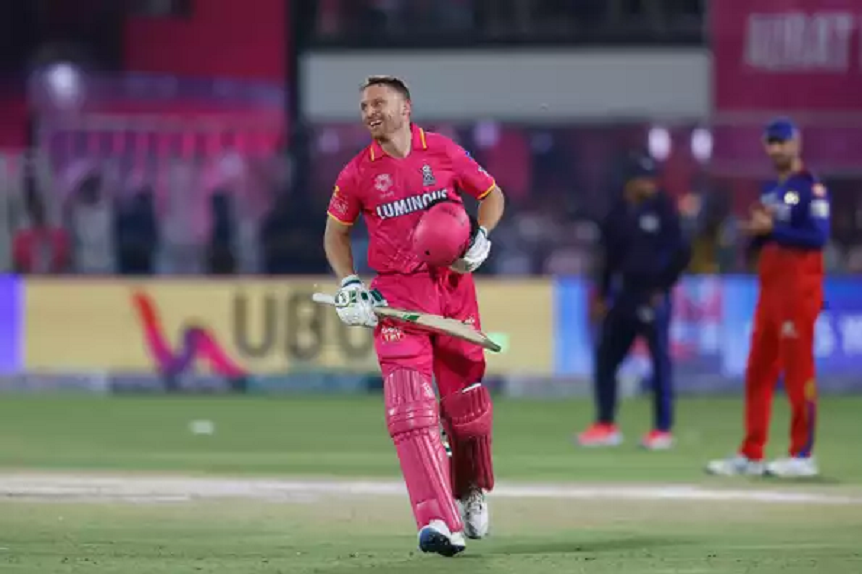
Virat Kohli’s eighth IPL century went in vain as Rajasthan Royals secured a comfortable six-wicket win to go four-from-four at the start of IPL 2024. It was the third time that Kohli’s IPL century came in a losing cause as Jos Buttler’s unbeaten sixth IPL ton – achieved off the last ball of the chase – and Sanju Samson breezy half-century helped Royals over the line with five balls to spare at the Sawai Mansingh Stadium in Jaipur on Saturday.
There have been better and more fluent centuries Kohli has scored in the IPL. His innings was littered with shots that he couldn’t time as well as he would’ve liked partly down to the slightly tacky nature of the pitch in the first half of the match. There was ample intent to attack, but not every shot proved as effective as he would’ve liked. It took him 67 balls to reach the three-figure mark, the joint-slowest by anyone in IPL history.
He got going smoothly early on though, dictating terms in the powerplay. The acceleration began in the second over when he hit Nandre Burger over the mid on region for a boundary and then flicked another four through square leg. The region between deep square leg and deep mid wicket proved to be his most productive area from where he picked up nearly three-fourth of his runs. He even pulled Burger for a six in the pacer’s next over and provided RCB a strong start.
However, while he got off to a strong start and maintained their scoring rate, Kohli mentioned after his innings that it was decided that the pitch wasn’t as flat as it seemed from the outside and that they were forced to recalibrate the attempted total from 190 to 180 with one of the set openers batting till the end. Royals were also clever with their tactics. The pacers took the pace off consistently and bowled the short of good length, while the spinners also varied their pace and forced the batters to hit towards the longer boundary.
Every now and then, Kohli did manage to hit a few boundaries. He was particularly good against Avesh Khan in the death overs, slicing his yorker square of the wicket, flicking him through mid wicket, hitting straight down the ground and even through the cover region – all for boundaries. However, he didn’t get similar success against Burger in the end overs and the refusal to pick the extra runs while nearing his century ensured that RCB were restricted to 183 for 3 eventhough Kohli registered his joint-highest T20 score.
Faf du Plessis had got the innings going with a thumping drive over covers for four in the first over, and powered RCB to a fruitful opening partnership. Not only was it the first time this season that RCB had played out the powerplay without losing a wicket but they also blunted Royals’ attack, which had picked nine scalps in this period in their first three games.
In the company of Kohli, du Plessis added 125 runs for the opening wicket – the 47th century stand for the franchise and the second highest against Royals. While the RCB skipper was largely away from strike for most parts of the innings, he ensured the duo added more runs on the day and continued to score at rate of almost nine per over to set up a strong base for the rest of the batters to go on the offensive at the latter stage of the innings.
Interestingly, several of Royals’ better fielders made some mistakes. While Dhruv Jurel and Riyan Parag misfielded balls at the boundary, Trent Boult put down a sitter. However, the dropped catch didn’t prove too costly as du Plessis fell off the next ball, hitting flat to Jos Buttler at long on, despite it being a more than 70-meter shot. They even missed a few run out chances.
However, following the dismissal of du Plessis after scoring a 33-ball 44, Royals were quick to pounce on that opening, and ensured that the new batters didn’t have it any easier. After serving a couple of slower balls to Glenn Maxwell, Burger cleaned him up with a faster one. Saurav Chauhan’s debut wasn’t too noteworthy either as he was dismissed for a six-ball nine, offering a catch to Yashasvi Jaiswal at mid wicket, where he took it off a second attempt. Cameron Green’s attempt to muscle some big shots didn’t yield the desired result, as he could add only five runs in six deliveries.
Early on, there were signs that RCB could trouble RR on a pitch that Kohli had claimed wasn’t as flat as it looked. Reece Topley had Yashasvi Jaiswal top-edging a pull to mid off off the second delivery of the chase. Soon, Buttler could’ve been caught and then run out. But RCB let both chances slip away. The Royals opener, who had been enduring a bit of a patchy form lately was looking scratchy early on in the chase. In the first four overs RR managed to score only 25 runs.
Buttler and Samson dictated the run chase. The signs of a counterattack had started in the fifth over, but it was in the last over of the powerplay that they truly went into overdrive, with Buttler smoking Mayank Dagar for three boundaries and a six. The slip-ups from the RCB fielders were plenty. To add to it, even Kohli put down an opportunity to dismiss Samson on 28 when he dived forward but couldn’t hold on to a catch.
Samson, who was also slow to start off, went to the fifth gear in Dagar’s second over when he smashed the left-arm spinner for a six and two boundaries, and brought up his half-century in the process.
As the partnership flourished, RCB kept running out of ideas. While the two batters were quick to use deft touches to their advantage, they largely targetted the straight boundaries. In 86 balls, they put on a 148-run stand which almost sealed the fate of the contest. Samson fell in the 15th over pulling Siraj to the fine leg fielder, who took the catch barely a few inches from the boundary.
Needing 32 runs off the last five overs, the hosts didn’t need to sweat too much. Parag was dismissed chipping to the short mid wicket fielder and Jurel edged a delivery down the legside to the ‘keeper, but RCB were left with too much to threaten the contest. Nonetheless, they managed to take it to the last over, which seemed highly unlikely at the end of the 14th over, where they were left defending only 38 runs with nine wickets in hand.
With one run needed off the last over, Buttler smoked Green for a six over the deep mid wicket boundary to bring up his sixth IPL century and help RR over the line.
Brief Scores:
Royal Challengers Bengaluru 183/3 in 20 overs (Virat Kohli 119*, Faf du Plessis 44; Yuzvendra Chahal 2-32, Nandre Burger 1-33) lost to Rajasthan Royals 189/6 in 19.1 overs (Jos Buttler 100*, Sanju Samson 69; Reece Topley 2-27, Mohammed Siraj 1-35) by 6 wickets











by Rex Clementine
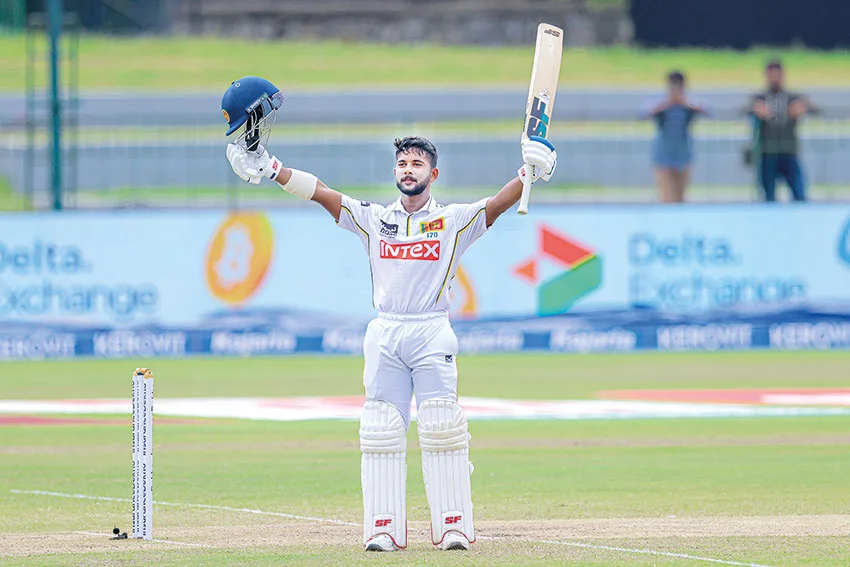
India are closing in on a big win at SSC after Sri Lanka slumped to 229 for six at stumps on day four of the second Test having been forced to follow on yesterday.
Sri Lanka lead by just 16 runs with four wickets in hand and with three sessions remaining, the tourists will be looking to wrap up victory and complete a 2-0 series sweep. India won the first Test in Galle by 165 runs.
Sonal Dinusha, who batted superbly for a hundred in the first innings, was unbeaten on seven when rain brought play to a premature end. With Sri Lanka now into the tail, Dinusha has his work cut out. He has been the hosts’ standout performer in the series, having also made 100 and 84 in Galle.
Sri Lanka resumed the day on 265 for eight, still needing 39 runs to avoid the follow on, but were bowled out for 290 and asked to bat again.
Although they lost both openers early, Kamindu Mendis and Pasindu Sooriyabandara gave Sri Lanka hope with a 115 run stand for the third wicket.
Sooriyabandara, who had made 80 in the first innings, once again played spin superbly, using clever footwork, while Mendis took on the fast bowlers.
But India had plenty of runs on the board and persisted with the short ball against Mendis, stationing three fielders on the boundary. Eventually, the plan paid off. Mendis took on Mohammed Siraj and perished for 55, with captain Shubman Gill running in from square leg to complete a fine catch.
That was the breakthrough India desperately wanted and the spinners quickly turned the screws. Three wickets fell for just nine runs as Sri Lanka surrendered the initiative and India regained control.
Sooriyabandara missed out on a well deserved hundred when he charged Manav Suthar. The left-arm spinner cleverly fired the ball wide, leaving the batter stranded as Rishabh Pant whipped off the bails in a flash. Sooriyabandara’s 92 came off 173 balls and contained ten fours and a six.
Having spent considerable time in the field, India’s bowlers were beginning to tire, evident from the number of loose deliveries they sent down. But Sri Lanka’s batters lacked the patience to drive home the advantage, with several throwing away their wickets just when the hosts appeared to be clawing their way back into the contest.

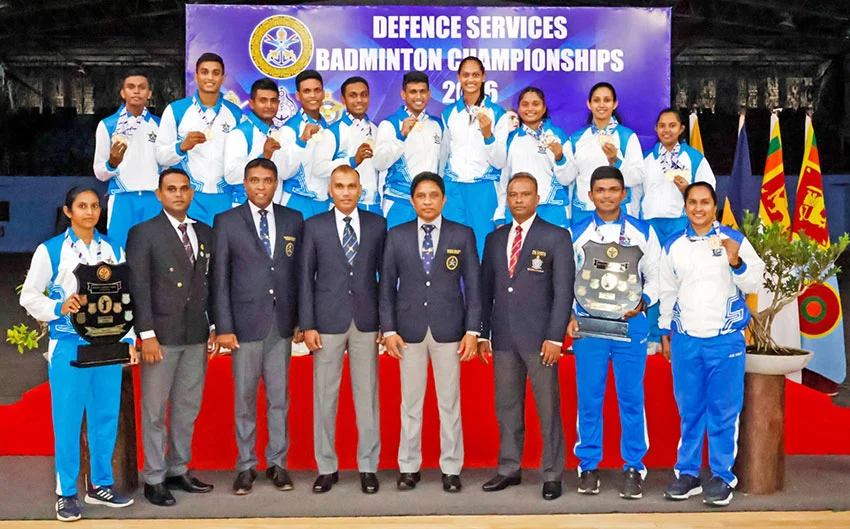
Sri Lanka Air Force emerged Overall Champions in both the Men’s and Women’s categories at the 14th Defence Services Badminton Championship concluded successfully on 21 August 2026 at the Sri Lanka Army Indoor Sports Complex, Panagoda.
The SLAF Men’s Team secured the Open Men’s Doubles and Men’s Team Championships, while the Women’s Team excelled by winning the Open Women’s Singles, Open Women’s Doubles and Women’s Team Championships.
In the Open Men’s Doubles, Leading Aircraftman Lochana De Silva and Aircraftman Achintha Imeshaqe secured the championship, while Aircraftwoman Praveena Wijesundara and Aircraftwoman Anurangi Masakorala claimed the Open Women’s Doubles title with Aircraftwoman Praveena Wijesundara winning the Open Women’s Singles Championship.
Major General Mohan Premaratne, President of the Sri Lanka Army Badminton Federation, was the Chief Guest at the awards ceremony while SLAF’s Director Sports Air Commodore Prabath Dissanayake, former Chairman Badminton Sri Lanka Air Force Air Commodore Poojana Gunathilake, Secretary Air Force Sports Council Group Captain Eranda Geeganage and Secretary Badminton Sri Lanka Air Force Wing Commander Thushara Wijeratne. were also present.

Malki Madara and Shashini Fernando shared nine wickets between them to help Sri Lanka Air Force Women beat Chilaw Marians Cricket Club Women by 169 runs and propel their team to the semi finals of the Major Club Womens Limited Over cricket tournament conducted by Sri Lanka Cricket.
In the game played at their home ground in Katunayake on Monday [24], Sri Lanka Air Force posted 276 runs for the loss of eight wickets with Ashani Kaushalya topping the score card with 57 runs off 81 balls with ten hits to the ropes.Sasini Alwis and Wethumya Wijesuriya captured three wickets each.
Chasing 277 to win Shashini Fernando captured five wickets while Malki Madara captured four wickets to restrict the Chilaw Marians Cricket Club Women to 107. Skipper Sanduni Nisansala scored 38 off 61 balls with four boundaries and a six.
Sri Lankan Air Force Women will meet Panadura Sports Club Women for the semi-final at the LRDC ground on Friday (28)
Scores:
Sri Lanka Air Force Women 276/8 in 50 overs [Ashani Kawshalya 57, Malsha Shehani 32, Savindi Cooray 34*; Sasini Alwis 2-48, Wethumya Wijesuriya 2-67]
Chilaw Marians Cricket Club Women 107/10 in 43.5 overs [Sanduni Nisansala 38; Malki Madara 4-14, Shashini Fernando 5-09]

Showers above 50 mm are likely in the Western, Sabaragamuwa and North-western provinces and in Kandy, Nuwara-Eliya, Galle and Matara districts

Patali alleges NPP conspiring to put off elections indefinitely

August 15 Super Dvora tragedy: Search continues for missing officer’s body

Tripartite MoU to expand free cardiothoracic surgeries at KDU Hospital

Jaffna to mark Int’l Day of the Disappeared

Unfolding El Niño and burning issues

‘Dates have the highest sugar content to fight Coronavirus’

Sunday Island 27 December – Headlines

#SundayIsland 17th December – Headlines

Sunday Island – 28th March

Sunday Island Headlines – 21 March

Sunday Island – 21st February – Headlines
-
 News6 days ago
Country’s first woman Surveyor General appointed
-

 Business5 days ago
SriLankan Airlines makes ShakthiSAT Mission possible for talented Sri Lankan student
-

 Features6 days ago
Medical education in Sri Lanka: Then and now
-
 Latest News6 days ago
Imran Khan moved to private hospital amid deteriorating health
-

 Latest News6 days ago
Government has declared 21, 22 and 23 August 2026 as national days of mourning
-
 Features4 days ago
My secondary schooling after Royal Primary
-

 Latest News5 days ago
Tharanga edges out Chopra in 88m javelin battle
-

 News6 days ago
22A: Opp. demands all available SC judges hear petitions