
Features
Building a family, land reforms and developing a new mango variety


Foundation for a successful gem and jewellery business also laid
He struck up a relationship with a Philipino agricultural scientist attached to the ADB in Anuradhapura and they worked together to identify a mango which Sri Lanka could be proud of. We had about 12 varieties but the mixture did not yield profitable results. With a lot of experimentation they finally came up with the variety now known islandwide as the TJC mango, registered with the Department of Agriculture as the TOMEJC (named after Tom Ellawala and Juan Carlos).
by Nalini Ellawela
(Excerpted from her recently published autobiography)
Our three children were born in the short space of three and a half years. Although we had maids to attend to the mundane needs, those early years took a terrible toll on my physical well-being. But as I look back, it was like running a nursery class with all three children wanting the same thing at the same time. Fortunately, Nilanthi, the eldest and being a girl, was given to minding her own business and preferred to entertain herself from a very early age by looking at pictures and books. No dolls for her. She just did not bother to handle them.
In the meanwhile, the boys kept fighting with each other and were given to understand from a very early age that they should not brawl with their sister. Toys were very difficult to come by in that era of socialism. Fortunately, we lived on the estate and they had the open spaces as well as the river and the irrigation canal, to give them the kind of fun that today’s children lack.
By the end of December 1964, we decided to move into Battaramulla where we had a small house and a five-acre block of land. This was ideal for a small farm and, with the agricultural background that he had, Tom immediately wanted to go in for livestock. Before long, we had collected a herd of heavy milk yielding buffaloes and set up a thriving Buffalo Curd business. Polduwa Farm Curd was the dessert of choice for all the fashionable ladies of Colombo 7. Fancy myself, after a degree in law at the University of Peradeniya, being referred to as the Kiri Nona whenever I entered the Kollupitiya market! I can assure you that they did not teach me how to make good quality curd during those years at Peradeniya.
One of the first things I had to do to make myself independent was to get my driving license. Tom had, in the meantime, mentioned that I should do everything to make myself self-reliant. This required me to have an understanding of what funds we had and how to handle them. We had a rather powerful car – a Ford Zephyr with a six-cylinder engine and, when I went for my driving test, I was driving at the high speed of 40 m.p.h when the examiner asked me whether I always drove in this reckless manner.
After the license was given, I began to get about on my own, though rather nervously. I soon realized that I had a serious handicap and could not under any circumstances multi-task. I had to concentrate on what I was doing, and if I let my mind stray even for a moment, I would miss my track.
Both Tom and Nilanthi were subject to asthmatic attacks and the doctor suggested seaside living to get over this difficulty. So, we moved into a house in Carlwil Place, Kollupitiya, away from the flowering grass fields of Battaramulla. Nilanthi may have been 10 when she finally got over her breathing difficulties and perhaps the seaside did help. Upto that point of time she was ailing and spent half the year at home. She must have been about six years of age when she went into a severe asthmatic attack which refused to subside even after about 30 injections. She had turned blue and the doctors were thinking of putting her into the iron lung when she finally rallied. I must have aged about 10 years over that incident.
Born into an Anglican Christian family and having married an Anglican Christian, we did not have any problems in finding places for our children in our old schools. Nilanthi was admitted to Ladies’ College and the boys to St Thomas’ Preparatory School. In spite of a very unhealthy and troublesome start to her schooling career, Nilanthi was able to distinguish herself academically in due course. She went on to a career in the medical world as a University teacher.
Chanaka and Suresh, having enjoyed one year of nursery at Ladies’ College, were admitted to St. Thomas’ Prep school which was only five minutes away from home. They were constantly battling with each other till they entered their teens. Chanaka was the accident prone one giving us nail biting experiences. Stitches were common for Chanaka. The chin, wrist and the thigh show the scars of his daring moves.
The boys did not have the same academic backing in Sri Lanka as Nilanthi when they finished with Prep School. This led to their transfer to the International School at Kodaikannal for the A/L years. While Chanaka, the elder, moved on to a course in Gemmology in America, Suresh, the youngest, returned home, wanting to join the business straightaway. By this time, the business was picking up and Tom had set up an office in Carlwil Place with three or four assistants. But I was not willing to let Suresh handle money at 17, without being mature enough to understand that money was only a tool. So with great difficulty and a lot of persuasion he was sent off to England where he was to follow a degree in Business Management.
As I look back on those turbulent years, I admit that I too was not mature enough to handle the complicated ramifications of interpersonal relationships and financial imbalances that we were confronted with. Life was extremely difficult and challenging, but I do not recall despondency or depression. Money was never in plenty but we always had what we really wanted or maybe needed.
My husband
My life story would not be complete if I did not draw a comprehensive picture of the man I had chosen to live with. As I look back, I am full of appreciation of the wonderful qualities he had (not forgetting his weaknesses!) to enrich my life and the quality of the family we developed together.
His mother had passed away at the early age of 39, when he was only 17. As to what scars this incident left on the adolescent mind is something I have always tried to understand. His caring and compassionate ways must have been surely inherited from his mother, because his father was a strict disciplinarian and stern in his relationships. For the 10 years I knew him, the ritual of ‘good morning’ and ‘how are you’ were the only verbal exchanges that were made freely.
Our partnership, which originated through parental goodwill, lasted for more than 59 years. In keeping with the traditions of those times, our marriage was, to a large degree, an ‘arranged’ one. For a marriage which rose from a background such as this, one would imagine that our life together was humdrum and boring. Left to my own devices it may have truly turned out to be so. But my husband was of a more romantic disposition and lifted our relationship to an exciting and warm level.
Very early in our life together it became quite clear that “attachment with detachment”was to be our life’s guiding force. He was willing to give me total freedom and trusted me implicitly in whatever I did and wherever I went. As the father and husband he gave leadership to the family and provided us with our needs, fun and enjoyment. But he left decision making within the family unit to me. While he was busy building houses and earning the money for me to burn, I had to spend my time and energy to guide our children through to rewarding pursuits as well as keep myself gainfully occupied.
Tom had a very expensive hobby. While others went in for wine,women and song, he went in for building structures with brick and cement. Since he had missed his vocation, his creative capacity to design and build was tested over the years. Architects or engineers were never consulted. Plans were never drawn. A simple baas from the village was all he needed. Building walls and breaking them down was child’s play. If ever I was away from the country, at a workshop or seminar, I was always confronted with additions to the house on my return. His capacity for innovation and creativity were his outstanding qualities. Additionally, there was an intense desire to use waste material as well as ‘rejects’ which most people would not touch. The Metige at Mahausakande is an outstanding example of this skill.
He also loved to take a challenge. When all others were giving up, this was the right time for Tom to enter and prove his mettle. There was a Frenchman who had come to Sri Lanka and was working with one of the leading companies in Colombo crafting high-end jewellery, who was introduced to Tom. At this time, we did not have a workshop and knew little of the craft. One day, I came home to Carlwil Place when I found our drawing room converted into a workshop. The need for consultation or discussion had not occurred to him.
This was my first insight into the man and his mysterious way of letting go of material assets. Here was someone who was desperately in need of finding a new way of income generation and he took the opportunity with both hands. With that brave inroad, he was able to set up a company which, today, ranks as one of the best jewellery manufacturers and exporters in the country.
The first lesson I learned through this experience, which was, to say the least, shattering for any housewife, was that happiness cannot be achieved through material assets. Personal power is not through the exterior but from the interior. We both picked up a simple lifestyle, comfortable, yet ostentatious, while being more conscious of the ethical demands of healthy living.
Tom was quick at picking up the technical stuff as we entered the digital era in our middle years. As for me, even a single button sent my head into a spin. When computers came along, he insisted that I become familiar with the machine if I wanted to be a useful person in the community. I shrank from the challenge for as long as I could, but one year when I was away at yet another conference, he purchased a laptop, had it placed on my desk, and told me on my return that I should not behave like a village idiot. This pushed me into learning the basics of word-processing with the help of my young secretary at the Sumithrayo office. In my fifties, I was young enough to learn something new. How grateful I am today for this great push he gave me.
In a long journey of over 80 years, Tom has gone through many vocations and income generating activities. Starting with rubber plantations, he moved onto Gem and Jewellery manufacturing and from there to producing the TJC, a mango which has its own flavour and attributes. I noticed that he was given to pioneering ventures, which began to bore him once the challenge was over, and then wanting to move onto something new. This would happen at regular intervals of four to six years.
The only interest he did not leave behind for something new was his wife. From the rubber plantations, he started the farming activity at Battaramulla, where he built up a fine herd of heavy milking buffaloes. But with the introduction of the Parliament complex to Sri Jayawardenapura the farm had to be closed down. Before Land Reform, he also had this consuming passion about photography and was acclaimed as a prize winning photographer.
With the change in livelihood following Land Reform, attention was turned to gems and, thereafter, jewellery. It is important to note that whatever he put his hands on, he reached out for the best. He bought his own ‘hang poruwa’, the local cutting machine, and learned how to cut a gem. He was of the view that to tell others how to do it, one had to know the technique oneself. Ultimately, he could fashion a stone as well as anybody who called himself a professional lapidarist. It was much later that the electric machine came to Sri Lanka and he was able employ his own cutters.
This was followed by a community development scheme at Ellawala. Keen to offer employment to the villagers, he recruited and trained about 60 young men and women, having set up a lapidary in the village. He also took a toy making industry to Ellawala, but that was short lived. The village school that his father built got a face lift and village life took on a new vibrancy.
With the change in government and the installation of President Chandrika, he was offered the Chairmanship of the Gem Authority. During this spell at the Gem Authority, he took the opportunity to modernize Ratnapura as the City of Gems. Many changes were effected in the gem trade, both at the public and private sector levels, during his time as Chairman. In recognition of the work he did, the then President Chandrika Bandaranaike Kumaranatunge, honored him with the Desamanya title.
When that was done, he went back to the land, but now at Dambulla, where the Directors of Ellawala Exports – the mother Company – wanted to invest in agriculture. They had leased out the land from the Mahaveli Development Authority and planted it with a variety of mangoes. Tom now left the active management of the company he founded in Colombo in the hands of the younger generation and turned his attention to making the mango plantation a profitable one.
He struck up a relationship with a Philipino agricultural scientist attached to the ADB in Anuradhapura and they worked together to identify a mango which Sri Lanka could be proud of. We had about 12 varieties but the mixture did not yield profitable results. With a lot of experimentation they finally came up with the variety now known islandwide as the TJC mango, registered with the Department of Agriculture as the TOMEJC (named after Tom Ellawala and Juan Carlos).
At 82, he spends much of his time in and among the mango trees, talking to the trees as well as the staff. He makes a special effort to keep himself active but the lack of a consuming and challenging prospect does seem to lower his spirits every now and then. At the point of writing and on the eve of his 83rd birthday, he is visibly feeble both in spirit and body. Not yet accustomed to spending a day quietly without action, he is not the man that he used to be.
Land Reform and change in lifestyle
Mercifully, Tom’s father passed away just before the Land Reform Bill was brought into operation. He would not have survived it as land and ownership of land was his great pride and joy in life.
In 1970, with the implementation of the Land Reform Bill, our lifestyle was beset with serious issues. Left with only 50 acres (mostly fruit trees) and three children all under the age of 10, our financial needs were rather heavy, even in those days when money was not so important. Tom was always ready for a challenge. He was not willing to give up and spend a lifetime of complaining about the injustices of the State.
Tom decided to take up, at a professional level, the only other income generating activity he was familiar with. Coming from Ratnapura, the city of gems, he felt he could cope with the business of buying and selling gems. The village of Ellawala had yielded some of the finest gems in the past. But upto now, the family engaged in the business of gemming and selling the rough to the traders, mostly Muslim. This was not serious business but gave a little extra pocket money every now and then. To have a comprehensive idea of the business, he arranged for a period of understudy with a friend who had established himself as a dealer of repute in Singapore. He left for Singapore in 1974, leaving me to handle the family affairs for one year.
There he learned to cut and polish a gem, to recognize, value and buy them aswell as how to set up a retail business. This was made possible because his brother-in-law, Lyn De Alwis, was stationed in Singapore, helping with the establishment of a Zoo. 1974 was also an important milestone in my life. This was the year that the Founder of Sri Lanka Sumithrayo, Joan De Mel, invited me to help her set up the organization.
After Tom’s return from Singapore, he set himself up on a small scale and began buying and selling gems. A business that he was able to walk into because of his connections with Ratnapura and Eheliyagoda. The gem traders were willing to trust him as his father was well known in the district and used to give them all the gems that came out of his gem pits. Up to this time, the gems were sold to the traders and the family had not actually entered the trade.
These years were very unsettling but we were both emotionally ready and mature enough to face the challenge and overcome the difficulties we had to face. The children did well in school and I had all the time to be with them at home. When the youngest, Suresh, turned 10 and he was busy on the cricket field, I began to look for a pursuit that could bring me a sense of fulfillment. By 1977, the business was picking up and the new Jayawardene government opened the doors for free trade. Reluctantly, I worked in the office but the activity really did not stimulate me. However, in these difficult times one could not be too choosy.
During these years, we also tried to emigrate to Australia, but without success. A close friend suggested we consult our stars and took us with our horoscopes to a renowned astrologer based in distant Badulla. I recall how he mentioned that we were not destined to suffer the indignities of forsaking one’s mother land! Furthermore, he told me that I would never be able to earn by doing a job although qualified to do so. He cautioned Tom to provide for me well and virtually keep me in clover.
This caused a lot of amusement at that time and I have always reminded him about the astrologer’s words of advice. I immediately set up an informal contractual agreement for the two of us. “You earn, I burn.” This has been the active logo for our enduring partnership of more than 50 long years.
For all the work I have been involved with after my 35th year, I was able to offer my services as a volunteer because Tom earned while I burned! However, he never once questioned me on how I was using his hard earned earnings.
My entire perception about material wealth and the desire for multiplying as well as stashing away our income took a remarkable turn after 1970, when we were left with only 50 acres to call our own. It was a frightening prospect with growing children to be fed, clothed and educated. As we look back on those challenging years, we realize that fate has been very kind to us although the State was not. We were never in want, but we were also not given to luxurious or wasteful living.
It was during these times that we began to understand that money could not buy happiness. However, we had to move on to a city-oriented, money-based business lifestyle. Far different from the village based, estate life which was leisurely and certainly more healthy in its holistic sense. Society was fast moving into a consumer oriented, materialistic lifestyle where money was flowing in fast and goods were becoming freely available. Suddenly, you needed money to buy all the tantalizing goods which were being offered. How does one learn the difference between needing and wanting?
Looking back on the actual impact of the Land Reform Bill of 1970, I realize that my entire value system took a turn with this event. There was no room for bitterness. The State took away what was rightfully ours and left us to identify new income generating sources. While others perished with the accompanying stress, Tom was able to pick up the threads and start a new way of life. The coffers were virtually empty but we were never in want. We entered a period of enjoying the simple joys of family life and faced the challenges of this new lifestyle with equanimity.
(From changing attitudes and values by Nalini Ellawela)

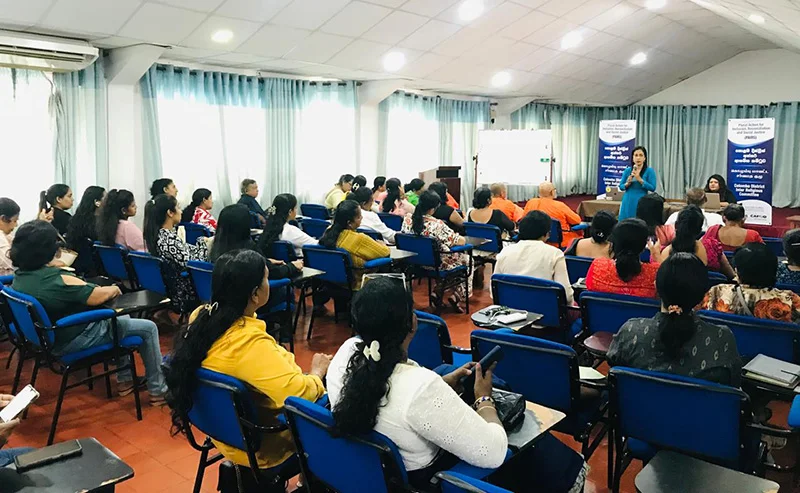
Problems and solutions in plural societies like Sri Lanka’s which have deep rooted ethnic, religious and linguistic cleavages require a consciously inclusive approach. A major challenge for any government in Sri Lanka is to correctly identify the problems faced by different groups with strong identities and find solutions to them. The durability of democratic systems in divided societies depends less on electoral victories than on institutionalised inclusion, consultation, and negotiated compromise. When problems are defined only through the lens of a single political formation, even one that enjoys a large electoral mandate, such as obtained by the NPP government, the policy prescriptions derived from that diagnosis will likely overlook the experiences of communities that may remain outside the ruling party. The result could end up being resistance to those policies, uneven implementation and eventual political backlash.
A recent survey done by the National Peace Council (NPC), in Jaffna, in the North, at a focus group discussion for young people on citizen perception in the electoral process, revealed interesting developments. The results of the NPC micro survey support the findings of the national survey by Verite Research that found that government approval rating stood at 65 percent in early February 2026. A majority of the respondents in Jaffna affirm that they feel safer and more fairly treated than in the past. There is a clear improving trend to be seen in some areas, but not in all. This survey of predominantly young and educated respondents shows 78 percent saying livelihood has improved and an equal percentage feeling safe in daily life. 75 percent express satisfaction with the new government and 64 percent believe the state treats their language and culture fairly. These are not insignificant gains in a region that bore the brunt of three decades of war.
Yet the same survey reveals deep reservations that temper this optimism. Only 25 percent are satisfied with the handling of past issues. An equal percentage see no change in land and military related concerns. Most strikingly, almost 90 percent are worried about land being taken without consent for religious purposes. A significant number are uncertain whether the future will be better. These negative sentiments cannot be brushed aside as marginal. They point to unresolved structural questions relating to land rights, demilitarisation, accountability and the locus of political power. If these issues are not addressed sooner rather than later, the current stability may prove fragile. This suggests the need to build consensus with other parties to ensure long-term stability and legitimacy, and the need for partnership to address national issues.
NPP Absence
National or local level problems solving is unlikely to be successful in the longer term if it only proceeds from the thinking of one group of people even if they are the most enlightened. Problem solving requires the engagement of those from different ethno-religious, caste and political backgrounds to get a diversity of ideas and possible solutions. It does not mean getting corrupted or having to give up the good for the worse. It means testing ideas in the public sphere. Legitimacy flows not merely from winning elections but from the quality of public reasoning that precedes decision-making. The experience of successful post-conflict societies shows that long term peace and development are built through dialogue platforms where civil society organisations, political actors, business communities, and local representatives jointly define problems before negotiating policy responses.
As a civil society organisation, the National Peace Council engages in a variety of public activities that focus on awareness and relationship building across communities. Participants in those activities include community leaders, religious clergy, local level government officials and grassroots political party representatives. However, along with other civil society organisations, NPC has been finding it difficult to get the participation of members of the NPP at those events. The excuse given for the absence of ruling party members is that they are too busy as they are involved in a plenitude of activities. The question is whether the ruling party members have too much on their plate or whether it is due to a reluctance to work with others.
The general belief is that those from the ruling party need to get special permission from the party hierarchy for activities organised by groups not under their control. The reluctance of the ruling party to permit its members to join the activities of other organisations may be the concern that they will get ideas that are different from those held by the party leadership. The concern may be that these different ideas will either corrupt the ruling party members or cause dissent within the ranks of the ruling party. But lasting reform in a plural society requires precisely this exposure. If 90 percent of surveyed youth in Jaffna are worried about land issues, then engaging them, rather than shielding party representatives from uncomfortable conversations, is essential for accurate problem identification.
North Star
The Leader of the Lanka Sama Samaja Party (LSSP), Prof Tissa Vitarana, who passed away last week, gave the example for national level problem solving. As a government minister he took on the challenge the protracted ethnic conflict that led to three decades of war. He set his mind on the solution and engaged with all but never veered from his conviction about what the solution would be. This was the North Star to him, said his son to me at his funeral, the direction to which the Compass (Malimawa) pointed at all times. Prof Vitarana held the view that in a diverse and plural society there was a need to devolve power and share power in a structured way between the majority community and minority communities. His example illustrates that engagement does not require ideological capitulation. It requires clarity of purpose combined with openness to dialogue.
The ethnic and religious peace that prevails today owes much to the efforts of people like Prof Vitarana and other like-minded persons and groups which, for many years, engaged as underdogs with those who were more powerful. The commitment to equality of citizenship, non-racism, non-extremism and non-discrimination, upheld by the present government, comes from this foundation. But the NPC survey suggests that symbolic recognition and improved daily safety are not enough. Respondents prioritise personal safety, truth regarding missing persons, return of land, language use and reduction of military involvement. They are also asking for jobs after graduation, local economic opportunity, protection of property rights, and tangible improvements that allow them to remain in Jaffna rather than migrate.
If solutions are to be lasting they cannot be unilaterally imposed by one party on the others. Lasting solutions cannot be unilateral solutions. They must emerge from a shared diagnosis of the country’s deepest problems and from a willingness to address the negative sentiments that persist beneath the surface of cautious optimism. Only then can progress be secured against reversal and anchored in the consent of the wider polity. Engaging with the opposition can help mitigate the hyper-confrontational and divisive political culture of the past. This means that the ruling party needs to consider not only how to protect its existing members by cloistering them from those who think differently but also expand its vision and membership by convincing others to join them in problem solving at multiple levels. This requires engagement and not avoidance or withdrawal.
by Jehan Perera
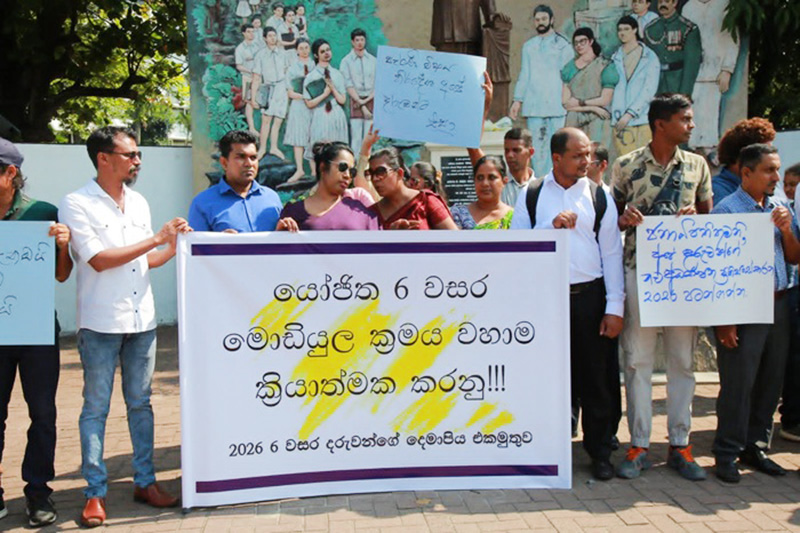
 As the debate on educational reforms rages, I find it useful to pay as much attention to the reactions they have excited as we do to the content of the reforms. Such reactions are a reflection of how education is understood in our society, and this understanding – along with the priorities it gives rise to – must necessarily be taken into account in education policy, including and especially reform. My aim in this piece, however, is to couple this public engagement with critical reflection on the historical-structural realities that structure our possibilities in the global market, and briefly discuss the role of academics in this endeavour.
Two broad reactions
The reactions to the proposed reforms can be broadly categorised into ‘pro’ and ‘anti’. I will discuss the latter first. Most of the backlash against the reforms seems to be directed at the issue of a gay dating site, accidentally being linked to the Grade 6 English module. While the importance of rigour cannot be overstated in such a process, the sheer volume of the energies concentrated on this is also indicative of how hopelessly homophobic our society is, especially its educators, including those in trade unions. These dispositions are a crucial part of the reason why educational reforms are needed in the first place. If only there was a fraction of the interest in ‘keeping up with the rest of the world’ in terms of IT, skills, and so on, in this area as well!
Then there is the opposition mounted by teachers’ trade unions and others about the process of the reforms not being very democratic, which I (and many others in higher education, as evidenced by a recent statement, available at https://island.lk/general-educational-reforms-to-what-purpose-a-statement-by-state-university-teachers/ ) fully agree with. But I earnestly hope the conversation is not usurped by those wanting to promote heteronormativity, further entrenching bigotry only education itself can save us from. With this important qualification, I, too, believe the government should open up the reform process to the public, rather than just ‘informing’ them of it.
It is unclear both as to why the process had to be behind closed doors, as well as why the government seems to be in a hurry to push the reforms through. Considering other recent developments, like the continued extension of emergency rule, tabling of the Protection of the State from Terrorism Act (PSTA), and proposing a new Authority for the protection of the Central Highlands (as is famously known, Authorities directly come under the Executive, and, therefore, further strengthen the Presidency; a reasonable question would be as to why the existing apparatus cannot be strengthened for this purpose), this appears especially suspect.
Further, according to the Secretary to the MOE Nalaka Kaluwewa: “The full framework for the [education] reforms was already in place [when the Dissanayake government took office]” (https://www.wsws.org/en/articles/2025/08/12/wxua-a12.html, citing The Morning, July 29). Given the ideological inclinations of the former Wickremesinghe government and the IMF negotiations taking place at the time, the continuation of education reforms, initiated in such a context with very little modification, leaves little doubt as to their intent: to facilitate the churning out of cheap labour for the global market (with very little cushioning from external shocks and reproducing global inequalities), while raising enough revenue in the process to service debt.
This process privileges STEM subjects, which are “considered to contribute to higher levels of ‘employability’ among their graduates … With their emphasis on transferable skills and demonstrable competency levels, STEM subjects provide tools that are well suited for the abstraction of labour required by capitalism, particularly at the global level where comparability across a wide array of labour markets matters more than ever before” (my own previous piece in this column on 29 October 2024). Humanities and Social Sciences (HSS) subjects are deprioritised as a result. However, the wisdom of an education policy that is solely focused on responding to the global market has been questioned in this column and elsewhere, both because the global market has no reason to prioritise our needs as well as because such an orientation comes at the cost of a strategy for improving the conditions within Sri Lanka, in all sectors. This is why we need a more emancipatory vision for education geared towards building a fairer society domestically where the fruits of prosperity are enjoyed by all.
The second broad reaction to the reforms is to earnestly embrace them. The reasons behind this need to be taken seriously, although it echoes the mantra of the global market. According to one parent participating in a protest against the halting of the reform process: “The world is moving forward with new inventions and technology, but here in Sri Lanka, our children are still burdened with outdated methods. Opposition politicians send their children to international schools or abroad, while ours depend on free education. Stopping these reforms is the lowest act I’ve seen as a mother” (https://www.newsfirst.lk/2026/01/17/pro-educational-reforms-protests-spread-across-sri-lanka). While it is worth mentioning that it is not only the opposition, nor in fact only politicians, who send their children to international schools and abroad, the point holds. Updating the curriculum to reflect the changing needs of a society will invariably strengthen the case for free education. However, as mentioned before, if not combined with a vision for harnessing education’s emancipatory potential for the country, such a move would simply translate into one of integrating Sri Lanka to the world market to produce cheap labour for the colonial and neocolonial masters.
According to another parent in a similar protest: “Our children were excited about lighter schoolbags and a better future. Now they are left in despair” (https://www.newsfirst.lk/2026/01/17/pro-educational-reforms-protests-spread-across-sri-lanka). Again, a valid concern, but one that seems to be completely buying into the rhetoric of the government. As many pieces in this column have already shown, even though the structure of assessments will shift from exam-heavy to more interim forms of assessment (which is very welcome), the number of modules/subjects will actually increase, pushing a greater, not lesser, workload on students.
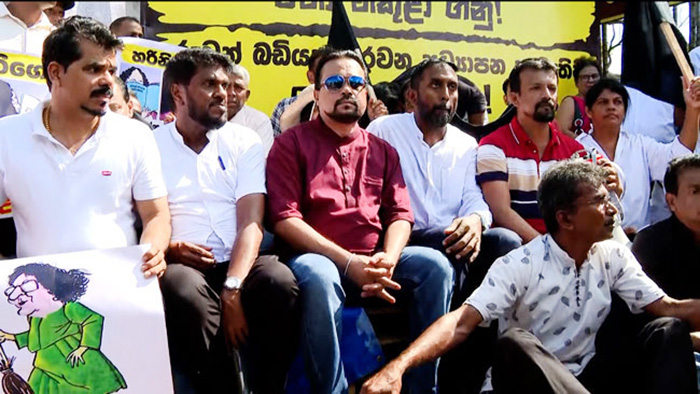
A file photo of a satyagraha against education reforms
What kind of education?
The ‘pro’ reactions outlined above stem from valid concerns, and, therefore, need to be taken seriously. Relatedly, we have to keep in mind that opening the process up to public engagement will not necessarily result in some of the outcomes, those particularly in the HSS academic community, would like to see, such as increasing the HSS component in the syllabus, changing weightages assigned to such subjects, reintroducing them to the basket of mandatory subjects, etc., because of the increasing traction of STEM subjects as a surer way to lock in a good future income.
Academics do have a role to play here, though: 1) actively engage with various groups of people to understand their rationales behind supporting or opposing the reforms; 2) reflect on how such preferences are constituted, and what they in turn contribute towards constituting (including the global and local patterns of accumulation and structures of oppression they perpetuate); 3) bring these reflections back into further conversations, enabling a mutually conditioning exchange; 4) collectively work out a plan for reforming education based on the above, preferably in an arrangement that directly informs policy. A reform process informed by such a dialectical exchange, and a system of education based on the results of these reflections, will have greater substantive value while also responding to the changing times.
Two important prerequisites for this kind of endeavour to succeed are that first, academics participate, irrespective of whether they publicly endorsed this government or not, and second, that the government responds with humility and accountability, without denial and shifting the blame on to individuals. While we cannot help the second, we can start with the first.
Conclusion
For a government that came into power riding the wave of ‘system change’, it is perhaps more important than for any other government that these reforms are done for the right reasons, not to mention following the right methods (of consultation and deliberation). For instance, developing soft skills or incorporating vocational education to the curriculum could be done either in a way that reproduces Sri Lanka’s marginality in the global economic order (which is ‘system preservation’), or lays the groundwork to develop a workforce first and foremost for the country, limited as this approach may be. An inextricable concern is what is denoted by ‘the country’ here: a few affluent groups, a majority ethno-religious category, or everyone living here? How we define ‘the country’ will centrally influence how education policy (among others) will be formulated, just as much as the quality of education influences how we – students, teachers, parents, policymakers, bureaucrats, ‘experts’ – think about such categories. That is precisely why more thought should go to education policymaking than perhaps any other sector.
(Hasini Lecamwasam is attached to the Department of Political Science, University of Peradeniya).
Kuppi is a politics and pedagogy happening on the margins of the lecture hall that parodies, subverts, and simultaneously reaffirms social hierarchies.

 Don Sherman was quite a popular figure in the entertainment scene but now he is better known as the Singing Chef and that’s because he turns out some yummy dishes at his restaurant, in Rajagiriya.
However, now the spotlight is gradually focusing on his daughter Emma Shanaya who has turned out to be a very talented singer.
In fact, we have spotlighted her in The Island a couple of times and she is in the limelight, once gain.
When Emma released her debut music video, titled ‘You Made Me Feel,’ the feedback was very encouraging and at that point in time she said “I only want to keep doing bigger and greater things and ‘You Made Me Feel’ is the very first step to a long journey.”
Emma, who resides in Melbourne, Australia, is in Sri Lanka, at the moment, and has released her very first Sinhala single.
“I’m back in Sri Lanka with a brand new single and this time it’s a Sinhalese song … yes, my debut Sinhala song ‘Sanasum Mawana’ (Bloom like a Flower).
“This song is very special to me as I wrote the lyrics in English and then got it translated and re-written by my mother, and my amazing and very talented producer Thilina Boralessa. Thilina also composed the music, and mix and master of the track.”
Emma went on to say that instead of a love song, or a young romance, she wanted to give the Sri Lankan audience a debut song with some meaning and substance that will portray her, not only as an artiste, but as the person she is.
Says Emma: “‘Sanasum Mawana’ is about life, love and the essence of a woman. This song is for the special woman in your life, whether it be your mother, sister, friend, daughter or partner. I personally dedicate this song to my mother. I wouldn’t be where I am right now if it weren’t for her.”
On Friday, 30th January, ‘Sanasum Mawana’ went live on YouTube and all streaming platforms, and just before it went live, she went on to say, they had a wonderful and intimate launch event at her father’s institute/ restaurant, the ‘Don Sherman Institute’ in Rajagiriya.
It was an evening of celebration, good food and great vibes and the event was also an introduction to Emma Shanaya the person and artiste.
Emma also mentioned that she is Sri Lanka for an extended period – a “work holiday”.
“I would like to expand my creativity in Sri Lanka and see the opportunities the island has in store for me. I look forward to singing, modelling, and acting opportunities, and to work with some wonderful people.
“Thank you to everyone that is by my side, supporting me on this new and exciting journey. I can’t wait to bring you more and continue to bloom like a flower.”

“Sri Lanka Set to Become the First South Asian Country to Enter the Global Charter on Children’s Care Reform”

Incoming Bangladesh PM Tarique Rahman, lawmakers sworn into parliament

Samra’s record 110 in vain as Phillips and Ravindra put New Zealand in Super Eights

Canada reacts as cheating row rocks curling superpower

Long queues and confusion mar first day of India’s landmark AI summit

Ancient bone may prove legendary war elephant crossing of Alps

‘Dates have the highest sugar content to fight Coronavirus’

Sunday Island 27 December – Headlines

#SundayIsland 17th December – Headlines

Sunday Island – 28th March

Sunday Island Headlines – 21 March

Sunday Island – 21st February – Headlines
-
 Life style3 days ago
Marriot new GM Suranga
-

 Business2 days ago
Ministry of Brands to launch Sri Lanka’s first off-price retail destination
-
 Features3 days ago
Monks’ march, in America and Sri Lanka
-

 Midweek Review7 days ago
A question of national pride
-
 Business7 days ago
Autodoc 360 relocates to reinforce commitment to premium auto care
-
 Opinion6 days ago
Will computers ever be intelligent?
-
 Features3 days ago
The Rise of Takaichi
-
 Features3 days ago
Wetlands of Sri Lanka: