
Features
Buddhist Navigations of Ideological Tensions: Capitalism and Communism in Bhikkhu Politics


· The Preamble
In the context of the ideological clash between capitalism and communism, the year 2024 stands as a pivotal moment in Sri Lanka’s electoral history. The presidential election held in 2024 culminated in the remarkable ascendance of Mr Anura Kumara Dissanayake, leader of the Janatha Vimukthi Peramuna (JVP), who became the ninth President of the Democratic Socialist Republic of Sri Lanka. This victory signals a profound transformation, indicating a potential shift in economic policies from entrenched capitalist ideologies towards a more socialist agenda.
This election also marks a striking departure from the JVP’s previous alignment with violent Marxist principles that advocated social upheaval through armed conflict. Embracing the democratic process, the JVP has sought to secure its political mandate through elections rather than insurrection. In contrast to past political leaders, this new leadership is actively formulating pragmatic policies that respect the diverse religious and cultural landscapes of the nation, acknowledging the significant role of religion in the lives of its people. The JVP’s considerable electoral success portends a promising shift towards a new era of political engagement, one that leans more heavily on socialist ideals rather than the traditional capitalist economic practices that have dominated post-independence Sri Lanka.
· Capitalism or Socialism?
This paper delves into the dynamic responses and political stances of two eminent twentieth century Sri Lankan Buddhist monks regarding the policy frameworks and political ideologies that emerged during the governance leading up to the Cold War era (1945–1991). These figures exemplify two distinctive contemporary Buddhist interpretations of the ideological tensions between capitalism and communism. Amid the rapidly shifting political and economic ideologies of the colonial period, both capitalism and communism presented formidable challenges for Sri Lankan Buddhists navigating the complexities of the 20th century.
Buddhism’s relatively underdeveloped political frameworks necessitated that its practitioners grapple with the harsh realities of feudalism, and the consequences of colonial governance. Upon gaining independence in 1948 and adopting a democratic system, Sri Lanka found itself increasingly drawn into the allure of capitalist principles while simultaneously confronting the ideological enticements of communism.
This paper seeks to shed light on the authentic yet often provocative contributions of two left-leaning preeminent Sri Lankan Buddhist monks: (a) Uḍakändavala Saraṇaṅkara (1897–1966), the founding President of the Communist Party of Sri Lanka (established in 1943) and (b) Walpola Rahula (1907–1997), the esteemed author of What the Buddha Taught (1959). Their contributions illustrate how they skillfully navigated the intricate tensions arising from the ideological divides between capitalism and communism in post-colonial Sri Lanka.
· An Anti-imperialist Buddhist Fighter: Uḍakändavala Saraṇaṅkara (1897–1966)
In 1943, as the Communist Party of Sri Lanka emerged on the political landscape, Venerable Uḍakändavala Saraṇaṅkara boldly stepped into the role of its inaugural President. His leadership spanned several pivotal years until Dr. Sugiswara Abeywardena Wickramasinghe (1900–1981), the first Leftist elected to Ceylon State Council in 1931 took the helm. In recognition of his unwavering commitment to fostering global peace, Uḍakändavala was awarded the esteemed Lenin Peace Prize in 1957, establishing him as a pivotal figure in the international movement advocating against nuclear proliferation.
From a remarkably young age, Uḍakändavala passionately contributed to Sinhala-language patriotic literature, notably through publications such as Sinhala Jâtiya (Sinhala Nation, f. 1905) edited by the novelist Piyadasa Sirisena (1875–1946). By the time of his passing in 1966, he had crafted a wealth of written work. While at the forefront of the Communist Party, he committed himself to editing its newspaper, Navalôkaya (New World), and undertook the essential task of translating critically acclaimed literary works, including Maxim Gorky’s Mother (1906) and Victor Hugo’s Les Misérables (1862) into Sinhala, thereby enriching the cultural landscape of his homeland.
Uḍakändavala emerged as a central figure in the struggle against imperialism and British colonial rule. His profound writings offer piercing critiques of imperialism and colonialism in Ceylon, contributing significantly to contemporary socialist thought. His autobiography, Satanaka Satahan: Svayam Likhita Caritapadanaya (Memoirs on a Struggle: An Autobiography), serves as a crucial resource for understanding his life and the context of his political and social activism.
The profound writings of Anagârika Dharmapâla (1864–1933) published in the Sinhala Bauddhayâ (f. 1906) were instrumental in shaping Uḍakändavala’s activist identity. His early interactions with Dharmapâla and his work, Sinhala Bauddhayâ, propelled him into a significant intellectual partnership. Uḍakändavala recalls the transformative moment of their first meeting at Dharmapâla’s residence in Kollupitiya, Colombo, which led to an invitation to travel to India in 1921, a pivotal opportunity that would further solidify his commitment to social justice and activism.
From a remarkably young age, Uḍakändavala’s fierce anti-imperialist and anti-colonialist convictions were strikingly clear during his time in India. Unlike many of his contemporaries, including senior Buddhist monks like Ram̆bukwellç Siddhârtha (1889–1941), later Lecturer in Sanskrit, Pali and Sinhalese at the Ceylon University College (1928–1941), who supported imperialist agendas, Uḍakändavala boldly opposed the visit of the Prince of Wales to India in 1921. He stood resolutely alongside fellow Indians who rejected the oppressive hand of colonial authority. Under the influential guidance of Dharmapâla, the Buddhist monks of the Mahâbodhi Society in Calcutta organized a blessing ceremony for the Prince, which featured the chanting of pirit (protective recitations). In a powerful display of conviction, Uḍakändavala refused to participate in this ceremony, marking a pivotal moment in his unwavering commitment to activism against imperialism and colonial rule. The shifting dynamics within the Mahâbodhi temple ultimately led Uḍakändavala to resign from his post at the Mahâbodhi Society and consider returning to Ceylon. Yet, during his journey back, he made a consequential decision to expand his studies at Santiniketan (p. 62).
Under the inspiring mentorship of Nobel Laureate Rabindranath Tagore (1861–1941) at Santiniketan (Abode of Peace), Uḍakändavala thrived, achieving fluency in Bengali (Vanga language). On May 17, 1927, during the annual Vesak ceremony in Calcutta, he delivered a powerful speech in Bengali before Dharmapâla. This address not only captivated Dharmapâla but also highlighted Uḍakändavala’s significant accomplishments in contrast to those previously brought to India. As a result, Dharmapâla recommended him for a stipend from the Mahâbodhi Society to support his academic endeavors at Santiniketan.
Uḍakändavala’s educational journey in India immersed him in the fervent nationalist movements of Bengal, where he emerged as a passionate advocate for Indian liberation. This transformative experience deeply influenced his political beliefs upon returning to Ceylon, especially through his exposure to liberation and communist ideologies. While his autobiography chronicles his life only up to 1941, during his return to Ceylon amidst World War II, it provides essential insights into the complex web of his religious, social, political, and economic influences. Further exploration of Uḍakändavala’s contributions is vital for fully grasping his impact up until his passing in 1966.
In the domain of religious contributions, Uḍakändavala stands out for his significant advancements. He was among the pioneering Sri Lankans to advocate for the official recognition of Pôya (Full Moon) as a public holiday, a position he championed as early as 1927. This crucial recognition, however, did not materialize in Sri Lanka until 1967 when the event was marked by issuing a set of four postal stamps depicting Mihintalç, Úrî Mahâ Bodhi and Úrîpâda. Uḍakändavala is also known as the person who introduced Buddhist elements to their Marxist public meetings to enable the left-leaning politicians stand on the island’s soil.
In Ceylon, Uḍakändavala became a controversial Buddhist figure. He did not shy away from voicing his incisive critique of prominent figures in Sri Lanka, deeming many of them as staunch allies of imperialism and colonialism. His most pointed criticisms were directed at individuals such as Mr. D.R. Wijewardena (1886–1950), the influential newspaper tycoon of Lakehouse Newspapers, Sir Tikiri Bandara Panabokke (1883–1963), who was the first Minister of Health in the State Council, the Chief Patriarch of the Siam Fraternity at Malvatta Chapter and Ram̆bukwellç Siddhârtha (already introduced above). Uḍakändavala’s trenchant evaluations of these figures are evident throughout his compelling work, “Satanaka Satahan”: Memoirs on a Struggle—An Autobiography.
Immersed in the vibrant academic environment fostered by Tagore, Uḍakändavala became an integral part of the Indian freedom movement in Bengal. Upon enrolling at the University of Calcutta in 1931, Uḍakändavala quickly earned acclaim within the academic community, ultimately being elected President of the Students’ Union—a testament to his influence and leadership. The critical turning point in his activism occurred on March 23, 1932. His passionate involvement reportedly included aiding militants, resulting in his imprisonment by the British for four years. After his release, he faced deportation to Ceylon in 1936, further cementing his legacy as a dedicated adversary of colonialism.
Uḍakändavala’s brand of socialism is deeply rooted in two vital dimensions: his passionate opposition to British colonial rule and the burgeoning nationalism that swept across both India and Ceylon. Through his steadfast commitment to these causes, Uḍakändavala has left an indelible impact on the social and political landscape of his era.
· Socialist Sympathizer Walpola Rahula (1907–1997)
Ven. Dr. Walpola Rahula stands out as one of the most influential authors and scholars of Buddhism in Sri Lanka. His transformative experiences at the University of Paris-Sorbonne, France not only elevated his stature but also earned him widespread international recognition. Even prior to his time in France, Walpola had already established himself as a provocative figure in Ceylon. His legacy resonates powerfully today in academic institutions, particularly in World Religions courses, where his seminal work, What the Buddha Taught, is extensively utilized by universities across North America introducing Buddhism into their curricula.
Walpola Rahula is recognized as an eminent authority in Theravâda Buddhism, distinguished by his numerous pivotal publications, including The Heritage of the Bhikkhu (1974), and History of Buddhism in Ceylon (1956). He has also made significant contributions to Mahâyâna Buddhism (with the publication of Le compendium de la super-doctrine: Philosophie—Abhidharmasamuccaya d’Asanga, 1971), showcasing his broad expertise in the field and reinforcing his standing as a scholar of considerable international influence.
The revolutionary and critical dimensions of Walpola’s thinking are vividly illustrated in his early writings, published between 1933 and 1934 in Satyôdaya Patrikâ (Papers on the Awakening of Truth). This collection, later published as Satyôdaya, underscores Walpola’s role as a reformist preacher, passionately advocating for the rediscovery of the essence of Buddhist heritage as a vital institution. His unwavering commitment to reform is evident, culminating in his manifesto, Bhisuvage Urumaya (The Heritage of the Bhikkhu), published in Sinhala in 1946. Notably, Walpola was the first Buddhist monk to enroll at the University of Ceylon, where he pursued his degree under the esteemed mentorship of G.P. Malalasekere (1899–1973), setting a precedent for future monks in academia.
In 1995, journalist Gunadasa Liyanage compiled a revealing biography of Walpola, the venerable monk asserted his non-affiliation with any left-wing political party. However, it is essential to acknowledge Walpola’s significant role at the founding meeting of the Lanka Sama Samaja Party (LSSP) in 1935. At this formative meeting, Walpola made invaluable contributions to Marxist and socialist initiatives, coining the term “sama samâja” (Equal Society) to articulate the party’s vision. When Liyanage inquired about his potential role as a founding member, Walpola responded with clarity: “I may have given the name to the party. I also supported those young leaders. However, I was never a member of that party.”
In the late 1940s, Walpola, alongside the esteemed Vidyâlankara monks, vigorously championed the electoral success of the Lanka Sama Samaja Party. His involvement in leftist politics positioned him as a radical and controversial figure, provoking the ire of imperialists and right-wing politicians, including the first Prime Minister, D.S. Senanayake (1884–1952). This legacy cements his status as a transformative force in Sri Lankan politics and Buddhism, as well as a powerful advocate for socialism.
· Uḍakändavala and Walpola
In a turbulent social landscape, Uḍakändavala and Walpola’s paths intertwined, albeit briefly, in India. Young Walpola aspired to enroll in Tagore’s esteemed institution, Santiniketan, during a harrowing smallpox epidemic that had gripped Calcutta. Tragically, he contracted the disease while caring for a fellow monk who eventually succumbed to it. Upon arriving at Santiniketan in 1926, Walpola faced intense scrutiny and fierce opposition due to his recent exposure in Calcutta. Among the skeptics, Uḍakändavala stood out as the most vocal in his resistance to Walpola’s presence.
This initial confrontation between two influential Buddhist monk socialists at Santiniketan would have lasting implications for their futures. Between 1936 (the year of Uḍakändavala’s deportation to Ceylon) and 1950 (Walpola’s departure to Sorbonne in Paris), despite being contemporaries residing in Ceylon (perhaps living in Colombo suburbs) and sharing a fervent commitment to socialism (having close affinities with Lanka Samasamaja Party and the Communist Party of Sri Lanka), and having frequent intercourse with notable left-leaning political stalwarts such as Colvin R. de Silva (1907–1989), N.M. Perera (1905–1979), Leslie Goonewardene (1909–1983), and S.A. Wickramasinghe, all of whom played instrumental roles in the formation of Marxist and Communist-oriented socialist parties they seemingly abandoned all communication and collaboration even for the sake of creating a socialist world ethos on the island.
· Conclusion
The crucial question arises: to what extent are the Buddhist reflections on the ideological clashes between capitalism and communism both authentic and contentious? This paper has shed light on the experiences of two influential Sri Lankan Buddhist monks who passionately advocated a socialist society in the shadow of imperialism and colonialism. Their viewpoints were profoundly shaped by the pervasive capitalist ethos that dominated their society during this tumultuous period in both India and Ceylon.
The insights they offered unveil radical yet practical ideas about governance in the pre-Cold War era and the decades that followed. As capitalism and communism emerged as significant and often contested political and economic ideologies throughout the twentieth century, many Sri Lankans—particularly Buddhists—found themselves grappling with formidable challenges. Navigating these intricate frameworks during such a transformative time proved to be an immense struggle for the average Sri Lankan.
In the wake of independence in 1948, the political and economic landscapes became fraught with extraordinary obstacles that, to this day, are far from resolved. In a remarkable turn of events, Sri Lanka witnessed its first communist-oriented political party rise to power in its electoral history in 2024. This pivotal moment invites a critical examination of how the dynamics of capitalism will interact with the socialist, communist, and Marxist principles championed by the JVP, its leftist leaders, and the current governing regime.
Ven. Prof. Mahinda Deegalle ✍️
University of Cambridge


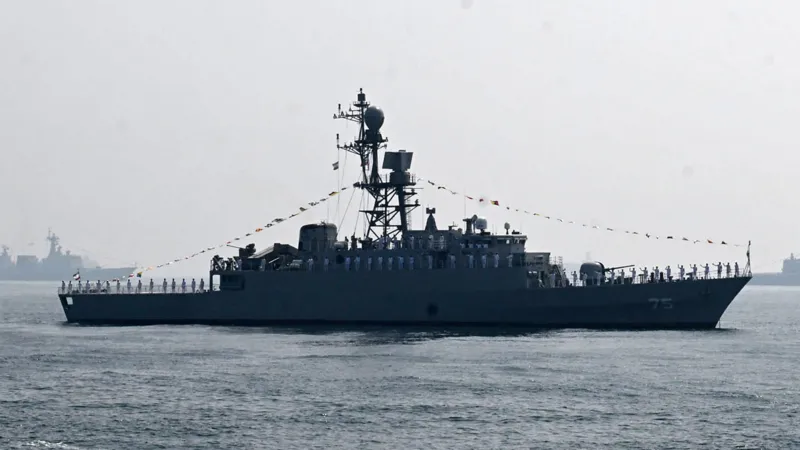
On 17 February, the Indian Navy posted a cheerful message on X.
“Welcome!” it wrote, greeting the Iranian warship Iris Dena as it steamed into the port of Visakhapatnam to join an international naval gathering.
Photographs showed sailors in crisp whites and a grey frigate gliding in the sea harbour on a clear day. The hashtags spoke of “Bridges of Friendship” and “United Through Oceans”.
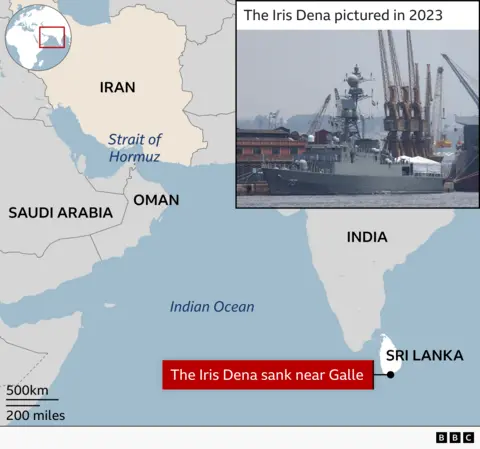
Two weeks later the ship, carrying 130 sailors, lay at the bottom of the Indian Ocean. It had been torpedoed by a US submarine off Sri Lanka’s southern coast on 4 March.
Commissioned in 2021, the Dena was a relatively new vessel – a Moudge-class frigate of Iran’s Southern Fleet, which patrols the Strait of Hormuz and the Gulf of Oman.
According to US Defence Secretary Pete Hegseth, the vessel “thought it was safe in international waters” but instead “died a quiet death”. Rescue teams from Sri Lanka have recovered at least 87 bodies. Only 32 sailors survived.
The sinking marks a dramatic widening of the war between America, Israel and Iran. And, though it occurred in international waters of the Indian Ocean and outside India’s jurisdiction, it is an awkward moment for Delhi.
“The war has come to our doorsteps. That is not a good thing,” says retired Vice Admiral Arun Kumar Singh.
For some strategists, the episode carries broader implications for India’s regional standing.
Indian strategic affairs expert Brahma Chellaney wrote on X that the US torpedoing of the Iranian warship in India’s “maritime neighbourhood” was “more than a battlefield episode” – calling it a “strategic embarrassment” for Delhi.
“By sinking a vessel returning from an Indian-hosted multilateral exercise, Washington effectively turned India’s maritime neighbourhood into a war zone, raising uncomfortable questions about India’s authority in its own backyard,” Chellaney wrote.
Just days before its destruction, the Dena had been a diplomatic guest of the Indian Navy.
The ship had travelled to Visakhapatnam, a sun-washed port city on India’s east coast, to participate in the International Fleet Review 2026 and Exercise Milan, a large multilateral naval exercise meant to showcase India’s growing maritime leadership.
Seventy-four countries and 18 warships took part in the events, which Delhi described as a demonstration of its ambition to become the Indian Ocean’s “preferedsecurity partner”.
Visiting ships at such multilateral exercises usually do not carry a full combat load of live munitions, unless scheduled for a live-fire drill, according to Chellaney. Even during the sea phase, when drills and live firing take place, ships carry only tightly controlled ammunition limited to the specific exercises.
Singh, an invitee to the event, recalls seeing the warship and its Iranian sailors in Visakhapatnam just days before its fate changed.
“I saw the boys marching in front of me,” he says of the Iranian naval contingent during the parade along the seafront, just 10m away. “All young people. I feel very sad.”
He says on 21 February, the assembled ships – including the Iranian vessel – sailed out for the sea phase of Exercise Milan, scheduled to run until 25 February.
“What happened next is less clear: the ship may have returned to port or peeled away after exercises. Either way, the waters where it was later sunk – off Galle in Sri Lanka – lie only two to three days’ sailing from India’s east coast,” Singh says. What the ship was doing in the 10-12 days in between is not clear.
Singh, who has commanded submarines, believes the sequence leading up to the attack was probably straightforward.
The US, he notes, tracks vessels across the world’s oceans. “They would have known exactly when the ship left and where it was heading,” he says. A fourth of America’s submarine fleet of 65-70 is at sea at any given time, according to analysts.
According to the Indian Navy, the Iranian warship had been operating about 20 nautical miles west of Galle – roughly 23 miles (37km) – in waters that fall under Sri Lanka’s designated search-and-rescue zone.
The attack, Singh says, appears to have involved a single Mark-48 torpedo, a heavyweight weapon carrying about 650 pounds of high explosive, capable of snapping a ship in two. Video footage suggests the submarine may have fired from 3-4km away, around 05:30 local time.
The aftermath was grim and swift.
The warship reportedly sank within two to three minutes, leaving little time for rescue. “It’s a miracle they managed to send an SOS,” Singh says, which was picked up by the Sri Lanka Maritime Rescue Coordination Centre in Colombo.
According to the Indian Navy, a distress call from the Iranian warship was picked up by Colombo in the early hours of 4 March, triggering a regional search-and-rescue effort.
The navy said in a statement that Sri Lanka’s navy began rescue operations first, while India moved to assist later.
The Indian Navy deployed a long-range maritime patrol aircraft to support the search and kept another aircraft with air-droppable life rafts on standby.
A naval vessel already operating nearby reached the area by late afternoon. Another ship, which sailed from the southern Indian port city of Kochi to join the effort, continues to comb the waters for survivors and debris.
Under the Second Geneva Convention, countries at war are required to take “all possible measures” to rescue wounded or shipwrecked sailors after a naval attack. In practice, however, this duty applies only if a rescue can be attempted without putting the attacking vessel in serious danger.
Singh says submarines are rarely able to help.
“Submarines don’t surface,” he says. “If you surface and give up your position, someone else can sink you.”
Singh suspects the speed of the sinking – and possibly sparse shipping in the area at the time – meant few nearby vessels could respond. “A ship breaking up that fast leaves almost no chance,” he says.
In a shooting war, Singh says, the legal position is blunt.
Fighting between the United States and Iran had been under way since 28 February, with claims that 17 Iranian naval vessels had already been destroyed.
“When a shooting war is on, any ship of a belligerent country becomes fair game,” he says.
Many questions remain. Why was the Iranian warship still in waters near Sri Lanka nearly two weeks after leaving India’s naval exercise? Was it heading home, or on another mission? And how long had the US submarine been tracking it before firing?
For Delhi, the episode is diplomatically awkward.
India has drawn closer to Washington on defence while maintaining long-standing political and economic ties with Tehran – a balancing act the war has made harder.
Indian Prime Minister Narendra Modi has called broadly for “dialogue and diplomacy” to resolve conflicts, but has neither addressed the sinking of the Iranian vessel directly nor criticised the American strike.
Iran’s Foreign Minister Abbas Araghchi described the attack as “an atrocity at sea” and stressed that the frigate had been “a guest of India’s Navy”. Meanwhile Sri Lanka has taken control of another Iranian naval vessel off its coast after an engine failure forced it to seek port, a day after the US attack.
The episode has nonetheless sparked debate within India’s strategic community.
Kanwal Sibal, a veteran diplomat, argued that India’s responsibility may not be legal, but it is moral.
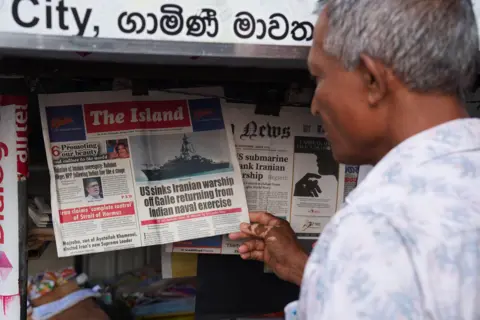
“The Iranian ship would not have been where it was had India not invited it to the Milan exercise,” he wrote on X. “A word of condolence at the loss of lives of those who were our invitees would be in order.”
Others like Chellaney have framed the issue in more strategic terms.
He described the strike as a blow to India’s maritime diplomacy. The torpedoing of the frigate in “India’s maritime backyard”, he argued, punctured Delhi’s carefully cultivated image as a “preferred security partner” in the Indian Ocean.
“In one torpedo strike, American hard power has punctured India’s carefully cultivated soft power,” says Chellaney.
As the debate gathered pace in strategic circles, India’s official response remained cautious.
External Affairs Minister S Jaishankar said on X that he had held a telephone conversation with Araghchi, and also posted a photograph of a meeting with Iran’s Deputy Foreign Minister Saeed Khatibzadeh at a foreign policy summit in Delhi.
For military historian Srinath Raghavan, the legal position is clear: once the Iranian vessel left India’s shores, Delhi had no formal responsibility.
The strategic message, however, is harder to ignore.
“First, the spreading geography of this war. Second, India’s limited ability to manage its fallout,” says Raghavan.
“Indeed, the US Navy has fired a shot across the bow aimed at all regional players, including India.”
[BBC]

“All animals are equal, but some animals are more equal than others” ––George Orwell, Animal Farm
 When I wrote in this column an essay on 4th February 2026 titled, the ‘Beginning of Another ‘White Supremacist’ World Order?’, my focus was on the hypocrisy of Canadian Prime Minister Mark Carney’s Davos address on 20 January 2026 to the World Economic Forum. It was embraced like the gospel by liberal types and the naïve international relations ‘experts’ in our country and elsewhere. My suspicion of Carney’s words stemmed from the consistent role played by countries like Canada and others which he called ‘middle powers’ or ‘intermediate powers’ in the world order he critiqued in Davos. He wanted such countries, particularly Canada, “to live the truth?” which meant “naming reality” as it exists; “acting consistently” towards all in the world; “applying the same standards to allies and rivals” and “building what we claim to believe in, rather than waiting for the old order to be restored.” These are some memorable pieces of Carney’s mantra.
Yet unsurprisingly, it only took the Trump-Netanyahu illegal war against Iran to prove the hollowness in Carney’s words. If he placed any premium on his own words, he should have at least voiced his concern against the continuing atrocities in the Middle East unilaterally initiated by the US and Israel. But his concern is only about Iran’s seemingly indiscriminate attacks across the region targeting US and Israeli installations and even civilian locations in countries allied with the Us-Israel coalition.
Issuing a statement on 3 March 2026 from Sydney he noted, “Canada has long seen Iran as the principal source of instability and terror in the Middle East” and “despite more than two decades of negotiations and diplomatic efforts, Iran has not dismantled its nuclear programme, nor halted its enrichment activities.” A sensible observer would note how the same statement would also apply to Israel. In fact, Israel has been the bigger force of instability in the Middle East surpassing Iran. After all, it has exiled an entire population of people — the Palestinians — from their country to absolute statelessness has not halted its genocide of the same people unfortunate enough to find themselves in Gaza after their homeland was taken over to create Israel in 1948 and their properties to build illegal Jewish settlements in more recent times. And then there is the matter of nuclear weapons. Israel has never been hounded to stop its nuclear programme unlike Iran. There is, in the world order Carney criticixed and the one in his fantasy, a fundamental difference between a ‘Jewish bomb’ and a ‘Muslim bomb’ in the ‘clash of civilisations’ as imagined by Samuel P. Huntington and put into practice by the likes of Messers Trump, Netanyahu, and Carney. That is, the Jewish bomb is legitimate, and the Muslim one is not, which to me evokes the commandments in the dystopian novella Animal Farm.
But Carney, in his new rhetoric closely echoing those of the leaders of Germany, UK and France, did not completely forget his Davos words too. He noted, in the same statement, “we take this position with regret, because the current conflict is another example of the failure of the international order.” But in reality, it is not the failure of the current international order, but its reinforcement by the likes of Mr Carney, reiterating why it will not change.
Coming back to the US-Israel attack on Iran, anyone even remotely versatile in the craft of warfare should have known, sooner or later, the rapidly expanding theatre of devastation in the Middle East was likely to happen for two obvious reasons. One, Iran had warned of this outcome if attacked as it considered those countries hosting US and Israeli bases or facilities as enemies. This is military common sense. Two, this was also likely because it is the only option available for a country under attack when faced with superior technology, firepower and the silence of much of the world. I cannot but feel deep shame about the lukewarm and generic statements urging restraint issued by our political leaders notwithstanding the support of Iran to our country in many times of difficulty at the hands of this very same world order.
When I say this, I am not naïvely embracing Iran as a shining example of democracy. I am cognizant of the Iranian regime’s maltreatment of some of its own citizens, stifling of dissent within the country and its proxy support for armed groups in the region. But in real terms, this is no different from similar actions of Israel and the US. The difference is, the actions of these countries, particularly of the US, have been far more devastating for the world than anything Iran has done or could do. US’s misadventures in Vietnam, Iraq, Syria, and Afghanistan come to mind — to take only a handful of examples.
But it is no longer about Carney and the hollowness of his liberal verbal diarrhoea in Davos. What is of concern now is twofold. One is the unravelling fiction of what he called the ‘new world order’ in which he located countries like Canada at the helm. And the second is the reality of continuing to live in the same old world order where countries like Canada and other middle and intermediate powers will continue to do the bidding of powerful aggressors like the US and Israel as they have done since the 20th century.
Yet, one must certainly thank Trump and Mr Natenyahu for one thing. That is, they have effectively exposed the myth of what used to be euphemistically called the ‘western civilisation.’ Despite its euphemism, the notion and its reality were omnipresent and omnipotent, because of the devastating long term and lingering consequences of its tools of operation, which were initially colonialism and later postcolonial and neocolonial forms of control to which all of us continue to be subjected.
One thing that was clearly lacking in the long and devastating history of the ‘western civilisation’ in so far as it affected the lives of people like us is its lack of ‘civilisation’ and civility at all times. Therefore, Trump and Mr Netanyahu must be credited for exposing this reality in no uncertain terms.
But what does illegal and unprovoked military action and the absence so far of accountability mean in real terms? It simply means that rules no longer matter. If Israel and the US can bomb and murder heads of state of a sovereign country, its citizens including children, cause massive destruction claiming a non-existent imminent threat violating both domestic and international law, it opens a wide playing field for the powerful and the greedy. Hypothetically, in this free-for-all, China can invade India through Arunachal Pradesh and occupy that Indian state which it calls Zangnan simply because it has been claiming the territory of itself for a very long time and also simply because it can. India can invade and occupy Sri Lanka, if it so wishes because this can so easily be done and also because it is part of the extended neighbourhood of the Ramayana and India’s ‘Akhand Bharat’ political logic. Sri Lanka can perhaps invade and occupy the Maldives if it wants a free and perennial supply of Maldive Fish. Incidentally, the Sri Lankan Tamil guerrilla group, People’s Liberation Organization of Tamil Eelam nearly succeeded in doing so 1988.
Sarcasm aside, even more dangerous is the very real possibility of this situation opening the doors for small, violent and mobile militant groups to target citizens of these aggressor countries and their allies as we saw in the late 1960s and 1970s. This will occur because in this kind of situation, many people would likely believe this form of asymmetric warfare is the only avenue of resistance open to them. It is precisely under similar conditions that the many Palestinian armed factions and Lebanese militia groups emerged in the first place. If this happens, the victims will not be the fathers and the vociferous supporters of the present aggression but all of us including those who had nothing to do with the atrocities or even opposed it in their weak and inaudible voices.
If I may go back to Carney’s Davos words, what would “to live the truth?”, “naming reality”, “acting consistently” and “applying the same standards to allies and rivals” mean in the emerging situation in the Middle East? Would this kind of hypocrisy, hyperbole, choreographed silence and selective accusations only end if a US invasion of Greenland, an integral part of the ‘White Supremacist’ World Order’ takes place? By then, however, all of us would have been well-trained in the art of feeling numb. By that time, we too would have forgotten yet another important line in Animal Farm: “No animal shall kill any other animal without cause.”

Sexual education is a vital component of holistic education, contributing to physical health, emotional well-being, gender equality, and social responsibility. Despite its importance, sexual education remains a sensitive and often controversial subject in many societies, particularly in culturally conservative contexts. In Sri Lanka, discussions around sexuality are frequently avoided in formal and informal settings, leaving young people to rely on peers, social media, or misinformation. This silence creates serious social, health, and psychological consequences. By examining the Sri Lankan context alongside international examples, the importance of comprehensive and age-appropriate sexual education becomes clear.
Understanding Sexual Education
Sexual education goes beyond biological explanations of reproduction. Comprehensive sexual education includes knowledge about human anatomy, puberty, consent, relationships, emotional health, gender identity, sexual orientation, reproductive rights, contraception, prevention of sexually transmitted infections (STIs), and personal safety. Importantly, it also promotes values such as respect, responsibility, dignity, and mutual understanding. When delivered appropriately, sexual education empowers individuals to make informed decisions rather than encouraging early or risky sexual behavior.
The Sri Lankan Context: Silence and Its Consequences
In Sri Lanka, sexual education is included in school curricula mainly through subjects such as Health Science and Life Competencies, however the content is often limited and taught with hesitation. Many teachers feel uncomfortable discussing sexual topics openly due to cultural norms, religious sensitivities, and fear of parental backlash. As a result, lessons are rushed, skipped, or delivered in a purely biological manner without addressing emotional, social, or ethical dimensions.
This lack of open education has led to several social challenges. Teenage pregnancies, although less visible, remain a significant issue, particularly in rural and estate sectors. Young girls who become pregnant often face school dropouts, social stigma, and limited future opportunities. Many of these pregnancies occur due to lack of knowledge about contraception, consent, and bodily autonomy.
Another serious concern in Sri Lanka is child sexual abuse. Numerous reports indicate that many children do not recognize abusive behaviour or lack the confidence and language to report it. Proper sexual education, especially lessons on body boundaries and consent, can help children identify inappropriate behavior and seek help early. In the Sri Lankan context, where respect for elders often discourages questioning authority, this knowledge is especially crucial.
Furthermore, misinformation about menstruation, nocturnal emissions, and bodily changes during puberty causes anxiety and shame among adolescents. Many Sri Lankan girls experience menarche without prior knowledge, leading to fear and confusion. Similarly, boys often receive no guidance about emotional or physical changes, reinforcing unhealthy notions of masculinity and silence around mental health.
Cultural Resistance and Misconceptions
Opposition to sexual education in Sri Lanka often stems from the belief that it promotes immoral behaviour or encourages premarital sex. However, international research consistently shows the opposite: young people who receive comprehensive sexual education tend to delay sexual initiation and engage in safer behaviours. The resistance is therefore rooted more in cultural fear than empirical evidence.
Religious and cultural values are important, but they need not conflict with sexual education. In fact, sexual education can be framed within moral discussions about responsibility, respect, family values, and care for others principles shared across Sri Lanka’s major religious traditions. Ignoring sexuality does not protect cultural values; rather, it leaves young people vulnerable.
International Evidence: Lessons from Other Countries
Several countries demonstrate how effective sexual education contributes to positive social outcomes.
In the Netherlands, sexual education begins at an early age and is age-appropriate, focusing on respect, relationships, and communication rather than explicit sexual activity. As a result, the Netherlands has one of the lowest rates of teenage pregnancy and STIs in the world. Young people are encouraged to discuss feelings, boundaries, and consent openly, both in schools and at home.
Similarly, Sweden introduced compulsory sexual education as early as the 1950s. Swedish programs emphasise gender equality, reproductive rights, and sexual health. This long-term commitment has contributed to high levels of sexual health awareness, low maternal mortality among young mothers, and strong societal acceptance of gender diversity. Sexual education in Sweden is also closely linked to public health services, ensuring access to counseling and contraception.
In many developing contexts, international organisations have supported sexual education as a tool for social development. UNESCO promotes Comprehensive Sexuality Education (CSE) globally, emphasising that it equips young people with knowledge, skills, attitudes, and values that enable them to protect their health and dignity. Studies supported by UNESCO show that CSE reduces risky behaviours, improves academic outcomes, and supports gender equality.
In countries such as Rwanda and South Africa, sexual education has been integrated with HIV/AIDS prevention programs. These initiatives demonstrate that sexual education is not a luxury of developed nations but a necessity for public health and social stability.
Comparing Sri Lanka with International Models
When compared with international examples, Sri Lanka’s challenges are not due to lack of capacity but lack of open dialogue and political will. Sri Lanka has a strong education system, high literacy rates, and an extensive public health network. These strengths provide an excellent foundation for implementing comprehensive sexual education that is culturally sensitive yet scientifically accurate.
Unlike the Netherlands or Sweden, Sri Lanka may not adopt early-age sexuality discussions in the same manner, but age-appropriate education during late primary and secondary school is both feasible and necessary. Topics such as puberty, menstruation, consent, online safety, and respectful relationships can be introduced gradually without violating cultural norms.
Sexual Education in the Digital Era
The urgency of sexual education has increased in the digital age. Sri Lankan adolescents are exposed to sexual content through social media, films, and online platforms, often without guidance. Pornography frequently becomes a primary source of sexual knowledge, leading to unrealistic expectations, objectification, and distorted ideas about consent and relationships.
Sexual education can counter these influences by developing critical thinking, media literacy, and ethical understanding. Teaching young people how to navigate digital relationships, cyber harassment, and online exploitation is now an essential component of sexual education.
Gender Equality and Social Change
Sexual education also plays a crucial role in promoting gender equality. In Sri Lanka, traditional gender roles often limit open discussion about female sexuality while excusing male dominance. Comprehensive sexual education challenges these norms by emphasizing mutual respect, shared responsibility, and equality in relationships.
Educating boys about consent and emotional expression helps reduce gender-based violence, while educating girls about bodily autonomy strengthens empowerment. In the long term, this contributes to healthier families and more equitable social structures.
The Way Forward for Sri Lanka
For sexual education to be effective in Sri Lanka, several steps are necessary. Teachers must receive proper training to handle the subject confidently and sensitively. Parents should be engaged through awareness programs to reduce fear and misconceptions. Curriculum developers must ensure that content is age-appropriate, culturally grounded, and scientifically accurate.
Importantly, sexual education should not be treated as a one-time lesson but as a continuous process integrated into broader life skills education. Collaboration between schools, healthcare providers, religious leaders, and community organisations can help normalise discussions around sexual health while respecting cultural values.
Finally , sexual education is not merely about sex; it is about health, dignity, safety, and responsible citizenship. The Sri Lankan experience demonstrates how silence and taboo can lead to misinformation, vulnerability, and social harm. International examples from the Netherlands, Sweden, and global initiatives supported by UNESCO clearly show that comprehensive sexual education leads to positive individual and societal outcomes.
For Sri Lanka, embracing sexual education does not mean abandoning cultural values. Rather, it means equipping young people with knowledge and ethical understanding to navigate modern social realities responsibly. In an era of rapid social and technological change, sexual education is not optional it is essential for building a healthy, informed, and compassionate society.
by Milinda Mayadunna ✍️

Selling pressure makes a dent in CSE’s early trading gains

Qatar partially reopens airspace as Iranian strikes continue to hit Gulf

The final voyage of the Iranian warship sunk by the US

AI-generated Iran war videos surge as creators use new tech to cash in

Huge explosions rock major Tehran airport as Israel strikes ‘regime infrastructure’

India hit back but Sutherland, Hamilton impress to give Australia the edge

‘Dates have the highest sugar content to fight Coronavirus’

Sunday Island 27 December – Headlines

#SundayIsland 17th December – Headlines

Sunday Island – 28th March

Sunday Island Headlines – 21 March

Sunday Island – 21st February – Headlines
-

 Features6 days ago
Brilliant Navy officer no more
-

 News2 days ago
University of Wolverhampton confirms Ranil was officially invited
-

 Opinion6 days ago
Sri Lanka – world’s worst facilities for cricket fans
-

 News3 days ago
Legal experts decry move to demolish STC dining hall
-

 Features6 days ago
A life in colour and song: Rajika Gamage’s new bird guide captures Sri Lanka’s avian soul
-

 Business3 days ago
Cabinet nod for the removal of Cess tax imposed on imported good
-
 Features7 days ago
Overseas visits to drum up foreign assistance for Sri Lanka
-

 News2 days ago
Female lawyer given 12 years RI for preparing forged deeds for Borella land