
Latest News
Brits and Kapp fifties help South Africa to their first victory of India tour


After defeats in the ODI series and the one-off Test, South Africa began their run to the T20 World Cup with a morale-boosting victory over India in the first T20I in Chennai.
Starring in the win were Tazmin Brits whose 81 – an innings of contrasts – set South Africa up along with Marizane Kapp, The pair added 96 in just 9.2 overs; Kapp’s own contribution was a robust 33-ball 57 as the visitors posted 189 for 4.
India’s chase began well with Smriti Mandhana’s 30-ball 46, but her wicket slowed things down considerably, until they found their ammunition through Jemimah Rodrigues’ punchy 29-ball half-century.
Eventually, the target proved steep as South Africa’s spinners used the slow pitch and the absence of dew to their advantage. In the end, India fell 12 runs short after flirting with the possibility of a heist when Rodrigues brought the equation down from 47 off 18 to 21 off six.
Laura Wolvaardt came out all guns blazing and took Renuka Singh for 16 runs in the third over. But South Africa weren’t able to build on that with Brits, at this point, struggling to hit the ball off the square.
Brits took 10 deliveries to get off the mark and the piling up of dots made Wolvaardt take more risks than she would’ve liked. One such stroke – walking across to expose all three stumps in a bid to sweep left-arm spinner Radha Yadav into acres of open space – led to her downfall in the eighth over to leave South Africa 50 for 1.
Kapp began with two fours off her first three balls, the first one, an inside-out drive over extra cover, particularly attractive. But she was also massively lucky to be reprieved twice in the 10th over.
First, Richa Ghosh failed to hang on to a catch behind the stumps when Kapp was on 11 and then Mandhana put down a tough chance at the long-off fence with the South African allrounder on 11. This helped unleash Kapp, which reduced the pressure Brits after she had limped to a run-a-ball 25 at the 10-over mark.
Fighting a back injury, Kapp had shelved her sweeps for large periods during the Test match between these two teams a few days ago. But in perhaps a sign that she was feeling heaps better, Kapp displayed different variations of her sweeps as her innings progressed – the full-blooded ones, the paddles, the scoops and even the reverse – during a 30-ball half-century that injected momentum into South Africa’s innings.
Brits broke the shackles in the 11th over when she heaved legspinner S Asha over the long-on boundary, even as Kapp went berserk at the other end in their near-century stand.
Brits should’ve been out on 50 when she top-edged a slog, only for Ghosh to grass the opportunity. It would prove game-changing in a sense as Ghosh, who was hit on the chin by the ball rebounding off her gloves, while tumbling to the floor was ruled out of the rest of the game due to concussion.
It took Brits until the 17th over of the innings to hit top gear, when she launched Radha for back-to-back sixes to offset any pressure from Kapp’s wicket in the same over. South Africa ransacked 58 runs off the last five to head into the break with momentum firmly with them.
Brief scores:
South Africa Women 189 for 4 in 20 overs (Laura Wolvaardt 33, Tazmin Brits 81, Marizanne Kapp 57; Pooja Vastrakar 2-23, Radha Yadav 2-40) beat India Women 177 for 4 in 20 overs (Jemimah Rodrigues 53*, Smriti Mandhana 46, Harmanpreet Kaur 35; Ayabonga Khaka 1-39, Chloe Tryon 1-32, Nadine de Klerk 1-30, Nonkululeko Mlaba 1-32) by 12 runs

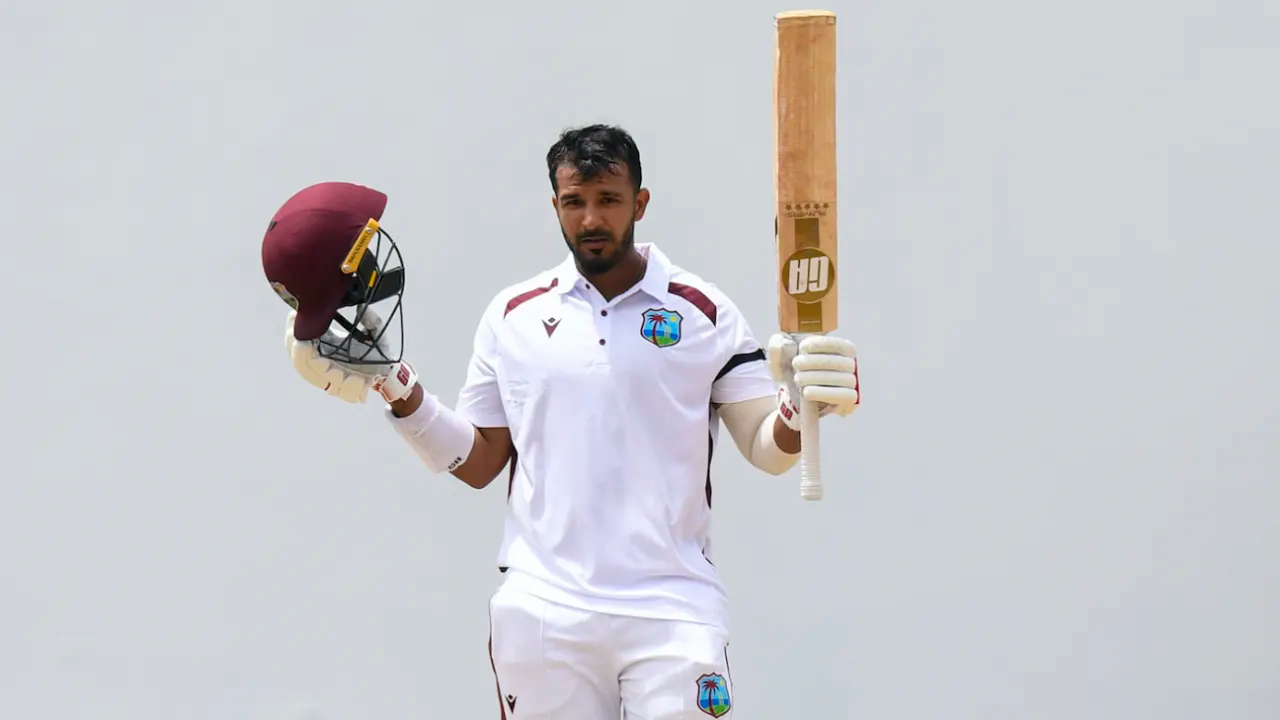
Amir Jangoo amassed 233, RostonChase hit 194, and through a record-breaking 401-run partnership, the pair slow-roasted Sri Lanka on day three in Antigua. Their gargantuan stand delivered West Indies to a position of extraordinary strength, securing them a 318-run first innings lead. That in the four overs they got to bowl at Sri Lanka, West Indies dismissed the dangerous Pathum Nissanka, and created other chances, buoying them further heading into day four.
Jangoo and Chase now not only have the highest sixth wicket stand in the history of Test cricket, they also have the second highest partnership for West Indies, behind only Garfield Sobers and Conrad Hunte. Both batters improved on their previous first-class high scores, Chase easily beating his 137 not out, and Jangoo surpassing his domestic 218.
That Jangoo produced a knock of such astonishing concentration, and expansive range, in just his third Test innings was especially impressive. Until he got out attempting to accelerate about midway through the last session, his innings was largely chanceless. He batted 373 deliveries on his own, and he and Chase batted 100.2 overs, seeing out three complete sessions together. Though they had begun slowly, both batters sped up through the day and were finding boundaries off both the quicks and spinners through the second and third sessions of the day.
Sri Lanka’s attack found the pitch utterly docile for most of day three. They were missing their fastest quick Lahiru Kumara, who went off the field with a hamstring niggle early the previous day. Their quicks were earnest in the first hour, but once Jangoo and Chase saw out the second new ball (the ball was four overs old when day three began) with a period of disciplined batting, Sri Lanka’s quicks lost some venom, and captain Dhananjaya de Silva went increasingly to his spinners – Sonal Dinusha in particular.
The one exception for Sri Lanka was Milan Rathnayaka, who was intense in each of his day three spells, and created chances even in a dreary second session, having Chase dropped by a diving wide slip for 108. Later in the day, it would be Rathnayaka who would break the enormous stand, and would go on to complete a well-deserved five-wicket haul, finishing with 5 for 124. Dinusha, the left-arm spinning allrounder, conceded 234 runs himself in this innings, though he did also pick up two wickets, including that of Chase.
Patience had defined Jangoo and Chase’s batting in the first hour. Jangoo, for example, didn’t score off the first 15 deliveries he faced on day three, while Chase was only marginally less defensive. When conditions began to ease after the first hour, however, they began to slip into more fluent modes of operation. In the afternoon session, when the pair really propelled West Indies into the ascendancy, they plundered 136 runs at a rate of more than five an over. Jangoo was especially strong square of the wicket on the offside and down the ground. Chase was excellent through the covers. Jangoo, additionally, would sometimes tonk the spinners over the straight boundary.
Right through the day the pair would notch up milestones – both for themselves, and the partnership. The milestone that drew the most raucous celebration came soon after tea, when Jangoo completed his double with a sweep through square leg, leaping in the air as he took off for the run. Although only hundreds were in attendance, the house was on its feet for him, coach Daren Sammy and the West Indies dressing room giving him an especially warm ovation. Having come into the XI only as a replacement player for the injured Shai Hope, Jangoo has essentially made himself undroppable for the second Test.
After tea the pair took the scoring up even one further gear, Jangoo hitting some memorable sixes over square leg, while Chase continued to drive powerfully. Jangoo was out attempting to repeat a pulled six though the ball was not quite short enough for that shot. The resultant top-edge was gobbled up by the wicketkeeper. Chase was out much later, under-edging Dinusha into his stumps when a sweep went awry. He was six short of what would also have been his first double century.
Rathnayake would take two further wickets before West Indies declared the innings. Nissanka was out caught behind feeling for a Jayden Seales away-swinger first ball of the second over. Nightwatcher Kasun Rajitha could have been out too, had Jangoo at short leg held a sharp, low chance off the bowling of Kemar Roach.
Scores:
Scores: Day 3 Stumps
Sri Lanka 308 and 15 for 1 (Kasun Rajitha 4*, Nishan Madushka 2*; Jayden Seales 1-5) trail West Indies 626 for 9 dec (Amir Jangoo 233, Roston Chase 194; Milan Rathnayaka 5-124) by 303 runs
[Cricinfo]

For a second day in a row, the United States has launched strikes against Iran, once again citing an attack against a commercial vessel as a motivation.
Saturday’s renewed attacks are the latest indication that a regional Middle East ceasefire, established as part of a June 17 memorandum of understanding (MOU), might be at a breaking poInt.
In a statement, the US Central Command (CENTCOM), which directs military action in the Middle East, explained that the latest attacks came “at the Commander in Chief’s direction”.
“CENTCOM forces launched strikes today in direct response to continued Iranian aggression against commercial shipping,” it wrote.
“U.S. military aircraft targeted Iranian military surveillance infrastructure, communication systems, air defense sites, drone storage facilities, and minelayer capabilities.”
[Aljazeera]

India suffered a potential injury scare ahead of the Test series in Sri Lanka, with their No.3 B Sai Sudarshan retiring hurt on 7 while playing for India A against Sri Lanka A during the third day of the first four-dayer in Galle. After scoring a century in the first innings, Sai Sudharsan retired hurt in the fourth over of India A’s second innings. By the end of the day’s play, however, India A had stretched their lead to 170.
Chhattisgarh opener Aayush Pandey and Devdutt Padikkal were unbeaten on 20 each at stumps.
India A had claimed a first-innings lead of 122 after dismissing Sri Lanka A for 330 in their first innings. Resuming from an overnight 113 for 2, they were guided by half-centuries from captain Sahan Arachchige (72) and Ashen Bandara (70). Nuwandi Fernando, who had passed his own fifty on day two, had his innings cut short on 84 on day three.
For India A, Auqib Nabi, who was the top wicket taker in the previous Ranji Trophy season and was a net bowler during India’s one-off Test against Afghanistan in New Chandigarh, was the pick of the bowlers, returning 4 for 58 in 19.4 overs. Sri Lanka A lost their last five wickets for 30 runs, with Nabi taking four of those.
Left-arm fingerspin-bowling allrounder Harsh Dubey and Vidarbha fast bowler Yash Thakur picked up two wickets apiece. India A then closed out the day on 48 for 0.
Scores:
India A 48 for 0 in 17 overs (Devdutt Padikkal 20*, Ayush Pandey 20*) and 452 for 6 dec in 111.4 overs [Sai Sudarshan 132, Dhruv Jurel 141, Shaik Rasheed 63; Chamika Gunasekera 3-64, Dilum Sudeera 2-143] lead Sri Lanka A 330 in 101.4 overs (Nuwanidu Fernando 84, Ashen Bandara 70, Sahan Arachchige 72; Aaqib Nabi 4-58, YashThakur 2-51, Harsh Dubey 2-84) by 170 runs
[Cricinfo]

Zafar, Feroza lead Pakistan to consolation win

Jangoo 233, Chase 194 put West Indies in commanding position

Showers will occur at times in the Western, Sabaragamuwa and North-western provinces and in Galle, Matara, Kandy and Nuwara-Eliya districts

Venezuelans dig for earthquake survivors as death toll rises to 1,430

Chemmani mass graves: Govt to seek international forensic help

ADB approves $57.4 million package to boost Lanka’s rooftop solar drive

‘Dates have the highest sugar content to fight Coronavirus’

Sunday Island 27 December – Headlines

#SundayIsland 17th December – Headlines

Sunday Island – 28th March

Sunday Island Headlines – 21 March

Sunday Island – 21st February – Headlines
-

 Features7 days ago
Sri Lanka developing independent hydrographic capabilities
-

 Opinion6 days ago
Ranasinghe Premadasa: The man who would not take ‘No’ for an answer
-
 News1 day ago
Another 1,132 Sri Lankan Personnel to be deployed for United Nations Peacekeeping Missions
-

 Latest News7 days ago
Sooryavanshi thumps fastest List A fifty as India A win tri-series
-

 Opinion5 days ago
Sri Lanka’s national security: Justice, reconciliation, and forward-looking vigilance
-

 News5 days ago
US Assistant Secretary of State for South and Central Asian Affairs meets President
-

 News3 days ago
Kelaniya emerges as highest ranked Lankan uni in Times Higher Education Sustainability Impact Ratings
-

 Opinion4 days ago
A triumph for Pakistan’s skilled diplomacy at Iran-US talks