
Business
Bottle-to-bottle recycling can boost Sri Lanka in the transition to circularity in plastics

By Amila Abeynayaka
Dr. Abeynayaka is a Policy Researcher currently attached to the IGES Centre Collaborating with UNEP on Environmental Technologies (CCET), Institute for Global Environmental Strategies (IGES), Japan.
Pollution caused by the irresponsible disposal of plastics is a significant issue, particularly in developing countries like Sri Lanka.
 According to Great Britain’s Royal Statistical Society, it is estimated that only 9% of all plastics ever produced globally has been recycled. This is particularly concerning since according to the United Nations Environment Programme (UNEP), all nations collectively produce about 300 million metric tonnes of plastic every year – nearly equivalent in weight to that of the entire global human population.
However, not all plastics are equal in this equation. Polyethene terephthalate (PET) plastics, in particular, stand out, given that they are 100% recyclable. PET is considered the most promising food-packaging plastic for recycling and is used extensively for this purpose, particularly for the production of bottles containing drinks, hand sanitisers, dishwashing liquid etc. In addition, PET is more suitable for the recycling process, given its ability to minimise the possibility of contamination following consumption.
Hence, in sharp contrast with the overall recycling rate of plastics, PET bottle recycling rates in some countries exceed 80%. Sri Lanka also aspires to increase its PET bottle collection and recycling rate from 27% to 100% by 2025 to ‘ensure safe, high-quality and durable products,’ as per the National Action Plan on Plastic Waste Management in Sri Lanka (NAPPWM).
The changes required
Technology is not a constraint and is already available within the country. However, achieving this target requires crosscutting enabling conditions, including legal arrangements and policy changes, stakeholder engagement and dialogue, public participation, financing, and capacity development.
Legal and policy changes are necessary for a crucial shift towards bottle-to-bottle recycling. This relates to recycling an entire PET bottle to produce a new PET bottle, a concept that has been successfully implemented in many developed regions.
After being used by consumers, the three common scenarios for PET bottles are; bottle-to-bottle recycling, incineration and landfill disposal.
It is clear that bottle-to-bottle recycling is by far the preferred option among these options. It reduces pollution and carries a host of other benefits, including reducing carbon emissions by decreasing the need for new plastics.
However, Sri Lanka doesn’t legally allow recycled products in food-grade manufacture. The Extraordinary Gazette Notification No. 1160/30 of 29th June 2010 prohibits the use of ‘any food in any package, appliance, container or vessel that has been made from recycled plastic.’ This reality needs to change and conducive regulations/policies should be introduced.
Implementing the changes
In terms of implementation, bottle-to-bottle recycling can be done through two methods; mechanical and chemical recycling. The first refers to using mechanical processes (which typically involve cleaning, grinding, re-melting, and re-granulating). It is considered that through this method, bottle-to-bottle recycling is possible up to 4 to 6 times for PET plastics.
Chemical recycling, in contrast, uses a chemical process to achieve this objective, to break down the material to its original form for processing and, after that, for the production of new items. This system allows potentially infinite cycles of recycling. Still, it has implications for the comparatively larger generation of carbon emissions associated with transboundary PET waste movements.
Besides the method of recycling that should be employed, another critical consideration is whether bottle-to-bottle recycling carries risks since the plastics could potentially get contaminated, especially in food-grade packaging. For instance, contact between plastics and other waste, such as electronic waste, increases the risk of the presence of toxic metals in recycled plastics.
However, such concerns can be addressed by putting the necessary safeguards in place by adopting models similar to those of developed countries. For instance, in the European Union (EU), recycled plastics used in food contact materials should only be obtained from recycling processes that have been assessed for safety by the European Food Safety Authority and authorised by the European Commission.
Transition to a ‘circular’ model
Such certification ensures the separation of different types of waste, domestic waste collection systems with storage and transportation that avoid contaminations and sound tech-driven recycling. Another alternative exists, too, including chemical recycling to regenerate material similar to virgin material.
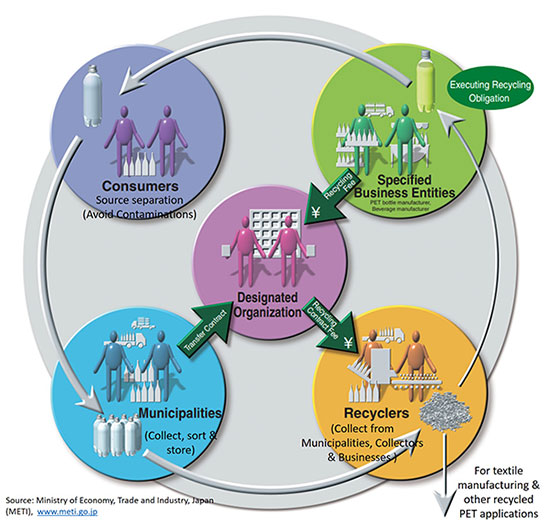
However, such efforts require collaboration between and high levels of awareness among all stakeholders. This includes manufacturers and recyclers in the private sector, consumers and the Government. The model used in Japan provides an excellent case study. In this model, consumers ensure proper segregation of used plastic containers and packages, which facilitates the collection of the segregated waste by the Municipal Government. Manufacturers recycle this waste and, after that, use it in products. Hence, all stakeholders play an equally-critical role, which ensures the smooth functioning of the system.
Sri Lanka too can transition to a similar model, with high ‘circularity,’ which involves a ‘closed loop’. In this, the value of plastics is retained through reuse and recycling, not allowing leakage into the environment. This is unlike the present ‘linear’ model in which plastics are used and disposed of, creating significant damage.
Such a model will be beneficial economically – for instance, by reducing foreign exchange lost through imports of plastics each year and socially and environmentally – by reducing pollution and its harmful effects – which includes the likes of the increased spread of diseases such as dengue.
Hence, Sri Lanka should begin the transition towards bottle-to-bottle recycling of PET plastics. However, as indicated, this requires the support of all stakeholders.
The author would appreciate your feedback on the article. You can start a conversation with Dr. Abeynayaka directly on Twitter on @litterlifecycle.
Web: www.iges.or.jp/en | www.ccet.jp
Transforming “waste” into “resources” once again (a Japanese example)

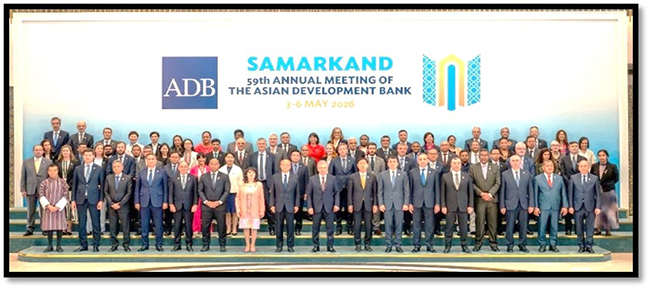
In the ancient Silk Road city of Samarkand, where merchants once connected civilisations through trade and ideas, a new conversation unfolded from 3–6 May at the 59th Annual Meetings of the Asian Development Bank.Political leaders, central bank governors, investors, innovators and development partners gathered under a compelling theme: “Crossroads of Progress: Advancing the Region’s Connected Future.”
The message resonating across the forum was unmistakable. Asia and the Pacific are entering a decisive decade in which connectivity, technology and regional cooperation will shape economic power and social resilience. Supply chains are being redesigned. Artificial intelligence is transforming productivity. Energy systems are becoming increasingly interconnected. Financing models are evolving to accommodate climate pressures and development needs. Countries that move quickly and cohesively are likely to benefit from this transformation. Those trapped in internal fragmentation risk falling behind.
The Annual Meetings demonstrated that the future envisioned by the ADB is no longer theoretical. Across the region, governments are already repositioning themselves to participate in a more integrated Asian economy. Discussions focused heavily on cross-border infrastructure, digital innovation, energy interconnection, sustainable finance and regional policy harmonisation.
One recurring theme was that “integration is power.” In an era marked by geopolitical uncertainty and economic disruption, regional cooperation is increasingly viewed as the foundation of resilience. From trade corridors and logistics systems to energy-sharing mechanisms such as the ASEAN Power Grid, policymakers emphasised that countries can no longer afford to operate in isolation.
The conversations in Samarkand also reflected how development itself is being redefined. Data, digital infrastructure and artificial intelligence are becoming as important as roads, ports and airports. Governments across Asia are already deploying AI-enabled public services, fintech systems, smart agriculture and real-time disaster response technologies to improve efficiency and social inclusion.
Equally important was the recognition that public financing alone will not be enough to meet the region’s ambitions. The ADB repeatedly stressed the need for innovative financing mechanisms capable of mobilising private capital while strengthening domestic fiscal systems. Climate adaptation, energy transition and infrastructure expansion will require development finance that is scalable, catalytic and capable of attracting long-term investor confidence.
For Sri Lanka, the discussions carried particular significance.
Having emerged from one of the gravest economic crises in its post-independence history, Sri Lanka today stands at a delicate juncture. The country possesses many of the advantages needed to participate meaningfully in Asia’s next growth phase: strategic geographic positioning, human capital, maritime access and longstanding relationships with multilateral institutions such as the ADB. Yet the gap between potential and preparedness remains considerable.
While many Asian economies appear to have moved toward greater institutional maturity and long-term policy coordination, Sri Lanka continues to wrestle with recurring political instability, governance concerns, debt restructuring pressures and inconsistencies in economic policymaking. Questions surrounding legal processes, public sector reforms and policy continuity continue to affect investor confidence and national coherence.
The challenge facing Sri Lanka is therefore not merely economic. It is fundamentally institutional and political.
The larger Asian story unfolding in Samarkand was one of countries aligning national purpose with regional opportunity. Whether through digital transformation, energy integration or climate financing, many nations appear increasingly focused on continuity, coordination and long-term execution. Sri Lanka, by contrast, still appears engaged in resolving foundational questions about governance, accountability and economic direction.
This does not diminish the country’s prospects. Rather, it highlights the urgency of reform and policy harmonisation if Sri Lanka is to become a meaningful participant in the region’s connected future.
The ADB’s vision for Asia is ultimately centered on resilience through cooperation. It is a vision in which countries strengthen themselves not in isolation, but through deeper engagement with regional systems of trade, finance, energy and technology. For Sri Lanka, this presents both an opportunity and a warning.
The opportunity lies in leveraging multilateral partnerships, embracing digital modernisation, strengthening institutional credibility and integrating more deeply into emerging regional networks. The warning is that Asia’s transformation is accelerating. Countries unable to build stable governance structures and coherent development strategies may struggle to capture its benefits.
Samarkand itself offered a symbolic reminder of this reality. Historically, it flourished because it connected worlds. Today, Asia is once again building new networks of connection – digital, financial, infrastructural and geopolitical.
The question confronting Sri Lanka is whether it can align its political will and economic resilience quickly enough to travel alongside the region’s next decade of growth rather than watch it from the margins.
By Sanath Nanayakkare
Business
CBSL and Australia’s S4IE programme partner to advance digital financial literacy for MSMEs


The Central Bank of Sri Lanka (CBSL) has entered into a Memorandum of Understanding (MoU) with Australia’s Skills for an Inclusive Economy (S4IE) programme to launch a pilot initiative aimed at enhancing digital financial literacy among micro, small, and medium enterprises (MSMEs). Recognised as a vital engine of Sri Lanka’s economic recovery and inclusive development, MSMEs stand to benefit from targeted interventions designed to improve access to finance, strengthen institutional coordination, and foster a more supportive enabling environment.
The pilot will test evidence-based approaches, the outcomes of which will inform future policy design and programming. CBSL intends to scale successful measures in collaboration with national and international partners.
Commenting on the partnership, Dr. P. Nandalal Weerasinghe, Governor of the Central Bank of Sri Lanka, stated: “This initiative reflects CBSL’s dedication to practical, evidence-based solutions. The pilot enables us to test and refine methodologies that can be expanded over time to deliver sustainable outcomes for MSMEs across the country.”
His Excellency Matthew Duckworth, Australian High Commissioner to Sri Lanka, emphasied the program’s long-term vision: “Australia is pleased to partner with the Central Bank of Sri Lanka on this initiative. From the outset, our focus has been on building systems and partnerships that are both sustainable and scalable, ensuring benefits extend well beyond the pilot phase.”
The initiative aligns with broader efforts to promote inclusive economic growth and strengthen institutional capacity. It reflects Australia’s ongoing partnership with Sri Lanka in support of reforms that advance economic stability, resilience, and shared prosperity.
Representing the Australian High Commission, Zoe Kidd, First Secretary (Development), and R. Sivasuthan, Senior Programme Officer, reaffirmed Australia’s commitment to close collaboration with CBSL. Their aim is to ensure the pilot yields actionable insights and sustainable outcomes, with a clear pathway toward future scaling.

Adding to the existing pressures, the Public Utilities Commission of Sri Lanka (PUCSL) has approved a revision of electricity tariffs for the second quarter of 2026, effective from today for users who consume over 180 electricity units. This increase arrives just as the Sri Lankan rupee faces renewed pressure, having recorded a 3.6% depreciation against the US dollar year-to-date. The convergence of a weaker currency and higher power costs creates renewed pressure on the cost of living.
For the average Sri Lankan household, this policy shift is not just a line item on a utility bill; it is a catalyst for a broader inflationary trend. Even before this revision, headline inflation had already shown signs of a sharp ascent, with the Colombo Consumer Price Index (CCPI) surging to 5.4% in April 2026, a stark jump from the 2.2% recorded only a month prior.
This statistical climb is most painfully visible at the local marketplace. At the Narahenpita Economic Centre, the cost of essentials has become highly volatile: beans have climbed to Rs. 700/kg, while carrots have reached Rs. 400/kg. The protein basket is equally strained, with Kelawalla fish priced at Rs. 2,980/kg. With the new electricity tariffs taking effect, the food manufacturing industry now faces fresh overheads for processing, refrigeration, and packaging. These increased costs will inevitably trickle down to the retail shelf, threatening to push these prices even higher.
While global energy markets offered a brief moment of relief with Brent crude prices dipping by over $6 per barrel last week, the domestic impact of a depreciating rupee means that the cost of imported fuel and raw materials remains high.
This invisible pressure, combined with the visible hike in electricity rates, leaves little room for families to breathe.
Despite these immediate challenges, the broader economic framework shows pockets of resilience, according to the Central Bank’s economic indicators. Industrial production in food and apparel grew steadily earlier this year, and the government recorded a notable budget surplus of Rs. 169.7 billion in the first two months of 2026.
However, as the nation moves into the second quarter, the strength of this fiscal discipline will be tested against the lived reality of its citizens. As the new rates come into effect from today, Sri Lankans are left to wait and see just how much further their kitchen budgets can be stretched.
By Sanath Nanayakkare

Treasury theft: Speaker’s conduct brought to IPU’s attention: SJB

Navin calls for formal alliance between UNP and SJB

Diversion of USD 2.5 million: COPF accused of shielding culprits

Showers likely to last for several days: Met Dept.

At Asia’s crossroads, Sri Lanka must decide how it will join the future

Aligning graduate output with labour market needs:Why national policy intervention essential

‘Dates have the highest sugar content to fight Coronavirus’

Sunday Island 27 December – Headlines

#SundayIsland 17th December – Headlines

Sunday Island – 28th March

Sunday Island Headlines – 21 March

Sunday Island – 21st February – Headlines
-

 News4 days ago
MIT expert warns of catastrophic consequences of USD 2.5 mn Treasury heist
-

 News6 days ago
CJ urged to inquire into AKD’s remarks on May 25 court verdict
-

 Editorial4 days ago
Clean Sri Lanka and dirty politics
-

 News1 day ago
Lanka Port City officials to meet investors in Dubai
-
 Opinion6 days ago
Security, perception, and trust: Sri Lanka’s delicate balancing act
-

 News2 days ago
SLPP expresses concern over death of former SriLankan CEO
-

 Editorial3 days ago
The Vijay factor
-

 News5 days ago
Development Officer bids Rs. 48 mn for CPC’s V8 at auction