
Business
Black, White and Grey Markets: The dynamics of foreign exchange and remittances in Sri Lanka

By Bilesha Weeraratne
Written Ahead of International Migrants’ Day on December 18, 2021
Despite the pandemic and related difficulties in remitting, remittances to Sri Lanka had picked up by December 2020 to record year-over-year growth of 5.8 %, contrary to all expectations.
The reasons for such a quick rebound include catching up on postponed remittances, accumulated terminal employment benefits and savings-related remittances of migrant workers laid off due to the pandemic, receipt of counter-cyclical remittances from less frequent remitters and the shift from informal to formal channels. In the current context of the foreign exchange crisis in Sri Lanka, the latter is the most critical factor to focus on.
From Informal to Formal Channels
The fundamental reason for remitters to shift from informal to formal channels was the accessibility issue during lockdowns or limited physical operations. Similarly, the increased risk of informal channels may have encouraged the use of formal channels. With adjustments to operate under the new normal and easing of lockdown measures, it is reasonable to assume that the informal remittance channels may have also evolved to function during the pandemic. As such, the Central Bank of Sri Lanka’s (CBSL’s) Special Deposit Accounts (SDA), with its 1-2% higher interest rate and the LKR 2 higher foreign exchange rate for remittances channelled through licensed commercial banks (LCBs), were woefully inadequate to retain such recently converted formal remitters.
Black, White and Grey Foreign
Exchange Rates
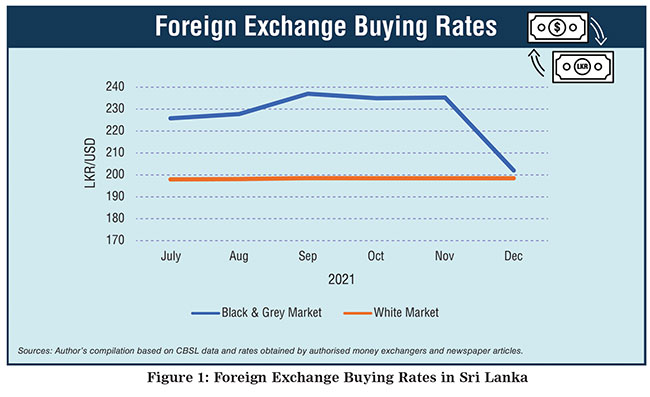
 One of the key attractions of informal remittances is the relatively low cost, partly due to the more attractive exchange rate offered by informal channels. The recent movements in the official LKR/USD foreign exchange rate indicated high pressure towards further depreciation and the excess demand amidst the deteriorating supply of USDs within the Sri Lankan economy resulted in a wide divergence between the exchange rate offered by the LCBs – the white market, and non-bank but authorised money exchangers. The latter can be termed ‘the grey market’ because they are permitted to buy foreign exchange, albeit did at their own rate. The divergence was even more pronounced compared with those of the black market or kerb rate.
Figure 1 below indicates a wide gap exceeding LKR 25 across the different foreign exchange markets from July to November 2021. This gap created an opportunity for informal remittances exchanged in the Sri Lankan grey or black foreign exchange market to be more rewarding to remitters. The extra LKR 2 and the subsequent top-up to an extra LKR 10 offered by the LCBs paled in comparison! Finally, in early December 2021, those in the grey market were forced to adhere to the soft pegged LKR/USD 198-202 rate.
Sources: Author’s compilation based on CBSL data and rates obtained by authorised money exchangers and media articles.
(https://economynext.com/sri-lanka-rupee-quoted-at-225-226-50-to-us-dollar-in-kerb-market-amid-money-printing-83579/;
https://economynext.com/sri-lanka-rupee-weakens-to-227-228-50-to-dollar-in-kerb-market-bond-yields-up-85162/;
https://ceylontoday.lk/news/official-directive-strengthens-kerb-market;
https://economynext.com/sri-lanka-cb-expects-falling-remittance-to-reverse-trend-from-october-87157/)
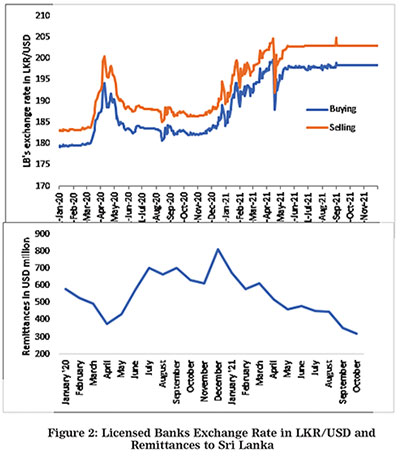
As seen in the top panel in Figure 2, when the CBSL intervention stabilised the LKR-USD exchange rate, formal remittances to Sri Lanka shown in the bottom panel continued on a steeper decline in October and November 2021.
Desperate Measures
In 2021 various mechanisms were rolled out to access foreign currency available in the economy. In May 2021, the CBSL directed that LCBs sell 10% of inward worker remittances converted to the CBSL. In October, a previous directive on the mandatory conversion of merchandise export proceeds was expanded to cover services. The change also shifted away from a 25% limit, to converting the “residual” after utilising goods and services export proceeds.
The Attractiveness of Informal Channels
 This latest update has resulted in much confusion. Though the CBSL indicated that this directive would not affect worker remittances, operationally, this does not appear very likely. A single Personal Foreign Currency Account (PFCA) may receive foreign exchange as worker remittances from a family member or a well-wisher and payment for trade-in services. The method of distinguishing the two types of inward remittances is still unclear to many. At the same time, many individuals have already received correspondence from commercial banks requesting to convert the funds in their PFCAs.
Amidst the confusion and effort to protect workers’ foreign currency earnings, more migrant workers are seeking informal channels to remit, while others refrain from or delay remitting. Yet others are diverting their remittances to accounts held overseas.
Sources: Top panel https://www.cbsl.gov.lk/en/rates-and-indicators/exchange-rates; Bottom panel CBSL, Weekly Economic Indicators, various dates
Early Warning
Remittances are seasonal. As such, official remittances in December may increase. But it should not be prematurely considered an indicator of the success of the recent efforts to increase remittances or divert from informal to formal channels. The departures for labour migration during the first half of 2021 are a mere third of the pre-pandemic departures in the same period in 2019. Many migrant workers who return are unable to find foreign jobs and this depleted stock of Sri Lankan migrant workers is a weak base to prop up formal remittances.
Moreover, domestic economic hardship makes many migrants and families desirous of a possible extra return through informal remittance channels. As such, excessive regulations to clamp down on informal remittances may inadvertently create a breeding ground for even greater informal activities and black markets, thereby proving entirely counter-productive to the intended objectives.
Future efforts to increase remittances should not underestimate the resilience of informal remittance channels crafted along the centuries-old method of Undiyal or Hawala. Thus, instead of overly focusing on shifting from informal to formal channels of remittances, policies should mainly focus on ensuring a more realistic exchange rate. Similarly, it is important to encourage labour migration and trade in services and their remittances.
Link to original blog: https://www.ips.lk/talkingeconomics/2021/12/17/black-white-and-grey-markets-the-dynamics-of-foreign-exchange-and-remittances-in-sri-lanka/#
Bilesha Weeraratne is a Research Fellow at IPS focusing on internal and international migration and urbanisation. She is also interested in labour economics, economic development, and economics of sports. Prior to re-joining IPS in 2014, Bilesha was a Postdoctoral Research Associate at Princeton University, USA. Bilesha holds a MPhil and a PhD in Economics from the City University of New York, USA. (Talk to Bilesha – bilesha@ips.lk)



A suspected cyber fraud targeting Sri Lanka’s Department of External Resources has triggered a high-level investigation after hackers allegedly manipulated official email communications to divert funds to unauthorised overseas accounts, Deputy Finance Minister Dr. Anil Jayantha Fernando said.
The sophisticated breach is believed to have involved the interception and alteration of email exchanges between the Department and Export Finance Australia, raising serious concerns over vulnerabilities in the Government’s digital financial communication systems.
According to the Deputy Minister, the fraud came to light following suspicious changes detected in bank account details linked to a payment transaction involving India. This anomaly prompted officials to scrutinise prior correspondence, eventually uncovering what appears to be a coordinated cyber intrusion designed to reroute funds.
“This was not a routine technical glitch. There is clear indication of external interference where communication trails have been tampered with,” Jayantha said, noting that complaints had already been lodged with law enforcement authorities.
“Investigations are now being handled by the Criminal Investigation Department (CID), which is probing the extent of the breach, the financial losses incurred, and the possible involvement of international cybercrime networks”.
Financial analysts warn that the incident underscores growing risks faced by state institutions engaged in cross-border financing arrangements, particularly when relying heavily on unsecured or inadequately protected communication channels.
The Department of External Resources plays a pivotal role in managing Sri Lanka’s foreign-funded projects and liaising with international lenders and export credit agencies. Any compromise in its communication systems could have far-reaching implications for investor confidence and the country’s financial credibility.
Authorities are expected to review existing cybersecurity protocols across key financial institutions in the wake of the breach, with calls mounting for tighter safeguards, encrypted communications, and multi-layer verification systems for fund transfers.
Meanwhile, officials remained tight-lipped on the exact quantum of funds involved, citing the ongoing nature of the investigation. However, sources indicated that the attempted diversion was significant enough to raise alarm at the highest levels of the Finance Ministry.
The incident adds to a growing list of cyber-related financial threats confronting governments worldwide, highlighting the urgent need for robust digital governance frameworks as Sri Lanka continues to engage with international financial partners.
By Ifham Nizam
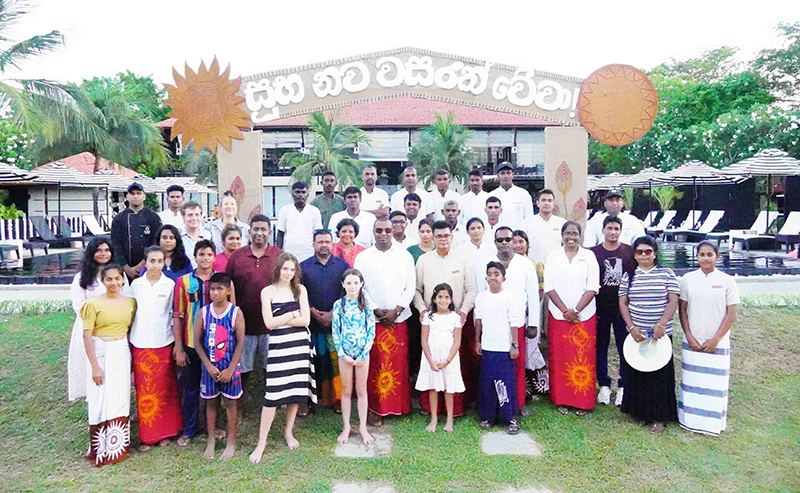
There is something about Avurudu that naturally fills every corner of Sri Lanka with energy and connection, and this year, that spirit extended to the shores of Pasikudah. At Sun Siyam Pasikudah, part of the Prive Collection within The House of Siyam, the Sinhala and Tamil New Year was celebrated on 14 April with a vibrant, full day programme that brought together guests and team members in true festive spirit, warm, lively, and centred around shared traditions and generous feasts.
The day followed the rhythm that Sri Lankan families know well. At the auspicious hour determined by the almanac for the New Year, the hearth at The Kitchen was ceremonially lit and the milk pot set to boil, symbolising warmth, unity, and the drawing in of abundance for the year ahead. This followed another auspicious moment at noon where a Traditional Sweet Table was laid out, where kiribath, kokis, kavum, aasmi and more were on offer, prepared by the resort’s culinary team and enjoyed by guests who had gathered, some for whom this was the most natural thing in the world, and others encountering the tradition for the very first time.
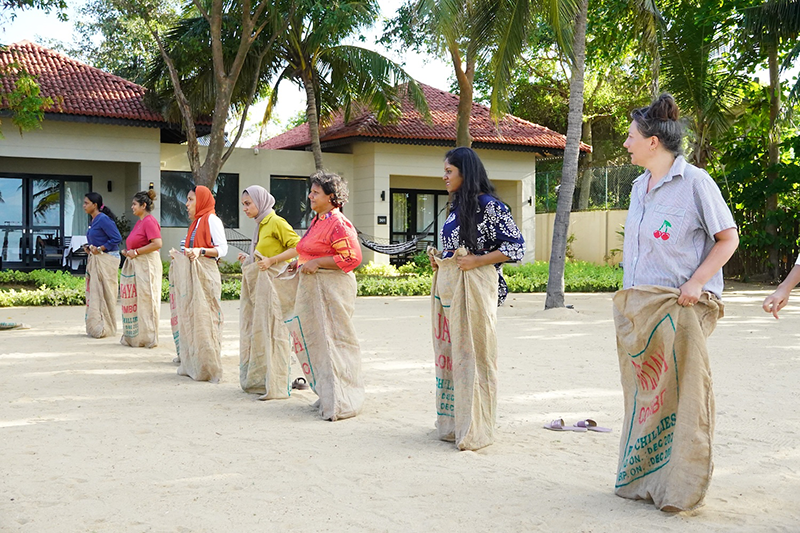
From 3:00 PM onwards, the afternoon opened into games. The resort grounds hosted the full run of Avurudu classics: Kana Muttiya (Pot Breaking), Kaba Adeema (Tug of War), Banis Kama (Bun Eating Contest), Balum Pipirawima (Balloon Blowing), Kotta Pora (Pillow Fighting), the Sack Race, Spoon Race, Blindfold Yogurt Feeding, Eyeing the Elephant, and Finding the Coin on the Plate. Guests of all ages joined in, and the kind of laughter that filled the afternoon is really the only way to describe what Avurudu at its best feels like.
“Avurudu is one of those occasions where the feeling in the air does all the work. The auspicious timings, the lighting of the hearth, the sweet table, the games in the afternoon: each of these carries its own meaning, and when you observe them properly and together, the day takes on a quality that is hard to replicate at any other time of year. We wanted our guests, wherever they had travelled from, to feel genuinely part of that, not simply watching from the outside. I think the day showed that Pasikudah is a place where that kind of celebration feels entirely at home,” said Arshed Refai, General Manager, Sun Siyam Pasikudah
The celebration is also a reflection of a broader moment for this stretch of the Sri Lankan coast. Pasikudah has long been known among those who seek it out: a bay of extraordinary calm and clarity, unhurried in a way that the island’s busier coastal destinations rarely are. What has shifted in recent years is that more people are finding it. Sri Lanka welcomed over 600,000 international visitors in the first quarter of 2025, generating tourism revenue of USD 1.025 billion, and the East Coast is increasingly part of that conversation. Sun Siyam Pasikudah has been central to placing Pasikudah on that map.
The resort’s 34 pavilions, offered in one and two bedroom configurations across garden and beach settings, are styled in a way that is quietly striking: monochrome interiors with warm golden accents, spacious and well-considered, always with the ocean close by. Dining is spread across The Kitchen, The Cellar, The Slice and Grill, The Tea House, and The Bar, with destination dinners available for guests who want a private evening under the stars. Sailing excursions along the coastline, spa and wellness, and encounters with local arts and crafts complete what Sun Siyam Pasikudah offers throughout the year.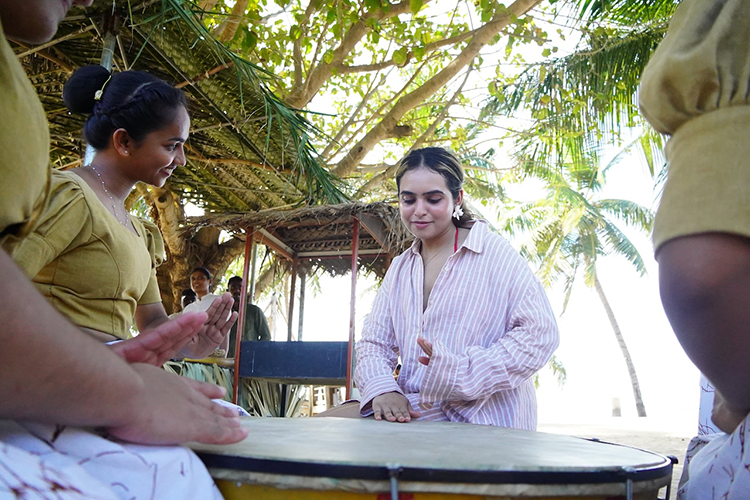
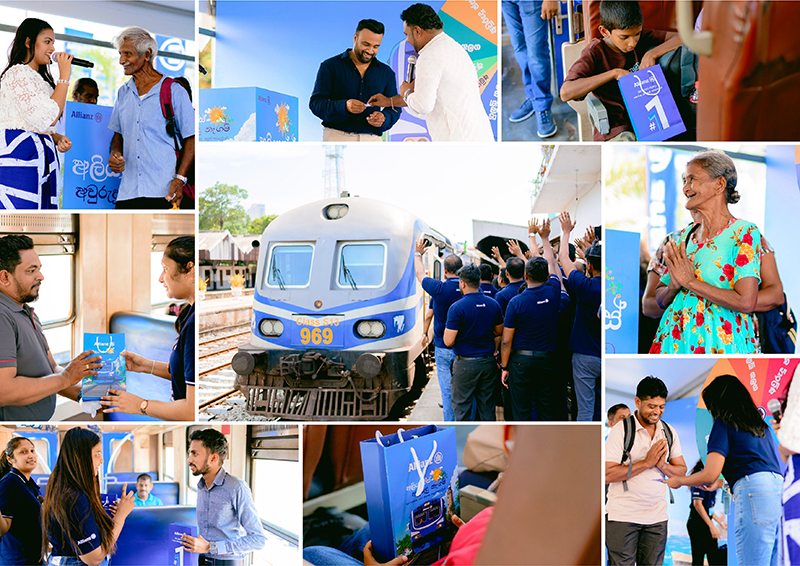
During the Sinhala and Tamil New Year, a time defined by togetherness, tradition and returning home, Allianz Insurance Lanka Limited once again stood alongside Sri Lankan communities by continuing its Avurudu Negam initiative for the second consecutive year, expanding its reach to support families during the festive travel period.
Building on the positive response to last year’s programme, Allianz Avurudu Negam 2026 was shaped to make the journey home special and loved during Avurudu. In response, Allianz offered ticket refunds to eligible passengers travelling on the Galu Kumari service from Maradana, supporting passengers journeying home to celebrate the New Year with loved ones.
Passengers boarding from Maradana and Fort and travelling beyond Galle up to Belliatta were eligible for the refund, helping make the journey home more affordable at a meaningful time of year. Acknowledging that financial strain frequently continues even after the celebrations conclude, Allianz extended the refund window until 30th April, easing the cost of returning to Colombo after Avurudu.
To complement this support, Allianz added a heartfelt touch rooted in New Year tradition. Traditional oil cakes were distributed to passengers boarding from Maradana, allowing families to take a familiar symbol of Avurudu back home and share it around their festive tables.
Allianz also prioritised protection during this period. Passengers eligible for the refund were given the option to obtain free Allianz Personal Accident Insurance, reflecting the belief that protection does not end with a journey, but continues wherever people go. In addition, these passengers were included in an LKR 1 million raffle draw, as an extension of the existing campaign, offering one winner shopping vouchers redeemable at outlets of their choice and support that extends beyond the New Year season.

Iran says ‘fully prepared’ for football team’s World Cup participation

LA 2028 Olympic cricket stadium in IPL proposal

Oil rises above $106 per barrel as US, Iran deadlocked in Strait of Hormuz

UAE captain Waseem fined and handed demerit point for criticising umpiring

Shanto century, Mustafizur five-for seals series win for Bangladesh

Showers above 75 mm are likely at some places in the Western, Sabaragamuwa, Central, North-western and Southern provinces

‘Dates have the highest sugar content to fight Coronavirus’

Sunday Island 27 December – Headlines

#SundayIsland 17th December – Headlines

Sunday Island – 28th March

Sunday Island Headlines – 21 March

Sunday Island – 21st February – Headlines
-
 News4 days ago
Rs 13 bn NDB fraud: Int’l forensic audit ordered
-

 Business7 days ago
Harnessing nature’s wisdom: Experts highlight “Resist–Align” path to resilience
-

 Opinion5 days ago
Shutting roof top solar panels – a crime
-

 News7 days ago
Gratiaen Trust announces longlist for the 33rd Annual Gratiaen Prize
-

 News6 days ago
From Nuwara Eliya to Dubai: Isha Holdings markets Agri products abroad
-

 News2 days ago
Lanka faces crisis of conscience over fate of animals: Call for compassion, law reform, and ethical responsibility
-

 News5 days ago
Church calls for Deputy Defence Minister’s removal, establishment of Independent Prosecutor’s Office
-
 News7 days ago
Heroin haul transported on 50-million-rupee contract