
Sports
Bearding the lion in its own den

36th Anniversary of Sri Lanka’s first ever Test match at Lord’s – Part 2
by Rohan Wijeyaratna
By now it was clear Gower and the selectors had grievously erred in under estimating the visitors, while over-estimating themselves. Far from being overawed, Sri Lanka had risen to the occasion and set in motion a prolonged leather hunt, that was fast becoming an embarrassment to England. As they drearily dragged themselves on to the field for the third successive day at Lord’s, the truth slowly dawned upon all, that England hadn’t seen off even half the visiting side yet.
The only wicket for the day
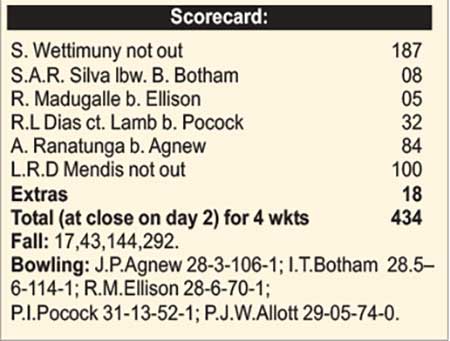
But let’s not get too far ahead of the story. The wicket of Ranatunga midway through the second afternoon was the only success England enjoyed on day two. Possessing a composure and temperament that was well beyond his years, Ranatunga played a commendable hand for one so young in consolidating the Sri Lankan middle order. He enjoyed some luck along the way when Gower spilled him in the gully when on 66, but by lunch on day two, Sri Lanka were healthily placed at 271 for three, with Ranatunga on 74 and Wettimuny on 137. England had toiled hard in the morning session for no return.
Reputedly, the English crowds are the fairest in the world. It is a repute they wear very well. On this occasion they were genuine in their appreciation of the Lankan batting, even though it was at the expense of their own team. Tragically, with a Test hundred at Lord’s beckoning him, Ranatunga playing forward to Agnew, allowed a shaft of light to remain between bat and pad and was castled through it. He had made 84 in 248 minutes of batting, having added 148 for the fourth wicket. Sri Lanka were 292 for four, when Duleep Mendis walked in.
Unfinished business
 Mendis knew he had some unfinished business in England. As previously mentioned (The Island – 23rd May, 2020), he could have won his side a famous victory nine years before, in the inaugural Prudential World Cup, but by knocking himself out via his own outer edge to a Thomson ‘screamer’ at a time when he had the Australian attack by its throat, he failed to fulfill that dream. That was when fate intervened and prevented what threatened to be a major tournament upset, when he and Sunil Wettimuny were involved in a furious attack on Ian Chappell’s men. Now at Lord’s, Mendis had Sunil’s younger brother for company and the stage could not have been better set for him to deliver a vintage ‘Mendis Special’. The wicket held no terrors; the bowling was near pedestrian; his team was well placed, and the man at the other end was looking like the Rock of Gibraltar by the minute! In short, Mendis could not have asked for a better setting to make the stage, indubitably his!
A man apart
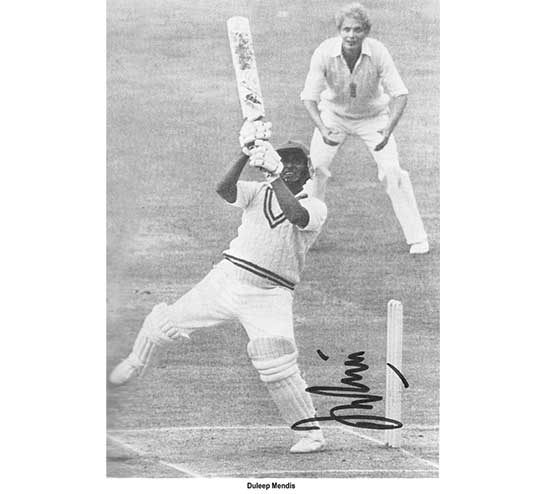
England on the other hand seemed reminded that Mendis met his nemesis in 1975 whilst hooking. Thanks possibly to some old rope well swallowed, their bowlers determined they would give him a working over, with the short ball. Accordingly, Allott began with a hurried delivery that pitched and arrived head high to Mendis on an inconvenient off stump trajectory. Somewhat taken aback and definitely hurried, the batsman managed a reflex hook down to long leg – a shot of no great conviction. This encouraged all other leather flingers to smack their lips, dreaming of possibilities. Soon it was Agnew pitching short at Mendis. Back and across went the portly skipper, picking up the ball from his off and hooking it down to long leg for four. Agnew bowled slightly short again and Mendis – now going back, smoked it venomously wide of extra cover for four, to bring up the 300. With each shot he now played, Mendis assumed greater authority. Agnew next bowled a more fullish length and Mendis drilled it right back at him, like a blast from a cannon. It was a stinging blow and technically a chance, though Agnew had no hope in hell of catching it. A back footed square slash to a wide, short, Agnew delivery seemed almost violently dismissive. Everyone by now had come to realize they were watching a very special passage of play in the match, and a very special person enacting it. Everyone had also begun to realize that Duleep Mendis was a man apart, from those who preceded him.
But England hadn’t still lost hope. On came England’s man for all seasons – Ian Botham; now specifically tasked to remove this bothersome Mendis. It took no great intelligence to figure Botham would try and bounce out Mendis, and it took no even greater intelligence to figure, Mendis would accept the challenge. The crowd was expectant. The moment of truth had arrived.
Mendis versus Botham
A languid drive from Wettimuny to deep point brought him on to 154; the highest score by any batsman in his country’s first Test in England. It also brought Mendis on strike. Botham resuming, ran in and delivered. It was a mean bouncer on the off stump and curving in; head high and rising. There was a flurry of activity and in the blink of an eye the ball had disappeared into the Mound stand backward of square for six! The momentarily stunned crowd now broke into loud cheer. Not to be outdone, Wettimuny in the next over from Ellison, gloriously executed a cracking cover drive off his back foot to bring up his best score in Test cricket – 160 off 383 balls in 514 minutes of batting. The ball was now back in Botham’s hand for the following over.
 Botham with his best days of pace behind him, was still, stubborn as a mule. He hadn’t probably heard that in the far outposts of the great empire, there were men who were no respecters of reputations. Possibly with such a bulldog mindset, Botham ran in and bounced again. Out came the hook shot in a flash; six more over square leg and into the Mound Stand! Although visibly wounded, Botham was still not ready to give up. Repositioning the two men he already had for the shot on the leg side boundary, he bounced one last time. It was on a middle and leg line and inconveniently close to Mendis’ head. Mendis undaunted, hooked yet again! The ball evaded the two men on the fence and ended up in the Mound stand for a third successive time. A visibly angry Botham was now seen muttering some ‘unprintables’ at his captain, for no doubt persisting with this daft idea of bouncing Mendis out. The Lankan skipper had now moved to 49, hammering three sixes off Botham in two overs and leaving no one in any doubt as to who was bossing the show in this particular contest. With each of his blows over the ropes, the crowd erupted, and with the third, the cheering rose to a crescendo. This was sensational stuff! Duleep Mendis the Lankan lion had bearded the British lion in its own den! At tea, Sri Lanka were 370 for four with Mendis on 52 and Wettimuny on 173.
Ran ‘em ragged
It took only 14 balls after tea for play to be suspended through bad light for 94 long minutes. Hence when play resumed, close of play was extended well beyond six o’clock. Between Mendis’ arrival and the eventual close of play, the score had surged by another 142 runs with Mendis making exactly one hundred of them. They came off 112 deliveries and mostly in fading light; sometimes almost too dark to recognize the dusky Sri Lankan skipper from 22 yards away! Thrice Mendis refused the offer of light and finally when he accepted, it was only after he had reached three figures. By now he had shown that between him and those that came before, there was a clear distinction. While most of the others applied grace and beauty from a bygone era around their technical correctness, Mendis’ method remained simple. He either blocked it or smashed it. And there was nothing vulgar about it at all. It was just that when in the mood he had this god given ability to reduce any bowling attack to pulp, without slogging. Simply put, Mendis ran England ragged. He was without doubt, the master of all he surveyed, that afternoon.








“I’m going to put it very simple: it’s hurtful, it’s painful and it’s shameful,” Farveez Mahroof, the former Sri Lanka allrounder, said, pretty much summing up the mood among cricket fans in the island after their abject failure against New Zealand on Wednesday in Colombo. That it came after being bowled out for 95 by England and meant Sri Lanka’s T 20 World Cup 2026 was over just added to the sense of dejection.
“It’s not a pitch that you can play through the line, I get it. But the way some of the batters just gifted their wickets away, apart from Pathum Nissanka’s delivery [from Matt Henry], every other dismissal was a soft dismissal, giving the wickets away, just like the England game, where all ten were soft dismissals,” Maharoof said on ESPN Cricinfo TimeOut after the match. “Continuing the same trend into another game, a must-win game, shows Sri Lanka were not up to the mark with the bat.”
Nissanka has been Sri Lanka’s best batter in the tournament, and the main man in their win over Australia, when he slammed a 52-ball 100 not out. On Wednesday, Henry produced a peach to Nissanka first ball, and “whatever hopes that Sri Lanka had just vanished”.
At the T20 World Cup, which Sri Lanka came to after losing 3-0 to England in a series at home, they beat Oman and Ireland, teams ranked lower than them, and then Australia in the group stage, but since then, it has all been downhill. Zimbabwe, England and now New Zealand have beaten Sri Lanka, and the last two have come after poor batting performances.
“It’s becoming a bad habit to have. I have been doing this analysis for seven-eight years, I keep saying the same old thing: once in a while, a good game, and our hopes are high; all of a sudden, come crashing down to the earth,” Maharoof said, referring to the Australia game. “It’s not the first time. I just hope something down the line, this has to come to an end, some hard decisions have to be made.
“I think after the next game, before the next series starts, Sri Lanka’s selectors and the think tank should really think of the future, what are the capabilities of the players, who should stick and who should not stick, and move on. I expect probably in the next couple of weeks, some hard decisions are going to be made. If not, I will be very surprised.”
Sri Lanka end their campaign with a game against Pakistan, in Pallekele on February 28.
[Cricinfo]
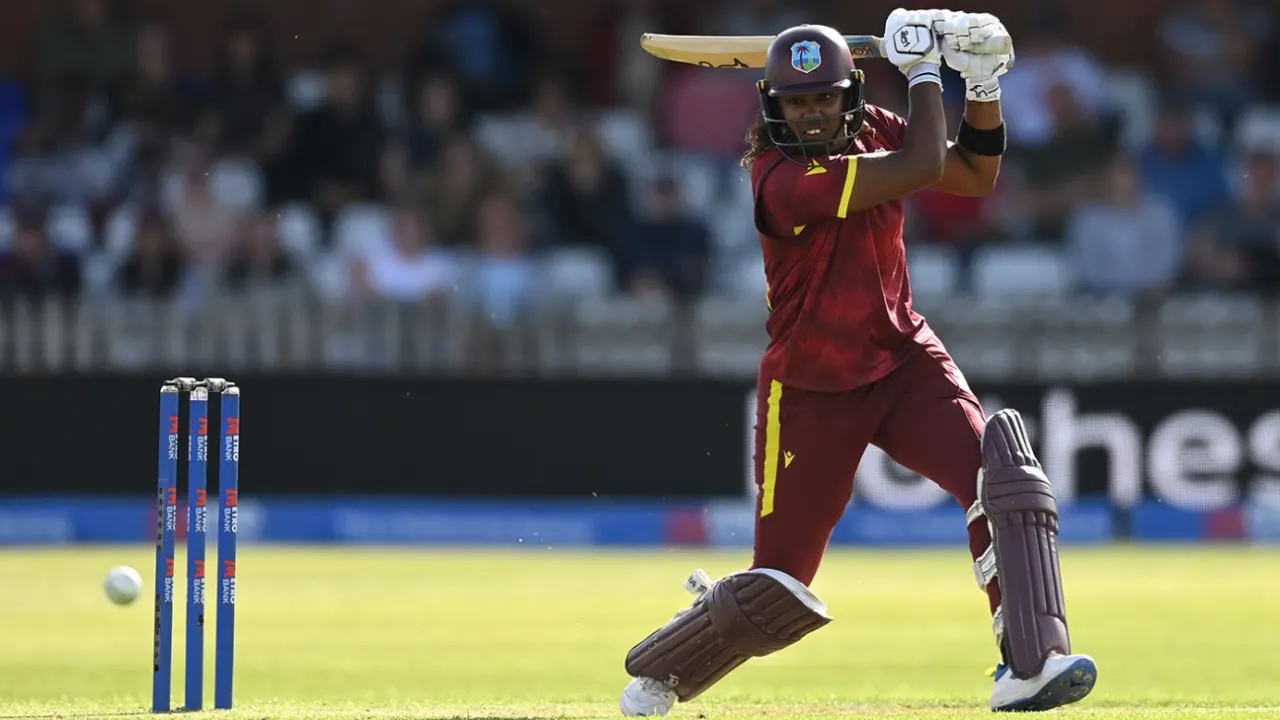
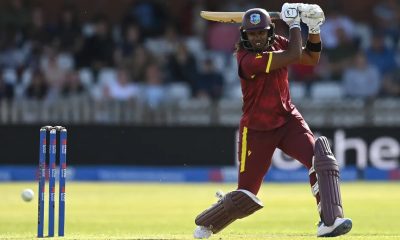
Hayley Matthew’s tenth ODI century led West Indies to a six-wicket victory in the final match of the series against Sri Lanka and gave them their first points in the new Women’s Championship cycle.
Sri Lanka had already secured the series but couldn’t clinch a whitewash as Matthews dominated: she started the match by removing opposite number Chamari Athapaththu in the first over of the contest and then compiled an 118-ball hundred, which took West Indies most of the way in their chase.
“I felt like I was in a pretty good space batting-wise and probably just [in the] first game got pretty unlucky with how I got out and then in the second match gave my own hand away,” Matthews said. “So I certainly felt like I was in a space where I wasn’t exactly being too threatened at the crease and I knew I just had to lock in and try to take it a bit deeper.”
The home side was in early trouble in St George’s against a target of 218 with Qiana Joseph and Shemaine Campbelle falling to Malki Madara to leave West Indies 12 for 2. But after taking 12 balls to find her first boundary, Matthews did not look back as she took charge of the innings, adding 124 for the third wicket with Stefanie Taylor, who moved second on the all time run scorers list in ODIs.
Matthews’ fifty came from 48 balls before she slowed a little in the second half of her innings, but the asking rate was never a threat for West Indies. She did give a chance on 70 when Nilakshika Silva was unable to hold a return catch. The ball after reaching the century, though, Matthews picked out deep midwicket but a stand of 49 between Deandra Dottin and Chinelle Henry finished the job.
Following the early loss of Athapaththu, Sri Lanka’s innings was anchored by Harshitha Samarawickrema’s 70 off 112 balls. She added 78 for the third wicket with Vishmi Gunaratne, but the visitors struggled to lift the scoring rate in the latter stages as West Indies chipped away, with Karishma Ramharack removing Gunaratne and Samarawickrama in the space of four overs.
Brief scores:
West Indies Women 218 for 4 in 46 overs (Hayley Matthews 100, Stefanie Taylor 38, Chinelle Henry 32*; Malki Madara 2-33) beat Sri Lanka Women 217 for 7 in 50 overs (Hasini Perera 27, Harshitha Samarawickrama 70, Kavish Dilhari 45*, Hayley Matthews 2-33, Karishma Ramharack 2-39) by six wickets
[Cricinfo]

Pulisha Thilakarathne top scored with 89 runs and held the top order batting together as Trinity scored first innings points and took major honours in the Ranil Abeynayake Memorial Trophy cricket encounter at BRC ground on Wednesday.
Trinity took a first innings lead of over 50 runs and declared their innings with two wickets in hand to find Thomians doing better in the second essay.
Jayden Amaraweera was in the forefront of the Thomian revival in the second innings as he scored his second half century of the match. Aaron Kodituwakku missed a second half century by five runs.
For Trinity, Mahendra Abeysinghe and Dinal Fernando were the others to make contributions with over 40 runs, while Aadham Hilmy made 32.
Scores:
S. Thomas’ 189 all out in 77.4 overs
(Aaron Kodituwakku 72, Jaden Amaraweera 50, Shanil Perera 37n.o.; Kanika Anthony 5/66, Dinal Fernando 3/34) and 182 for 5 in 53 overs (Jaden Amarawera 68, Aaron Kodituwakku 45;
Chaniru Senarathne 2/44)
Trinity 54 for 1 overnight 246 for 8 decl. in 58.2 overs (Pulisha Thilakarathne 89, Mahendra Abeysinghe 44, Dinal Fernando 45, Adam Hilmy 32; Abheeth Paranawidana 4/95, Gimhan Mendis 3/41) (RF)

Maharoof expects ‘some hard decisions’ after Sri Lanka’s T20 World Cup exit

Matthews’ century leads West Indies to six-wicket victory

Cuba says it shot dead four people on US-registered speedboat

’Reimagining International Relations from a Global South Perspective’ offers a timely and rigorous contribution, providing key insights into policy, diplomacy, and global governance – PM

Fair weather will prevail over most parts of the island

CID arrests former top military intelligence officer under PTA

‘Dates have the highest sugar content to fight Coronavirus’

Sunday Island 27 December – Headlines

#SundayIsland 17th December – Headlines

Sunday Island – 28th March

Sunday Island Headlines – 21 March

Sunday Island – 21st February – Headlines
-

 Features4 days ago
Why does the state threaten Its people with yet another anti-terror law?
-

 Features4 days ago
Reconciliation, Mood of the Nation and the NPP Government
-

 Features4 days ago
Victor Melder turns 90: Railwayman and bibliophile extraordinary
-

 Features3 days ago
LOVEABLE BUT LETHAL: When four-legged stars remind us of a silent killer
-
 Features4 days ago
Victor, the Friend of the Foreign Press
-
 Latest News6 days ago
New Zealand meet familiar opponents Pakistan at spin-friendly Premadasa
-

 Latest News6 days ago
Tariffs ruling is major blow to Trump’s second-term agenda
-

 Latest News6 days ago
ECB push back at Pakistan ‘shadow-ban’ reports ahead of Hundred auction