
Sports
Bearding the lion in its own den

36th Anniversary of Sri Lanka’s first ever Test match at Lord’s – Part 2
by Rohan Wijeyaratna
By now it was clear Gower and the selectors had grievously erred in under estimating the visitors, while over-estimating themselves. Far from being overawed, Sri Lanka had risen to the occasion and set in motion a prolonged leather hunt, that was fast becoming an embarrassment to England. As they drearily dragged themselves on to the field for the third successive day at Lord’s, the truth slowly dawned upon all, that England hadn’t seen off even half the visiting side yet.
The only wicket for the day
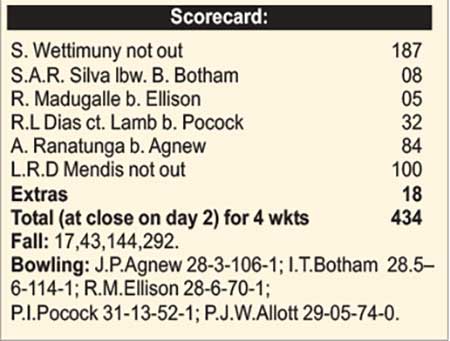
But let’s not get too far ahead of the story. The wicket of Ranatunga midway through the second afternoon was the only success England enjoyed on day two. Possessing a composure and temperament that was well beyond his years, Ranatunga played a commendable hand for one so young in consolidating the Sri Lankan middle order. He enjoyed some luck along the way when Gower spilled him in the gully when on 66, but by lunch on day two, Sri Lanka were healthily placed at 271 for three, with Ranatunga on 74 and Wettimuny on 137. England had toiled hard in the morning session for no return.
Reputedly, the English crowds are the fairest in the world. It is a repute they wear very well. On this occasion they were genuine in their appreciation of the Lankan batting, even though it was at the expense of their own team. Tragically, with a Test hundred at Lord’s beckoning him, Ranatunga playing forward to Agnew, allowed a shaft of light to remain between bat and pad and was castled through it. He had made 84 in 248 minutes of batting, having added 148 for the fourth wicket. Sri Lanka were 292 for four, when Duleep Mendis walked in.
Unfinished business
 Mendis knew he had some unfinished business in England. As previously mentioned (The Island – 23rd May, 2020), he could have won his side a famous victory nine years before, in the inaugural Prudential World Cup, but by knocking himself out via his own outer edge to a Thomson ‘screamer’ at a time when he had the Australian attack by its throat, he failed to fulfill that dream. That was when fate intervened and prevented what threatened to be a major tournament upset, when he and Sunil Wettimuny were involved in a furious attack on Ian Chappell’s men. Now at Lord’s, Mendis had Sunil’s younger brother for company and the stage could not have been better set for him to deliver a vintage ‘Mendis Special’. The wicket held no terrors; the bowling was near pedestrian; his team was well placed, and the man at the other end was looking like the Rock of Gibraltar by the minute! In short, Mendis could not have asked for a better setting to make the stage, indubitably his!
A man apart
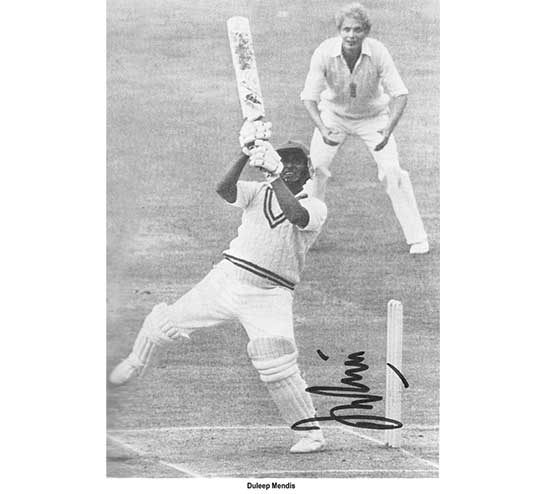
England on the other hand seemed reminded that Mendis met his nemesis in 1975 whilst hooking. Thanks possibly to some old rope well swallowed, their bowlers determined they would give him a working over, with the short ball. Accordingly, Allott began with a hurried delivery that pitched and arrived head high to Mendis on an inconvenient off stump trajectory. Somewhat taken aback and definitely hurried, the batsman managed a reflex hook down to long leg – a shot of no great conviction. This encouraged all other leather flingers to smack their lips, dreaming of possibilities. Soon it was Agnew pitching short at Mendis. Back and across went the portly skipper, picking up the ball from his off and hooking it down to long leg for four. Agnew bowled slightly short again and Mendis – now going back, smoked it venomously wide of extra cover for four, to bring up the 300. With each shot he now played, Mendis assumed greater authority. Agnew next bowled a more fullish length and Mendis drilled it right back at him, like a blast from a cannon. It was a stinging blow and technically a chance, though Agnew had no hope in hell of catching it. A back footed square slash to a wide, short, Agnew delivery seemed almost violently dismissive. Everyone by now had come to realize they were watching a very special passage of play in the match, and a very special person enacting it. Everyone had also begun to realize that Duleep Mendis was a man apart, from those who preceded him.
But England hadn’t still lost hope. On came England’s man for all seasons – Ian Botham; now specifically tasked to remove this bothersome Mendis. It took no great intelligence to figure Botham would try and bounce out Mendis, and it took no even greater intelligence to figure, Mendis would accept the challenge. The crowd was expectant. The moment of truth had arrived.
Mendis versus Botham
A languid drive from Wettimuny to deep point brought him on to 154; the highest score by any batsman in his country’s first Test in England. It also brought Mendis on strike. Botham resuming, ran in and delivered. It was a mean bouncer on the off stump and curving in; head high and rising. There was a flurry of activity and in the blink of an eye the ball had disappeared into the Mound stand backward of square for six! The momentarily stunned crowd now broke into loud cheer. Not to be outdone, Wettimuny in the next over from Ellison, gloriously executed a cracking cover drive off his back foot to bring up his best score in Test cricket – 160 off 383 balls in 514 minutes of batting. The ball was now back in Botham’s hand for the following over.
 Botham with his best days of pace behind him, was still, stubborn as a mule. He hadn’t probably heard that in the far outposts of the great empire, there were men who were no respecters of reputations. Possibly with such a bulldog mindset, Botham ran in and bounced again. Out came the hook shot in a flash; six more over square leg and into the Mound Stand! Although visibly wounded, Botham was still not ready to give up. Repositioning the two men he already had for the shot on the leg side boundary, he bounced one last time. It was on a middle and leg line and inconveniently close to Mendis’ head. Mendis undaunted, hooked yet again! The ball evaded the two men on the fence and ended up in the Mound stand for a third successive time. A visibly angry Botham was now seen muttering some ‘unprintables’ at his captain, for no doubt persisting with this daft idea of bouncing Mendis out. The Lankan skipper had now moved to 49, hammering three sixes off Botham in two overs and leaving no one in any doubt as to who was bossing the show in this particular contest. With each of his blows over the ropes, the crowd erupted, and with the third, the cheering rose to a crescendo. This was sensational stuff! Duleep Mendis the Lankan lion had bearded the British lion in its own den! At tea, Sri Lanka were 370 for four with Mendis on 52 and Wettimuny on 173.
Ran ‘em ragged
It took only 14 balls after tea for play to be suspended through bad light for 94 long minutes. Hence when play resumed, close of play was extended well beyond six o’clock. Between Mendis’ arrival and the eventual close of play, the score had surged by another 142 runs with Mendis making exactly one hundred of them. They came off 112 deliveries and mostly in fading light; sometimes almost too dark to recognize the dusky Sri Lankan skipper from 22 yards away! Thrice Mendis refused the offer of light and finally when he accepted, it was only after he had reached three figures. By now he had shown that between him and those that came before, there was a clear distinction. While most of the others applied grace and beauty from a bygone era around their technical correctness, Mendis’ method remained simple. He either blocked it or smashed it. And there was nothing vulgar about it at all. It was just that when in the mood he had this god given ability to reduce any bowling attack to pulp, without slogging. Simply put, Mendis ran England ragged. He was without doubt, the master of all he surveyed, that afternoon.







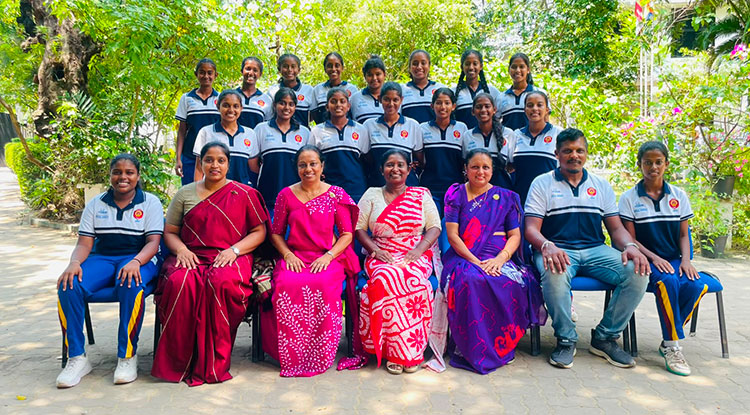
President’s Balika Nawala, won the girls’ hockey title at the All Island Schools Games, held recently at the Astro Turf, Reid Avenue. It was the second consecutive year the school had claimed the title.
Nethuli Dinethmi, who played a vital role in the team’s success, was named Best Player of the tournament.The victorious team is pictured here with the school’s officials, namely, H.P.M.P.D.Hasanthi Pathirathna, Principal, S.K.Tharsha Ranasinghe, Vice Principal, M.D.D. Aloka Dissanayake, Teacher in Charge of Sports, R.P.D. Dilrukshi, Teacher in Charge of Sports and Chathura Kalum Rupasinghe (Coach).
(Pic by Thushara Athapaththu)

by Rex Clementine
Sri Lanka were once pioneers in limited overs cricket, setting the bar so high that the rest of the world was left scrambling to catch up. And mind you, this was not confined to the 50 over format, where Sri Lanka tore up the coaching manuals, embraced an unconventional brand of cricket and took the world by storm.
Even in T20 cricket, despite not possessing an abundance of power hitters, Sri Lanka punched well above their weight.
Clever improvisation, fearless innovation and a willingness to back unorthodox talent helped them make the cricketing world eat humble pie. Fast forward to the present, however, and the picture is anything but rosy. Sri Lanka’s T20 cricket is in a sorry state, and there is no hiding the mountain of work ahead.
In Pakistan, their shortcomings have been laid bare, with the team repeatedly found wanting and left high and dry.
Successive administrations have tried every trick in the book to arrest the slide. Power hitting coaches have been brought in, psychologists engaged, players given unrestricted access to franchise leagues and emerging talent afforded regular exposure. Yet, for all these efforts, Sri Lanka’s players, particularly the batters, have struggled to raise the bar.
The series defeat to Pakistan was Sri Lanka’s fifth this year. Add to that the disappointments at the World Cup and the Asian Games and the picture becomes even more depressing. True, Sri Lanka returned from Japan with a bronze medal, but India provided a brutal reminder of the widening gulf between the haves and the have nots.
So, where do Sri Lanka go from here?
The Cricket Committee would do well to pick the brains of captains and coaches who have cracked the T20 code in recent years. There is no shame in learning from those who have mastered the format. The challenge is to identify a blueprint for su ccess and see how best those ideas can be adapted to Sri Lankan cricket.
Head coach Gary Kirsten himself has worked with successful franchises around the world. Perhaps he should be given a free hand to bring in specialist expertise if he believes that is what the team needs.
For all the disappointments in T20 cricket, fielding had remained one area where Sri Lanka could still hold their heads high. Alarmingly, even that department is beginning to unravel. The wheels appear to be coming off in a discipline that was once a hallmark of Sri Lankan cricket.
There were, however, a few encouraging signs in the final game against Pakistan. The manner in which Kusal Mendis went about his business was a breath of fresh air. The Sri Lankan captain struck at an impressive 181, combining clean hitting with the sort of innovation that has been conspicuously absent from the team’s batting.
Kamindu Mendis, too, showed signs of returning to form and Sri Lankan supporters will be hoping the pair can carry that momentum into the triangular ODI competition, also featuring England, which gets underway later this week.
Sri Lanka badly missed Pathum Nissanka, their highest ranked T20I batter at number nine in the ICC rankings. His absence robbed the batting line up of much needed quality and consistency. To compound matters, a troublesome hamstring has left his participation in the ODI leg uncertain as well.
The occasional flash of brilliance may offer some comfort, but it cannot disguise the larger malaise. Sri Lanka were once the trendsetters in limited overs cricket. Today, they are struggling to keep pace with the rest. Unless there is a serious rethink, the gap will only grow wider.

by Reemus Fernando
Richmond College, Galle wrapped up their group stage unbeaten as Tenusha Nimsara claimed his second five-wicket haul of the tournament, steering them to a thrilling two-wicket win over D.S. Senanayake College, Colombo, in their U19 Division I Tier A Limited Overs Tournament Group B encounter at Karandeniya on Wednesday.
Chasing a modest target of 118, Richmond reached 118 for eight in 44.2 overs, surviving a tense battle after DSS had put up a determined fight with the ball.
Earlier, DSS were bowled out for 117 as Richmond’s bowlers delivered an impressive collective performance. Left arm spinner Nimsara was the standout performer, claiming five wickets for just eight runs in eight overs, including two maidens. Hiruk Akalanka and Punal Hansajith claimed one wicket each, while Tenura Dias and Gayuka Manawadu took two and one wickets respectively. It was Nimsara’s second five-wicket haul. He has 14 wickets against his name going to the quarter finals.
Richmond struggled in their essay as DSS bowlers kept the pressure on throughout the chase. Sadil Dias led the attack with three wickets for 26 runs, while Oshadha Perera claimed two wickets.
Vinuda Ravishan played a crucial role in Richmond’s chase, scoring 44 off 114 deliveries.
Unbroken seventh-wicket stand steers Wesley
Wesley College secured a vital four-wicket victory over S. Thomas’ College in their Tier A match at Mount Lavinia thanks largely to an unbroken seventh-wicket partnership.
Chasing a modest target of 140, Wesley were in trouble at 82 for six before Lithum Senuja and Lithma Perera joined forces to guide their side home. The pair shared an unbroken 58-run partnership for the seventh wicket, taking Wesley to 140 for six in 44.1 overs.
Senuja anchored the innings with a patient unbeaten 46 off 116 balls, while Perera provided valuable support with an unbeaten 25 off 43 deliveries. Their composed partnership ensured Wesley overcame a difficult situation to claim victory.
St Joseph’s secure quarter-final place
St Joseph’s College, Darley Road scored a 46 run win under the DLS method against Thurstan in their encounter at Darley Road to secure a place in the quarter finals.
Batting first, St Joseph’s posted 193 all out in 44.4 overs, with Kavith Fernando top-scoring with 53 off 53 balls. Yenula Dantanarayana contributed 38 and Aveesha Samash made 36.
Thurstan reached 112 for seven in 30 overs against a revised par score of 158. Rachintha De Silva scored 42 off 27 balls, while Vigneswaran Akash starred with three wickets for 21 runs. Nushan Perera and Vishwa Peiris claimed two wickets each.
Earlier in the tournament they beat Gurukula and St. Servatius’ while conceeding their only defeat against Nalanda.
Mahanama beat Cambrians
Mahanama College, Colombo, beat Prince of Wales’ College, Moratuwa, by five wickets in their match at Moratuwa. Prince of Wales’ scored 141/9 in 27 overs, with Matheesha Aponsu top-scoring with 58. Mahanama chased down the target, reaching in 18.4 overs. Sineth Veerarathne scored 48 off 26 balls, while Dulneth Algawatte remained unbeaten on 30. Ojash Shankar took three wickets for Prince of Wales.
Janith Panditharathna took four wickets as St. Peter’s College Colombo beat Lumbini by 58 runs in their match at Colts ground.

Showers or thundershowers will occur at most parts of the island

Prison rules to be revised over monks’ attire

AC President recuses himself from hearing prison attire case pertaining to Gnanasara Thera

Court orders steps to obtain INTERPOL Red Notice against Basil

CID informs Fort Magistrate’s Court investigation into money laundering case against Namal completed

No force used to make Gnanasara Thera wear prison garb – Prisons

‘Dates have the highest sugar content to fight Coronavirus’

Sunday Island 27 December – Headlines

#SundayIsland 17th December – Headlines

Sunday Island – 28th March

Sunday Island Headlines – 21 March

Sunday Island – 21st February – Headlines
-

 News6 days ago
NDB fraud Rs 60mn more than reported
-

 News6 days ago
Removing monk’s robes matter for Sangha to decide: Mahanayake Theras
-

 News4 days ago
Sri Lanka escalates anti-graft drive with Shiranthi’s jailing
-

 News5 days ago
NPP govt. reminded of its responsibilities as US warship leaves Colombo
-

 Latest News5 days ago
Farhan, Sadaqat help Pakistan ace 183 chase to go 1-0 up
-

 News6 days ago
BHC, Colombo: “LTTE remains a proscribed org. in the UK”
-

 Latest News3 days ago
Farhan and Sadaqat help Pakistan seal series in style
-

 News4 days ago
Iranian ships stranded, Lanka fears US sanctions