
Features
Back home working in Sri Lanka with WHO, ILO, World Bank and ICES


(Excerpted from Memories that linger: My journey through the world of disability by Padmani Mendis)
Although I had carried out assignments for all the WHO Regional Offices except the European Office quite early on in my journey, I had not really had the opportunity to work with WHO Colombo. That is until the year 2012 when the World Report on Disability was published jointly by WHO and the World Bank, a very significant event for disabled people worldwide. The Regional Office in New Delhi, for reasons best known to them, had selected Sri Lanka as a regional focal point for an official launch of the publication.
Dr. Lanka Dissanayake was handling the subject of disability in WHO Colombo and helped coordinate the event. Responsibility was shared by the Ministries of Social Services and that of Health. It was obvious to anyone that on this occasion the former held the floor. Disability was theirs and theirs alone. So clear they made it, that the Minister of Health left it to his deputy to attend the event. His position, it seemed, had been insulted. Such was the hierarchy.
Dr. Tom Shakespeare, one of the key figures behind the prestigious World Report, came from the UK to represent WHO and the World Bank. The launch was quite an affair. As is usual with the Ministry an exhibition of products made by disabled people was organised as well as a concert by them. A committee of six members from both ministries was set up to oversee arrangements. Dr. Dissanayake brought me into the committee. My task was to accompany Tom Shakespeare on a programme of visits she arranged for him. But she brought me in really because beyond the launch, she had another activity in mind.
And this is how she got the activity going. She took the opportunity of the launch of the publication to suggest to the two ministries that they launch at the same time the preparation of a National Plan of Action for Disability. This was later called the NAPD. The two ministries had naught to do but work with each other. To see the activity through she gave me an official position as a Consultant to work with the two ministries.
With the relevant officials, we brought together disabled people and others with expertise in various areas in particular groups to prepare the eight sections of the plan. These were based on the National Policy on Disability, NPD. My task, as well as providing advice, was the preparation of the written edited document based on the drafts submitted by the groups.
Much was achieved this way until it was time for an open forum. This was held with the participation of over 200 people. I have not to this day seen that many disabled people participate together with others at such an event in Sri Lanka.
The process did not end there. We followed through using the email to circulate the draft document as widely as possible. Feedback obtained was fed in until the draft was as complete as it could be. I estimated quite roughly that well over 600 people had participated in the preparation of that document.
Approved by the two ministries, it was submitted to cabinet by the Minister of Social Welfare. The formal document in the three languages has on its cover both ministries as co-producers. And a decade after our National Policy on Disability had been approved, we now had in 2014 a National Plan for its implementation.
How I wish that I could say that these documents were put into effect by government. No, that was never formally done. But one can still have some sense of satisfaction that much of the statements in the National Policy and strategies in the National Action Plan have even to some small extent been disseminated within and have pervaded our society. This is to be credited to concerned individuals and organisations, including academia dedicated to improving the situation of our disabled people over these many years.
It may also be that it was a result of these efforts as well as others that a consciousness grew in our society about the situation of our disabled people. And consequently, a consciousness also of their rights. And of what appeared to be associating disability with rights in the increasing public discourse and national dialogue. But no, not yet a major concern within government.
Following these few small steps, many hoped finally that Sri Lanka had taken a leap in 2016. This was when our country finally ratified the UN Convention on the Rights of Persons with Disabilities or CRPD, on February 8 of that year. Nope. No action to follow. False alarm again. Our government was likely responding to outside pressure that this had to be done. The enabling legislation for the CRPD is, just to remind you, still in the pipeline. The mechanism for its implementation has never been given a thought.
Nonetheless the two National Human Rights Action Plans (NHRAPs) that were made at around this time included disabled people as a subject area. I participated in the preparation of the NHRAP 2012 – 2016. It had been decided that disability was to be a cross-cutting issue in this plan and I was invited to serve on the relevant drafting committees.
By the time NHRAP 2017 – 2021 was being prepared, Sri Lanka had approved the CRPD so Disability had a whole section to itself. Here I was appointed to the drafting committee of the Disability section. Both remained as documents prepared using expensive paper with a glossy cover.
The whole fiasco led one to believe the NHRAPs were made only to impress the international community. Or to respond to their vociferous requests for Sri Lanka to fulfil our international commitments.
Journeying with the International Labour Organisation, Colombo
Journeying with the ILO in Colombo took me into a completely new ethos. Work, employment and the right to an income that was not connected with Community Based Rehabilitation (CBR). The right to work is the area in which perhaps the rights of disabled adults are most violated. Just as for children the greatest violation would undoubtedly be the right to education.
The most interesting of the tasks I did for ILO was in the Factory Improvement Programme implemented by the EFC or Employers Federation of Ceylon. It was therefore called the ILO – EFC Factory Improvement Programme.
This was an ILO regional programme aimed at improving the overall efficiency levels and competitiveness of selected factories. Including disabled people in these factories was part of the programme. A manual for training factory managers to fulfil programme aims was being developed by ILO.
My task was to field test the module in the manual which dealt with the inclusion of disabled people. I was first required to visit 10 factories in the western province selected for the field test and motivate employers to include disabled people in their workplace. Most were garment industries, while a few were related to the tea trade. It was a first experience for me going inside these factories and meeting staff. The factories were exceptionally well maintained as were their gardens, usually landscaped. All very pleasant.
I was most surprised by this finding. That is, nine of the 10 factories already had disabled employees. Speaking with them, I found that these employees were quite content with their situation. The managers, it appeared needed no motivating from me. This finding did not quite match the situation we found on the ground. The National Census of 2012 indicated that unemployment among disabled people was over 70%. Field workers believe it is even higher.
Beyond this was another welcome finding. While I was on the floor of a certain garment factory with the factory manager, the bell rang announcing the tea break. All the workers on the floor left as if in a hurry to make the most of the free time they were given. Except for one young man who waited to look around him; he went up to a colleague’s machine, did something with it and then left.
The manager explained to me what it was about. The young man, let’s call him Nanda, looked around him to see if all was in order. He found that a colleague had failed to switch his machine off, and this is what Nanda did before leaving the floor. The manager went on to tell me that Nanda had, the previous year, been recognised as the “Best Employee”. Nanda was deaf. He communicated with his colleagues using gestures and signs they made up. His impairment was no barrier at this workplace.
At yet another factory, the manager was proud to show me around so I could see how he had integrated in his factory more than a dozen disabled employees. He went on to say to me “If you bring me 20 disabled people tomorrow, I will give them all work.” And who talks of the low productivity levels of these our people?
The World Bank
Two of the more interesting tasks I did for The World Bank I would like to share with you. They were quite different from each other. The first took me in 2009 to many parts of my country again talking with many people from many different walks of life and a variety of institutions. This learning and experience went into a comprehensive report I gave to The World Bank calling it “Disability in Sri Lanka”.
The first appointment I carried out for this task was with the Director-General of Labour. Before I entered the beautiful new building housing the Ministry and Department of Labour, I had a toss, fell flat on my face and injured my foot. It was awfully painful and I could see my foot swelling up immediately. Appointments with these people were hard to get so I went ahead with it. It was later when I got to a hospital that I found out I had a fracture. My foot was put in a plaster cast. It could not take any weight for six weeks.
And so I started using a wheelchair. And this I used until I had completed the task travelling to all parts of the island for my work. Accessible hotels were very hard to find. Many buildings and offices were inaccessible. But people were kind. Even top Government officials came down to earth to meet me, some down from their Ivory Towers.
For the second task of preparing a document, I worked with the Ministry of Health, disabled people and a few others. This was approved and published by the ministry as their rehabilitation policy in 2014 and called “National Guidelines for Rehabilitation Services in Sri Lanka”. The process of preparing it involving discussions with a wide range of health personnel seemed to make them conscious to some degree of the needs of disabled people.
ICES and the Disability Policy Brief
The last formal work I carried out on my journey was with the International Centre for Ethnic Studies, ICES. The ICES was popular in our world because of the interest it showed in disability. Dr. Mario Gomes, the Executive Director, could very easily be approached by both disabled people and by us disability workers for particular support that we needed. So over the years, many meetings and workshops were sponsored and some research conducted related to disability.
Disability by this time had moved out of the public discourse. Action on it seemed to be low-key. Binendri Perera, an attorney attached to the University of Colombo and I discussed with Dr. Gomes the possibility of preparing for publication a brief document that may help to change this situation. The outcome of this is the ICES publication “Disability Policy Brief for Law Makers, Administrators and Other Decision Makers” in all three languages.
What Binendri and I did was synthesise in the document in point form the National Policy and National Action Plan both of which had Cabinet approval and the UN Convention on Disability which Sri Lanka had ratified.
To do this we analysed each recommendation and put them into one chart so that they could be related to each other and compared. This we trusted would lead to a comprehensive approach to implementation. We believed this simple format would encourage users to understand their respective roles in the overall process and take whatever action they could. ICES made sure it was distributed to reach all districts in Sri Lanka and divisions within many of those districts. One last attempt to move closer to a better life for our disabled people.
End of travel, but not of The Journey
I started my Journey in the World of Disability here at home in my Sri Lanka. I have shared with you the first small step of my journey that I took while yet at school with my decision to be a physiotherapist. And with that first step, the next to proceed to the UK to be an Orthopaedic Nurse as a means of studying to be a Physiotherapist.
It was right at the start of the five years and more of learning this process took that I made my contacts with disabled people of all ages. First as their nurse, to many their friend and confidante. Space permits me to share with you my experiences with only a few individuals of the many thousands that impacted my life as it was to unfold.
The first was but a small step, but one that led to all the steps I have taken since, taken during the next 65 years of my life to the age of 83 where I am now, back home where I started. Sharing my memories with you.
During the 64 years that I journeyed, unending opportunities made for me a journey that criss-crossed continents. When asked about it I have said that “I travel horizontally”. Because whilst I was in South America and the Caribbean during the early years, the rest of my journey I have spent in Asia, Africa and much of it in between, in the Middle-East. To me that is more important than the journeys I made North-South, although to participate in the many conferences, meetings and workshops in the industrialised north was also rewarding, as much as it was in the countries of the global south. And, of course, to share my learning through the innumerable teaching opportunities in many of the same countries.
Since about six years or so ago, physical impairment and difficulties have ended travel for me. But my journey is not ended. This continues in the Realm of Disability to this day. Modern communication technology makes it possible to meet North to South and East to West. Skype and Zoom and the good old telephone itself are a boon. My same dining table still serves as a conference table when I sit with the many visitors who come to talk with me about the situation of disabled people in Sri Lanka and elsewhere, past and present.
To share with you how my journey continues as of now here at home are just two examples. Last week I was interviewed by a Master’s student named Nathaniel from Columbia University in New York. About certain aspects of disability in Sri Lanka. But our discussion and my sharing also brought into it an international perspective. He was involved in a multi-country research study related to inclusive adolescent health care, the Report of which will be presented to a UN agency.
The second, a few months ago I was interviewed by Taryn from Mc Gill University in Montreal, Canada, also on zoom. She was carrying out a study related to women activists in Sri Lanka. I told her I did not consider myself to be an activist. But her definition being what it was she could not accept my reasons for that, and we had a really interesting discussion. Which came to be focused on my global journey in disability as it impacted my work in Sri Lanka.
And with that, it is time now to move on. To move on and reflect on my life as I lived it and on these the memories I shared with you.







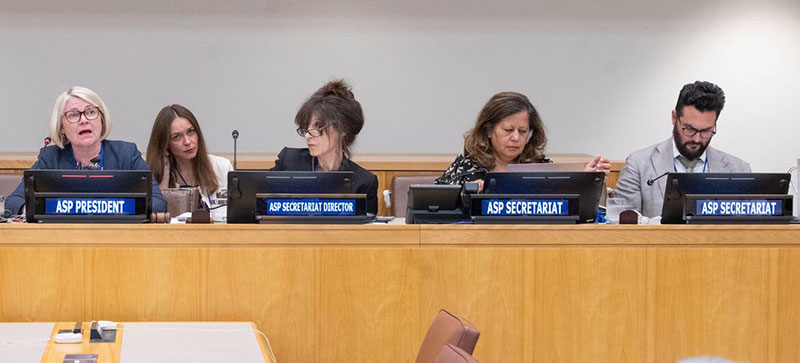
 US Secretary of State Marco Rubio’s warning to the International Criminal Court (ICC) was stark: ‘Either the ICC will end its threats, or we will end the ICC.’ It followed US central administration accusations that the court was unfairly targeting Americans on the basis of trumped-up war crimes charges.
However, a new plethora of sanctions has been clamped on the ICC by the US, which in turn has spurred accusations by sections of the world that the latter has unleashed an ‘assault’ on the international legal order.
What some of the sanctions would mean for the ICC was outlined by Rubio: ‘We will ban transactions with this rogue court, cutting off their resources and crippling their ability to operate against us.’
The ICC has shown consistency of purpose over the years. Despite some operational constraints it has indicted a large number of political strongmen from around the world, accused of war crimes and other governance excesses that come under its purview. Two such recent figures are: Russian President Vladimir Putin and Israeli Prime Minister Benjamin Netanyahu.
Rather than enjoy a mere nominal presence in the world community, the ICC has proved its effectiveness by detaining and bringing to justice scores of VIP politicians and others of their ilk who have been found guilty of human rights abuses and kindred excesses that come within the terms of reference of the ICC.
Accordingly, the international justice system would be stymied considerably as a result of the ICC being dis-empowered, particularly financially. Needless to say, potential and real perpetrators of the species of crime coming under the jurisdiction of the ICC would stand to gain most from such anarchic tendencies. That is, political repression globally would be enabled to enjoy a new lease of life.
A detailing of the types of crime coming under the purview of the ICC provides an idea of what it would cost the international community if the ICC’s operations are gravely hampered. They are mainly: genocide, war crimes, crimes against humanity and the crime of aggression.
That is, the part of the world to be worst affected would be the global South, since the latter is awash with the mentioned crimes. Needless to say, a chronically-disaffected South will sooner rather than later undermine the well being of the world dangerously. The world is already being put through these paces.
At the time of writing, ‘illegal migrants’ from the South, for example, are aggravating many a Western economy’s woes, besides creating for them acute law and order issues. The fact that these migrants’ presence goes on to become a virtual test of the migrant receiving states’ ability to forge domestic social inclusion in the face of jingoistic protests by mainly white supremacist groups is evidence of the latter. As is known, the US, to take just one example, has been up against this crisis for quite a while.
Accordingly, it will be in the best interests of the West if ‘illegal’ migrant arrivals on their shores are stemmed. If the socio-political and economic problems assailing the South are effectively managed through North-South collaborative, ‘trouble-shooting’ efforts the causes leading to ‘illegal’ migration and connected issues could be resolved at source as it were. For, it is the aggravation of the South’s material questions that lays the basis for the emergence of repressive and anti-democratic regimes in the hemisphere.
Until such time that the aforementioned issues in North-South relations are visited afresh and addressed urgently, a vibrantly functioning ICC would be needed. For, the latter would prove a deterrent to Southern political and military strongmen, highly prone to power abuse and like excesses, from coming into being in the wake of the South’s chronic material woes and the wars and conflicts that result from them.
It stands to reason then that the US would be acting in its own interests by enabling the ICC to perpetuate its mandate without hindrance. For a crop of issues that impinges negatively on internal law and order would be defused.
Meanwhile, there needs to be a meeting of minds among the rest of the West to put back in place a North-South dialogue process aimed at reducing some of the economic pressures that are weighing on the South.
Since economics usually drives politics it will be in the interests of the world community to scrutinizingly re-visit North-South issues of the past and put in place economic relief packages for Southern publics that would enable them to tide over their material hardships rather than permit the latter to aggravate into social disaffection and eventually armed militancy. It is the latter juncture that paves the way for the emergence of authoritarian rulers in the South who then go on to be a blight on their publics.
Accordingly, the Southern-based global development thinking of the past that envisaged a more equitable world economic order needs to be seen as an urgent need. That is, NAM’s international development paradigms need to be resuscitated to the extent possible.
It is unlikely that rightist governments of the West, such as the current Republican administration in the US, would find these projects feasible, but democratic states of Europe, led by perhaps the UK, are likely to think otherwise. For it would not be beneficial for the democratic world to be having on their hands repressive governments in the South who would be gravitating towards the major military and economic actors of the South, such as Iran and North Korea, who tend to be in constant power struggles with the West.
However, until such time that the mentioned, pro-people initiatives are given serious thought the ICC would need to be enabled by the international community to be in place comfortably and carry on with its mandate of bringing repressive rulers to book. Besides the ICC should pave the way for the peoples of the developing world to enjoy some substantial respite from the political repression and even terror which tend to be their lot.
Meanwhile, the wars of West Asia are relentlessly aggravating the economic hardships of people everywhere, driving the point home to enlightened sections that there is no alternative to peacemaking. A challenge is to convert the US under President Trump to this line of thinking.

 This week, I give you five simple, time-tested homemade remedies that help reduce the appearance of blemishes, control excess shine and leave your skin feeling softer and smoother.
The Honey and Lemon Brightening Dab:
For stubborn blemish marks, this is a classic. Mix one teaspoon of pure bee honey with three to four drops of fresh lemon juice. Apply gently, only on the affected spots, and leave for 10 minutes before rinsing with lukewarm water. While honey soothes and softens, lemon helps to brighten naturally. Use twice a week in the evening.
Besan and Rose Water Oil-Control Pack:
An ideal remedy to combat shine, especially on the T-zone. Take two teaspoons of besan (gram flour) and mix with sufficient rose water to form a smooth paste. Add a pinch of turmeric for its antiseptic goodness. Apply evenly, keep for 15 minutes and wash off. It absorbs excess oil without over-drying, leaving a beautiful matte finish.
Aloe Vera and Cucumber Ice Soother:
Blend fresh aloe vera gel with the juice of a grated cucumber and freeze the mixture in an ice tray. Each morning, wrap one cube in a soft muslin cloth and gently rub over a cleansed face for 30 seconds. It calms, tightens pores and imparts a baby-soft smoothness.
Oatmeal and Curd Gentle Polish:
Roughness and old blemish marks need gentle exfoliation. Combine one tablespoon of finely powdered oatmeal with one tablespoon of fresh curd (yoghurt). Massage very gently, in circular motions, for one minute, leave for five minutes and rinse. It removes dead cells and unveils softer, clearer skin.
Multani Mitti and Green Tea Magic Mask:
Brew some green tea and allow it to cool completely. Mix one and a half teaspoons of Multani Mitti (Fuller’s Earth) with the tea water to make a fine paste. Apply for 10 to 12 minutes – do not let it dry and crack completely – and wash off. It draws out impurities, fades blemishes and bestows a fresh, shine-free glow.
A Gentle Reminder:
As with any natural remedy, always do a patch test on your inner arm first. For those with oily or combination skin, avoid heavy coconut oil application and harsh scrubbing, as they tend to aggravate shine and blemishes.

 Dream of performing on a world stage? Well, here is your unique, golden opportunity!
The World Championships of Performing Arts (WCOPA) — the one and only official “Talent Olympics” — is the world’s premier global platform for aspiring singers, dancers, actors, models, instrumentalists, etc., to compete, shine and be discovered!
And, yes, this world stage is open to YOU, Sri Lankans living in Sri Lanka and overseas!
Held annually in glittering Las Vegas, WCOPA brings together over 70 countries, all competing for Gold, Silver and Bronze Medals, just like the traditional Olympics.

Lakisha Bernard: Will represent Team Sri Lanka at WCOPA 2027
Outstanding performers vie for the coveted titles of Junior and Senior Grand Champion Performer of the World, with winners and standout participants awarded over $500,000 in scholarships, cash awards and prizes to catapult their education and careers!
Sri Lanka is already making waves! At WCOPA 2026, Natharie Wickramasinghe, representing Team Sri Lanka, made the nation proud by winning a Bronze Medal in the Ethnic/Folklore Dance category!

Lakisha: Accomplished freelance Model and Fashion Design graduate
Recruitment for this prestigious competition is handled through a system of scouts and licensed National Directors — and this is where our very own Chris Rajendra, now based in Las Vegas, and National Director for Team Sri Lanka, comes into the scene.
If you are a singer, dancer, actor, model, instrumentalist — if you have talent burning inside you — contact Chris Rajendra today for registration and, who knows, you may find yourself in Las Vegas, and proudly draped in the Sri Lankan flag, at WCOPA 2027!
The contact address is: Chris Rajendra, wcopa.nationaldirector.sl@gmail.com
or chris.rajendra@gmail.com
Meanwhile, a star is born for 2027, in the form of Lakisha Bernard who is all set to represent Team Sri Lanka at WCOPA 2027.
Originally hailing from the sun-drenched coastal city of Colombo and now carving out her creative career in Canada, 22-year-old Lakisha is stepping into the international spotlight.
This accomplished freelance Model and Fashion Design graduate has officially been appointed as the Team Sri Lanka Promoter for Canada as she prepares to represent Team Sri Lanka at WCOPA in Las Vegas.
Lakisha brings a unique blend of high-fashion sensibility, captivating camera presence and expert garment design to the Team.
Having built her career, from local college shoots to high-glamour concepts, Lakisha’s inspiring journey embodies the true spirit of cultural bridge-building and creative resilience, bringing immense pride and recognition to Sri Lanka on the global stage.
WCOPA 2027 will be held at the legendary Westgate Hotel & Casino, Las Vegas, from 12th to 20th July – the very same iconic arena where the late, great Elvis Presley himself performed!
Your moment is now. Your stage is Las Vegas, so hurry and contact Chris Rajendra.

AgriConnect Sri Lanka’ to be launched on 30 October to Modernise the Agricultural Sector Through Digitalisation

57th Annual Saints’ Quadrangular Tournament on Saturday and Sunday

Showers or thundershowers will occur at most parts of the island

Prison rules to be revised over monks’ attire

AC President recuses himself from hearing prison attire case pertaining to Gnanasara Thera

Court orders steps to obtain INTERPOL Red Notice against Basil

‘Dates have the highest sugar content to fight Coronavirus’

Sunday Island 27 December – Headlines

#SundayIsland 17th December – Headlines

Sunday Island – 28th March

Sunday Island Headlines – 21 March

Sunday Island – 21st February – Headlines
-

 News7 days ago
NDB fraud Rs 60mn more than reported
-

 News7 days ago
Removing monk’s robes matter for Sangha to decide: Mahanayake Theras
-
 News6 days ago
NPP govt. reminded of its responsibilities as US warship leaves Colombo
-

 News5 days ago
Sri Lanka escalates anti-graft drive with Shiranthi’s jailing
-
 Latest News6 days ago
Farhan, Sadaqat help Pakistan ace 183 chase to go 1-0 up
-
 News7 days ago
BHC, Colombo: “LTTE remains a proscribed org. in the UK”
-

 Latest News4 days ago
Farhan and Sadaqat help Pakistan seal series in style
-

 News5 days ago
Iranian ships stranded, Lanka fears US sanctions