
News
Auto companies slam brakes on Sri Lanka exports, production

Mumbai: A severe economic crisis in Sri Lanka has forced many Indian automotive firms to slam the brakes on exports of vehicle kits as well as production at the local assembly operations they have set up in the island nation.
Shipments of vehicle kits, including those for light commercial vehicles, trucks and buses, have declined sharply, as the neighboring country is grappling with precarious forex reserves and fuel shortages, said industry executives.
While companies like Tata Motors have been exporting vehicle kits to distributors in Sri Lanka, others such as Mahindra & Mahindra, Ashok Leyland and TVS Motors have local assembly operations in the country.
“We are unable to get the kits, so we cannot put finished products out in the market,” said Rajeev Pandithage, chief operating officer-mobility sector at Diesel & Motor Engineering, one of the oldest and largest dealers for Tata Motors and Mahindra tractors in Sri Lanka.
Imports of vehicle kits are heavily restricted in Sri Lanka owing to the forex crunch.
Diesel & Motor Engineering had started assembly of the Tata Ace small commercial since there were import restrictions on completely built units of vehicles. It wants to launch the vehicle soon given the huge demand for such low-cost vehicles, said Pandithage.
Besides, the distributor can import fully built tractors. However, Pandithage said, “We are facing forex issues to open LCs (letters of credit). Before the season starts, we have a stock of at least 1,000 tractors. This time we have just about 150, which is clearly not enough.”
Farmers want to buy new tractors, he said, but higher interest rates and rising inflation are not allowing them to do so.
A Tata Motors spokesperson said the company stays committed to the Sri Lanka market and prays that the country recovers from the crisis at the earliest. “Tata Motors continues to have a positive outlook about the Sri Lanka market,” said the spokesperson.
Tata Motors has been running its operations in Sri Lanka since 1961 and the country continues to be a priority market. “The company has consistently grown grown over the years and is now the largest selling commercial vehicle brand in Sri Lanka. It has the widest range of products, from the 750 kg Ace to 45-tonne Prima trucks,” said the company spokesperson.
Two-wheeler maker Bajaj Auto said due to the forex shortage, imports of most auto products including two-wheelers and three-wheelers were stopped by the Sri Lankan government almost a year ago. “As a result, our exports in the previous year were negligible. In 2019-20, we exported over 30,000 units, which also was a decline over the previous highs,” said Rakesh Sharma, executive director, Bajaj Auto. “A small restart was made recently based on efforts to localise and generate employment there. Now, with this dislocation, we have to wait and see how that initiative unfolds.”
Mahindra & Mahindra set up assembly operations in Sri Lanka with the Ideal Group to produce the KUV 100 mini sport utility vehicle (SUV) and Bolero Maxi pickup truck in August 2019. “We cannot ramp up production as there is difficulty in sourcing,” said Nalin Welgama, executive chairman, Ideal Group. “The target was to sell at least 5,000 vehicles a year through this JV (joint venture). We sell about 200-250 of such vehicles a month. Our assembly is continuing despite the forex challenges.”
The KUV 100 and the Bolero Maxi are entry-level products and there is a good demand for them, he said.
Distributors are hoping they can accelerate production of such low-cost vehicles, which continue to have a good demand in Sri Lanka.
Mahindra & Mahindra set up a completely-knocked-down assembly plant in Welipenna through a JV with local partner Ideal Motors. “Our vehicles including KUV 100 and Bolero City Pickup have been well received. Further, last week, M&M signed an agreement with Sri Lanka Police for 750 Scorpio SUVs,” said a company spokesperson.With over 35,000 customers in Sri Lanka, M&M remains committed to the long-term prospects of the market and will continue to work on building and strengthening its brand and position in the country.”
TVS Motors retails several of its two-wheeler models such as the 100 cc economy motorcycle TVS Sport and the 125 cc scooter TVS NTORQ Race Edition through local assembly. The launch of this scooter, in January 2020, triggered a turnaround in the Sri Lankan scooter segment.
In January this year, the Sri Lankan government approved the purchase of 500 buses from Ashok Leyland for its transport board.
Queries emailed by ET to TVS Motors and Ashok Leyland did not elicit a response till press time.
As Sri Lanka battles the worsening crisis, automakers realise that production cannot be immediately ramped up due to economic uncertainty and low business activity, said industry executives. However, local players are confident that production will not come to a complete halt, they said.
As Sri Lanka moved from a market economy to a product economy, exports of CBUs (completely built units) came to a halt
Due to forex shortages, imports of most auto products including for 2- and 3-wheelers were stopped by the Sri Lankan govt
Automakers are adopting a wait-and-watch approach because of economic uncertainty and low business activity
Covid sent Lankan economy into a tailspin, drying up earnings from tourism, foreign remittances In March 2020, the govt imposed an import ban on new cars, which left car parts in short supply. (ToI)



The Department of Immigration and Emmigration has decided effective from 28th February 2026, to grant a free fourteen (14) day visa extension to all tourists who are unable to leave Sri Lanka due to flight cancellations. 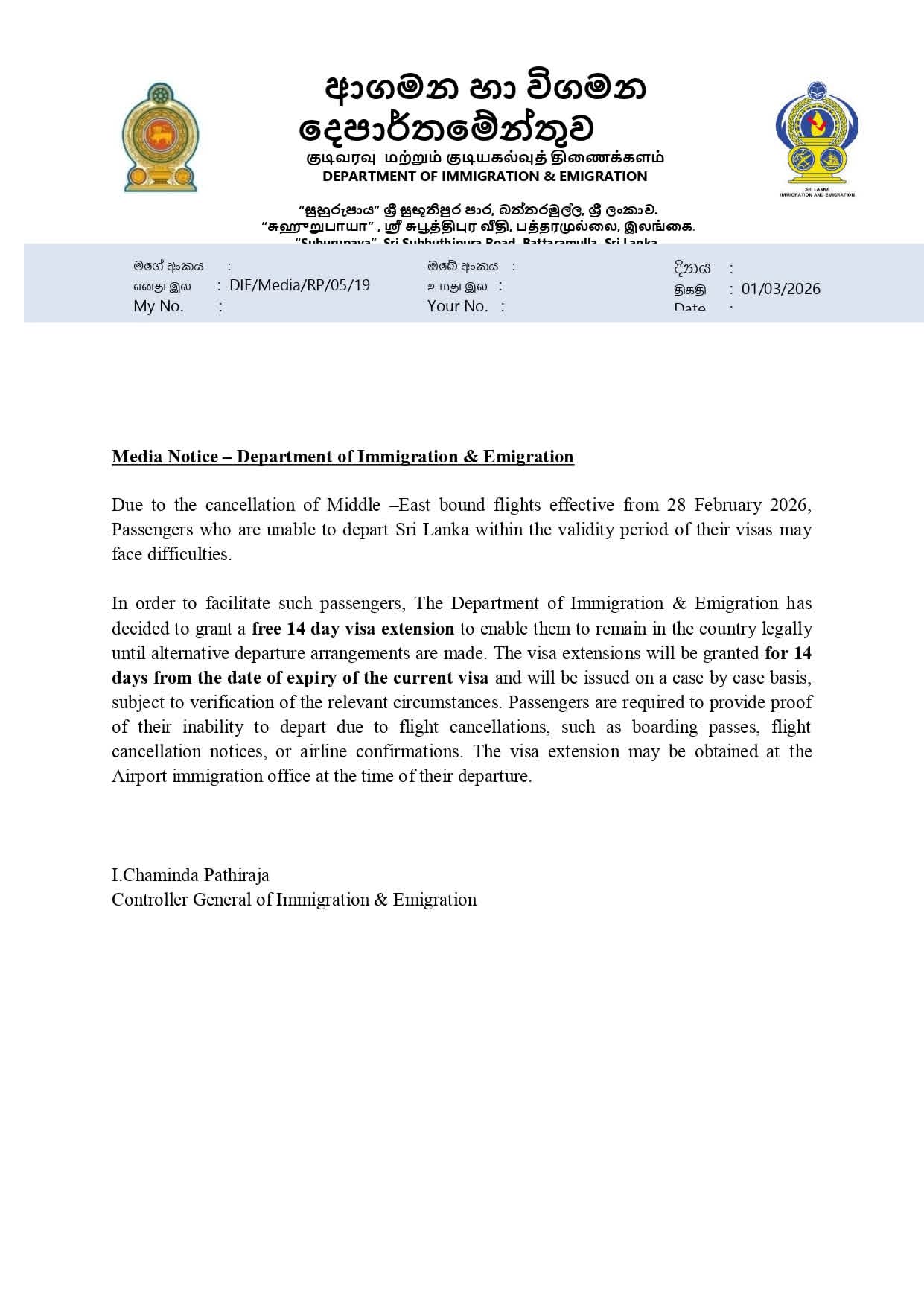
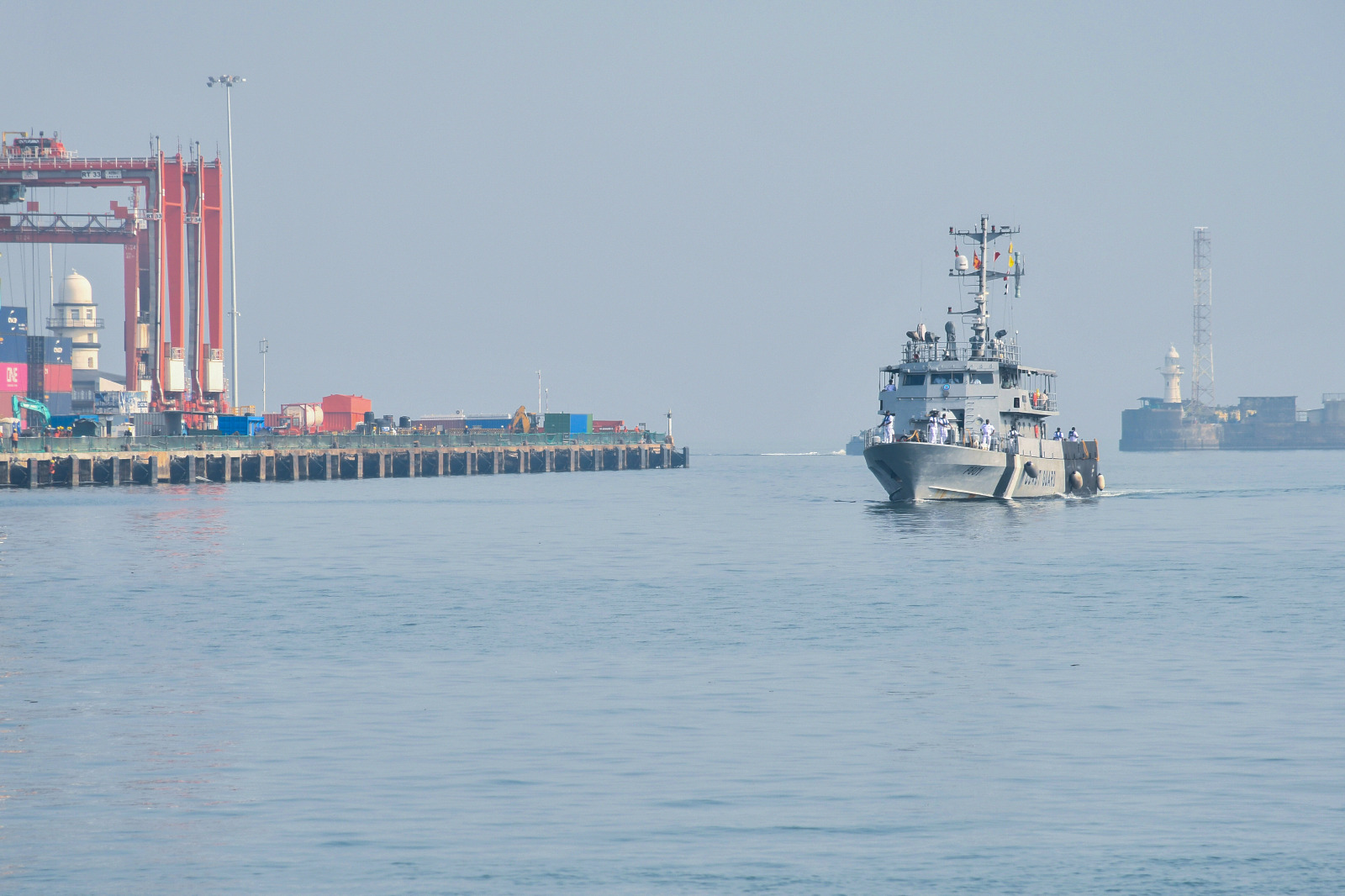
The Maldives Coast Guard Ship Huravee arrived at the Port of Colombo for replenishment purposes on 02 Mar 26. The visiting ship was welcomed by the Sri Lanka Navy (SLN) in compliance with time-honoured naval traditions.
The ship is a 48.9m long Offshore Patrol Vessel which is commanded by Lieutenant Colonel Ahmed Nafiu Mohamed.
Meanwhile, the ship’s crew is scheduled to visit several tourist attractions in the city of Colombo, during their stay in the island.
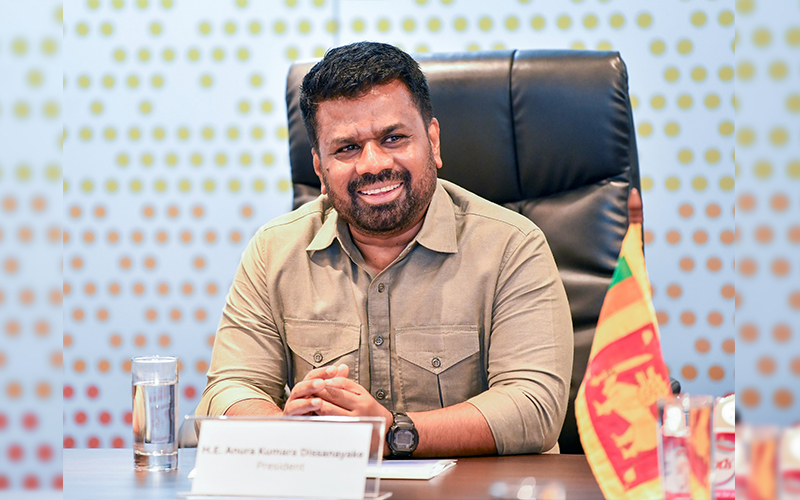
President Anura Kumara Dissanayake yesterday called for an immediate and peaceful resolution of the escalating Middle East conflict, warning that the crisis could have far-reaching repercussions on the global economy, including Sri Lanka.
Addressing Parliament, the President stressed that no military conflict benefited humanity, particularly at a time when destructive military technologies were rapidly advancing.
“Any military conflict does not create a favourable situation for any group of people,” he said, urging all parties to make urgent commitments towards peace. “As Sri Lanka, our position is that all parties involved in this war must, as soon as possible, take steps toward a peaceful world.”
He cautioned that Sri Lanka could not remain insulated from the fallout from the conflict, noting that disruptions to global oil and gas supplies, threats to migrant workers in the Middle East, and potential shocks to tourism, remittances, shipping and aviation were real concerns.
A national programme was being formulated to mitigate the impact, he said, adding that its success would hinge on broader international efforts to restore stability, the President said.
Acknowledging public anxiety shaped by past economic hardships, President Dissanayake said social stability could not be ensured through rhetoric alone but required tangible guarantees that citizens would not face another crisis.
While noting that the government had successfully navigated multiple challenges since assuming office, he described the Middle East situation as distinct due to the uncertainty surrounding its duration and outcome.
The government, he said, was closely monitoring developments. The Central Bank had conducted a review with a report on the likely economic impact expected shortly. The Ministry of Finance is also preparing an assessment of the potential effects on public life, alongside measures to ensure the uninterrupted provision of essential services locally and for Sri Lankans overseas.
“The primary responsibility for finding a path out of the crisis rests with the Government,” he said, calling on Parliament and the public to collectively confront the challenge under a unified national plan.
Providing a detailed account of the country’s energy reserves, the President said storage capacity rather than supply remained the key constraint. Excluding the Indian Oil Corporation tanks in Trincomalee, total storage capacity at Kolonnawa and Muthurajawela stands at approximately 150,000 metric tons.
Diesel stocks were currently sufficient for 33 days, with refining contributing around 1,800 metric tons daily. Petrol reserves will last 27 days, with a 35,000 metric ton shipment due on March 7 or 8 expected to extend availability to around 40 days.
Aviation fuel stocks are adequate for 49 days, supported by both daily refining and imports. Scheduled shipments include vessels from RM Parks on March 14, Sinopec on March 17, IOC on March 21 and the Ceylon Petroleum Corporation on March 28.
Crude oil supplies were sufficient to operate the refinery for 26 days, with an additional shipment expected to extend operations by a further 18 days, the President said.
“Because of this, there is no crisis regarding oil,” the President assured Parliament.

Free 14 day visa extension for visitors unable to depart Sri Lanka

US embassy in Dubai hit; Israel pounds Tehran, Beirut

Perera, Sugandika, Ranaweera take Sri Lanka to T20I series win over West Indies

Maldives Coast Guard Ship Huravee arrives in Colombo

New charges for son of Norway’s crown princess on trial for rape

US sends planes to evacuate nationals from Middle East as Iran conflict spreads

‘Dates have the highest sugar content to fight Coronavirus’

Sunday Island 27 December – Headlines

#SundayIsland 17th December – Headlines

Sunday Island – 28th March

Sunday Island Headlines – 21 March

Sunday Island – 21st February – Headlines
-

 Opinion5 days ago
Jamming and re-setting the world: What is the role of Donald Trump?
-

 Features2 days ago
Brilliant Navy officer no more
-
 Features5 days ago
An innocent bystander or a passive onlooker?
-
 Features6 days ago
Ratmalana Airport: The Truth, The Whole Truth, And Nothing But The Truth
-

 Opinion2 days ago
Sri Lanka – world’s worst facilities for cricket fans
-
 Business6 days ago
IRCSL transforms Sri Lanka’s insurance industry with first-ever Centralized Insurance Data Repository
-

 Business5 days ago
An efficacious strategy to boost exports of Sri Lanka in medium term
-
 Features3 days ago
Overseas visits to drum up foreign assistance for Sri Lanka