
Sports
Athapaththu is new number one


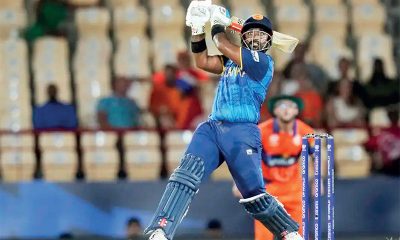
Chamari Athapaththu, who scored an unbeaten 195 in just 139 balls to take Sri Lanka to a remarkable win over South Africa in their final ODI in Potchefstroom last week, has risen to the No. 1 spot in the ICC’s batting rankings for women’s ODIs.
Athapaththu’s knock broke a number of records in women’s cricket, including the highest individual score in a successful ODI chase. It was also the second-highest individual score in a successful ODI chase across women’s and men’s cricket, behind Glenn Maxwell’s 201 not out against Afghanistan at the 2023 World Cup.
Chasing South Africa’s 301 for 5, itself the result of Laura Wolvaardt’s outstanding 147-ball 184 not out – which took her series tally to 335 runs – Sri Lanka got home in just 44.3 overs to square the series. The second-best individual score for Sri Lanka in the chase was Nilakshika Silva’s 50 not out in 71 balls.
Following that effort, Athapaththu achieved her highest-ever rating of 773 on the ICC table, and moved past Nat Sciver-Brunt, who has 764 points. Wolvaardt, who had entered the top five in the last update of the rankings, moved up two more spots, past Beth Mooney and Smriti Mandhana, to third place.
Hayley Matthews, meanwhile, jumped seven spots to reach No. 11 on the same table after scoring 140 not out and 44 in West Indies’ wins over Pakistan in the first two ODIs of their three-match series.
Among bowlers, Sadia Iqbal, the Pakistan left-arm spinner, moved up six places to enter the top 20 after returns of 2 for 38 and 1 for 36 in the two games against West Indies.












by Reemus Fernando
Supun Chathura of Welimada Central and Tharindi Chamalka of Nuwara Eliya High School claimed the boys’ and girls’ titles at the All-Island Schools Games Half Marathon, held in Colombo on Sunday.
Chathura won the boys’ race in a notable 1:14.51. Sameesha Nimsath of St. Pope Paul the Sixth MV, Gampaha, took second in 1:16.40, while Suranga Lal Kumara of Pussadewa Secondary School, Batagolla, clinched third in 1:16.42.
In the girls’ category, Chamalka won in 1:28.56. D.M.S. Nimsarani of CWW Kannangara MMV, Matugama (1:31.09), and W.S.C. Priyadharshani of President’s College, Ambagasdowa (1:33.10), finished second and third respectively.
The 21.0975-kilometre race, sponsored by Nestomalt, started at the Ministry of Education in Battaramulla. It passed through Polduwa Junction, Parliament Road, Ape Gama Junction, Kimbulawala Junction, Thalawathugoda, Hokandara Junction, Arangala Junction, Koswatta and Battaramulla Palanthuna Junction before returning to the starting point.
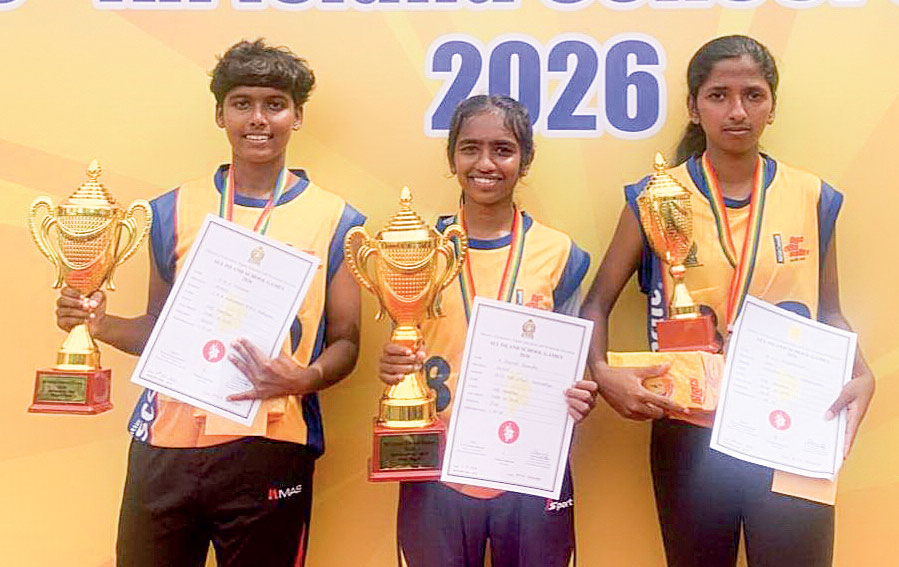
Girls winners (from left)D.M.S. Nimsarani (2nd), Tharindi Chamalka (first) and W.S.C. Priyadharshani
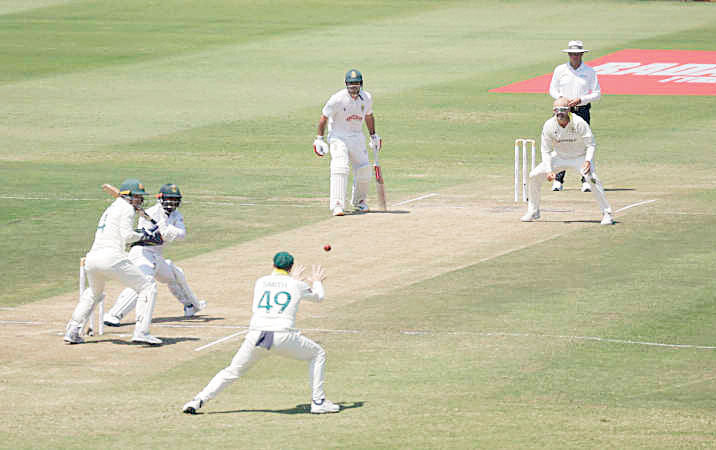
Pat Cummins outfoxed a lacklustre South Africa batting-order on a relatively benign Durban surface, while Steven Smith continued to showcase his mastery in the slips as Australia eyed a big first innings lead in the opening Test.
Outstanding bowling and fielding suffocated South Africa, who appeared set to be bowled out before tea on day three until a rearguard from Keshav Maharaj and Simon Harmer halted Australia’s push.
Cummins has been at his best, consistently challenging the batters as he regularly hit speeds of 140kph and above. He had 3-54 from 15 overs by tea, with all four frontline bowlers having taken wickets.
Smith backed up the bowlers by claiming three sublime catches, which lifted him past Joe Root for the most Test catches by a non-wicketkeeper.
With great anticipation, Smith moved into position to snare skipper Temba Bavuma, who had unfurled a reverse-sweep off Nathan Lyon. Smith then pulled off a stunning catch to dismiss David Bedingham, diving across first slip – it was No. 221 of his Test career.


Maaz Sadaqat crashed 96 off 51,Sahibzada Farhan clobbered 73 off 44, and Pakistan scorched their way through the last 12 overs of their innings to mount a fearsome total of 215 for 3. Pakistan reaped 156 runs just in the last 12 overs of their innings, as a 73-run stand between Sadaqat and Farhan was followed by a manic 72-run partnership between Sadaqat and Hasan Nawaz.
Sri Lanka’s batting was woeful in response. They slumped to 64 for 5 by the 11th over, with none of their top seven managing to get to 30. They limped to 133 for 7, having had their hopes of leveling the series wrecked by quicks Mohammad Imran and Salman Mirza, who took five wickets between them.
Sadaqat propels Pakistan into the stratosphere
The openers had laid a decent platform with Pakistan having got to 55 for 1 by the end of the seventh over. But it was Sadaqat who injected the energy that truly set Pakistan on course to their mammoth total. Having gone at less than a run a ball in his first eight balls, Sadaqat unleashed a spectacular lofted square drive off Eshan Malinga to collect his first six, before pumping the same bowler down the ground later in the 10th over.
Sadaqat would go on to clobber six further sixes and five further fours. The big hits tended to come down the ground, while his fours were more square of the wicket. Of the 125 runs Pakistan plundered in the second half of their innings, 79 off 40 came from Sadaqat, who pummeled both pace and spin with equal relish. Off the sixteenth over, bowled by Maheesh Theekshana, Sadaqat thumped three sixes in the arc between long on and midwicket.
Sadaqat, whose previous top score in three T20Is had been 50, could have gone to triple figures off the last ball of the innings, but holed out to deep cover instead, unable to quite find the power to lift a Malinga slower ball over the ropes. He had utterly dominated the middle and late overs, however.
Farhan sets the tone
On another flat Rawalpindi deck, Farhan made the first big charge, although he waited until spin came on to really get into high gear. Theekshana was one of his main victims as well. Farhan’s first six came from a slog sweep off Theekshana in the seventh over, before he launched the same bowler over wide long on and cow corner off successive balls in the ninth over. Getting to his 12th T20I fifty off the 31st ball he faced, Farhan began to aim big blows off the seamers as well. He was caught at deep third off the bowling of Dasun Shanaka, in the 15th over.
Sri Lanka stumble in the powerplay
An excellent Salman Mirza bouncer took the glove of Lahiru Udara in the first over, ending the innings of one of Sri Lanka’s few form batters for a mere five runs. And although Sineth Jayawardena – playing his first international in a full-strength Sri Lanka side – hit three consecutive boundaries in the third over, Sri Lanka were unable to build up any momentum in the powerplay. By the end of the sixth over, they had laboured to 35 for 2.
Imran’s spell lights up the middle overs
A full house in Rawalpindi was treated to some excellent fast bowling by Imran, who finished with the game’s best figures of 3 for 11 from his four overs. Having got Jayawardena to top-edge a desperate pull shot at the end of his second over, Imran had Kusal Mendis caught behind off a slower delivery, before two balls later (a wide in between), he took Sahan Arachchige’s edge with a quick delivery angled across the left-hander. Wicketkeeper Khawaja Nafay made two diving grabs to convert these chances in the eighth over.
All through his unbroken spell, Sri Lanka’s batter struggled to so much as hit Imran off the square, despite the good batting conditions on offer. Imran mixed up his pace, frequently going to slower balls, but his line and length control were also excellent through the spell. When he finished his unbroken spell at the end of the 10th over, Sri Lanka’s required rate had climbed past 15.
Chamindu Wickramasinghe and Theekshana struck some late boundaries, but by the time they came to the crease, Sri Lanka did not have a realistic shot at levelling this series. They lost by 82 runs in the end.
Scores:
Pakistan 215 for 3 in 20 overs (Sahibzada Farhan 73, Fakhar Zaman 22, Maaz Sadaqat 96, Hasan Nawaz 19*; Maheesh Theekshana 1-55, Eshan Malinga 1-41,Dasun Shanaka 1-30) beat Sri Lanka 133 for 7 (Sineth Jayawardena 22, Kamnbdu Mendis 23, Chamindu Wickremasinghe 29, Maheesh Theekshana 32*; Salman Mirza 2=28, Mohammad Imran 3-11, Saim Ayub 1-19, Shadab Khan 1-19) by 82 runs
[Cricinfo]

Showers above 75 mm are likely at some places in the Western, Sabaragamuwa, Central, Southern, Uva and North-Western provinces and in Anuradhapura and Mannar districts.

New prison regulations for monks serving jail terms soon: President’s Office

CP alleges NPP has taken the blame for illegal US sanctions on Iranian vessels

Ex-Tiger witness claims Ekneligoda proposed to fire missile at MR’s plane

Chandrasekaran welcomes Indian stand of Katchatheevu

Alleged killer of couple apprehended

‘Dates have the highest sugar content to fight Coronavirus’

Sunday Island 27 December – Headlines

#SundayIsland 17th December – Headlines

Sunday Island – 28th March

Sunday Island Headlines – 21 March

Sunday Island – 21st February – Headlines
-

 Features4 days ago
The Sri Lankan who made Scottish history
-

 Features6 days ago
Preventing grievances from becoming communal
-

 Sports4 days ago
Nissanka absence opens door for Sri Lanka’s young guns
-

 News5 days ago
Gnansara Thera to be assigned to prison printing section: Officials
-

 News3 days ago
NDB fraud Rs 60mn more than reported
-

 News3 days ago
Removing monk’s robes matter for Sangha to decide: Mahanayake Theras
-

 Features4 days ago
Future of Sri Lanka’s state university system: Should it be shut down and reopened?
-

 News5 days ago
OIC of FCID summoned before Maligakanda Magistrate