
Business
ASPI hits record 20,000 points but profit-takings emerge latterly


CSE recorded a positive market trend for the 11th consecutive day yesterday and the All Share Price Index topped 20,000 points, rising 99 points in early trading. Subsequently heavy profit- takings were noted which pushed the market to a negative mood, market analysts said.
Turnover stood at Rs 4.52 billion with 11 crossings. Those crossings were reported in JKH, whose share price traded at Rs 24.70, CT Lands one million shares crossed to the tune of Rs 33 million; its shares traded at Rs 33, Ceylon Cold Stores 200,000 shares crossed for Rs 22.4 million; its shares traded at Rs 112, Royal Ceramic 500,000 shares crossed for Rs 22 million; its shares traded at Rs 44, Commercial Bank 120,000 shares crossed for Rs 21 million; its shares traded at Rs 174.75 and HNB 55000 shares crossed for Rs 20.6 million; its shares fetched Rs 374.
In the retail market companies that mainly contributed to the turnover were; DFCC Rs 258 million (1.6 million shares traded), Pan Asian Bank Rs 254 million (4.4 million shares traded), JKH Rs 238 million (9.8 million shares traded), HNB Rs 216 million (579,000 shares traded), Royal Ceramic Rs 202 million (4.61 million shares traded), Sampath Bank Rs 146 million (one million shares traded) and NDB Rs 134 million (943,000 shares traded). During the day 157.5 million share volumes changed hands in 39707 transactions.
It is said that manufacturing sector led the market, especially JKH, while the banking and financial sector became the second largest contributor to the market, especially DFCC and HNB.
Yesterday, the rupee opened at Rs 301.10/22 to the US dollar in the spot market, relatively flat from Rs 301.20/30 the previous day, while bond yields held broadly steady, dealers said. The telegraphic transfer rates were: euro buying Rs 342.332 selling Rs 353.5380, British pound buying Rs 394.27 selling Rs 405.6214, American dollar buying Rs 297.7500 selling Rs 304.75.
A bond maturing on 15.10.2028 was quoted at 8.85/90 percent, up from 8.75/85 percent. A bond maturing on 15.12.2029 was quoted at 9.40/43 percent, up from 9.35/40 percent. A bond maturing on 15.03.2031 was quoted at 9.85/95 percent. A bond maturing on 15.12.2032 was quoted at 10.25/30 percent, from 10.23/26 percent.
By Hiran H.Senewiratne

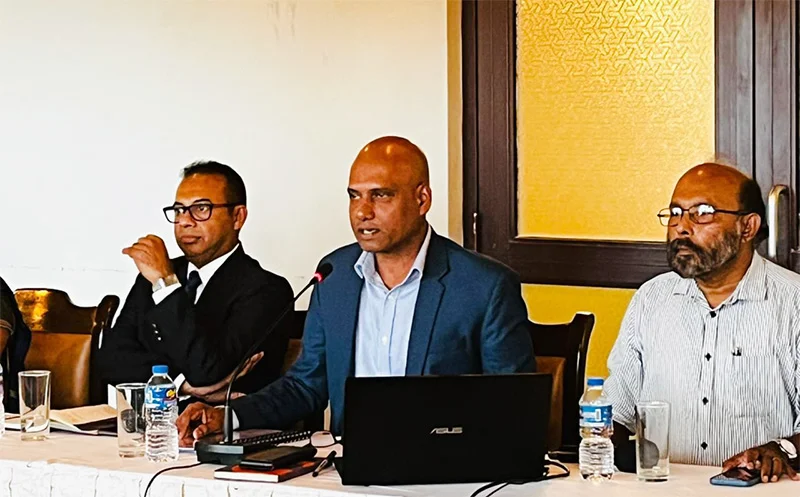
Specialised training programme set to begin
The Sri Lanka Institute of Tourism & Hotel Management (SLITHM) has launched a new initiative that could quietly reshape the country’s tourism industry – the National Tourist Interpreter Training Programme.
The idea, explained by SLITHM Chairman Dheera Hettiarachchi, is simple but important. Sri Lanka does not need to rely only on bigger tourist numbers or louder promotion. It needs to help visitors understand the country better.
“This is where the concept of a tourist interpreter comes in”, he said.
“Unlike traditional tour guides, who mainly explain and show places, interpreters are trained to go deeper. They connect the story behind what visitors see; linking history, culture, environment and local life. In a country like Sri Lanka, where ancient heritage, rich biodiversity and living communities are closely connected, this approach can make a real difference,” Hettiarachchi explained.
The programme itself will run for three months and focus more on field visits and practical learning rather than classroom teaching. It is open to academics and professionals with knowledge in areas such as history, culture, environment and research. Those who complete the course will receive a National Tourist Interpreter Licence from the Sri Lanka Tourism Development Authority, along with a digital badge.
With a course fee of around Rs. 250,000, this is not meant for mass entry. The target is a smaller, more specialised group. These interpreters are expected to work with destination management companies, serving high-end travellers who are looking for meaningful and informed experiences, not just sightseeing.
Speaking further, the SLITHM chairman said: “Globally, this trend is already visible; visitors increasingly expect detailed explanations about nature, conservation and local communities in the destinations they visit. They want to know not just what they are seeing, but why it matters. Sri Lanka has the natural and cultural depth to offer this kind of experience. What has been missing is the structured way of delivering that knowledge. That is where this initiative fits in.”
According to SLITHM, there is also a wider benefit. Visitors who understand a place tend to respect it more. This can reduce damage to sensitive sites and support conservation efforts, creating a better balance between tourism and the environment.
In this context, a new group of trained interpreters could gradually change how Sri Lanka is presented to the outside world. Instead of quick impressions shaped by social media, these interpreters can offer informed, thoughtful accounts of the country, combining knowledge with storytelling.
For a destination long promoted mainly for its beaches and scenery, this shift towards deeper storytelling may be both timely and necessary.
By Sanath Nanayakkare

A quiet but persistent strain is being felt by Sri Lanka’s savers, particularly retirees and fixed-income households who depend on bank interest to meet daily expenses such as groceries, medicine and utility bills. As deposit rates remain subdued, this segment continues to absorb the impact of a changing monetary environment with little visibility, even as broader conditions begin to ease for borrowers.
The latest economic indicators show that this pressure on savers is unfolding alongside a gradual shift towards lower lending rates and improved liquidity in the banking system.
At the centre of the transition is the Average Weighted Prime Lending Rate (AWPR), which declined to 9.63% in the week ending April 24, 2026, easing by 16 basis points from the previous week. This signals that borrowing costs are beginning to edge down, offering some relief to businesses and individuals reliant on credit.
In practical terms, housing loans, business overdrafts and working capital facilities could become marginally cheaper in the period ahead. However, as banks tend to adjust lending rates cautiously, the full benefit may take time to reach small businesses and ordinary consumers.
In contrast to the relief expected for borrowers, savers are likely to remain under pressure. Deposit rates have not shown a corresponding upward movement, meaning that interest income, a crucial lifeline for many households remains constrained in real terms, especially against the backdrop of rising living costs.
Monetary developments during the week also reflect a careful balancing act by policymakers. Reserve money declined, largely due to a reduction in currency in circulation, which stood at around Rs. 1.79 trillion by April 24. This suggests tighter control over physical cash in the system, possibly aimed at maintaining price stability and managing inflation expectations.
Yet, within the banking system itself, liquidity conditions have eased significantly. Total outstanding market liquidity rose sharply to a surplus of Rs. 199.17 billion, nearly doubling from the previous week. This increase indicates that banks have plenty of cash, which typically encourages lending and places downward pressure on interest rates.
For the public, the implications are mixed and unevenly distributed. Borrowers stand to gain gradually from lower interest rates, and businesses may find credit more accessible as liquidity improves. Consumers could also benefit from increased competition among banks to lend.
But for savers – a significant yet often overlooked segment – the story is different. With deposit returns remaining relatively low, their purchasing power continues to be tested, underscoring a growing divide in how monetary policy outcomes are experienced across society.
By Sanath Nanayakkare
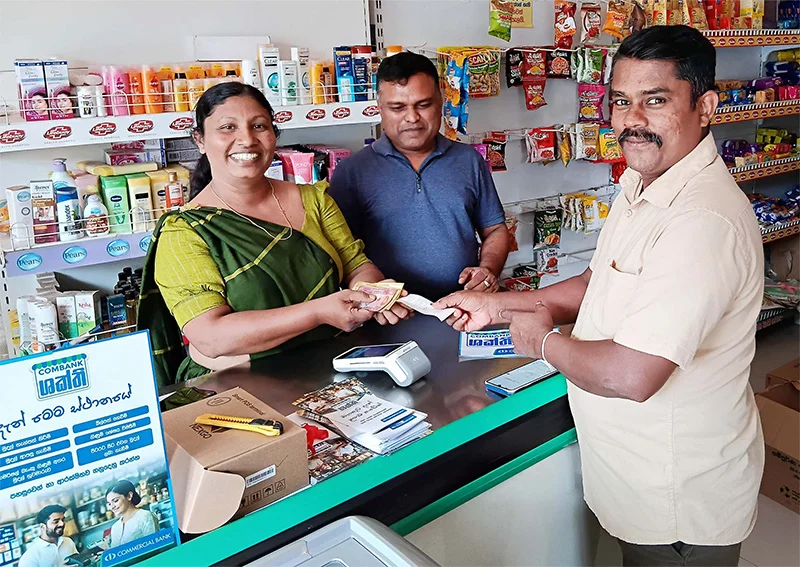
Commercial Bank of Ceylon has expanded its ‘ComBank Shakthi’ Agency Banking network to 26 strategic locations nationwide, adding 22 new outlets to the four pilot sites launched earlier.
The initiative partners with trusted local businesses or individuals who act as bank intermediaries, equipped with specialised POS devices running proprietary software for secure, real-time transactions. Customers can perform cash deposits, withdrawals, fund transfers, balance inquiries, and bill payments closer to home—reducing travel time and cost.
The expansion strengthens financial inclusion for underserved and unbanked communities, particularly in rural areas, and integrates closely with the Bank’s Agriculture and Micro Finance Units (AMFU), leveraging existing community trust. Agency outlets now complement Commercial Bank’s 272 traditional branches, bringing total physical access points to 298.
New locations include Katupotha, Oddusudan, Baduraliya, Vankalai, Akkaraipattu, and Lahugala, among others. The four pilot outlets remain at Tissamaharama, Hambantota, Siyambalanduwa, and Buttala.

Police officers donate LKR 9,687,462 from day’s salary to ‘Rebuilding Sri Lanka’ Fund

Iran’s top diplomat in Russia as Tehran intensifies efforts to end the war

Rinku, Narine win Kolkata Knight Riders error-strewn Super Over game

Rabada and Sudharsan crush Chennai Super Kings

Showers or thundershowers will occur at several places in most parts of the island after 1.00 pm

Heat Index at Caution Level in the Northern, North-central, North-western, Western, Sabaragamuwa, Southern, and Eastern provinces and in Monaragala district during the day time

‘Dates have the highest sugar content to fight Coronavirus’

Sunday Island 27 December – Headlines

#SundayIsland 17th December – Headlines

Sunday Island – 28th March

Sunday Island Headlines – 21 March

Sunday Island – 21st February – Headlines
-
 News7 days ago
Rs 13 bn NDB fraud: Int’l forensic audit ordered
-

 News5 days ago
Lanka faces crisis of conscience over fate of animals: Call for compassion, law reform, and ethical responsibility
-
 News4 days ago
Whistleblowers ask Treasury Chief to resign over theft of USD 2.5 mn
-

 News4 days ago
No cyber hack: Fintech expert exposes shocking legacy flaws that led to $2.5 million theft
-

 News16 hours ago
BIA drug bust: 25 monks including three masterminds arrested
-

 News5 days ago
USD 2 mn bribe: CID ordered to arrest Shasheendra R, warrant issued against ex-SriLankan CEO’s wife
-

 Business2 days ago
Nestlé Lanka Announces Change in Leadership
-

 News2 days ago
Hackers steal $3.2 Mn from Finance Ministry