
Sports
Asian Games medals cap remarkable year in track and field sports

by Reemus Fernando
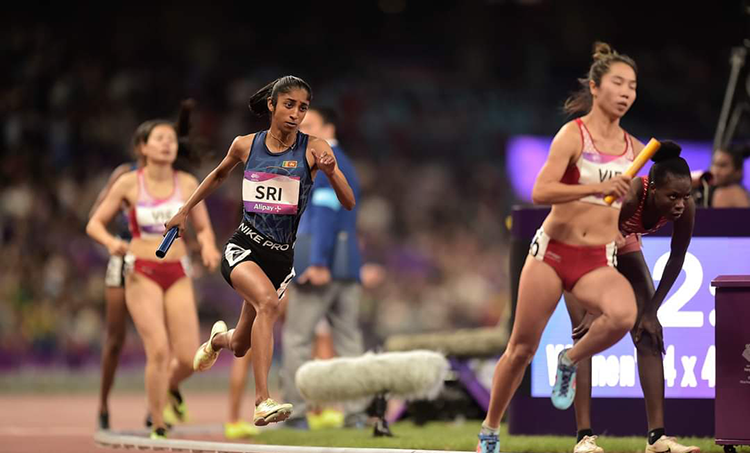
Ending a decades long medal drought at the Asian Games was the most remarkable accomplishment by the track and field athletes during 2023. From schoolgirl Tharushi Karunaratne’s triumphant entry into track and field folklore to the men’s 4×400 metres team’s record-breaking feat at the Asian Athletics Championships breathed life into otherwise forgotten disciplines in the country’s sporting landscape.
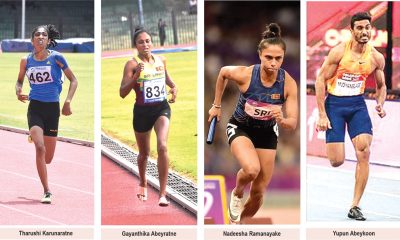
The Ratnayake Central Walala prodigy had already showcased her potentials when she brushed shoulders against the likes of Gayanthika Abeyratne in the 800 metres and Nadeesha Ramanayake in the 400 metres during the previous year. The season opening trial in March was where Karunaratne exhibited her prowess first this year, winning the 800 metres in an Asia leading time of 2:01.39 seconds at Diyagama. It was followed by an impressive 53.41 seconds triumph in the 400 metres.
At the Asian Junior Championships, she bagged three medals including two golds. She was some five seconds clear of the silver medal winner when she sealed the gold in the 800 metres in a 2:05.64 seconds feat at the Yecheon Stadium in Yecheon, South Korea. Then she clinched the silver in the 400 metres while Jayeshi Uththara bagged the bronze. The 4×400 metres mixed relay gold was won in a new national record time when she joined Uththara, Vinod Ariyawansa and Shehan Dilranga. The other medal, a bronze was won by Kahawatta Central athlete Malith Yasiru who cleared 15.82 metres in the triple jump.
The Asian Athletics Championship held in Thailand was a remarkable success as Sri Lanka won eight medals including three golds. Sri Lanka men’s 4×400 metres team inclusive of Aruna Dharshana, Kalinga Kumarage, Pabasara Niku and Rajitha Rajakaruna smashed the meet record to win gold in a time of 3:01.56 seconds. They beat formidable India to the second place and shocked relay enthusiasts earning applauds from even rivals in a World Championship year.
They could not repeat the same feat at the Asian Games and the World Championships but the future looks bright for the relay team as three out of the four medallists are still in their early 20s. The other two gold medals were won by Karunaratne and Nadeesha Ramanayake. Karunaratne won the 800 metres gold in a new championship record time of 2:00.66 seconds, which Ramanayake stopped the clock in the 400 metres in a new personal best of 52.61 seconds. Veteran Gayanthika Abeyratne won bronze medals in the 800 metres and the 1,500 metres.
When Sri Lanka entered the Asian Games this year the country had endured a medal drought in track and field since 2006. Tharushi Karunaratne, the men’s 4×400 metres team, the women’s 4×400 metres team and Dilhani Lekamge combined to win four medals for Sri Lanka. While Karunaratne beat a strong field to win the 800 metres gold, the men’s 4×400 metres team settled for bronze behind India and Qatar. Lekamge threw the javelin to a new national record distance of 61.57 metres to clinch the silver medal. The women’s 4×400 metres team inclusive of Karunaratne, Ramanayake, Uththara and Lakshima Mendis settled for bronze behind Bahrain and India.
While victories at Asian Level were the top performances of the track and field team, triple jumper Shreshan Dhananjaya decamping during a competition in Europe and steeplechaser Nilani Ratnayake’s suspension due to a doping violation were the real low points of an otherwise remarkable year.
The country could not have the services of two leading athletes at Asian level this year. While Italy based sprinter Yupun Abeykoon who had produced a phenomenal sub ten seconds performance in the 100 metres had to withdraw from the team due to an injury, US based high jumper Ushan Thivanka did not make himself available due to reasons best known to him.
With their probable return Sri Lanka can only look forward to better performances during the Olympic year.












Former captain Marvan Atapattu has warned Sri Lanka that muddled planning and last-minute tinkering will continue to leave them stumped on the world stage after another sobering exit from the T20 World Cup.
The former champions crashed out of the Super Eight stage with a game to spare following three straight defeats, their meek loss to New Zealand on Wednesday a bitter pill to swallow in front of a packed house. Sri Lanka were second best from the toss to the post-mortem, barely laying a glove on the Kiwis.
“Our planning has to be better than this,” Atapattu told Telecom Asia Sport, pulling no punches. “You pick your players two years before a World Cup and help them evolve. You keep backing them once you have identified talent. That is how you go into a World Cup. Here, two months before the tournament, we aren’t sure who is going to be our captain.”
Atapattu said chopping and changing on the eve of a global event was a recipe for disaster.
“Your core players need to remain the same set of guys whom you have backed. There can be injuries and loss of form and you deal with them accordingly, but wholesale change is an indication that there’s no planning,” he added.
He also flagged concerns over the granting of No Objection Certificates for franchise leagues, warning that Sri Lanka risked burning the candle at both ends.
“You have to protect your centrally contracted players. There’s no point if your key player is injured for a World Cup,” Atapattu said.
Sri Lanka were forced into late reshuffles after calling up replacements for three players, most notably missing leg-spinner Wanindu Hasaranga, who pulled out after the opening game with a hamstring strain. His absence left a gaping hole in the middle overs.
Atapattu was equally critical of the kind of surfaces Sri Lanka have dished out at home, arguing low, slow turners offer a false sense of security.
“Play on good pitches. Then your bowlers, in particular, learn the art of containing free-flowing batters,” he remarked. “If you only play on surfaces that suit you, you are not preparing for global events.”
Pointing to England’s meticulous build-up, Atapattu said smart preparation separated contenders from also-rans.
“Look at England. Before the World Cup, they came to Sri Lanka and spent two weeks here. That is smart work,” he said. “We often play teams like Bangladesh, Afghanistan and Zimbabwe and when we beat them, we think our cricket is in good shape. But when we play the big boys, we are found out.”

96th Battle of the Maroons
There was a time when both Ananda and Nalanda arrived at their annual Big Match with individuals who had amassed over a thousand runs and captured more than fifty wickets in a single season — feats that underlined their dominance and added glitter to the occasion.
This year, however, neither side carries such towering personal milestones into the 96th Battle of the Maroons, which commences today at the SSC Grounds. With both teams playing comparatively fewer fixtures than in previous seasons, opportunities for players to build monumental statistics were limited. As a result, the souvenir numbers may not fully reflect the true potential within each camp.
Yet Big Matches are rarely decided on paper. Form books and statistics often fade into the background when tradition, pride and history take centre stage. Despite a season short on overwhelming positives, both Ananda and Nalanda possess enough match-winners to turn this three-day encounter into a compelling contest.
Ananda will look to their captain Kithma Widanapathirana to lead from the front. The stylish all-rounder has scored over 300 runs, including a century, while maintaining a strike rate of 100. More significantly, his off-spin has made him the side’s leading wicket-taker with over 30 scalps, making him a genuine dual threat.

Nalanda College Team (Front row from left) Nuwan Soyza (Head Coach), Kapila Nanda Kumara (Master in Charge), Viraj de Silva (PoG), Anupa Weerararthe (Deputy Principal), Osanda Hettiarachchi (Captain), Iran Champika Silva (Principal), Nadul Jayalath (Vice Captain), Charitha Kushan (Vice Principal), Deepthi Kulathunga (Asst. Principal), Monishan Chathuranga (Asst. MiC), Nimanth Pieris (Asst. Coach). Back row from left), Thiviru Ranasinghe, Sahas Godage, Ranmith Senarath, Methuka Perera, Hasith Rathnayaka, Santhul Wijerathna, Omith Rathnayaka, Lithum Wijekumara, Malsha Fernando, Dunitha Anusara, Nemindu Akmeemana, Mihin Soyza, Dunal Sendanayaka, Gayuka Herath, Gevindu Manamperi, Sadew Wijesekara.
Lithma Perera has also crossed the 300-run mark with a century to his name and will be expected to anchor the innings. Himira Kudagama, another key performer with over 250 runs this season, spearheads the pace attack and provides balance to the side. Meanwhile, left-arm spinner Sharada Jayaratne appears to be peaking at the right time. His six-wicket haul against Richmond lifted his season tally to 24 wickets and signalled his readiness for the big stage.
Nalanda, too, have their share of dependable performers. Captain Osanda Hettiarachchi, along with Ranmith Dinuwara, Mihin Zoysa, Nadul Jayalath and Gevindu Manamperi, have been among the runs in recent outings, giving the batting unit much-needed stability. In the bowling department, Hasith Rathnayake, Dunitha Anusara, Malsha Fernando and Sahash Godage have delivered impactful spells and will shoulder the responsibility of containing Ananda’s batting.
However, Nalanda will be eager to put behind them some unwanted records from the season. They conceded the highest team total among top Division sides when Mahinda piled up 507 for seven declared — a performance that exposed vulnerabilities in their bowling attack. With three days of intense Big Match cricket ahead, Nalanda’s bowlers will be determined to avoid a repeat of such circumstances.
While the absence of extraordinary individual milestones may be evident this year, the essence of the Battle of the Maroons remains unchanged. Tradition, pride and the unpredictability of schoolboy cricket promise a fiercely fought encounter where new heroes can emerge and lasting memories can be created.
(RF)

Sri Lanka’s T20 World Cup campaign went up in smoke on home soil, three defeats on the trot snuffing out semi-final hopes and leaving supporters seeing red. In conditions tailor-made for them, the hosts got their sums horribly wrong against New Zealand and England, with the Kiwis hammering the final nail, a 61-run drubbing on Wednesday.
The script at Colombo’s RPS is no closely guarded secret: win the toss, bat first, stack the runs and unleash the spinners as the pitch frays. Yet, Dasun Shanaka chose to defy history. Chasing on a wearing surface was always going to be like batting on a minefield. He later admitted it was the wrong call, but at this level, mea culpas are cold comfort.
At 86 for six, New Zealand were on the ropes, barely able to pick Maheesh Theekshana’s variations. It was the moment to twist the knife. Instead, Shanaka held back his trump card. The gamble misfired spectacularly. Theekshana’s first three overs cost just nine; his last disappeared for 21 as 70 runs leaked in the final four overs.
RPS traditionally slows and turns as the night wears on. That script, too, stayed true. Part-timer Rachin Ravindra cashed in with career-best figures, exposing Sri Lanka’s brittle middle order once more.
Shanaka’s own returns hardly strengthen his case. He neither nails down his place with the bat nor can be trusted to deliver four probing overs. Tactically, he has often been found wanting. Handing him the captaincy on the eve of a World Cup was like handing the Central Bank to Ajith Nivad Cabraal.
You do not reshuffle captains, selectors and coaching staff on the brink of a global event. Such surgery is best performed after the post-mortem, not before the operation. Sri Lanka flirted with danger and paid the price. The sight of 35,000 faithfuls booing their own in Colombo was a bitter pill, the long walk home feeling like a nightmare that refused to end.
It is now more than a decade since Sri Lanka reached the semi-finals of an ICC event. With preparation as patchy as this, that barren run threatens to stretch further.
Shanaka and chief selector Pramodya Wickramasinghe have occupied the hot seats before. Previous stints yielded little but turbulence; this chapter has brought fresh embarrassment. One thing they have rarely lacked is a conspiracy theory after a poor show. Shanaka has already aired his lines. The cricketing public now waits to hear the next instalment from Pramodya.
by Rex Clementine

CEB engineers raise alarm over power sector stability

CB identifies 24 pyramid scams in Sri Lanka

Church urges patience, warns against interference with Easter attacks probe

GMOA ups the ante, pulls out of ‘Arogya Clinics’

CEB unions give govt. 24-hour ultimatum

Confusion over this year’s Nekath Seettuwa

‘Dates have the highest sugar content to fight Coronavirus’

Sunday Island 27 December – Headlines

#SundayIsland 17th December – Headlines

Sunday Island – 28th March

Sunday Island Headlines – 21 March

Sunday Island – 21st February – Headlines
-

 Features5 days ago
Why does the state threaten Its people with yet another anti-terror law?
-
 Features5 days ago
Reconciliation, Mood of the Nation and the NPP Government
-

 Features5 days ago
Victor Melder turns 90: Railwayman and bibliophile extraordinary
-

 Features4 days ago
LOVEABLE BUT LETHAL: When four-legged stars remind us of a silent killer
-
 Features5 days ago
Victor, the Friend of the Foreign Press
-
 Latest News6 days ago
New Zealand meet familiar opponents Pakistan at spin-friendly Premadasa
-

 Latest News6 days ago
ECB push back at Pakistan ‘shadow-ban’ reports ahead of Hundred auction
-

 Latest News6 days ago
Tariffs ruling is major blow to Trump’s second-term agenda