
News
Arshdeep and Prabhsimran star as Punjab Kings hammer Mumbai Indians

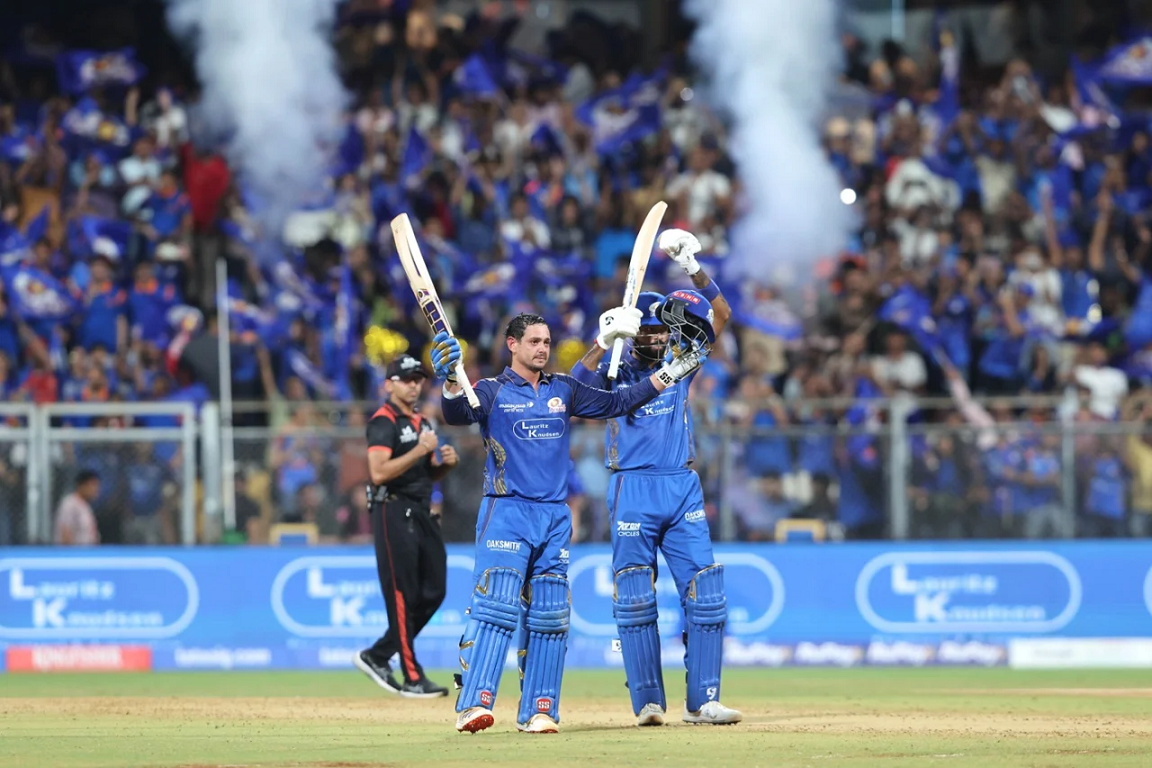
Quinton de Kock’s hundred on his comeback to the Mumbai Indians XI was overshadowed by Prabhsimran Singh and Shreyas Iyer’s demolition of the chase of 196 with 21 balls to spare to keep Punjab Kings unbeaten five games into the season. Arshdeep Singh swung the new ball, reversed the old one, and bowled a quiet over in the middle to lead PBKS’ strangle job on MI, who suffered their fourth successive defeat.
An injury to Rohit Sharma opened the door for de Kock to play his first match of this season and become only the third batter to score a century for three different IPL teams. He scored 112 off 60 balls, Naman Dhir was promoted to No. 4 and scored 50 off 31, but the rest of the MI innings never got going.
Allah Ghazanfar briefly threatened to scupper a typically boisterous PBKS chase with two wickets in the powerplay, but Prabhsimran and Iyer never let MI back in. Like Dhir and de Kock before him, Prabhsimran enjoyed a reprieve on 11, and finished unbeaten 80 off 39 to take his sensational IPL 2026 tally to 211 runs in 122 balls. It was the first time he stayed unbeaten in a successful chase in the IPL.
Iyer scored an equally important 66 off 35, his third consecutive half-century, starting with a four first ball when MI had taken two quick wickets.
Arshdeep came into the match with two wickets and an economy rate of 10.6 in four games this season. Two left-hand openers were the ideal setting for him to improve his performance. The new ball swung in the air and moved off the surface, and Arshdeep kept taking it away from Ryan Rickelton. He beat the bat three times in the first over. In his second, he bowled a wobble-seam ball that ended up on the pads, but Rickelton found deep square leg to perfection.
Arshdeep backed Suryakumar Yadav to walk out expecting movement from left to right, but he angled the seam away, drew a thick edge and doubled his season’s wickets tally in two balls, and also went past 100 IPL wickets.
Even before those two wickets, de Kock signalled dangerous intent with a silken, aerial extra-cover drive first ball off fellow South African Marco Jansen. In Jansen’s next over, Yuzvendra Chahal lost the ball in the lights and missed a sitter from Naman Dhir. In the last over of the powerplay, de Kock gave up on making his ground but Iyer missed the stumps from mid-off.
That drop wasn’t the last error Chahal made. He started his spell by searching and frequently over-pitching and ended up conceding five sixes in his three overs for 45. Dhir hit two of those, the one over extra cover the highlight of his innings.
By the time de Kock got to fifty, MI looked set for a total in excess of 200. From 97 for 2 in 10 overs, de Kock went up a gear even as Dhir caught up with him. At 125 for 2 in 12 overs, PBKS were looking at a challenging target.
The comeback for PBKS began with Jansen conceding just seven in the 13th over, but like in the game against Sunrisers Hyderabad, the lack of pace from Shashank Singh once again produced a game-changing wicket. In his 31-ball 50, Dhir evoked a lot of Hardik Pandya with a compact bat swing and shots that looked quite like the MI captain’s. Pandya himself, though, hardly got anything out of the middle of the bat. He eventually fell for 14 off 12 to what could well end up as the catch of the tournament.
Iyer didn’t even get his name on the scoreboard for this effort at long on: he went full length as he leaped to rein the ball in, caught it in his left hand while airborne, transferred it to his right even as he came down over the boundary, and managed to throw it to Xavier Bartlett before he touched ground.
With the ball reversing, Jansen and Arshdeep bowled excellent yorkers, going for eight and nine in overs 18 and 19. Sherfane Rutherford got four tailing pinpoint yorkers during his five-ball stay for one run. Only 70 came in the last eight, prompting Dhir to say during the innings break that MI were 20 runs short.
The way Priyansh Arya and Prabhsimran tucked into some buffet bowling from Deepak Chahar, it looked like 195 was not 20 short but 40. However, led by Jasprit Bumrah who bowled four straight dots to Arya, Ghazanfar ended up with two wickets in the powerplay: Arya caught at midwicket and Cooper Connolly caught behind.
There was a time when MI had strung together 10 balls for one run and a wicket across the second and third overs of the chase. Prabhsimran cut the 11th for a regulation catch to backward point but Bumrah, wicketless in six straight IPL matches now, dropped it.
When Connolly fell, MI were still hopeful of a comeback. Iyer, though, brought a sense of calm, playing Ghazanfar’s mystery spin like you would offspin. He cover-drove the first ball he faced for four, and PBKS never looked back.
Prabhsimran faced just six balls in the first five overs, which means he did most of the damage with the field spread out. It started when Chahar came back to bowl the eighth over. Prabhsimran charged at him to hit a 90-metre six over wide long-off before tucking one off the hip for four.
Now Prabhsimran began to dominate the strike and the scoring, bringing up his fifty with successive fours off Shardul Thakur in just 23 balls.
Bumrah might be wicketless but his bowling has been good through the season. However, when Iyer pulled him for a disdainful six in the 13th over, it was all over for MI. If there were any doubts remaining with 50 needed off the last seven overs, Prabhsimran dispelled them with a four and a six off Pandya. The end was swift and brutal with even Bumrah finishing with 0 for 41 in his four overs.
Brief scores:
Punjab Kings 198 for 3 in 16.3 overs (Priyansh Arya 15, Prabhsimran 80*, Cooper Connolly 17, Shreyas Iyer 66, Marcus Stoinis 10*; AM Ghazanfar 2-31, Shardul Thakur 1-42 ) beat Mumbai Indians 195 for 6 in 20 overs (Quinton De Kock 112*, Naman Dhir 50, Hardik Pandya 14; Arshdeep Singh 3-22, Marco Jansen 1-30, Shahshank Singh 1-19) by seven wickets
[Cricinfo]

Latest News
Let us dispel the roots of greed, hatred, and delusion, and transform our lives into a nobel period that brings peace and serenity – PM
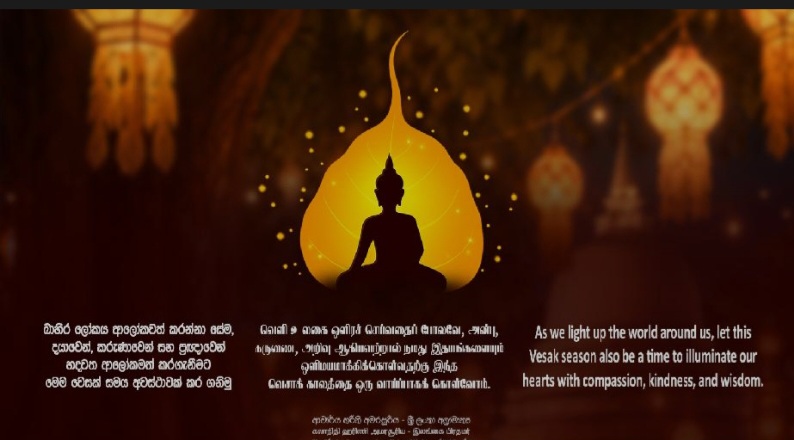
Prime Minister Dr Harini Amarasuriya in her Vesak day message called upon all Sri Lankans to dispel the roots of greed, hatred, and delusion, and transform their lives into a nobel period that brings peace and serenity
The Prime Ministers Vesak day message:
“It is an honor to extend Vesak day felicitations to all citizens of the nation during this sacred period in which lives are shaped in accordance with the noble teachings preached by Lord Buddha, and upholding the practice of Dhamma.
Just as the external world is illuminated by lanterns, this Vesak season should also be an opportunity to illuminate our own hearts with compassion, kindness, and wisdom. Let us dispel the roots of greed, hatred, and delusion, and transform our lives into a nobel period that brings peace and serenity.
“abhittharetha kalyāṇē” – Let us hasten towards the common good. The theme for this year’s State Vesak festival reflects the social needs of the present time. While eliminating narrow beliefs and mindsets, this Vesak festival should become a source of blessings and strength for us to build a nation dedicated to the common good and radiant with the values of the Dhamma.
Followed by the guidance of the Mahanayake Theros and the All Island Sasanarakshaka Mandalaya, I extend wishes for the State Vesak Festival, jointly organized by the Ministry of Buddhasasana, Religious and Cultural Affairs and the Ministry of Public Administration, Home Affairs, Provincial Councils and Local Government.
Through the deep bond that exists between the state and” Buddhism, the progress and prosperity of the country can be achieved through righteous governance. It is essential that we cultivate the patience needed to overcome the economic and social challenges we face as a nation, founded on the noble ideal of “May all beings be well, happy and at peace” where justice is ensured for all regardless of caste, race, or religion.
I respectfully invite all of you to join in celebrating an environmentally conscious and nature-friendly Vesak, walking the Middle Path. Let us move forward together towards a society grounded in principled conduct.
May everyone be blessed with a peaceful and meritorious Vesak!
News
Prime Minister and United Nations Resident Coordinator discuss post-Ditwah recovery and humanitarian cooperation
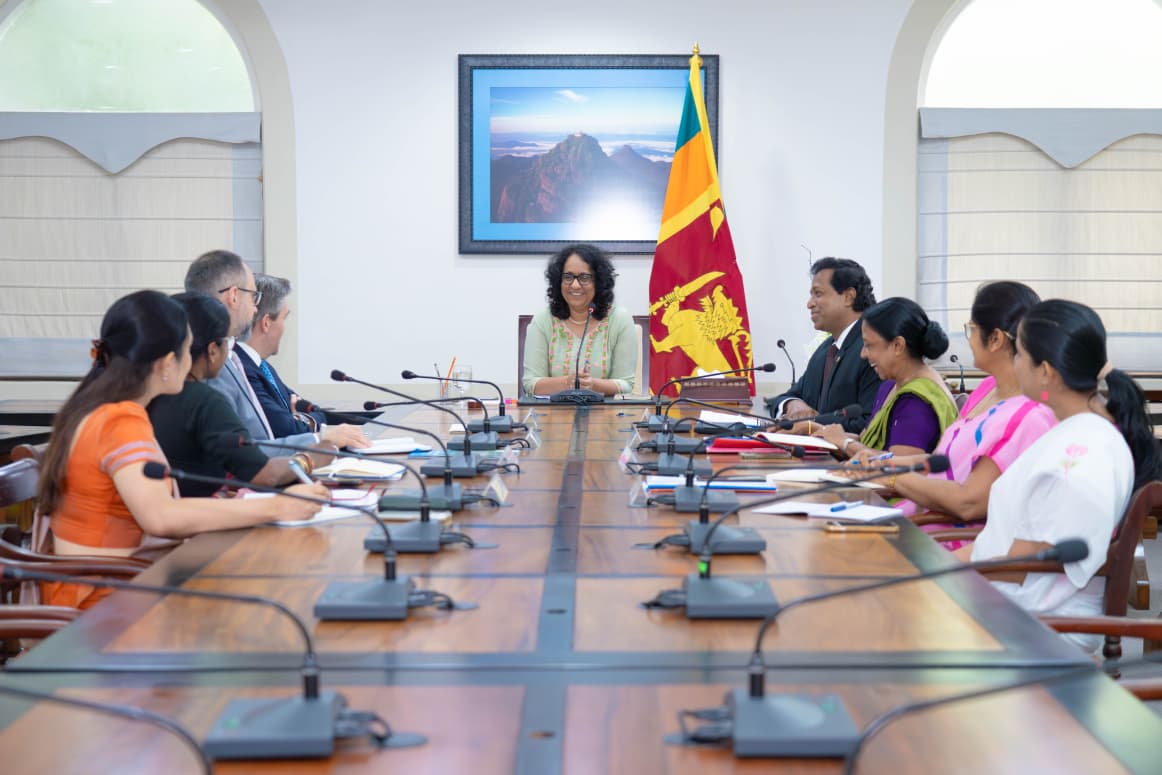
Prime Minister Dr. Harini Amarasuriya met with the United Nations Resident Coordinator in Sri Lanka, Marc-André Franche, at Temple Trees on Friday (29 May) to discuss post-Cyclone Ditwah recovery efforts and continued humanitarian cooperation between Sri Lanka and the United Nations.
Particular attention was drawn to the Humanitarian Priority Plan (HPP), launched in December 2025 to support communities affected by the cyclone. The initiative concluded on 30 April 2026 after providing humanitarian assistance to vulnerable populations across 25 districts through the collective efforts of 81 partner organizations.
The discussions highlighted the Government recognized the substantial international support mobilized through the HPP and noted the importance of sustained collaboration to ensure that recovery gains are maintained.
During the discussion the United Nations delegation formally presented the latest SRI LANKA Cyclone Ditwah Situation Report to the Prime Minister.
(Prime Minister’s Media Division)
Latest News
Further embrace the values of Buddhism founded upon non-violence, compassion and boundless loving-kindness towards all living beings – President
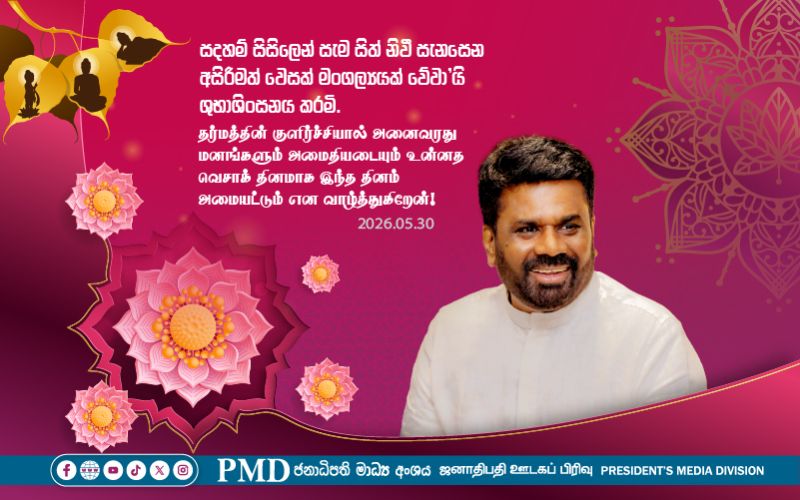
President Anura Kumara Dissanayake in his Vesak day message called upon all Sri Lankans to further embrace in their lives the values of Buddhism founded upon non-violence, compassion and boundless loving-kindness towards all living beings.
The full text of the Presidents message:
The Vesak festival, which commemorates the three pivotal milestones in the life of Lord Buddha: his birth, his attainment of enlightenment, and his passing (Nirvana), is the most sacred celebration for Buddhists across the world. The people of Sri Lanka, heirs to a proud culture enriched by Buddhist heritage, join Buddhists worldwide in devoutly observing this noble occasion.
Buddhism is the greatest philosophical teaching to have conveyed to the entire world a timeless and practical message of peace. The entirety of the Dhamma preached by the Gautama Buddha is founded upon the Four Sublime Virtues of loving-kindness, compassion, empathetic joy and equanimity.
Furthermore, peace, coexistence and reconciliation constitute the supreme teachings expounded not only by the Buddha but also by all enlightened teachers. Buddhism teaches that, in order to establish peace in the external world, inner spiritual peace within the individual must first be secured. We must recognise that this inward and peaceful approach, as advocated by Buddhism in guiding society towards collective noble objectives, is more relevant today than ever before. I believe that this was also the message brought to Sri Lanka recently by the Vietnamese monk Venerable Pannakara Thero, who undertook a pilgrimage on foot across the country.
Moreover, the celebration of Vesak is not merely a religious observance, but also a magnificent cultural festival that has, for thousands of years, reflected Sri Lankan identity, solidarity and artistic creativity. It is indisputable that the programmes organised alongside Vesak celebrations, giving prominence to acts of religious observance such as almsgiving, the observance of sil, meditation and Dhamma sermons, as well as the devotional offerings and festivities including dansals, Buddhist devotional songs, beautifully crafted lanterns and splendid pandals, greatly contribute towards fostering mutual understanding, reconciliation and coexistence among communities.
Inviting all people to further embrace in their lives the values of Buddhism founded upon non-violence, compassion and boundless loving-kindness towards all living beings, I extend my heartfelt wishes for a blessed Vesak festival in which all hearts may find peace, comfort and serenity through the soothing grace of the Dhamma.

Let us dispel the roots of greed, hatred, and delusion, and transform our lives into a nobel period that brings peace and serenity – PM

Prime Minister and United Nations Resident Coordinator discuss post-Ditwah recovery and humanitarian cooperation

Further embrace the values of Buddhism founded upon non-violence, compassion and boundless loving-kindness towards all living beings – President

Showers will occur at times in the Western, Sabaragamuwa and North-western provinces and in Galle, Matara, Kandy and Nuwara-Eliya districts

IMF urges Lanka not to meddle with exchange rate

Court orders arrest of Basil in Rs. 7.8m poll funds case

‘Dates have the highest sugar content to fight Coronavirus’

Sunday Island 27 December – Headlines

#SundayIsland 17th December – Headlines

Sunday Island – 28th March

Sunday Island Headlines – 21 March

Sunday Island – 21st February – Headlines
-

 News7 days ago
All-New GRAVITE launches at LKR 6.99 Mn
-
 Features7 days ago
The NPP’s pivot to the past
-
 News6 days ago
Police probe underway to ascertain links between criminals deported from UAE and local politicians
-
 News5 days ago
Easter Sunday carnage: Court told Maulana’s statement cannot be accepted without cross-examination
-
 Features7 days ago
End of Peacekeeping
-
 Opinion5 days ago
Undermining the democratic political framework
-

 News5 days ago
UK passport holder hiding here wants to have deportation order rescinded to leave without blemish
-
 Features2 days ago
The Division Bell Mystery