
Sports
Afif, Mustafizur give Bangladesh consolation win


Bangladesh Tour of Zimbabwe, 2022
After two famous run chases, Zimbabwe finally got one wrong in the third and final ODI against Bangladesh and went down by 105 runs. Chasing a target of 257, the hosts were bowled out for only 151 in 32.2 overs. The silver lining was that Zimbabwe soon got their hands on the trophy, with the 2-1 scoreline in their favour. For Bangladesh, it was a bittersweet finish too. They wrapped up the tour with an impressive performance but it doesn’t hide the fact that they lost both the T20I and ODI series on the tour, drawing sharp criticism from the fans and board alike.
Defending what was a decent target on a fresh surface, Bangladesh got off to the best of starts as Hasan Mahmud trapped Takudzwanashe Kaitano with the fifth ball of the innings. In the next over, Mehidy Hasan Miraz followed up with the wicket of Tadiwanashe Marumani that had Zimbabwe reeling at 7/2. It soon became 18/4 when Ebadot Hossain picked the wickets of Wesley Madhevere and in-form batter Sikandar Raza with consecutive deliveries. Raza, who scored unbeaten match-winning hundreds in the first two ODIs, got a first-ball duck this time.
With Raza gone, Taijul Islam and Mustafizur Rahman sliced through the middle order, picking between them the next four wickets to fall. The visitors, however, were caught unaware by the 68-run stand for the tenth wicket between Richard Ngarava (34* off 27) and Victor Nyauchi (26 off 31). Both the batters counterattacked from their ends, making Bangladesh huff and puff for about 10 overs to get the elusive final wicket and the win.
Earlier in the day, Afif Hossain’s 85* and Anamul Haque’s 76 propelled Bangladesh to 256/9 after Zimbabwe won the toss and put them in. Bangladesh openers negotiated the early swing and seam on offer to add 41 runs before Tamim Iqbal’s run out triggered a collapse. From 41/0, Bangladesh were 47/3 in a matter of eight balls as Najmul Hossain Shanto and Mushfiqur Rahim fell in a Brad Evans over moments after Tamim’s run out. Mushfiqur’s wicket in particular was down to Richard Ngarava’s diving catch running in from third man.
Anamul then added 77 runs for the fourth wicket with Mahmudullah, bringing up his fifth ODI fifty in the process. The opener even smashed a six onto the roof at the Harare Sports Club. It was Jongwe who got him caught-behind in the end, striking once again with the old ball in the middle overs.
But the breakthrough didn’t quite materialize for the hosts as Afif Hossain took over for Bangladesh from thereon. It didn’t help that Innocent Kaia dropped a regulation return chance when Afif was on 2; the batter would go on to add 83 more runs to his tally and help Bangladesh reach a competitive total. Four wickets fell in the last 10 overs as Zimbabwe continued to strike, with each of Sikander Raza, Luke Jongwe and Richard Ngarawa striking on either side of Taijul Islam’s run out. So it was largely down to Afif that Bangladesh scored 35 in the last four overs.
Brief Scores:
Bangladesh
256/9 in 50 overs (Afif Hossain 85*, Anamul Haque 76; Jongwe 2-38, Evans 2-53) beat Zimbabwe 151 all out in 32.2 overs (Ngarava34; Mustafizur 4-17) by 105 runs


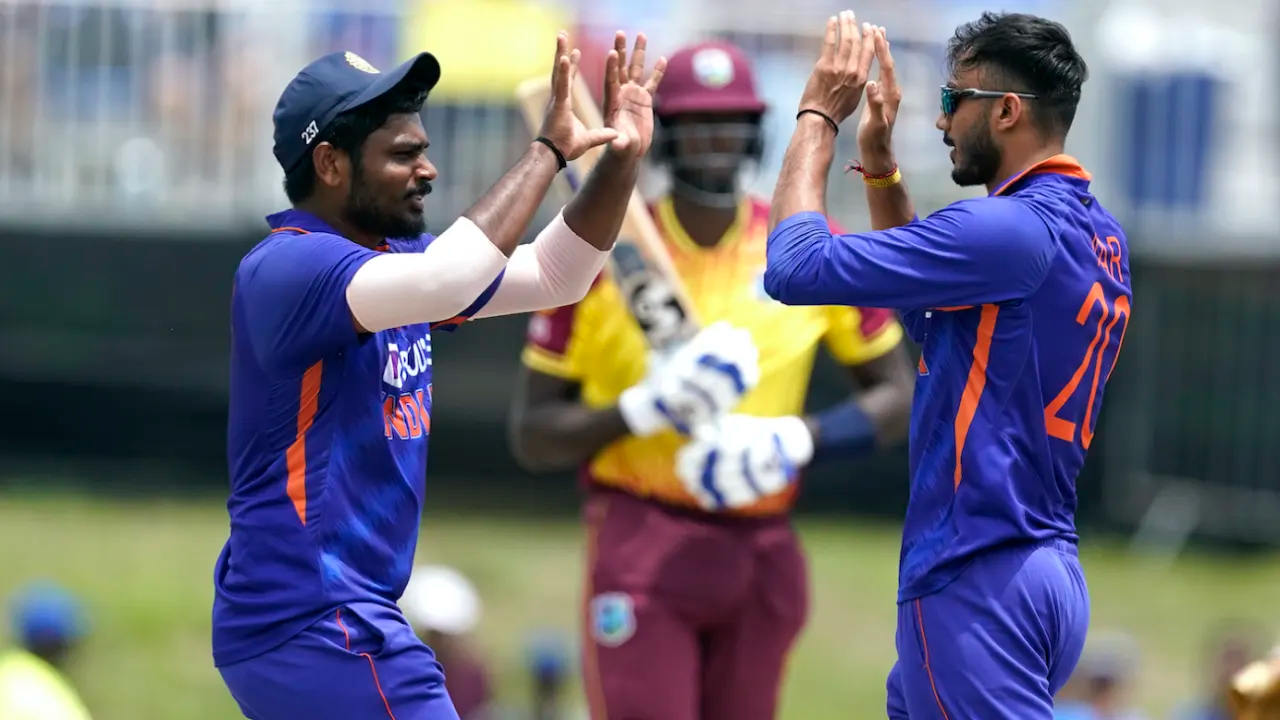
Zimbabwe won the toss and asked India to bat first in what was practically a must-win match for both sides. Thanks to South Africa’s win over Weszt Indies minutes before the toss, India now need to just win. Zimbabwe, though, need to win big.
Sikandar Raza, the Zimbabwe captain, said there was grass and moisture on the surface, and that he wanted his seamers to use it early. Raza didn’t even go for an X-ray on his injured hand lest it show a fracture and force him out of the big match.
Thanks to Raza’s call to field, we were to soon find out the batting position of SanjunSamson, whose inclusion brought about a huge cheer from the stands in Chennai, which will now be his home during the IPL. A Chennai boy, though, went out. Washington Sundar made way for the vice-captain Axar Patel, who had been left out for tactical reasons against South Africa.
Samson replaced a lower middle-order hitter Rinku Singh, who might or might not have his mind on other things. He made a quick visit to Delhi with his ailing father before rejoining the squad on the eve of this match. How Samson would fit in the batting was intriguing, but one thing was made clear: he was going to take the big gloves behind the wicket later in the night.
Zimbabwe made one change to go with their reading of the conditions. Legspinner Graeme Cremer went out for fast bowler Tinotenda Maposa.
India: Abhishek Sharma, Sanju Samson (wk), Ishan Kishan, Suryakumar Yadav (capt.), Tilak Varma, Hardik Pandya, Shivam Dube, Axar Patel, Arshdeep Singh, Varun Chakravarthy, Jasprit Bumrah
Zimbabwe: Tadiwanashe Marumani (wk), Brian Bennett, Dion Myers, Ryan Burl, Sikandar Raza (capt.), Tony Munyonga, Tashinga Musekiwa, Brad Evans, Tinotenda Maposa, Blessing Muzarabani, Richard Ngarava
[Cricinfo]
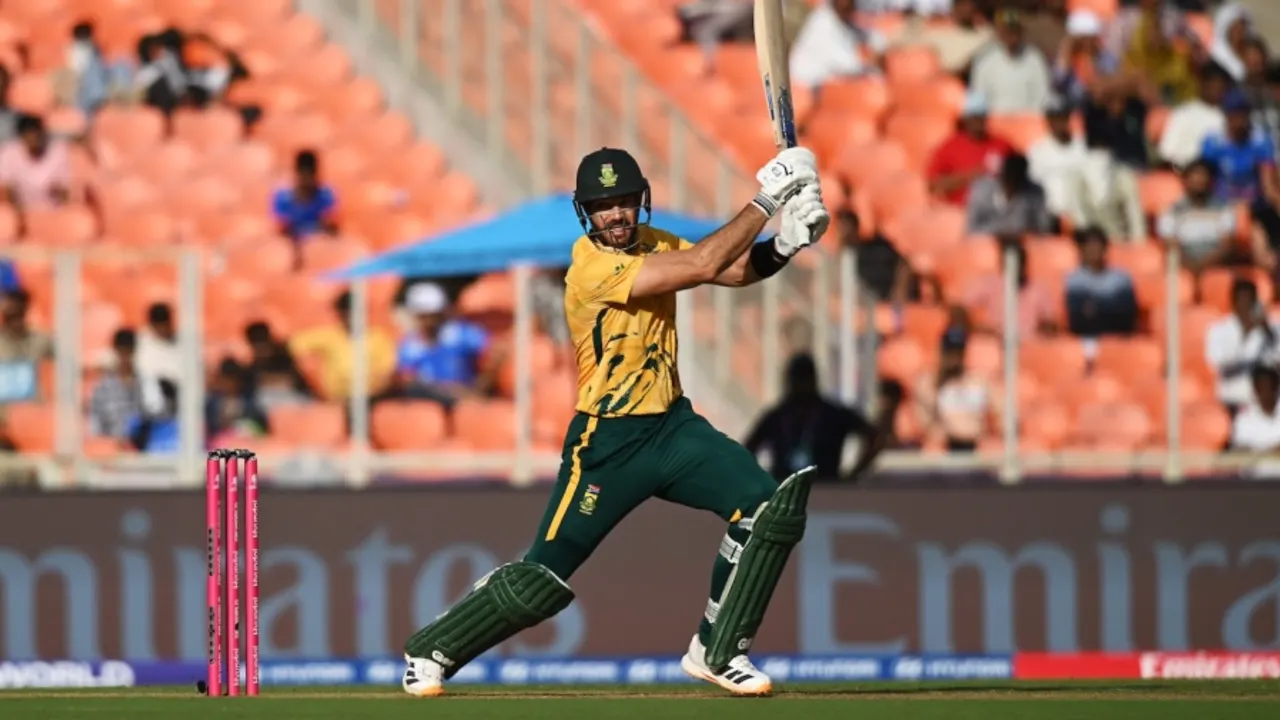
Aiden Markram’s 82 not out led South Africa to a nine wicket victory over West Indies that, while not confirming his side’s semi-final place just yet, underlined why many believe the Proteas could finally lift the T20 World Cup. In this meeting of the last two unbeaten sides at this tournament, South Africa were ruthless, maintaining their 100 per cent record with 23 balls to spare.
Markram’s third half-century of the tournament – his 22nd fifty-plus score in T20Is – made light work of a 177 chase. He and Quinton de Kock put on 95, their highest opening stand of the tournament, skewering whatever belief West Indies had picked up at the back end of a first innings that started disastrously.
Inserted on a tacky-looking Ahmedabad surface, West Indies were 83 for 7 in the 11th over, before a record T20I stand of 89 for the eighth wicket between Jason Holder and Romario Shepherd.
Lungi Ngidi (3 for 30) and Kagiso Rabada’s (2 for 22) were the chief architects of the early stages of that collapse, with Corbin Bosch (2 for 31) also chiming in, profiting from batters’ unrelenting pursuit of boundaries.
Shepherd’s unbeaten 52 – a maiden T20I half-century, sealed with an inside edge for four off the final ball of the innings – and a well-managed 49 from Holder was a part change of tact. But even they focused on finding the fence throughout their 57 deliveries together rather than ticking over to bat time, even if West Indies were able to use all 20 overs.
South Africa were far from perfect, dropping four catches and being a little passive in the field. But they took it to West Indies’s bowlers. All six used by Shai Hope ended up wearing economy rates in double figures, as de Kock’s 47 off 24) and then Ryan Rickleton’s unbeaten 45 off 28 dovetailed neatly as left-handed foils to Markram’s belligerent march to the finish line.
Brief scores:
South Africa 177 for 1 in 16.1 overs (Aiden Markram 82*, Quinton de Kock 47, Ryan Rickelton 45*; Roston Chase 1-46) beat West Indies 176 for 8 in 20 overs (Brandon King 21, Shai Hope 16, Sherfane Rutherford 12, Romario Shepherd 52, Jason Holder 49, Mathew Forde 11; Lungi Ngidi 3-20, Kagiso Rabada 2-22, Corbin Bosch 2-31) by nine wickets
[Cricinfo]
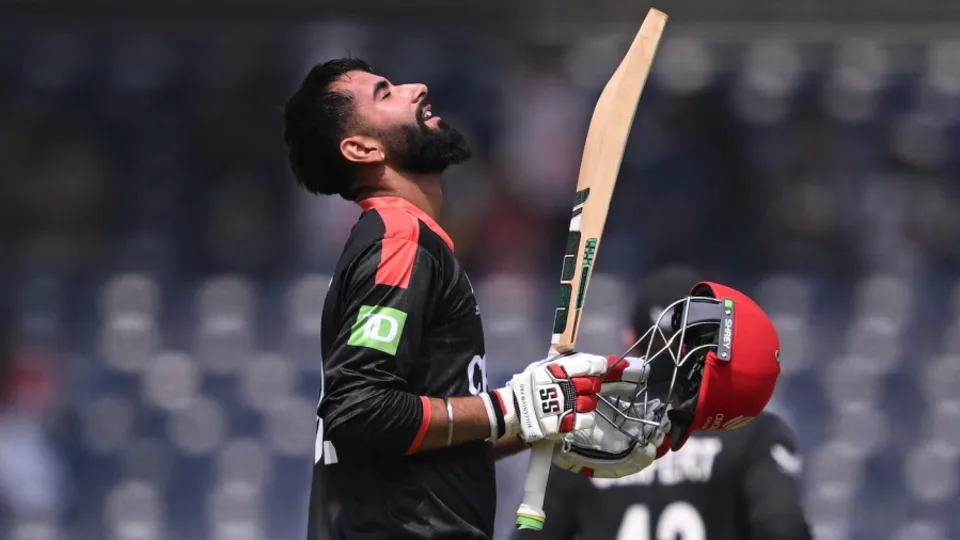
The 2026 T20 World Cup was one where the Associate teams shone the brightest, often pushing the Full Members to their limits. Who are the players that stood out at the World Cup? Here’s the Associate’s team of the tournament.
Yuraj Samra
Canada (144 runs at 36.00; strike rate 156.52)
The 19-year-old opener became the first Associate batter to score a T20 World Cup century against New Zealand. In his tournament-defining innings, he stepped down to Matt Henry, took apart James Neesham and dispatched Cole McConchie. But beyond the 110, he couldn’t cross 17 in the other three outings.
Shayan Jahangir
USA, wk (91 runs at 30.33; strike rate 137.87)
This wasn’t a great tournament for the Associate glovemen, so wicketkeeper Jahangir takes the other opener’s spot. Against Pakistan, with six team-mates falling for single-digit scores, Jahangir gave USA hope of a win with his 34-ball innings that fell one run short of a half-century. On the spin-friendly SSC surface, he dominated Saim Ayub, Mohammad Nawaz and Abrar Ahmed, but failed to replicate the same form in the other games.
Bas de Leede
Gerhard Erasmus
Namibia, capt (seven wickets at 11.85; economy 7.54)
The Namibia captain and allrounder did not have a productive time with the bat but he stood up with the ball, taking seven wickets. His best performance was 4 for 20, where the variations in his delivery stride helped maintain an economy of 5.00, even as India posted a strong 209. He dismissed Ishan Kishan, Tilak Varma, Hardik Pandya and Axar Patel. He also took 2 for 27 against USA and 1 for 25 against Pakistan.
Shubham Ranjane
USA (141 runs at 70.50; strike rate 180.76)
Ranjane produced multiple impact knocks against big teams. Facing mobility issues against India, Ranjane launched a 22-ball 37 by counterattacking against Pandya, Varun Chakravarthy and Mohammed Siraj. Then, against Pakistan, his 30-ball 51 didn’t let Pakistan rest easy. His 24-ball 48 against Netherlands gave USA an imposing 196. His medium-pace bowling also gave USA a crucial sixth-bowling option.
Ben Manenti
Italy (138 runs at 46.00; five wickets at 20.60)
The elder Manenti brother was an X-factor in Italy’s maiden campaign. His 2 for 9 in four overs deflated Nepal’s hopes and earned Italy their maiden World Cup win. His 25 – ball 60 against England kept his opponents on their toes. His 31-ball 52 against Scotland was another standout. Add in the two-for against West Indies and Ben Manenti has the highest impact-per-match numbers according to ESPNcricinfo’s metrics.
Michael Leask
Scotland (nine wickets at 13.55; economy 7.62)
Against Italy, Leask produced an explosive five-ball unbeaten 22 in the 20th over to take Namibia past 200 in Kolkata and then returned figures of 4 for 17 with his offspin. He wasn’t a big turner of the ball, but came from around the wicket to strangle right-hand batters, dismissing Harry Brook against England, too. Leask also took all three Nepal wickets, against right-handers, in Scotland’s final World Cup game.
The right-arm seamer from USA started the World Cup with a bang. A three-wicket over in the powerplay against India sent the Wankhede stadium into silence as he eventually finished with 4 for 25. That spell left India feeling very uncomfortable at halftime. Then against Pakistan, he went 4 for 25 again, relying on his hard-length deliveries that forced attacking shots into mis-hits. A further five scalps against fellow Associates left him with 13 wickets in four games, which, at the time of writing, remains the most in this tournament.
Aryan Dutt

US and Iran hold talks seen as crucial to prevent conflict

Zimbabwe opt to bowl, include Maposa; Samson, Axar back for India

Markram, bowlers lead South Africa’s rout of West Indies

Samra, Airee headline Associates’ team of the tournament

Maharoof expects ‘some hard decisions’ after Sri Lanka’s T20 World Cup exit

Matthews’ century leads West Indies to six-wicket victory

‘Dates have the highest sugar content to fight Coronavirus’

Sunday Island 27 December – Headlines

#SundayIsland 17th December – Headlines

Sunday Island – 28th March

Sunday Island Headlines – 21 March

Sunday Island – 21st February – Headlines
-

 Features5 days ago
Why does the state threaten Its people with yet another anti-terror law?
-

 Features5 days ago
Reconciliation, Mood of the Nation and the NPP Government
-

 Features5 days ago
Victor Melder turns 90: Railwayman and bibliophile extraordinary
-

 Features4 days ago
LOVEABLE BUT LETHAL: When four-legged stars remind us of a silent killer
-
 Features5 days ago
Victor, the Friend of the Foreign Press
-
 Latest News6 days ago
New Zealand meet familiar opponents Pakistan at spin-friendly Premadasa
-

 Latest News6 days ago
Tariffs ruling is major blow to Trump’s second-term agenda
-

 Latest News6 days ago
ECB push back at Pakistan ‘shadow-ban’ reports ahead of Hundred auction