
Latest News
A substantial wage hike on the cards for government employees in 2025 – Chairman of the Expert Committee on Public Service Salary Disparities


Chairman of the Expert Committee on Public Service Salary Disparities, Udaya R. Seneviratne said that the basic salary of public service employees will be increased by a minimum of 24% for primary-level service categories. Salaries will gradually increase from an average of 24% to 50%, for all government officials depending on current fiscal feasibility he added.
Mr. Seneviratne further said in light of prevailing inflation and economic conditions, a cost of living allowance of Rs. 25,000 will remain unchanged for three years and will be provided to all government employees for three consecutive years, starting from January 2025, with 2025 being considered the base year.
He emphasized that regardless of which government is in power, there is a pressing need to increase the salaries of public servants. These proposals were made to address and eliminate salary disparities, taking into account past trade union protests within the public service. Accordingly, the proposals have received approval from both the Cabinet and the Treasury.
Chairman of the Expert Committee on Public Service Salary Disparities, Udaya R. Seneviratne shared these views during a press conference titled “Collective Path to a Stable Country” held today (22) at the Presidential Media Centre.
Mr. Seneviratne stated that the basic salary for the primary-level service category employees will be Rs. 30,000.00, with the total salary, including the cost of living allowance, amounting to Rs. 55,000.00.
Public service plays a vital role in the development of Sri Lanka and is also the driving force of development. The restructuring efforts are prioritized to address the current challenges in the public sector. The Presidential Expert Committee on Public Service Salary Disparities has presented a comprehensive program aimed at creating a satisfying work environment for public servants, delivering excellent service to the people, and positioning the public service as a key driver of economic development.
He also said that action will be taken to provide the cost of living allowance of Rs. 12,500 each for the pensioners from January 2025 and measures will also be taken to award the claimed salary increment for the government officials who retired prior to the year 2020 and revise their pension accordingly.
Further, action will be taken to provide benefit through the Budget 2025 in step wise based on the current fiscal viability.
To enhance the effectiveness and efficiency of the Public Service and provide exceptional service to the public, a scientific work study will be conducted in 2025. This study will inform a comprehensive program to restructure the Public Service as needed. A thorough assessment of the required number of employees will also be carried out based on this evaluation.
Appropriate performance indicators (KPIs) will be introduced for government employees, and a system for granting annual salary increments based on performance progress will be developed. Additionally, methods for providing incentives and other non-financial benefits based on performance will be implemented.
To enhance the quality of public service and ensure a distinctive government service for taxpayers under the current tax policy, a competitive recruitment system will be established. This system will be based on the Sri Lanka Qualification Framework (SLQF) and National Vocational Qualification (NVQ). This approach aims to ensure that qualified individuals are placed in appropriate roles, creating a more effective and efficient public service.
The government’s capital investment program for E-Governance will prioritize the digitization and automation of the Public Service, with a focus on incorporating technology in every possible aspect over the next three years, starting in 2025.
Special attention will be given to implementing E-Governance across government ministries and institutions, beginning with Grama Niladhari offices. This initiative aims to enhance the performance of revenue-generating institutions and those providing public services.
Over the next three years, efforts will be made to restructure identified public institutions from their traditional departmental model—dependent on the General Treasury for many years—into an innovative enterprise model.
These institutions will be transformed into Public Quoted Companies with a democratic governance structure, where ownership is divided as 30% government shares, 30% investor shares, 30% public shares through stock market listing, and 10% employee shares.
Government officials who are eligible for pensions and are assigned to these new institutions will have their pensions deferred until they reach age 60. They will receive other benefits during their service in these institutions.
Measures will be introduced to optimize the delivery of certain government services by outsourcing these services to external providers. This approach aims to reduce government expenditures and encourage private sector involvement. It will help avoid unnecessary recruitment in the Public Service and enable private providers to offer more effective services. As a result, economic services will be expanded.
To ease the financial burden on government employees, the Agrahara Medical Insurance Scheme will be restructured to lower their health expenses. The plan is to maximize benefits through the scheme, with each government employee, including pensioners, contributing Rs. 1,000 per month.
Additionally, the National Insurance Trust Fund, which administers the Agrahara scheme, will enhance medical services for government employees. This will involve modernizing the national hospital system and gradually upgrading selected government hospitals with special amenities for employees.
Due to the high demand for Sri Lankans abroad, many are migrating for employment and higher education, drawn by the country’s reputation for free education and skilled human resources. As a result, Sri Lanka loses valuable talent and significant foreign exchange is spent on overseas education. A large number of eligible students miss out on opportunities to study at state universities due to limitations in free higher education, forcing parents to cover high costs for private institutions and international universities. The trend of university students leaving the country is increasing due to insufficient economic benefits.
To address these issues, it is proposed to secure free higher education, grant legal and administrative independence to universities, and offer affordable courses by effectively utilizing physical and human resources. This will develop additional revenue streams and benefit all stakeholders. By improving this system and integrating with foreign universities and training institutions, Sri Lanka could become a Centre for Knowledge, expanding opportunities for international students to complete their education in Sri Lanka and becoming a leading sector for foreign exchange earnings.
Sri Lanka has achieved a notable position in health indicators due to its establishment of free health services, leading to increased international recognition for its healthcare services and professionals. However, the migration of health professionals is rising due to international demand. To address this, there is potential to transform Sri Lanka into a centre for internationally recognized health services by elevating the quality of free healthcare provided.
Strategies will be developed to deliver healthcare to both local and foreign communities efficiently and economically. This includes managing free healthcare facilities securely and introducing healthcare innovations that leverage existing physical and human resources.
Similarly, Ayurvedic medical services can be enhanced to generate economic benefits. It is proposed to capitalize on Sri Lanka’s potential to become a leading centre in healthcare-based tourism.
[PMD]


Smriti Mandhana filled her batting coffers with her second T20I century, along the way surpassing Mithali Raj for the record for most runs in women’s internationals, to help India secure a second straight win on Thursday night in Dubai.
Hong Kong’s nerves showed on the field when they fell flat at the first sign of attack from India’s batters, and their timid approach in the chase further exposed the gulf in quality and experience. In the end, they lost by 137 runs – 13 more than what Mandhana managed on her own.
A second straight loss meant Hong Kong will only have some pride to play for, as a berth in the next round is now out of the equation.
India’s cautious start
At the end of five overs, India were 38 without loss – not concerning, but not dominating enough either. They took a while to suss up the lack of pace from the bowlers. Mandhana hogged much of the strike; Shafali Verma faced just six balls in the first five overs. Hong Kong couldn’t have been happier at having kept a lid on the scoring.
Shafali steps up
After a tight first over that went for just seven, offspinner Maria Lamplough was clobbered by Shafali for two fours and two sixes in a 22-run over that helped India take off.
Lamplough struggled for consistency and kept looping the ball up, with Shafali needing no second invitation. The first of the two sixes was a shovel over deep midwicket; the next even better – lofted inside-out over deep extra cover.
Shafali’s brief surge ended on 28 in the eighth over, when Marina took an excellent catch running in and diving full stretch from long-on off Ruchita Venkatesh’s bowling. By then, the openers had put on 74.
Mandhana prances towards record century
As new No. 3 Pratika Rawal took a while to gauge the pace of the surface, Mandhana reached her half-century – her 36th in T20Is – off 40 deliveries with a flat six over deep square. Mandhana’s default setting for much of this period was moving over to the off-side to set herself up for several variations of the slog in the arc between wide long-on and deep square.
Her next fifty came off just 18 deliveries. The century could’ve been nipped in the bud had she been taken at deep square leg in the 16th over off Siu Wai, but she accelerated even more soon after bringing up her century that helped her climb atop the list for most international hundreds in women’s cricket.
In the 18th over, she clobbered Venkatesh for three consecutive sixes, and in the same over also went past Mithali’s record for most international runs. This helped India finish strongly, the second half of their innings brought them 107 despite losing a clutch of wickets.
Nandani’s dream run continues
Coming off a three-for against Thailand, Nandani Sharma’s seam presentation and control was immaculate with the new ball as Hong Kong crawled to 4 for 1 in four overs. The wicket, off Mariko Hill, one of their most experienced batters, came off a superb in-ducker on the back of three successive away-swingers. Nandani added one more wicket to her kitty to finish with 2 for 6 off her three overs.
The collapse
The highest partnership of the innings was the 27 between Yasmin Daswani and Natasha Miles for the second wicket; a period where they hardly threw any caution to the wind, choosing instead to bat overs and gain some match time against an opponent they were playing for the first time in 14 years.
The partnership ended when Daswani’s attempt to heave into the leg side was intercepted by a leaping Bharti Fulmali at midwicket to give Deepti Sharma a wicket. Six balls later, Miles was out attempting to cut Prema Rawat’s sharp leg break, nicking behind to Richa Ghosh.
That was the start of the collapse, as India’s spinners closed in, each one getting onto the scorecard with a bagful. There were eight single-digit scores, with 15 the highest. They lost their last five wickets in 11 deliveries, collapsing from 54 for 5 to 56 all out.
India couldn’t have asked for an easier route into the semi-finals.
Scores:
India Women 193 for 5 in 20 overs (Smriti Mandhana 124, Shafali Verma 28, Pratika Rawal 10, Richa Gosh 11, Harmanpreet Kaur 10; Marina Lamplough 2-46, Ruchitha Venkatesh 1-30, Joyleen Kaur 1-12) beat Hong Kong Women 56 in 16.2 overs (Natasha Miles 15, Yasmin Daswani 11, Marina Lamplough 14; Nandani Sharma 2-06, Shree Charani 2-16, Deepti Sharma 3-09, Prema Rawat 2-12) by 137 runs
[Cricinfo]
Latest News
Sun directly overhead Nittambuwa, Algama, Malwana, Aranayake, Meegahakiula and Panamkadu about 12.09 noon today (04)

The sun is going to be directly over the latitudes of Sri Lanka from 28th of August to 07th of September due to its apparent southward relative motion.
The nearest places of Sri Lanka over which the sun is overhead today (04) are Nittambuwa, Algama, Malwana, Aranayake, Meegahakiula and Panamkadu about 12.09 noon.
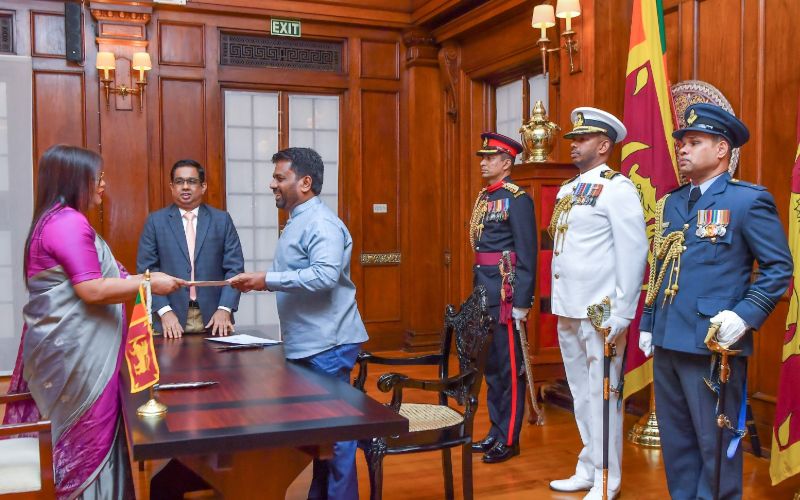
Ms Sajeewani Dilka Lakmali Karunannayake was sworn in as a Judge of the Court of Appeal before President Anura Kumara Dissanayake at the Presidential Secretariat this afternoon (03).
She previously served as an Additional Solicitor General at the Attorney General’s Department.
The appointment has been made to fill a vacancy on the Court of Appeal.
Secretary to the President Dr Nandika Sanath Kumanayake was also present on the occasion.
(President’s Media Division)

Devapathiraja clinch U15 Division I title with 33-run win over Royal

Mandhana’s record ton powers India into semi-finals

Sun directly overhead Nittambuwa, Algama, Malwana, Aranayake, Meegahakiula and Panamkadu about 12.09 noon today (04)

Showers expected in the Uva, Central and Eastern provinces and in Polonnaruwa and Mullaittivu districts after 2.00 p.m

Norochcholai digs into dwindling coal stocks, two units slash generation

22A: BASL decides against making written submissions after SC refuses to grant it right of reply

‘Dates have the highest sugar content to fight Coronavirus’

Sunday Island 27 December – Headlines

#SundayIsland 17th December – Headlines

Sunday Island – 28th March

Sunday Island Headlines – 21 March

Sunday Island – 21st February – Headlines
-

 Features5 days ago
“Wrap Me Up in My Blazer”— A Gentlemanly Bradby Reminiscence
-

 Features4 days ago
When Sri Lankan stories find their own voice
-
 Features5 days ago
JVP/NPP government as seen from outside by Lionel Bopage now domiciled in Australia
-

 News4 days ago
BASL takes exception to Justice Ganepola being denied a place in SC
-

 Editorial6 days ago
Govt. trying to dupe UN Rapporteur?
-
 Features5 days ago
Prof. Savitri Goonesekere: What has she done?
-

 Features5 days ago
World Trade Politics: Canada rebuffs Trump’s tariff blackmail
-
 News5 days ago
Legal avenues explored to bring back Mahendran, aka Harjan Alexander