
Opinion
A simple, immediate solution to potentially dangerous shortage of air traffic control officers


BY Capt. G A Fernando MBA
gafplane@sltnet.lk
RCyAF/ SLAF, Air Ceylon, AirLanka, SIA, Sri Lankan Airlines.
And CAASL
In a recent interview conducted by Chamuditha Samarawickrama of Truth with Chamuditha fame with Thisara Amarananda, President of the Sri Lanka Air Traffic Controllers’ Association (SLATCA), it was revealed that the existing cadre of Air Traffic Control Officers was dangerously low due to migration of senior Air Traffic Control Officers (ATCOs) seeking more lucrative jobs abroad.
There are only 80 ATCOs instead of the required 138. They currently work overtime to keep air traffic services going. If four more ATCOs leave, it will lead to cumulative fatigue which may eventually bring the services provided in Sri Lankan airspace to a halt.
As a possible consequence our airspace of over 60,000 square nautical miles will be carved out amongst adjoining or regional countries such as Indonesia, Australia, Maldives and India. Sri Lanka will lose valuable foreign exchange revenue amounting to an average of $35,000 per day, derived from payment by airlines for flying through Sri Lankan airspace. Sri Lanka in turn provides the carriers with flight monitoring and traffic Information, and search and rescue facilities.
An Air Traffic Controller’s job is unique, requiring a good standard of English and communication skills. While the job generally maintains a lower profile than most others in the eyes of the general public, the service is provided day in and day out 24/7. Maintaining the flow of aircraft in and out of airports and en route is essential to aviation safety. This is also why the work of Air Traffic Control is rated as one of the most stressful in the world (Montgomery, 2010).
ATCOs function at three levels. (1) Aerodrome Controllers who use their eyes and ears while in the control tower of an airport up to an altitude of about 4,000 feet; (2) Approach Controllers who monitor and control air traffic on radar from 4,000 feet to 15,000 feet; and (3) Area Controllers (from Ratmalana) who control traffic above 15,000ft on radar and Controller Pilot Data Link Communications (CPDLC) when beyond line of sight. (Radar works on line-of-sight only.) It is obvious that a competent ATCO cannot be produced overnight.
The aviation environment is generally assumed, by the general public in particular, to be safe. The importance and significance of an ATCO’s job will only come into focus in the event of a high-profile incident or accident. In the past, all control and separation of air traffic was maintained by the use of headings and altitudes provided to the aircraft, known as ‘tactical radar vectoring’. With the introduction of new/future air navigation systems, separation of the majority of aircraft arrivals and departures at airports are looked after automatically. As a result, old skills of Air Traffic Controllers are lost and new skills have to be learnt. Separation and sequencing of aircraft could be done en route, long before their arrival at the destination airport. Because all aircraft are still not equipped with future air navigation systems, and the air traffic control systems are in the process of being modernised, the Air Traffic Controller enforces a ‘mixed mode’, i.e. controlling the old and the new, adding further stress to the conduct of the job.
The job of an Air Traffic Controller requires extensive training, knowledge, experience and skill, enabling the individual to ensure a safe, expeditious and orderly flow of air traffic with economy, collectively known as ‘Air Traffic Management’ (ATM). According to Costa (1996), there are six main ‘Stressors’ that affect the Job of Air Traffic Controllers: (1) Demand; (2) Operating Procedures; (3) Working times; (4) Working tools; (5) Working environment; and (6) Work Organisation.
(1) Demand: The number of aircraft under the purview of an Air Traffic Controller will constantly vary during a given duty period. The stress factor is directly proportional to this number. Accordingly, there will be highs and lows in the Air Traffic Controller’s workload during a given duty period. There could be unanticipated, nonessential traffic causing distractions, as well as unexpected events such as bad weather, medical and technical emergencies occurring in air traffic under their control.
(2) Standard Operating Procedures: Another stress factor is the need to operate within Standard Operating Procedures (SOP) required by the relevant organisations (Airport and Aviation Ltd and Civil Aviation Authority Sri Lanka) while striving to perform under constant, real-time pressure, sometimes creating the need to even bend the rules to get the work done. Working on the edge of maintaining control while realising the terrible consequences of a genuine human error adds to the anxiety and stress.
(3) Working Times: The working times could be any time of day or night and the Air Traffic Controller is expected to work at 100 percent efficiency (and nothing less) irrespective of the circadian (body clock) lows. Usually the job involves shift duties which sometimes lead to extended duty time to cover for an absent colleague. This adds to the stress. (Job and Home)
(4) Working Tools: The equipment an Air Traffic Controller has to work with, such as microphones, headsets, telephones, badly designed control panel layouts and radar display screens that may be old and outdated, is another source of stress. On the other hand, there is the need to become competent with futuristic technology for Communication, Navigation and Surveillance (CNS), including (CPDLC). The controllers need to regularly attend training courses and certification, to update themselves, thereby causing stress.
(5) Work Environment: Noise, light, temperature, ventilation, sitting posture, cafeteria and rest facilities, coupled with lack of seclusion from the distractions of the outside world, create stress for the Air Traffic Controller.
(6) The Work Organisation: Relationships with colleagues, salary, sometimes responsibility without authority. With the advent of Future Air Navigation Systems (FANS), there is a change of roles and responsibilities of the Air Traffic Controllers, and is bound to be stressful.
In Sri Lanka all ATCOs are University Mathematics graduates who had applied for the job as advertised in the Government Gazette. They had little or no knowledge of what the work involved. Therefore, they have to be orientated and trained ‘from scratch’. Unlike in the past in Sri Lanka, and the practice in other parts of the world, no qualified pilots were recruited to the job. The last pilot in the system retired in 2017.
Now, SriLankan Airlines has yet again advertised for Cadet Pilots and Junior First Officers. It is estimated that there are almost 200 eligible applicants. Unfortunately, many are called but only a few are selected. The selection process is not fool-proof, but considered to be the best under the circumstances.
Flight training is expensive. The requirement for eligibility is knowledge to sit and pass the Air Transport Pilots’ Licence (ATPL) theory examination and have enough flying experience and skill to be awarded a Commercial Pilots’ Licence and Instrument Rating (CPL/IR) with a twin-engine qualification endorsed on the licence. This will cost the student pilot in excess of Rs. 10 million, and take more than two years to accomplish. One has to be at least 17 years old to start basic flying training. Some go to the USA for training and exposure. Some foreign universities offer a pilot’s licence with a degree.
Unquestionably, parents undergo untold hardship to put their children through flight school. Some even get into debt and mortgage their only property. That’s the stark reality. It may not be wrong to say that most candidates are from middle class families where parents make many such sacrifices to be able to fund their children’s training for a so-called glamorous job which pays high salaries.
Airlines today have a good safety record, and although not acknowledged by the west, since 1947 Air Ceylon, Air Lanka and SriLankan Airlines have not lost a single passenger due to an air accident. All lives lost resulted from acts of terrorism. The ATCOs too, should be given due credit for the unseen and unsung role they have played and continue to play to maintain safe skies over Sri Lanka.
Due to a bottleneck in the pilot training process, SriLankan Airlines cannot recruit large numbers at once. Usually, recruitment occurs once approximately every 18 months. Those who are unsuccessful in joining the national carrier the first time have to spend three to five years applying over and over again before they find a slot in their chosen career, or become over-age. Meanwhile some become instructors in the many flying schools, or secure airline jobs abroad, while the rest (read: majority) simply give up their ambitions of becoming a pilot. There are many variables in the selection process, with an element of luck playing a large part.
Make no mistake, most young people who aren’t selected as cadets or Junior First Officers are bright, talented, enthusiastic and eager to work in the aviation industry. It is their passion that keeps them going. Unfortunately, they are not utilised in other aviation fields like Air Traffic Control. This valuable resource of qualified but inexperienced pilots, trained at great expense to their parents and the country (the latter in terms of foreign exchange for fuel, spares and equipment), isn’t recognised by either the Civil Aviation Authority Sri Lanka (CAASL) or Airport and Aviation Services Ltd (AASL).
Rather than recruiting personnel ‘off the street’ as it were, these young lads and lasses could enhance the ATCO cadre as Aerodrome Controllers. They have basic aviation sense and airmanship (common sense) and will need minimum training. That’s how it was in the Sixties and seventies. While it is likely that many will later move on to their chosen profession as airline pilots, there will be a few who will opt to stay as ATCOs, thereby enriching the competency levels of the aviation industry. It is a case of resource management. This is how it happens in most parts of the world.
Could this be the solution to the potentially dangerous problem in Sri Lanka?











Important events in the Christian calendar are to be regurlarly reviewed if they are to impact on the lives of people and communities. This is certainly true of Christmas.
Community integrity
Years ago a modest rural community did exactly this, urging a pre-Christmas probe of the events around Jesus’ birth. From the outset, the wisemen aroused curiosity. Who were these visitors? Were they Jews? No. were they Christians? Of course not. As they probed the text, the representative character of those around the baby, became starkly clear. Apart from family, the local shepherds and the stabled animals, the only others present that first Christmas, were sages from distant religious cultures.
With time, the celebration of Christmas saw a sharp reversal. The church claimed exclusive ownership of an inclusive gift and deftly excluded ‘outsiders’ from full participation.
But the Biblical version of the ‘wise outsiders’ remained. It affirmed that the birth of Jesus inspired the wise to initiate a meeting space for diverse religious cultures, notwithstanding the long and ardous journey such initiatives entail. Far from exclusion, Jesus’ birth narratives, announced the real presence of the ‘outsider’ when the ‘Word became Flesh’.
The wise recognise the gift of life as an invitation to integrate sincere explanations of life; true religion. Religion gone bad, stalls these values and distorts history.
There is more to the visit of these sages.
Empire- When Jesus was born, Palestine was forcefully occcupied by the Roman empire. Then as now, empire did not take kindly to other persons or forces that promised dignity and well being. So, when rumours of a coming Kingdom of truth, justice and peace, associated with the new born baby reached the local empire agent, a self appointed king; he had to deliver. Information on the wherabouts of the baby would be diplomatically gleaned from the visiting sages.
But the sages did not only read the stars. They also read the signs of the times. Unlike the local religious authorities who cultivated dubious relations with a brutal regime hated by the people, the wise outsiders by-pass the waiting king.
The boycott of empire; refusal to co-operate with those who take what it wills, eliminate those it dislikes and dare those bullied to retaliate, is characteristic of the wise.
Gifts of the earth
A largely unanswered question has to do with the gifts offered by the wise. What happened to these gifts of the earth? Silent records allow context and reason to speak.
News of impending threats to the most vulnerable in the family received the urgent attention of his anxious parent-carers. Then as it is now, chances of survival under oppressive regimes, lay beyond borders. As if by anticipation, resources for the journey for asylum in neighbouring Egypt, had been provided by the wise. The parent-carers quietly out smart empire and save the saviour to be.
Wise carers consider the gifts of the earth as resources for life; its protection and nourishment. But, when plundered and hoarded, resources for all, become ‘wealth’ for a few; a condition that attempts to own the seas and the stars.
Wise choices
A wise christmas requires that the sages be brought into the centre of the discourse. This is how it was meant to be. These visitors did not turn up by chance. They were sent by the wisdom of the ages to highlight wise choices.
At the centre, the sages facilitate a preview of the prophetic wisdom of the man the baby becomes.The choice to appropriate this prophetic wisdom has ever since summed up Christmas for those unable to remain neutral when neighbour and nature are violated.
Wise carers
The wisdom of the sages also throws light on the life of our nation, hard pressed by the dual crises of debt repayment and post cyclonic reconstruction. In such unrelenting circumstances, those in civil governance take on an additional role as national carers.
The most humane priority of the national carer is to ensure the protection and dignity of the most vulnerable among us, immersed in crisis before the crises. Better opportunities, monitored and sustained through conversations are to gradually enhance the humanity of these equal citizens.
Nations in economic crises are nevertheless compelled to turn to global organisations like the IMF for direction and reconstruction. Since most who have been there, seldom stand on their own feet, wise national carers may not approach the negotiating table, uncritically. The suspicion, that such organisations eventually ‘grow’ ailing nations into feeder forces for empire economics, is not unfounded.
The recent cyclone gave us a nasty taste of these realities. Repeatedly declared a natural disaster, this is not the whole truth. Empire economics which indiscriminately vandalise our earth, had already set the stage for the ravage of our land and the loss of loved ones and possessions. As always, those affected first and most, were the least among us.
Unless we learn to manouvre our dealings for recovery wisely; mindful of our responsibilities by those relegated to the margins as well as the relentles violence and greed of empire, we are likely to end up drafted collaborators of the relentless havoc against neighbour and nature.
If on the other hand the recent and previous disasters are properly assessed by competent persons, reconstruction will be seen as yet another opportunity for stabilising content and integrated life styles for all Lankans, in some harmony with what is left of our dangerously threatened eco-system. We might then even stand up to empire and its wily agents, present everywhere. Who knows?
With peace and blessings to all!
Bishop Duleep de Chickera

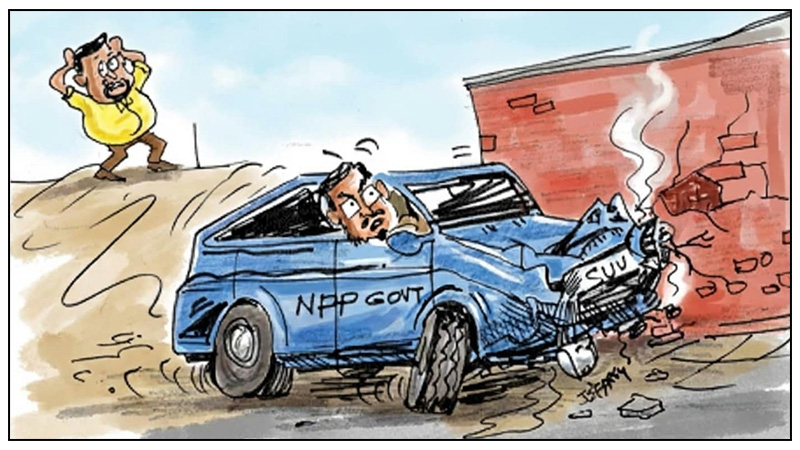
The NPP government is apparently sinking into a pit dug by the one of its members, ‘Dr’ Asoka Ranwala; perhaps a golden pit (Ran Wala) staying true to his name! Some may accuse me of being unpatriotic by criticising a government facing the uphill task of rebuilding the country after an unprecedented catastrophe. Whilst respecting their sentiment, I cannot help but point out that it is the totally unwarranted actions of the government that is earning much warranted criticism, as well stated in the editorial “Smell of Power” (The Island, 15 December). Cartoonist Jeffrey, in his brilliance, has gone a step further by depicting Asoka Ranwala as a giant tsunami wave rushing to engulf the tiny NPP house in the shore, AKD is trying to protect. (The Island, 18 December).
The fact that Asoka Ranwala is very important to the JVP, for whatever reason, became evident when he was elected the Speaker of Parliament despite his lack of any parliamentary experience. When questions were raised about his doctorate in Parliament, Ranwala fiercely defended his position, ably supported by fellow MPs. When the Opposition kept on piling pressure, producing evidence to the contrary, Ranwala stepped aside, claiming that he had misplaced the certificate but would stage a comeback, once found. A year has passed and he is yet to procure a copy of the certificate, or even a confirmatory letter from the Japanese university!
The fact that AKD did not ask Ranwala to give up his parliamentary seat, a decision he may well be regretting now following recent events, shows that either AKD is not a strong leader who can be trusted to translate his words to action or that Ranwala is too important to be got rid of. In fact, AKD should have put his foot down, as it was revealed that Ranwala was a hypocrite, even if not a liar. Ranwala led the campaign to dismantle the private medical school set up by Dr Neville Fernando, which was earning foreign exchange for the country by recruiting foreign students, in addition to saving the outflow of funds for educating Sri Lankan medical graduates abroad. He headed the organisation of parents of state medical students, claiming that they would be adversely affected, and some of the photographs of the protests he led refer to him as Professor Ranwala! Whilst leading the battle against private medical education, Ranwala claims to have obtained his PhD from a private university in Japan. Is this not the height of hypocrisy?
The recent road traffic accident he was involved in would have been inconsequential had Ranwala been decent enough to leave his parliamentary seat or, at least, being humble enough to offer an apology for his exaggerated academic qualifications. After all, he is not the only person to have been caught in the act of embellishing a CV. As far as the road traffic accident is concerned, too, it may not be his entire responsibility. Considering the chaotic traffic, in and around Colombo, coupled with awful driving standards dictated by lack of patience and consideration, it is a surprise that more accidents do not happen in Sri Lanka. Following the accident, may be to exonerate from the first count, a campaign was launched by NPP supporters stating that a man should be judged on his achievements, not qualifications, further implying that he does not have the certificate because he got it in a different name!
What went wrong was not the accident, but the way it was handled. Onlookers claim that Ranwala was smelling of alcohol but there is no proof yet. He could have admitted it even if he had taken any alcohol, which many do and continue to drive in Sri Lanka. After all, the Secretary to the Ministry overseeing the Police was able to get the charge dropped after causing multiple accidents while driving under the influence of liquor! He, with another former police officer, sensing the way the wind was blowing formed a retired police collective to support the NPP and were adequately rewarded by being given top jobs, despite a cloud hanging over them of neglect of duty during the Easter Sunday attacks. This naïve political act brought the integrity of the police into question. The way the police behaved after Ranwala’s accident confirmed the fears in the minds of right-thinking Sri Lankans.
In the euphoria of the success of a party promising a new dawn, unfortunately, many political commentators kept silent but it is becoming pretty obvious that most are awaking to the reality of a false dawn. It could not have come at a worse time for the NPP: in spite of the initial failures to act on the warnings regarding the devastating effects of Ditwah, the government was making good progress in sorting problems out, when Ranwala met with an accident.
The excuses given by the police for not doing a breathalyser test, or blood alcohol levels, promptly, are simply pathetic. Half-life of alcohol is around 4-5 hours and unless Ranwala was dead drunk, it is extremely unlikely any significant amounts of alcohol would be detected in a blood sample taken after 24 hours. Maybe the knowledge of this that made government Spokesmen to claim boldly that proper action would be taken irrespective of the position held. Now that the Government Analyst has not found any alcohol in the blood, no action is needed! Instead, the government seems to have got the IGP to investigate the police. Would any police officers suffer for doing a favour to the government? That is the million-dollar question!
Unfortunately, all this woke up a sleeping giant; a problem that the government hoped would be solved by the passage of time. If the government is hoping that the dishonesty of one of its prominent members would be forgotten with the passage of time, it will be in for a rude shock. When questioned by journalists repeated, the Cabinet spokesman had to say action would be taken if the claim of the doctorate was false. However, he added that the party has not decided what that action would be! What about the promise to rid Parliament of crooks?
It is now clear that the NPP government is not any different from the predecessors and that Sri Lankan voters are forced to contend with yet another false dawn!
by Dr Upul Wijayawardhana ✍️

The international tea industry is experiencing one of the most difficult periods in its history. Producers worldwide are caught in a paradox: tea must be made “cheaper than water” to stay competitive, yet this very race to the bottom erodes profitability, weakens supply chains, and drives away the most talented professionals whose expertise is essential for innovation. At the heart of this crisis lies the structure of commodity tea pricing. Although the auction system has served the world for over a century, it has clear limitations. It rewards volume rather than innovation, penalises differentiation, and leaves little room for value-added product development.
Sri Lanka, one of the world’s finest tea origins, feels this pressure more intensely than most. The industry’s traditional reliance on auctions prevents it from accessing the full premium that its authentic climate, terroir, and craftsmanship deserve. The solution is not to dismantle auctions—because they maintain transparency and global trust—but to evolve beyond them. For tea to thrive again, Ceylon Tea must enter the product market, where brand value, wellness benefits, and consumer experience define price—not weight.
Sri Lanka’s Unique Comparative Advantage
Sri Lanka possesses both competitive and comparative advantage unmatched by any other tea-producing nation. One of the least-discussed scientific advantages is its low gravitational pull, enabling the tea plant to circulate nutrients differently and produce a uniquely delicate, flavour-rich leaf. This natural phenomenon, combined with diverse microclimates, gives Sri Lankan tea extraordinary antioxidant density, rich polyphenols, and a full sensory profile representative of the land and its people.
However, this advantage is undermined by weaknesses in basic agronomy. Most estates do not use soil augers, and soil sampling is often inconsistent or unscientific. This leads to overuse of artificial fertilizer, underinvestment in regenerative practices, and weak soil organic matter (SOM). Without scientific soil management, even a world-class tea origin can lose its competitive edge. Encouragingly, discussions are already underway with the Assistant Indian High Commissioner in Kandy to explore sourcing 3,000 scientifically engineered soil augers for Sri Lanka’s perennial agriculture sector—a transformative step toward soil intelligence and sustainable input management.
Improving SOM, moderating fertilizer misuse, and systematically diagnosing soil nutrient deficiencies represent true sustainability—not cosmetic commitments. Plantation agriculture, which supports over one million Sri Lankan livelihoods, depends on this shift.
The Real Economic Challenge: Price per Kilogram
The most urgent sustainability problem is not climate change or labour cost—it is the low price per kilogram Sri Lanka receives for its tea. Nearly 20% of the tea leaf becomes “refuse tea”, a stigmatized fraction that still contains antioxidants and valuable nutrients but fetches a low price at auctions. The system inherently undervalues almost a fifth of the raw material.
A rational solution is to market the entire tea leaf without discrimination, transforming every component—tender leaf, mature leaf, fiber, and fines—into a premium product with a minimum retail value of USD 15 per kilogram. Achieving this requires product innovation, not further cost reduction.
Ceylon Pot Tea: A Transformative Opportunity
Ceylon Pot Tea emerges as a comprehensive solution capable of addressing long-standing structural issues in Sri Lanka’s tea industry. Unlike traditional tea grades, Pot Tea compresses the entire fired dhool into a high-value cube, similar to the global success of soup cubes. Every part of the leaf is represented, unlocking maximum biochemical utilisation and offering consumers a fuller taste profile with richer aroma, deeper colour, and higher antioxidant content.
Pot Tea is perfectly aligned with the health and wellness market, one of the fastest-growing global consumer segments. As an Herbal Medicinal Beverage (HMB), it captures the complete phytonutritional matrix of the tea leaf, including polyphenols, catechins, and climate-influenced compounds unique to Ceylon. The product also offers storytelling power: every cube reflects the terroir, the gentle fingers that plucked the leaf, and the mystical nature of tea grown in a land with unusually low gravitational intensity.
Already, international partners—particularly in Russia—and domestic innovators have expressed enthusiasm. Pot Tea aligns closely with the policy direction set by the Hon. Samantha Vidyarathne and the NPP Government, especially the national goal of achieving 400 million Kgs of national annual production per year by unlocking new value chains and premium product categories.
Why Immediate Government Intervention Is Necessary
For Sri Lanka to fully benefit from Ceylon Pot Tea and other modernized value chains, the government must urgently introduce:
1. Minimum Yield Benchmarks per hectare (3-year targets) for all perennial crops, informed by scientific investment appraisals.
2. A classification shift from “plantations” to land-based investment enterprises, recognising the capital-intensive, long-term nature of tea cultivation.
3. Incentives for soil testing, soil auger adoption, and SOM improvement programs.
4. Support for value-added tea manufacturing and export diversification.
These steps would create an enabling environment for Pot Tea to scale rapidly and position Sri Lanka as the world’s leading innovator in tea-based wellness products.
Way Forward: Positioning Ceylon Pot Tea for Global Leadership
The path ahead requires a coordinated national and industry-level effort. Sri Lanka must shift from simply producing tea to designing tea experiences. Ceylon Pot Tea can lead this transformation if:
1. Branding and Certification Are Strengthened
CCT (Ceylon Certified Tea) standards must be universally adopted to guarantee purity, origin authenticity, and ethical production practices.
2. Research, Soil Science & Agronomy Are Modernized
With scientific soil audits, optimized fertigation, and regenerative agriculture, Sri Lanka can unlock higher yields and stronger biochemical profiles in its leaf.
3. A Global Wellness Narrative Is Created
Position Pot Tea as a nutritional, therapeutic, anti-aging, and calming beverage suited for the modern lifestyle.
4. Export Market Activation Begins Immediately
Pilot shipments, influencer partnerships, and cross-border digital campaigns should begin with Russia, the Middle East, Japan, and premium EU markets.
5. Producers Are Incentivised to Convert Dhools to Cubes
This ensures minimal waste, improved margins, and equitable value distribution across the supply chain.
Conclusion: A New Dawn for Ceylon Tea
Ceylon Pot Tea offers Sri Lanka a rare chance to pivot from a commodity-driven past to a premium, wellness-oriented, high-margin future. It aligns economic sustainability with environmental responsibility. It empowers estate communities with modern agronomy. And most importantly, it transforms every gram of the tea leaf into value—finally rewarding the land, the planter, and the plucker.
If implemented with vision and urgency, Ceylon Pot Tea will not only revitalise an industry under immense pressure but also secure Sri Lanka’s place as the world’s most innovative and scientifically grounded tea nation.
By. Dammike Kobbekaduwe
(www.vivonta.lk & www.planters.lk) ✍️

Navy seizes an Indian fishing trawler poaching in Sri Lankan waters north of Talaimannar

Several spells of showers may occur in Central, Uva and Eastern provinces and in Polonnaruwa and Mullaittivu districts

India’s External Affairs Minister meets Sri Lanka PM

Shafali 69 not out , spinners lead India’s rout of Sri Lanka

Sri Lanka’s coastline faces unfolding catastrophe: Expert

SOC examines proposed amendments to the Microfinance and Credit Regulatory Authority Bill

‘Dates have the highest sugar content to fight Coronavirus’

Sunday Island 27 December – Headlines

#SundayIsland 17th December – Headlines

Sunday Island – 28th March

Sunday Island Headlines – 21 March

Sunday Island – 21st February – Headlines
-

 News2 days ago
Members of Lankan Community in Washington D.C. donates to ‘Rebuilding Sri Lanka’ Flood Relief Fund
-

 News7 days ago
Pope fires broadside: ‘The Holy See won’t be a silent bystander to the grave disparities, injustices, and fundamental human rights violations’
-

 News7 days ago
Pakistan hands over 200 tonnes of humanitarian aid to Lanka
-

 Business6 days ago
Unlocking Sri Lanka’s hidden wealth: A $2 billion mineral opportunity awaits
-

 News6 days ago
Army engineers set up new Nayaru emergency bridge
-

 News7 days ago
Officials of NMRA, SPC, and Health Minister under pressure to resign as drug safety concerns mount
-

 News7 days ago
Expert: Lanka destroying its own food security by depending on imported seeds, chemical-intensive agriculture
-

 Editorial7 days ago
Flawed drug regulation endangers lives