
Sports
A script gone sour!

36th Anniversary of Sri Lanka’s first ever Test match at Lord’s – Part 1
by Rohan Wijeyaratna
“We’ve actually come here” said the middle-aged man seated next to me, “to watch a proper game of cricket”. Dressed in jacket and a gaudy ‘bacon and eggs’ tie, he was with a group of four others, settling into their seats in the upper tiers of the New Tavern Stand, with the expectation of witnessing an enjoyable day’s cricket. The drift of their conversation seemed no different to the sentiments expressed in the English press and elsewhere, that the game about to begin would be agreeably one sided. Many felt England had a great opportunity of redeeming themselves after the fearful thrashing they received at the hands of the West Indies, earlier that summer.
No one could fault such sentiment. Sri Lanka’s lead up to their first Test at Lord’s had been less than impressive. Beginning 25th July, the Lankans played Nottinghamshire, Surrey, Gloucestershire, Hampshire, Kent, Sussex and Warwickshire and – barring Kent – they failed to bowl out any of the other sides even once. Also, they lost to Surrey. “Not much better than Cambridge University” was the honest appraisal of an experienced county coach, without stooping to insult. Going by the match results at the time, that seemed fair comment.
England’s rough summer
 This was 23rd August 1984. England had suffered a complete ‘blackwash’ earlier that summer at the hands of the West Indies, losing 5-0. The pounding was so intense and intimidating, it prompted cricket sages like Jim Swanton to suggest the drawing of a mandatory line across the wicket, compelling bowlers to pitch beyond it. That the West Indians derived most of their menace through their unrelenting pace there was no doubt, but the extent to which they used the short pitched delivery made it seem that batting was as much an exercise in self defense as it was, in defense of the wicket. Even night-watchmen weren’t spared. Batsmen literally jumped out of their skins with both feet off the ground, trying to keep the ball down, or frantically swaying out of the way to avoid grievous injury. The bowlers were like men possessed. There were not just one or two of them, but often four in tandem; all delivering at furious pace, unrelenting fury and unerring accuracy. Importantly, they were all pitched short of a good length. Whichever side of the divide one belonged, there was no denying this was violent cricket, which fell way short of the game’s famed chivalry. Given all of that, the Sri Lankan match at the tail end of the summer, was expected to offer the perfect antidote to what had gone on before.
Manna from heaven!
On a murky overcast morning, David Gower won the toss and sensing some possible early inroads, decided to field. As it proved, it was a serious misjudgment. Shortly, Wettimuny and Amal Silva walked out from the shadows of the hallowed pavilion at Lord’s, nervously aware how many illustrious men have trodden those very same steps before. They were greeted with polite applause, and soon everyone had taken their positions. But just before ‘play’ was called, there was an interruption. A scattering of banner waving detractors invaded the field and held up play for several minutes, to the complete bemusement of all! It took a while to connect that this was a demonstration with political connotations. When the ground was finally cleared, it was evident the pitch invasion had left its mark on at least one person in the middle.
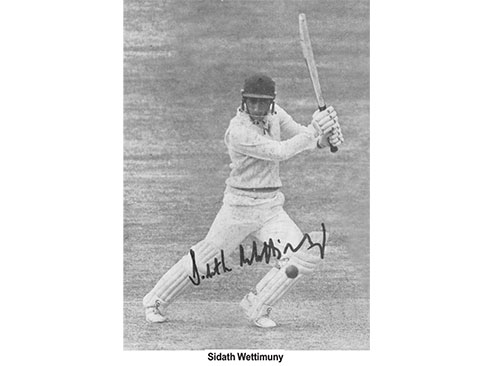
Walking to the middle and facing the first ball of a Lord’s Test match could be a daunting task to even the best amongst experienced campaigners. Sidath Wettimuny was no exception. The long walk, then taking guard, taking in the atmosphere, enduring the suspense of the ‘wait’ for the first ball; being sub-consciously reminded of his team’s expectations of him – all these would have created their own share of tensions, adding to the butterflies already in his stomach. Then suddenly, there came the disruption! To an already tensed Sidath Wettimuny, this seemed like manna from heaven!
On his way!
This disruption helped ease the mounting tension within Sidath Wettimuny and soon he was seen busily making explanations to his shell-shocked adversaries as to what the invasion was all about. Just moments before, these very same men had been aggressively scowling at him from the slip cordon and elsewhere, and now they were lapping up every word he uttered, as though it was the gospel! The interlude must have helped dispel all the butterflies in his stomach, for, when play got under way, and a shortish delivery presented itself outside the off, Wettimuny lost no time in getting well on top of it, cutting it neatly to the left of point for two. Shortly thereafter to a ball that was even shorter and wider, he launched into the type of shot he would normally never have played, unless well past 20. It was a well controlled, searing square cut, which sent the leather scuttling away between fourth slip and gully, to register Sri Lanka’s first Test boundary at Lord’s.
Wettimuny continued in this vein, taking most of the strike and doing most of the scoring. Presently, he essayed a sublime drive past point off Botham for four, and then unfurled a sumptuous repeat of the shot off Ellison. At most times he was copybook perfect, and when he wasn’t, he made sure the ball met the bat at its sweetest spot. Wide half volleys were spectacularly square driven while several other memorable strokes followed, as he reached the first of several milestones during his epic innings. He brought up his 50 by rolling off two dashing fours off Agnew in the final over before lunch; the first – an uppish slash over the slips to a very wide ball which stood up, and the other – a near one handed cover drive, coiling and then uncoiling with the shot, in one beautiful symphonic movement. Sri Lanka came into lunch at 81 for 2 with Wettimuny having made 51 of them.
Near vulnerable position
For a while at least within the first hour when the scoreboard read 42-2 after 13 overs, Gower’s decision with the toss seemed vindicated. Even though Jim Fairbrother’s farewell wicket to Test cricket was the friendliest featherbed any batting side could have asked for, and even though the bowling did no justice to the four slips and gully that stood in patient hope, Amal Silva batting with no trouble at all was trapped leg before to a Botham in-swinger. Madugalle the next man in, was comprehensively bowled shortly thereafter, to a delivery which swung back late. This left Wettimuny and Roy Dias to navigate the innings from a somewhat vulnerable position to the safety of the luncheon break, with the game still, evenly poised.
A throwback to a bygone era
If England harboured any hopes of an early breakthrough upon resumption, such hopes were quickly dashed by the two Sri Lankans. What unfolded after lunch was a delightful interlude of sublime Asian batting artistry, where wristwork, footwork, placement and touch, were amply displayed in a throwback to a by-gone era of technically correct batting, laced with style and unending grace. There was no further evidence needed to showcase the cricketing pedigree of both these batsmen. Relying mostly on his water-tight technique and his lyrical off-side driving, Wettimuny shortly reached his hundred in the 54th over, out of a total of 154. As the entire ground stood to him in warm applause, it was evident that the spirit of cricket was alive and well, and good cricket was being recognized; never mind from where it came.
Dias meanwhile, not to be outdone, displayed shades of his undisputed class. His regally elegant off-side play was complemented with decisive clips through midwicket to anything that was on his pads. He had not just style and grace, but command as well in all his offerings, but just when the stage was really well set for one great innings to remember, Dias fell victim to a clever piece of deception by the wily Surrey off- spinner Pocock. The bowler enticed him to go through with the shot, to a ball that hadn’t quite arrived and Dias paid the penalty. He made 32 out of a 102 run partnership from 150 minutes of batting.
In his element
 The departure of Roy Dias brought the pugnacious 21 year old Ranatunga to the center. Looking every bit as cheeky as he always was, Ranatunga quickly set about scuttling the bowling with an array of off side shots, using no noticeable back lift and curbing himself until the ball was almost upon him. He would then lean into it with some muscle and scuttle it away, be it from backward point to long-on. Anything that was on his pads, he would deftly deflect backward of square, with the assurance of a man who was in complete control of himself.
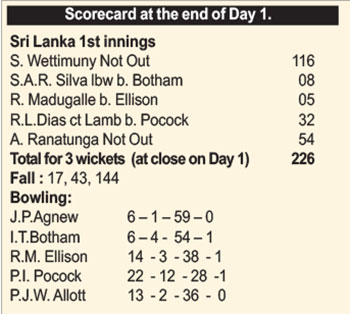
Wettimuny meanwhile, was increasingly stricken with cramp and was content on playing second fiddle. This allowed Ranatunga to take on the bulk of the bowling. The leftie would busily square drive or punch on the off, picking gaps or creating them, while gorging himself on the bowling as if it were a plate of rice. At tea, Sri Lanka were 173 for three and by the end of the day’s play 30 minutes before the scheduled close, they were 226 for three. Amply blessed with patience and style, Wettimuny returned unbeaten on 116 on a day he could do no wrong even if he tried. Ranatunga remained unbeaten on 54.
To be continued tomorrow.






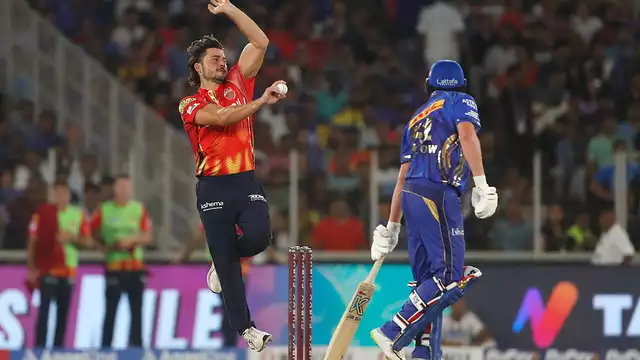

Why did David Miller refuse a single off the penultimate delivery with Delhi Capitals needing 2 off 2? It’ll be spoken of for a while, but not inside the Gujarat Titans change room. Because Prasidh Krishna bowled a nerveless slower bouncer off the final delivery that Miller missed, and Jos Buttler then nailed a direct hit with an underarm throw from behind the stumps to run out Kuldeep Yadav, clinching a dramatic first win for GT in IPL 2026.
Despite being adjudged run out on the field, Miller wasn’t in the mood to concede defeat, and reviewed the final ball for a possible wide. But when replays confirmed what he had perhaps known, he was crestfallen. Equally distraught in the dugout was K L Rahul, whose 52-ball 92 set the game up for DC but for one run.
It was GT’s first win of the tournament and the first loss for DC after starting the campaign with two wins in a row.
Thirty-six needed off 12. A bruised finger that didn’t make it easy for him to grip the bat had forced Miller to retire hurt with DC needing 81 off 42. But when Tristan Stubbs was run-out in the 17th over, Miller returned hoping to play second fiddle to Rahul. Instead, he was now expected to deliver a box-office hit with Rahul nicking behind off a full Mohammed Siraj delivery two balls later.
Miller nearly delivered what was expected, as he went 6, 4, 6 off Siraj, repeatedly peppering the short leg-side boundary. At the other end, Vipraj Nigam also ramped four off a short delivery to bring the equation down to a manageable 13 off the final over.
Prasidh was tasked to bowl the final over. His three overs prior to that had been walloped for 41; Rahul, his state mate, had climbed into him earlier in the night. But all that would’ve been forgiven if Prasidh delivered a gun final over. That GT could only have four fielders out due to a slow over rate added to his challenge. And he nearly succumbed.
Nigam made room and swung cleanly to hit the first ball to the long-off fence, but a rush of blood had him swipe the second delivery to Shubman Gill at mid-off. With DC now needing nine off four, Kuldeep gently deflected his first ball to deep third to leave the chase in Miller’s hands.
With the equation down to 8 off 3, Prasidh bowled a slot-ball that Miller walloped over long-off. But with two needed, Miller inexplicably refused a single to take it all upon himself to finish the deal. He couldn’t connect on the final ball, and Prasidh belted a roar. GT had pulled one from under DC’s rug in dramatic circumstances.
After scores of 1 and 0 in his first two games, Rahul announced himself with a 29-ball half-century that was as pleasing as they come for large parts. It was also one that didn’t have the baggage of him playing run-accumulator, like he has tended to in the past while opening the batting. This Rahul was fun, free and fearless and he helped DC overcome a few roadblocks along the way, like when they lost two wickets in two deliveries to Rashid Khan at the halfway mark.
Rahul was particularly menacing against the fast bowlers, and it began with a wristy flick that he sent way back over deep square off Kagiso Rabada. The early jitters out of the way – if he even had some inkling of them – he batted like a man possessed, fearlessly climbing into length balls from Prasidh over cover, and slapping disdainfully over point.
He is good, but where is the Rashid of old, they asked. Turns out he hadn’t gone anywhere. After he conceded just nine in his first two with DC rampant, he returned to dismiss Nitish Rana in his dramatic third over, the 10th of the innings. Having been given out lbw earlier, only for Rana to overturn the decision through DRS, he was out a few balls later when he miscued a googly to Sai Sudharsan at long-off. This was Rana’s third sub-20 score of the season.
This brought the in-form Sameer Rizvi to the middle, and he lasted all of one delivery as Rashid snuck through his inside-edge with a ripping googly to briefly elicit jitters in the DC camp. This is when Miller entered, before briefly exiting with seven overs left. But in the same over, when Rashid had Axar Patel slice one to Glenn Phillips running back from cover, GT started to have an opening.
On any other night, Rashid’s spell would have cracked open the game. The fact that DC were still in it despite these wickets was down to Rahul. It needed the skilful Siraj to dismiss him with DC needing 45 off three overs. By then, the pressure was telling.
That GT were eventually able to get over the line was down to their run cushion, made possible thanks to half-centuries from Jos Buttler, Gill and Washington Sundar. Buttler looked unshackled, hitting four sixes off his first 15 deliveries en route a bruising half-century, while Gill played himself in and then allayed fears of neck spasms during his takedown of Kuldeep with the slog sweep. Then Washington, promoted to No. 4, struck his maiden IPL fifty to shore up the innings.
Even so, GT managed just 49 off the last five. On another day, this may have proved to be costly. It didn’t on Wednesday, and for that, they have Rashid to thank.
Brief scores:
Gujarat Titans 210 for 4 in 20 overs (Sai Sudarshan 12, Shubman Gill 70, Jos Buttler 52, Washington Sundar 55, Glenn Phillips 14*; Mukesh Kumar 2-55, Lungi Ngidi 1-24, Kuldeep Yadav 1-42 ) beat Delhi Capitals 209 for 8 in 20 overs (Pathum Nissanka 41, KL Rahul 92, David Miller 41*, Vipraj Nigam 12; Mohammed Siraj 1-42, Rashid Khan 3-17, Prasidh Krishna 2-52) by one run
[Cricinfo]

A stunning hundred by opening bat Lasith Croospulle helped Sri Lanka ‘A’ to post a commanding 368 for nine in their allotted 50 overs and then restrict New Zealand ‘A’ to 158 for three and a secure a 44 run win [DLS method] at Suriyawewa yesterday. The win helped Sri Lanka to take an unassailable 2-0 series lead.
The star for Sri Lanka ‘A’ was the former Maris Stella College, Negombo cricketer Lasith Croospulle as he smashed 103 off just 76 balls hitting 13 fours and six sixes as the hosts piled up the runs.
Croospulle has represented Sri Lanka in one T20I and performances such as these are sure to earn him a regular spot in the white ball sides.
The middle order then ensured that they didn’t spoil the good work of the top order with captain Sahan Arachchige and Sonal Dinusha posting half-centuries.
Arachchige smashed 76 in 68 balls with five fours and two sixes while young Sonal Dinusha put the bowling to the sword during the death overs. His 93 came off 77 deliveries with six fours and four sixes.
Dinusha, who has already made his Test debut and impressed many with his electric fielding could have gone on to post his hundred but sacrificed his wicket in a bid to score quick runs.
With the World Cup less than a year away and the selectors keeping a close eye on the second string, performances like these are sure to get their attention.
Rain reduced the game to 28 overs and New Zealand were given a revised target of 203 but they only managed 158 for three to hand Sri Lanka a comfortable win.
Sri Lanka ‘A’ had won the first game by 140 runs in Galle. Saturday’s third one-dayer will be a dead rubber.
The teams will stay back at Suriyawewa for two further weeks where the two match unofficial Test series will be played.
The composition for the four day games is set to change with Pasindu Sooriyabandara set to lead the side.

BCCI curbs movement of benched IPL players in latest rules

Prasidh trumps Miller in last-ball finish as Gujarat Titans clinch thriller

Greece to ban social media for under-15s from next year

Showers will occur at a few places in the Western, Sabaragamuwa and North-western provinces and in Galle, Matara, Kandy, Nuwara-Eliya and Mannar districts after 2.00 p.m.

Sun directly overhead Chilaw, Bingiriya, Halmillawewa, Panduwasnuwara, Gokarella, Kawudupelella, Koppaveli and Kirankulam about 12:12 noon. today (09)

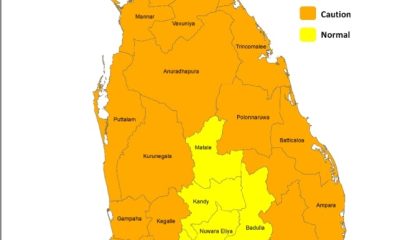
Heat Index at Caution Level in the Western, Sabaragamuwa, Southern, Eastern, North-western, Northern and North-central provinces and in Monaragala district

‘Dates have the highest sugar content to fight Coronavirus’

Sunday Island 27 December – Headlines

#SundayIsland 17th December – Headlines

Sunday Island – 28th March

Sunday Island Headlines – 21 March

Sunday Island – 21st February – Headlines
-

 Features4 days ago
Ranjith Siyambalapitiya turns custodian of a rare living collection
-

 News4 days ago
Global ‘Walk for Peace’ to be held in Lanka
-

 News2 days ago
Lankan-origin actress Subashini found dead in India
-

 Opinion6 days ago
Hidden truth of Sri Lanka’s debt story: The untold narrative behind the report
-

 Features4 days ago
Beyond the Blue Skies: A Tribute to Captain Elmo Jayawardena
-

 Features4 days ago
Aspects of Ceylon/Sri Lanka Foreign Relations – 1948 to 1976
-

 Features6 days ago
The Ramadan War
-

 Editorial5 days ago
Brouhaha over a book