
Features
A plea for establishing a transboundary Blue-Green Biosphere Reserve in Gulf of Mannar and Palk Bay

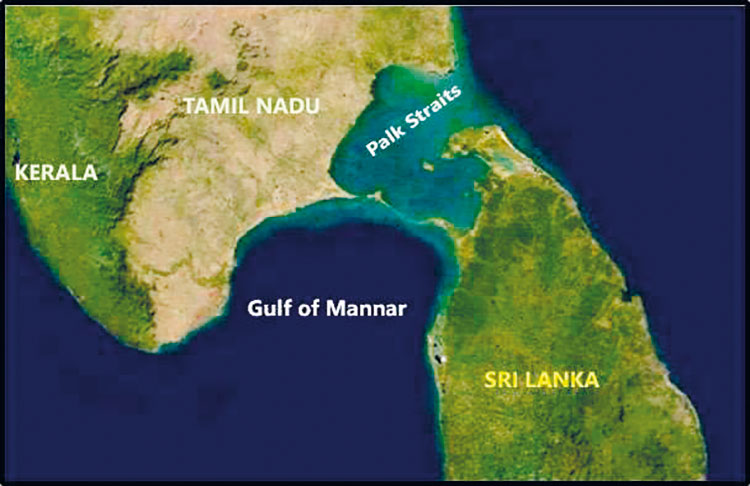
Blue-green land and waterscapes act as ecological corridors across land and water in creating an ecological continuity in order to protect and restore the habitats of native and naturalised species.
In addition, these ecological corridors also help to conserve and improve the habitats of migratory species, as well. One of the main objectives of establishing blue-green land-waterscapes is to reconcile increasing local/regional development and human livelihood challenges in a sustainable manner while, at the same time, safeguard biodiversity and their habitats/ecosystems, as far as possible.
While green landscapes are natural and semi-natural terrestrial vegetation types like natural forests and grasslands, blue waterscapes are aquatic or semi-aquatic vegetation types such as seagrass meadows, mangroves and coastal and other wetlands. These vegetated coastal ecosystems known as ‘blue carbon’ ecosystems are some of the most productive on Earth and located at the interfaces among terrestrial, freshwater and marine environments. They provide us with essential ecosystem services, such as serving as a buffer in coastal protection from storms and erosion, spawning grounds for fish, filtering pollutants and contaminants from coastal waters thus improving coastal water quality and contributing to all important food security.
In addition, they capture and store “blue” carbon from the atmosphere and oceans at significantly higher rates per unit area than tropical forests (Figure 1) and hence act as effective carbon sinks. By storing carbon, these ecosystems help to reduce the amount of greenhouse gas in the atmosphere, thus contributing significantly to mitigate the effects of climate change.

Figure 1: Carbon storage in different vegetation types (Source – What Is Blue Carbon and Why Does It Matter? – Sustainable Travel International)
.Blue-green Carbon Markets
The recognition of blue carbon (BC) ecosystems (primarily mangroves, seagrasses and tidal marshes) as an effective natural climate solution paved the way for their inclusion within carbon markets. Blue carbon is the marine analog of green carbon, which refers to carbon captured by terrestrial (i.e., land-based) plants. The blue-green carbon market involves buying and selling carbon credits from projects that protect and restore coastal and marine ecosystems (blue carbon) and terrestrial ecosystems (green carbon). Since Blue Carbon ecosystems have higher carbon sequestration (capture and store) potential compared to their terrestrial counterparts, blue Carbon credits are worth over two times more than green carbon credits. They offer opportunities for commercial enterprises to offset carbon emissions and in turn support climate action.
Blue Carbon projects are expected to grow twofold in the near future. With the recent surge in international partnerships and funding, there is immense growth potential for the blue carbon market. However, it is critically important to look beyond the value of the carbon sequestered to ensure the rights and needs of local communities that are central to any attempt to mitigate climate change using a blue and green carbon project.
Blue Carbon projects can serve as grassroot hubs for sustainable development by developing nature-based solutions in these ecosystems thus contributing to both climate change mitigation and adaptation. Globally, numerous policies, coastal management strategies, and tools designed for conserving and restoring coastal ecosystems have been developed and implemented. Policies and finance mechanisms being developed for climate change mitigation may offer an additional route for effective coastal management. The International Blue Carbon Initiative, for example, is a coordinated, global program focused on conserving and restoring coastal ecosystems for the climate, biodiversity and human wellbeing.
Until recently, most of these opportunities focus on carbon found in the above ground vegetative biomass and do not account for the carbon in the soil. On the other hand, blue carbon, in particular has the potential for immense growth in carbon capture economics in the near future and can provide significant socioeconomic and environmental benefits. Consequently, blue -green carbon habitats in the Gulf of Mannar – Palk Bay region represent invaluable assets in climate change mitigation and coastal ecosystem conservation and sustainable development.
Gulf of Mannar and Palk Bay Trans-boundary Region
The Gulf of Mannar and Palk Bay region form a transboundary area within the waters of southeastern India and northwestern Sri Lanka. This region supports dense seagrass meadows having a high level of marine biodiversity including marine mammals such as dugong. Sea turtles are frequent visitors to the gulf while sharks, dolphins, sperm and baleen whales too, have been reported from this area. The Mannar region is recognized as an Important Marine Mammal Area (IMMA) of the world by IUCN (Figure 2) and also an Important Bird Area by Birdlife International. This region as a whole is a store house of unique biological wealth of global significance and as such is considered as one of the world’s richest regions from a marine biodiversity perspective.
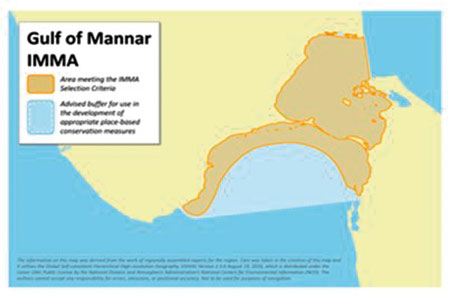
Figure 2. Gulf of Mannar and Palk Bay IMMA (Source – IUCN Joint SSC/WCPA Marine Mammal Protected Areas Task Force, 2022 IUCN-MMPATF (2022)
Gulf of Mannar Biosphere Reserve – India
India has already declared a part of this region as the UNESCO Gulf of Mannar Biosphere Reserve covering an area of 10,500 km2 of ocean with 21 islands and the adjoining coastline. The islets and coastal buffer zone include beaches, estuaries, and tropical dry broadleaf forests, while the surrounding seascape of the Marine National Park (established in 1986) and a 10 km strip of the coastal landscape that include seaweed communities, seagrass communities, coral reefs, salt marshes and mangrove forests form the coastal and marine component of the biosphere reserve on the Indian side of the Gulf of Mannar.
Sri Lankan ‘Proposed’ Biosphere Reserve
On the Sri Lankan side of the Palk Bay there is a semi-enclosed shallow water body between the southeast coast of India and Sri Lanka, with a water depth maximum of 13 m. To the south, a chain of low islands and reefs known as Adam’s Bridge or Rama Setu (Rama’s Bridge), separates Palk Bay from the Gulf of Mannar. The Palk Bay leads to Palk Strait (Figure 3). Palk Bay is one of the major sinks for sediments along with the Gulf of Mannar. Sediments discharged by rivers and transported by the surf currents as littoral drift settle in this sink.
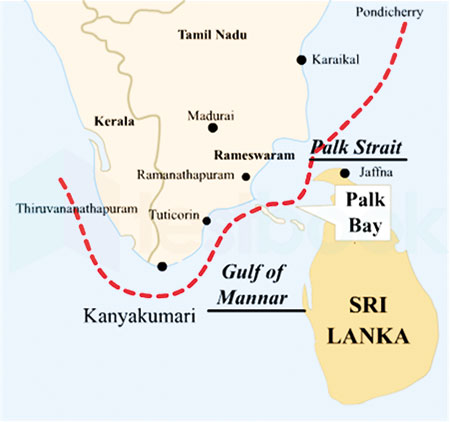
Figure 3: Gulf of Mannar and Palk Straits Source: Drishti IAS & Google Images
On the Sri Lankan side of the Palk Bay, studies are being conducted by the Dugong and Seagrass Conservation Project to establish an additional 10,000 hectares of Marine Protected Area to support the conservation of dugongs and their seagrass habitat in the Gulf of Mannar and Palk Bay. This project will involve the preparation of a multiple-community-based management plan in conjunction with government, fishing communities and the tourism industry.
With this valuable information emerging from projects of this nature, Sri Lanka has real opportunities to create a large marine protected area in the Gulf of Mannar and Palk Bay region and eventually merging them together with the Gulf of Mannar Biosphere Reserve of India to form a trans-boundary biosphere Reserve.
Terrestrial cum Marine Spatial Plan for the Gulf of Mannar and Palk Bay Region
Therefore, an excellent opportunity awaits both the Governments of Sri Lanka and India to collaborate in preparing of a terrestrial and marine spatial plan for this region, a prerequisite before going further on designing and implementing large scale development plans in establishing wind energy farms, mineral sand extraction, fishing industry, oil exploration and tourism development.
Coastal and Marine Spatial Planning (CMSP) is an integrated, place-based approach for allocating coastal and marine resources and space, while protecting the ecosystems that provide these vital resources.
On the Indian side, the Gulf of Mannar Biosphere reserve is well established and functional. On the Sri Lankan side, already there are three DWLC managed protected areas i) Adam’s Bridge Marine National Park (# 29 in the map – 18,990 ha declared in 2015), ii) Vedithalathiv Nature Reserve (# 35 -29,180 ha declared in 2016) and iii) Vankalai Sanctuary ( # 97 -4839 ha declared in 2008) (Figure 4) which can serve as the core zone of the Sri Lankan counterpart of a trans-boundary biosphere reserve. Due to the integrated nature of shallow wetland and terrestrial coastal habitats, Vankalai Sanctuary, in particular is highly productive, supporting high ecosystem and species diversity.
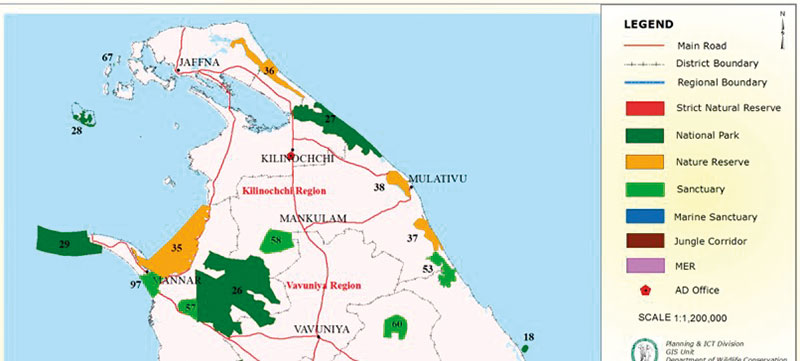
Figure 4: Protected Areas in Norther Sri Lanka Managed by the Department of Wildlife Conservation Source: DWLC
This site provides excellent feeding and living habitats for a large number of water bird species, including annual migrants, which also use this area on arrival and during their exit from Sri Lanka.
Having several coastal and marine protected areas already within the Sri Lankan territory provide an excellent opportunity to establish the Gulf of Mannar – Palk Bay blue-green Biosphere Reserve (Sri Lanka) initially and eventually to join up seamlessly with the already established Gulf of Mannar Biosphere Reserve on the Indian side to create a trans-boundary blue-green biosphere reserve.
This makes perfect sense because unlike sedentary plant species, mobile animal and plant groups (phytoplankton, in particular) do not respect human demarcated territorial boundaries. The provision of a common and unhindered protected coastal and marine passage for their customary movement for food and raising young is therefore of crucial importance in conservation management. Scientific evidence-based selection of additional areas, if necessary and their respective boundaries are best be determined in consultation with expert groups on marine mammals and reptiles, birds, fish, coastal vegetation conservation, sociology and industrial development from both sides of the divide.
Proper spatial planning needs to be done before large-scale development plans are designed and implemented in order to avoid conflicts of interest leading to inordinate delays and teething problems in project initiation. As a priority, the protected blue-green core and buffer regions need to be demarcated for their conservation. This could best be done in this narrow passage of land and water between Sri Lanka and India
( Palk Strait & Gulf of Mannar) by preparing a marine and terrestrial spatial plan along the UNESCO Man and Biosphere conceptual guidelines differentiating core, buffer and transition zones. While the protected areas in the core and buffer zone provide all important ecosystem services that would also serve as breeding ground for fish, crustaceans, marine reptiles, birds and mammals thereby provisioning sustainable industries to be developed in the surrounding transition areas demarcated in the joint spatial plan.
In addition, the Satoyama Global Initiative established by the Japanese at UNESCO as a global effort in 2009 to realise ‘societies in harmony with nature’ in which – Satoumi – specifically referring to the management of socio-ecological production landscapes in marine and coastal regions, is also a good model to be considered for conservation of biodiversity and co-existence between humans and nature.
Final Plea
In order to take this proposal forward from the Sri Lankan side, a number of useful baseline reports are already available including, but not limited to, the following: i. Biodiversity Profile of the Mannar District (CEJ & USAID 2022), ii. The Gulf of Mannar and its surroundings (IUCN 2012), iii) Atlas of Mangroves, Salt Marshes and Sand Dunes of the Coastal Area from Malwathu Oya to Pooneryn in the Northwestern Coastal Region, Sri Lanka (Ecological Association of Sri Lanka, Peradeniya, Sri Lanka, 2020). iv. Integrated Strategic Environment Assessment of the Northern Province of Sri Lanka (CEA 2014).
If this proposal to establish a Trans-boundary Blue-Green Biosphere Reserve in the Gulf of Mannar and Palk Bay is acceptable in principle to the Governments of Sri Lanka and India, it would be ideal if the Man and the Biosphere (MAB) program UNESCO which is an intergovernmental scientific program whose mission is to establish a scientific basis for enhancing the relationship between people and their environments to partner with the relevant Government and non-governmental agencies in both countries in making it a reality. This proposed concept has all the necessary elements for developing a unique sustainable conservation cum industrial development strategy via nature-based solutions while at the same time contributing to both climate change mitigation and adaptation.
by Emeritus Professor Nimal Gunatilleke,
University of Peradeniya



 The abduction of Venezuelan President Nicolas Maduro by US special forces on January 3rd and his coercive conveying to the US to stand trial over a number of allegations leveled against him by the Trump administration marks a dangerous degeneration of prevailing ‘world disorder’. While some cardinal principles in International Law have been blatantly violated by the US in the course of the operation the fallout for the world from the exceptionally sensational VVIP abduction could be grave.
Although controversial US military interventions the world over are not ‘news’ any longer, the abduction and hustling away of a head of government, seen as an enemy of the US, to stand trial on the latter soil amounts to a heavy-handed and arrogant rejection of the foundational principles of international law and order. It would seem, for instance, that the concept of national sovereignty is no longer applicable to the way in which the world’s foremost powers relate to the rest of the international community. Might is indeed right for the likes of the US and the Trump administration in particular is adamant in driving this point home to the world.
Chief spokesmen for the Trump administration have been at pains to point out that the abduction is not at variance with national security related provisions of the US Constitution. These provisions apparently bestow on the US President wide powers to protect US security and stability through courses of action that are seen as essential to further these ends but the fact is that International Law has been brazenly violated in the process in the Venezuelan case.
To be sure, this is not the first occasion on which a head of government has been abducted by US special forces in post-World War Two times and made to stand trial in the US, since such a development occurred in Panama in 1989, but the consequences for the world could be doubly grave as a result of such actions, considering the mounting ‘disorder’ confronting the world community.
Those sections opposed to the Maduro abduction in the US would do well to from now on seek ways of reconciling national security-related provisions in the US Constitution with the country’s wider international commitment to uphold international peace and law and order. No ambiguities could be permitted on this score.
While the arbitrary military action undertaken by the US to further its narrow interests at whatever cost calls for criticism, it would be only fair to point out that the US is not the only big power which has thus dangerously eroded the authority of International Law in recent times. Russia, for example, did just that when it violated the sovereignty of Ukraine by invading it two or more years ago on some nebulous, unconvincing grounds. Consequently, the Ukraine crisis too poses a grave threat to international peace.
It is relevant to mention in this connection that authoritarian rulers who hope to rule their countries in perpetuity as it were, usually end up, sooner rather than later, being a blight on their people. This is on account of the fact that they prove a major obstacle to the implementation of the democratic process which alone holds out the promise of the prgressive empowerment of the people, whereas authoritarian rulers prefer to rule with an iron fist with a fixation about self-empowerment.
Nevertheless, regime-change, wherever it may occur, is a matter for the public concerned. In a functional democracy, it is the people, and the people only, who ‘make or break’ governments. From this viewpoint, Russia and Venezuela are most lacking. But externally induced, militarily mediated change is a gross abnormality in the world or democracy, which deserves decrying.
By way of damage control, the US could take the initiative to ensure that the democratic process, read as the full empowerment of ordinary people, takes hold in Venezuela. In this manner the US could help in stemming some of the destructive fallout from its abduction operation. Any attempts by the US to take possession of the national wealth of Venezuela at this juncture are bound to earn for it the condemnation of democratic opinion the world over.
Likewise, the US needs to exert all its influence to ensure that the rights of ordinary Ukrainians are protected. It will need to ensure this while exploring ways of stopping further incursions into Ukrainian territory by Russia’s invading forces. It will need to do this in collaboration with the EU which is putting its best foot forward to end the Ukraine blood-letting.
Meanwhile, the repercussions that the Maduro abduction could have on the global South would need to be watched with some concern by the international community. Here too the EU could prove a positive influence since it is doubtful whether the UN would be enabled by the big powers to carry out the responsibilities that devolve on it with the required effectiveness.
What needs to be specifically watched is the ‘copycat effect’ that could manifest among those less democratically inclined Southern rulers who would be inspired by the Trump administration to take the law into their hands, so to speak, and act with callous disregard for the sovereign rights of their smaller and more vulnerable neighbours.
Democratic opinion the world over would need to think of systems of checks and balances that could contain such power abuse by Southern autocratic rulers in particular. The UN and democracy-supportive organizations, such as the EU, could prove suitable partners in these efforts.
All in all it is international lawlessness that needs managing effectively from now on. If President Trump carries out his threat to over-run other countries as well in the manner in which he ran rough-shod over Venezuela, there is unlikely to remain even a semblance of international order, considering that anarchy would be receiving a strong fillip from the US, ‘The World’s Mightiest Democracy’.
What is also of note is that identity politics in particularly the South would be unprecedentedly energized. The narrative that ‘the Great Satan’ is running amok would win considerable validity among the theocracies of the Middle East and set the stage for a resurgence of religious fanaticism and invigorated armed resistance to the US. The Trump administration needs to stop in its tracks and weigh the pros and cons of its current foreign policy initiatives.

 The British School in Colombo (BSC) hosted its Annual Christmas Carnival 2025, ‘Gingerbread Wonderland’, which was a huge success, with the students themseles in the spotlight, managing stalls and volunteering.
The event, organised by the Parent-Teacher Association (PTA), featured a variety of activities, including: Games and rides for all ages, Food stalls offering delicious treats, Drinks and refreshments, Trade booths showcasing local products, and Live music and entertainment.

The carnival was held at the school premises, providing a fun and festive atmosphere for students, parents, and the community to enjoy.
The halls of the BSC were filled with pure Christmas magic and joy with the students and the staff putting on a tremendous display.
Among the highlights was the dazzling fashion show with the students doing the needful, and they were very impressive.

The students themselves were eagerly looking forward to displaying their modelling technique and, I’m told, they enjoyed the moment they had to step on the ramp.
The event supported communities affected by the recent floods, with surplus proceeds going to flood-relief efforts.

 Hi! This week I’m giving you some beauty tips so that you could look forward to enjoying 2026 with a glowing younger looking skin.
Face wash for natural beauty
* Avocado:
Take the pulp, make a paste of it and apply on your face. Leave it on for five minutes and then wash it with normal water.
* Cucumber:
Just rub some cucumber slices on your face for 02-03 minutes to cleanse the oil naturally. Wash off with plain water.
* Buttermilk:
Apply all over your face and leave it to dry, then wash it with normal water (works for mixed to oily skin).
Face scrub for natural beauty
Take 01-02 strawberries, 02 pieces of kiwis or 02 cubes of watermelons. Mash any single fruit and apply on your face. Then massage or scrub it slowly for at least 3-5 minutes in circular motions. Then wash it thoroughly with normal or cold water. You can make use of different fruits during different seasons, and see what suits you best! Follow with a natural face mask.
Face Masks
* Papaya and Honey:
Take two pieces of papaya (peeled) and mash them to make a paste. Apply evenly on your face and leave it for 30 minutes and then wash it with cold water.
Papaya is just not a fruit but one of the best natural remedies for good health and glowing younger looking skin. It also helps in reducing pimples and scars. You can also add honey (optional) to the mixture which helps massage and makes your skin glow.
* Banana:
Put a few slices of banana, 01 teaspoon of honey (optional), in a bowl, and mash them nicely. Apply on your face, and massage it gently all over the face for at least 05 minutes. Then wash it off with normal water. For an instant glow on your face, this facemask is a great idea to try!
* Carrot:
Make a paste using 01 carrot (steamed) by mixing it with milk or honey and apply on your face and neck evenly. Let it dry for 15-20 minutes and then wash it with cold water. Carrots work really well for your skin as they have many vitamins and minerals, which give instant shine and younger-looking skin.

It’s 4-1 to Australia after Carey and Green complete stuttering chase at SCG

US seizes two ‘shadow fleet’ tankers linked to Venezuelan oil

Showers above 100 mm are likely at some places in the Eastern and Uva provinces and showers about 50-75 mm in other areas

Easter Sunday attacks: Govt. says wife of Katuwapitiya Church bomber alive

Indian Army Chief here

Kelaniya Duruthu Perahera

‘Dates have the highest sugar content to fight Coronavirus’

Sunday Island 27 December – Headlines

#SundayIsland 17th December – Headlines

Sunday Island – 28th March

Sunday Island Headlines – 21 March

Sunday Island – 21st February – Headlines
-

 News2 days ago
Interception of SL fishing craft by Seychelles: Trawler owners demand international investigation
-
 News2 days ago
Broad support emerges for Faiszer’s sweeping proposals on long- delayed divorce and personal law reforms
-

 News3 days ago
Private airline crew member nabbed with contraband gold
-

 News1 day ago
Prez seeks Harsha’s help to address CC’s concerns over appointment of AG
-

 News1 day ago
Govt. exploring possibility of converting EPF benefits into private sector pensions
-

 News5 days ago
Health Minister sends letter of demand for one billion rupees in damages
-

 Features2 days ago
Educational reforms under the NPP government
-

 Features3 days ago
Pharmaceuticals, deaths, and work ethics