
Features
A Humane Scholar at Oxford

by Jayantha Perera
I met Barbara Harrel-Bond, an anthropologist, by accident in April 1989. At that time, I was with the USAID-funded Mahaweli Agriculture and Rural Development Project (MARD). One day at lunchtime, an old jeep arrived at the project office. A white woman in her sixties emerged from the jeep. She was in a kurta and was carrying several notebooks in her hands. She smiled and asked me whether I could find someone who knew how Sinhala villagers interacted with Tamil villagers in the war-front area. I told her our professional staff had gone out for lunch, so she should wait until they returned.
With a cigarette on her lips, she introduced herself as Barbara. She was the Director of the Refugee Studies Programme (RSP) and a professor at Oxford University. She was an anthropologist with extensive field experience in Africa. Her book Imposing Aid: Emergency Assistance to Refugees was on international development aid. She was an authority in refugee studies and international refugee law. I told her I am a development anthropologist working on irrigation water management in the Mahaweli. Her eyes beamed with hope, and she shouted, “You are the man I wanted to meet!”
I invited her for lunch at my residence. I offered her a cold beer, which she gulped down in five seconds. She inquired whether it was okay to smoke inside the house. I said yes. I switched on the air conditioner in the sitting room, as it was hot and muggy. She was amused to feel the cold air and said, “It is nice to see an anthropologist who lives in an air-conditioned house in the field.” She thanked me for rescuing her from the scorching sun.
Barbara was interested in the history of rivalries between Tamils and Sinhalese. She asked me about their living conditions, income disparities, gender issues, and political orientation. I told Barbara we could discuss these issues at length if she could stay a few days at Aralaganwila. Barbara said she had planned several meetings and wanted to return to Colombo. She invited me for lunch during the weekend if I were in Colombo.
Our weekend meeting in Colombo was intellectually stimulating. Each time we discussed a new topic, she ordered more tea or beer while typing her notes into her laptop. It was a primitive machine with two cassette spools. One had the WordStar programme, and the other had her notes.
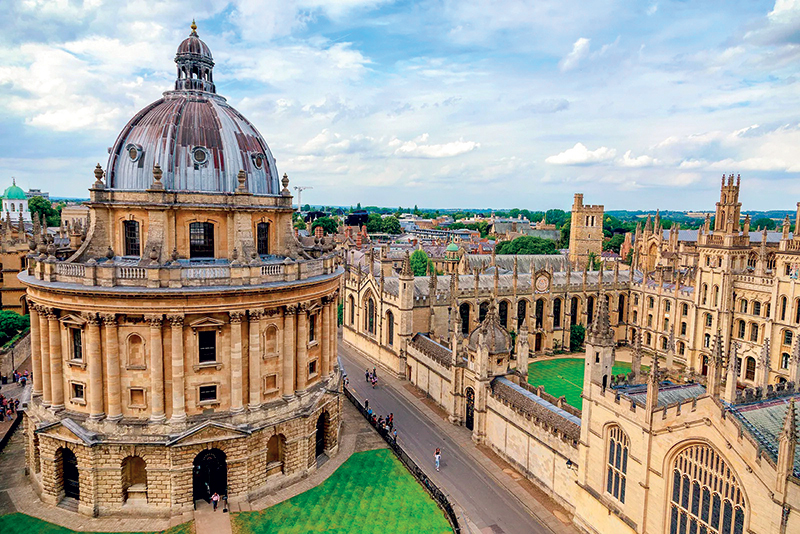
Barbara invited me to the RSP to deliver a few lectures on Sri Lanka, specifically its political structure and ethnic tensions. She told me that I could stay at her place in Oxford. After about two months, I received an invitation letter and a return air ticket from the RSP. When I reached Oxford, she told me she had sent a taxi to Heathrow Airport to bring me to Oxford. But she forgot to tell me where to meet the taxi driver.
Staying at her place in Oxford was an experience. She lived in an old house on St. Giles. I found a sleeping corner on a cosy sofa in her large living room when I arrived. She introduced me to two Ugandan refugees and an undergrad from a European University. The two Ugandans prepared the dinner. They cooked lamb in peanut gravy, and we all had that with rice and a salad.
After dinner, we all met in Barbara’s large bedroom to watch TV and discuss the day’s work and tomorrow’s programme. She lay down on her bed and listened to our discussions. She occasionally asked a question or two. That day, the TV did not work. She asked us whether one of us could check the TV. Only the young European women volunteered to check it. She said the electric plug was not correctly installed, but she quickly fixed it. Barbara laughed and teased others, saying, “I did not expect anthropologists to know how to turn on a TV.”
When I woke up the following day, Barbara had already brewed coffee. We took our cups to her library and settled into two comfortable chairs. Until 8 a.m., we discussed Sri Lanka’s socio-political conditions and the outlines of my upcoming two lectures. Barbara mentioned inviting several professors and lecturers from the law and development faculties to the lectures. She also hinted that I might join her as a research fellow shortly.
Before I left for Colombo, Barbara told me she would raise funds to recruit an anthropologist from the third world as a fellow. She explained the fellowship as teaching a two-term course at the postgraduate level on field methods in social sciences and qualitative data analysis. The fellow would also conduct an annual summer school on refugee studies. Later, she wrote, “We need someone like you who combines research and practical experience and can write well in English.”
Two months later, Barbara informed me that the RSP had raised funds for a Ford fellowship. She asked whether I would be interested in being the first Ford Fellow at the RSP. I did not answer her for two weeks as I was in a dilemma. I was happy at MARD. The Chief-of-Party was also an anthropologist with whom I shared my views on development. He was an amiable fellow. He told me I should stay with him on the project for at least five years. I had finished only 30 months of my contract. Life in the Mahaweli was comfortable, although there were two significant risks: the LTTE and wild elephants.
At that time, an official at the Mahaweli Ministry wanted more control over the project consultants. He complained to USAID I had written a paper criticising the Sri Lankan government’s agricultural policies. He tried to twist the paper’s contents to prove that I was against the MARD Project. The USAID held a formal meeting in which the DAI and the Mahaweli Development Ministry participated. The USAID and the DAI did not find any fault with my paper. However, the official was adamant that some action should be taken against me. I submitted my resignation letter to the Chief of Party. He was relieved to receive my resignation as he did not want to disagree with the government. I accepted the Ford fellowship at the RSP in Oxford. This decision filled me with a sense of accomplishment and inspiration for the future.

Barbara Harrel-Bond
Barbara introduced me to her staff on my first day at the RSP. The Administrative Officer, Belinda, brought a cake and coffee to celebrate my arrival. Soon after coffee, Barbara took about 10 portrait photographs of me at the entrance to the RSP. When I asked her why she took so many photos, she smiled and said that a good photographer should take a dozen photographs before selecting the best one. Barbara had written an editorial about me for the RSP Newsletter and included my photograph. Barbara took me to the Bodleian Library and introduced me to the librarian by saying: “This is Dr Perera, an anthropologist from Sri Lanka, our Ford Fellow for the next 18 months. Unfortunately, he got his doctorate from the radical Sussex University. But I assure you he would behave well and surely not set fire to the library.”
Among the few library rules was the hilarious one that says ‘not setting fire to the library’ in the application form. Barbara got my library membership and showed me its various sections. She then took me to Oxfam Bookshop, where one could buy second-hand books for a fraction of their original prices. Barbara bought most of her books from the Oxfam Bookshop. She said I could borrow any book from her personal library at home.
Barbara invited me to her house whenever she had leisure time, especially on weekends. We discussed family histories, reasons for studying anthropology, and my plans. Barbara said that she grew up as the only daughter of a postman in a remote part of South Dakota, USA. As a young woman, she loved horse riding in the Dakota plains. She married an American pastor in 1951 and accompanied him to Oxford in the mid-1960s. Her husband studied for a doctorate and returned to the USA without completing his studies. Barbara refused to return with him to the USA and stayed in Oxford.
She joined the Institute of Social Anthropology, where she earned a doctorate in Social Anthropology. Barbara called herself a legal anthropologist. She divorced her husband and married Samuel Okeke, a Nigerian engineer, in 1974 while doing fieldwork in Sierra Leone in West Africa. Barbara left him and returned to Oxford to devote her time to refugees. In 1982, she established the RSP at Oxford University.
Barbara worked with many people in her smoke-filled room at the RSP. She listened intently to each speaker. If she had any questions, she would probe them. The discussions prolonged until all agreed on a solution or conclusion. She found time between such meetings, sometimes as little as 15 minutes, to open her unfinished memos and articles to work on them. She gave me her draft memos and papers to comment on. Every month, she received several international journal articles for review. She, with a naughty smile on her face, just palmed them off to me to review. She read and edited each of my draft reviews. Barbara then scanned and emailed it to the concerned journal or the publisher. I remember examining about 10 journal articles.
I prepared detailed notes for each lecture on the field methods course. I distributed them in advance among my students from the Oxford Department of International Development and the Royal Forestry Institute. Barbara read them with interest and encouraged me to include my field experience to substantiate and illuminate my arguments. Sometimes, she attended my classes and initiated lively discussions. Barbara told me that it had been the tradition that the teacher who finishes his/her lecture at 5 p.m. or after should take the students for a beer at a nearby pub. Barbara introduced me to the staff of a large pub. At the bar, I asked her, “Is this the pub where anthropologists meet?” She said, “No, this is a pub where some anthropologists meet.”
She explained that anthropologists were a peculiar and dangerous tribe; one could see many feuds and resentment among them. She said a few of them believed anthropologists should live in primitive societies. She added, “But they smoke pipes and drink whiskey whenever an opportunity arises. They are known for carrying pocket whiskey flasks.” She told me that some of them ridiculed and criticised her for doing refugee studies, which they thought was a field of study in political science.
Barbara was a leader of a local group in Oxford that pressed local authorities to approve an “illegal” structure a sculptor had built in 1986 on a rooftop — a 25-foot colourful fibreglass shark that looked as if it had fallen from the sky and penetrated the roof. The fall symbolised the anger, desperation, and impotence of local people in the wake of the bombing of Libya by American warplanes, which regularly flew over Oxford.
The sculptor also wanted to make a statement against nuclear weapons. The falling shark was a metaphor for a falling atomic bomb. She petitioned local authorities, demanding freedom to protest the state’s follies. Barbara wrote to the House of Commons and House of Lords demanding that the state protect its citizens’ freedom of expression. She emphasised that the state should not encourage aggressors and bullies, such as Americans, to use the UK’s airspace to harm others.
Once Barbara returned from London with four young men and a young woman. They were refugees from Africa who just landed in London. The International Red Cross had received them and handed them over to Barbara to educate and find sources of income for them. She introduced them to the RSP staff, saying they were members of the RSP family. Barbara asked me to meet her at her residence at 6 p.m. on the same day. She wanted to discuss how to accommodate five refugees.
Barbara had a few folded bed frames. She opened a small storeroom in the basement and took out bedding and pillows. The four men and the woman helped her to make temporary beds. Barbara invited the woman to sleep in her bedroom. I asked Barbara about their dinner. She told me, “Let us cook rice and a meat curry. I know you are a good cook.” I cooked rice and beef curry with carrots and made a large salad. Barbara joined the group for dinner. She said, “Today is one of my happiest days. I have you five with me. We can do lots of things together. A refugee is not a burden but an asset, and that is what I always tell the world.”
Barbara enrolled the five refugees at the university as part-time students. She found work for them as an unskilled waiters at a restaurant. Three months later, I visited the restaurant with Barbara to see the four men. They served us tea with dignity, style, and happy faces. Barbara had sent the woman of the group to a fashion house to learn how to make fancy clothes. Once, the woman brought a beautiful long dress for Barbara. At the bottom of the dress was a slogan – ‘Do not mess up with Arizona!’ Barbara loved this dress. One day, Barbara showed me one of the men holding hands with a white woman on the road. Barbara was happy to see them and said, “They have gone native!”
Barbara nominated me to represent the RSP at the American Anthropological Association’s annual meetings in New Orleans. At the meetings, I introduced RSP publications and research and action plans. I discussed with agencies the possibility of getting support for refugee studies and summer refugee training programmes. Two months later, Barbara asked me to go to New Delhi, India, to represent the RSP at the international refugee studies conference. My main task at the meeting was identifying potential research and study fellows and encouraging them to visit the RSP. I read a research article at the conference on ‘social structure and political development in Sri Lanka.’ Later, the Journal of Refugee Studies at Oxford published it.
The most challenging task at the RSP was coordinating its summer refugee studies programme. About 20 participants came from several countries, and their demands varied widely. Some reported that English food could have been better in quality and taste. Many were more interested in visiting university colleges and nearby towns than attending the courses. Barbara’s idea was that if at least a few participants learned about refugee issues and were determined to support them, the world would become a better place for all of us.
A friend at the RSP told me that Barbara was absent-minded. A story circulating at the RSP was Barbara had three cats, and one of them had three kittens. The mother cat kept her babies in the washing machine’s drum. One day, without checking, Barbara threw a few pieces of her clothes into the drum, started the machine, and went away. When she returned home, she opened the washing machine to see the tragedy she had caused. Three kittens were beyond recognition, and their fur and flesh clung to her clothes!
By the end of my stay in Oxford, Barbara frantically looked for more funds to keep me at the RSP. Belinda took me to London and Cambridge for interviews with various sponsors. At that time, a development consultancy company called ITAD UK contacted me regarding a senior position in a World Bank-funded project in Sindh, Pakistan. I told Barbara about the new opening. She was happy to hear the news and advised me to take the job. She wanted me to do fieldwork and write about internal displacement in Pakistan. She also sent a recommendation letter to the ITAD saying that whoever gets my services should consider themselves fortunate.
Barbara was bestowed the Order of British Empire (OBE) in 2005 for refugee and forced migration studies and services. She died in 2018 at the age of 85 years. Tributes and obituaries poured in from around the world. In tributes and obituaries, I saw the words ‘campaigner’, ‘activist,’ and ‘champion. ‘An obituary aptly summarised her life – “She grew up riding horses across the plains. Something of the Wild West never left her.”

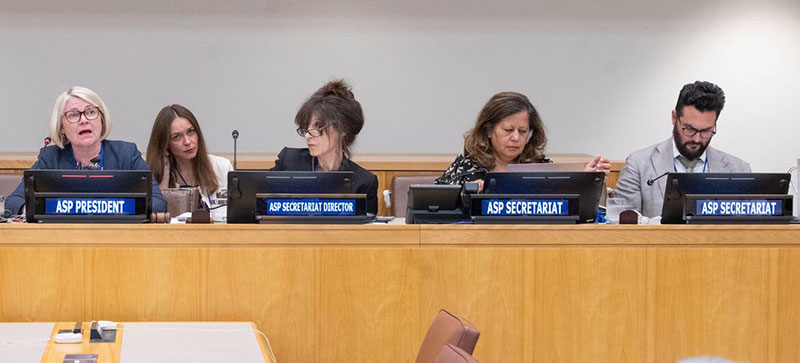
 US Secretary of State Marco Rubio’s warning to the International Criminal Court (ICC) was stark: ‘Either the ICC will end its threats, or we will end the ICC.’ It followed US central administration accusations that the court was unfairly targeting Americans on the basis of trumped-up war crimes charges.
However, a new plethora of sanctions has been clamped on the ICC by the US, which in turn has spurred accusations by sections of the world that the latter has unleashed an ‘assault’ on the international legal order.
What some of the sanctions would mean for the ICC was outlined by Rubio: ‘We will ban transactions with this rogue court, cutting off their resources and crippling their ability to operate against us.’
The ICC has shown consistency of purpose over the years. Despite some operational constraints it has indicted a large number of political strongmen from around the world, accused of war crimes and other governance excesses that come under its purview. Two such recent figures are: Russian President Vladimir Putin and Israeli Prime Minister Benjamin Netanyahu.
Rather than enjoy a mere nominal presence in the world community, the ICC has proved its effectiveness by detaining and bringing to justice scores of VIP politicians and others of their ilk who have been found guilty of human rights abuses and kindred excesses that come within the terms of reference of the ICC.
Accordingly, the international justice system would be stymied considerably as a result of the ICC being dis-empowered, particularly financially. Needless to say, potential and real perpetrators of the species of crime coming under the jurisdiction of the ICC would stand to gain most from such anarchic tendencies. That is, political repression globally would be enabled to enjoy a new lease of life.
A detailing of the types of crime coming under the purview of the ICC provides an idea of what it would cost the international community if the ICC’s operations are gravely hampered. They are mainly: genocide, war crimes, crimes against humanity and the crime of aggression.
That is, the part of the world to be worst affected would be the global South, since the latter is awash with the mentioned crimes. Needless to say, a chronically-disaffected South will sooner rather than later undermine the well being of the world dangerously. The world is already being put through these paces.
At the time of writing, ‘illegal migrants’ from the South, for example, are aggravating many a Western economy’s woes, besides creating for them acute law and order issues. The fact that these migrants’ presence goes on to become a virtual test of the migrant receiving states’ ability to forge domestic social inclusion in the face of jingoistic protests by mainly white supremacist groups is evidence of the latter. As is known, the US, to take just one example, has been up against this crisis for quite a while.
Accordingly, it will be in the best interests of the West if ‘illegal’ migrant arrivals on their shores are stemmed. If the socio-political and economic problems assailing the South are effectively managed through North-South collaborative, ‘trouble-shooting’ efforts the causes leading to ‘illegal’ migration and connected issues could be resolved at source as it were. For, it is the aggravation of the South’s material questions that lays the basis for the emergence of repressive and anti-democratic regimes in the hemisphere.
Until such time that the aforementioned issues in North-South relations are visited afresh and addressed urgently, a vibrantly functioning ICC would be needed. For, the latter would prove a deterrent to Southern political and military strongmen, highly prone to power abuse and like excesses, from coming into being in the wake of the South’s chronic material woes and the wars and conflicts that result from them.
It stands to reason then that the US would be acting in its own interests by enabling the ICC to perpetuate its mandate without hindrance. For a crop of issues that impinges negatively on internal law and order would be defused.
Meanwhile, there needs to be a meeting of minds among the rest of the West to put back in place a North-South dialogue process aimed at reducing some of the economic pressures that are weighing on the South.
Since economics usually drives politics it will be in the interests of the world community to scrutinizingly re-visit North-South issues of the past and put in place economic relief packages for Southern publics that would enable them to tide over their material hardships rather than permit the latter to aggravate into social disaffection and eventually armed militancy. It is the latter juncture that paves the way for the emergence of authoritarian rulers in the South who then go on to be a blight on their publics.
Accordingly, the Southern-based global development thinking of the past that envisaged a more equitable world economic order needs to be seen as an urgent need. That is, NAM’s international development paradigms need to be resuscitated to the extent possible.
It is unlikely that rightist governments of the West, such as the current Republican administration in the US, would find these projects feasible, but democratic states of Europe, led by perhaps the UK, are likely to think otherwise. For it would not be beneficial for the democratic world to be having on their hands repressive governments in the South who would be gravitating towards the major military and economic actors of the South, such as Iran and North Korea, who tend to be in constant power struggles with the West.
However, until such time that the mentioned, pro-people initiatives are given serious thought the ICC would need to be enabled by the international community to be in place comfortably and carry on with its mandate of bringing repressive rulers to book. Besides the ICC should pave the way for the peoples of the developing world to enjoy some substantial respite from the political repression and even terror which tend to be their lot.
Meanwhile, the wars of West Asia are relentlessly aggravating the economic hardships of people everywhere, driving the point home to enlightened sections that there is no alternative to peacemaking. A challenge is to convert the US under President Trump to this line of thinking.

 This week, I give you five simple, time-tested homemade remedies that help reduce the appearance of blemishes, control excess shine and leave your skin feeling softer and smoother.
The Honey and Lemon Brightening Dab:
For stubborn blemish marks, this is a classic. Mix one teaspoon of pure bee honey with three to four drops of fresh lemon juice. Apply gently, only on the affected spots, and leave for 10 minutes before rinsing with lukewarm water. While honey soothes and softens, lemon helps to brighten naturally. Use twice a week in the evening.
Besan and Rose Water Oil-Control Pack:
An ideal remedy to combat shine, especially on the T-zone. Take two teaspoons of besan (gram flour) and mix with sufficient rose water to form a smooth paste. Add a pinch of turmeric for its antiseptic goodness. Apply evenly, keep for 15 minutes and wash off. It absorbs excess oil without over-drying, leaving a beautiful matte finish.
Aloe Vera and Cucumber Ice Soother:
Blend fresh aloe vera gel with the juice of a grated cucumber and freeze the mixture in an ice tray. Each morning, wrap one cube in a soft muslin cloth and gently rub over a cleansed face for 30 seconds. It calms, tightens pores and imparts a baby-soft smoothness.
Oatmeal and Curd Gentle Polish:
Roughness and old blemish marks need gentle exfoliation. Combine one tablespoon of finely powdered oatmeal with one tablespoon of fresh curd (yoghurt). Massage very gently, in circular motions, for one minute, leave for five minutes and rinse. It removes dead cells and unveils softer, clearer skin.
Multani Mitti and Green Tea Magic Mask:
Brew some green tea and allow it to cool completely. Mix one and a half teaspoons of Multani Mitti (Fuller’s Earth) with the tea water to make a fine paste. Apply for 10 to 12 minutes – do not let it dry and crack completely – and wash off. It draws out impurities, fades blemishes and bestows a fresh, shine-free glow.
A Gentle Reminder:
As with any natural remedy, always do a patch test on your inner arm first. For those with oily or combination skin, avoid heavy coconut oil application and harsh scrubbing, as they tend to aggravate shine and blemishes.

 Dream of performing on a world stage? Well, here is your unique, golden opportunity!
The World Championships of Performing Arts (WCOPA) — the one and only official “Talent Olympics” — is the world’s premier global platform for aspiring singers, dancers, actors, models, instrumentalists, etc., to compete, shine and be discovered!
And, yes, this world stage is open to YOU, Sri Lankans living in Sri Lanka and overseas!
Held annually in glittering Las Vegas, WCOPA brings together over 70 countries, all competing for Gold, Silver and Bronze Medals, just like the traditional Olympics.

Lakisha Bernard: Will represent Team Sri Lanka at WCOPA 2027
Outstanding performers vie for the coveted titles of Junior and Senior Grand Champion Performer of the World, with winners and standout participants awarded over $500,000 in scholarships, cash awards and prizes to catapult their education and careers!
Sri Lanka is already making waves! At WCOPA 2026, Natharie Wickramasinghe, representing Team Sri Lanka, made the nation proud by winning a Bronze Medal in the Ethnic/Folklore Dance category!

Lakisha: Accomplished freelance Model and Fashion Design graduate
Recruitment for this prestigious competition is handled through a system of scouts and licensed National Directors — and this is where our very own Chris Rajendra, now based in Las Vegas, and National Director for Team Sri Lanka, comes into the scene.
If you are a singer, dancer, actor, model, instrumentalist — if you have talent burning inside you — contact Chris Rajendra today for registration and, who knows, you may find yourself in Las Vegas, and proudly draped in the Sri Lankan flag, at WCOPA 2027!
The contact address is: Chris Rajendra, wcopa.nationaldirector.sl@gmail.com
or chris.rajendra@gmail.com
Meanwhile, a star is born for 2027, in the form of Lakisha Bernard who is all set to represent Team Sri Lanka at WCOPA 2027.
Originally hailing from the sun-drenched coastal city of Colombo and now carving out her creative career in Canada, 22-year-old Lakisha is stepping into the international spotlight.
This accomplished freelance Model and Fashion Design graduate has officially been appointed as the Team Sri Lanka Promoter for Canada as she prepares to represent Team Sri Lanka at WCOPA in Las Vegas.
Lakisha brings a unique blend of high-fashion sensibility, captivating camera presence and expert garment design to the Team.
Having built her career, from local college shoots to high-glamour concepts, Lakisha’s inspiring journey embodies the true spirit of cultural bridge-building and creative resilience, bringing immense pride and recognition to Sri Lanka on the global stage.
WCOPA 2027 will be held at the legendary Westgate Hotel & Casino, Las Vegas, from 12th to 20th July – the very same iconic arena where the late, great Elvis Presley himself performed!
Your moment is now. Your stage is Las Vegas, so hurry and contact Chris Rajendra.

AgriConnect Sri Lanka’ to be launched on 30 October to Modernise the Agricultural Sector Through Digitalisation

57th Annual Saints’ Quadrangular Tournament on Saturday and Sunday

Showers or thundershowers will occur at most parts of the island

Prison rules to be revised over monks’ attire

AC President recuses himself from hearing prison attire case pertaining to Gnanasara Thera

Court orders steps to obtain INTERPOL Red Notice against Basil

‘Dates have the highest sugar content to fight Coronavirus’

Sunday Island 27 December – Headlines

#SundayIsland 17th December – Headlines

Sunday Island – 28th March

Sunday Island Headlines – 21 March

Sunday Island – 21st February – Headlines
-

 News7 days ago
NDB fraud Rs 60mn more than reported
-

 News7 days ago
Removing monk’s robes matter for Sangha to decide: Mahanayake Theras
-

 News5 days ago
Sri Lanka escalates anti-graft drive with Shiranthi’s jailing
-

 News6 days ago
NPP govt. reminded of its responsibilities as US warship leaves Colombo
-

 Latest News6 days ago
Farhan, Sadaqat help Pakistan ace 183 chase to go 1-0 up
-
 News7 days ago
BHC, Colombo: “LTTE remains a proscribed org. in the UK”
-

 Latest News4 days ago
Farhan and Sadaqat help Pakistan seal series in style
-

 News5 days ago
Iranian ships stranded, Lanka fears US sanctions