
Business
‘A coupon system that enforces quotas and rationing will not solve the balance of payments problem’

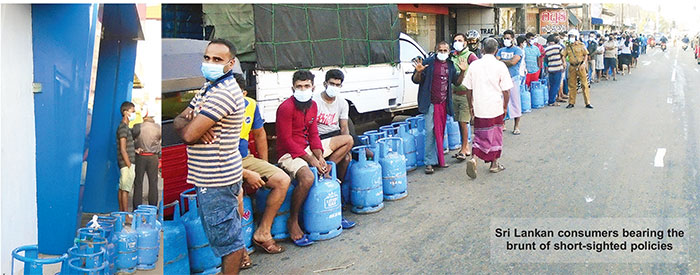
The media has reported that the government intends to implement a system of quotas for imports and the rationing of food and fuel. This is the latest in the long list of interventions over the last two years to address the growing balance of payments problems. Similar to previous measures this too only addresses the outward manifestation of a larger problem in the economy, but not its origin. Therefore, this policy measure too will ultimately prove futile.
The government took the right step a couple of months ago when they withdrew price controls on a few selected goods in the markets. Instead of further quotas and controls, what is needed now is to withdraw from further interventions in the financial and foreign exchange markets.
Sri Lanka has imposed an ever increasing web of controls on imports since April of 2020 but the trade deficit remains stubbornly high. In the period January-October 2021 imports rose by 26.5% and the overall trade balance grew by 34% to $-6,498m. This is despite a strong performance by exports, which rose 22.1%. The issue is not with exports but with imports caused by excess demand within the economy.
The government is running an extremely loose monetary policy, artificially holding down interest rates through interventions by the Central Bank. They are also running a large fiscal deficit, financed by Central bank credit or money printing. It is these two factors that are fueling domestic demand and as a result the spiral in imports. Curing the malady requires addressing its root, any other solution will at best only provide temporary relief.
Quotas and rationing – this is what a coupon system entails are cumbersome and costly to implement. They are also prone to corruption. Rationing will inevitably create black markets as coupons obtained by those best placed to acquire them are traded.
Existing import restrictions are hurting domestic trade, exports and consumers who face rising prices as a result of the shortages. People often characterise movement towards a larger trade deficit as “worsening,” this terminology is flawed and reflects a failure to appreciate that both imports and exports are beneficial for the smooth function of an economy.
Buying goods and services more cheaply than it costs to produce them at home, the nation benefits from imports. By selling goods and services in world markets, at higher prices for them than it could earn by selling only at home it benefits from exports.
What a country can produce is determined by the available resources. This also determines the standard of living of a country. Given the limitation of a fixed set of resources, if a country attempts to produce every single item that it needs it may not be very efficient in the way it utilises scarce resources. Shutting itself off from imports restricts the available inputs to local production.
There may be some things that can be produced efficiently while there may be others that do less well. It makes sense to allow a country to produce the things that it has a relative advantage at producing, and import what it does not. Thus imports are necessary for the growth of exports.
The proposed imposition of quotas will damage the economy even further and increase the suffering of citizens. The government needs to address the fundamental problem; tighten monetary and fiscal policy, free the currency and draw up a proper recovery plan that can prevent even further deterioration.
This will undoubtedly cause a shock – but will then allow trade and economic activity to resume. The alternative however is far worse; suppressing the symptoms of the disease will also stifle economic activity resulting in a slow, certain impoverishment with no hope of growth.
Advocata is an independent policy think tank based in Colombo, Sri Lanka. We conduct research, provide commentary and hold events to promote sound policy ideas compatible with a free society in Sri Lanka. Visit advocata.org for more information.
Advocata spokespersons are available for live and pre-recorded broadcast interviews via 077 4858401
CONTACT:
Yasodhara Kariyawasam
Communication Manager, Advocata Institute
Email: yasodhara@advocata.org

Business
Ambeon Securities hosts exclusive investor forum on Sri Lanka’s economic and market outlook


Ambeon Securities recently hosted an exclusive investor forum, bringing together clients, investors, business leaders, and market professionals for an insightful discussion on Sri Lanka’s economic outlook and investment opportunities amidst a challenging global landscape.
The event was organized with the objective of providing investors with valuable insights to make better-informed investment decisions while further strengthening the firm’s engagement with its growing client base.
The forum featured Baqar Zaidi, Director and Chief Economist for Sri Lanka and India at Citi Research, as the keynote speaker. Sharing his perspectives on the evolving global macroeconomic environment, Mr. Zaidi discussed key themes influencing emerging and frontier markets, Sri Lanka’s economic trajectory, and the opportunities lie ahead.
The keynote address was followed by an engaging panel discussion comprising Baqar Zaidi, Aravinda De Silva, respected investor, entrepreneur, and the Chairman of Arcasia Holdings. Hasitha Premaratne, Group Managing Director of Brandix and Asanka Herath, Chief Executive Officer – Unit Trusts and Head of Equities at LYNEAR Wealth Management.
Moderated by Imran Furkan, the panel explored a range of topics including Sri Lanka’s macroeconomic outlook, the future of the Colombo Stock Exchange, sectoral opportunities, capital allocation strategies, investor confidence, and the role of policy reforms in attracting investment and supporting long-term growth.
Speaking at the event, Charith Kamaladasa, Chief Executive Officer of Ambeon Securities, reaffirmed the company’s commitment to facilitate quality insights, informed perspectives, and meaningful dialogue to support their clients while building lasting relationships with them. He noted that in an environment where uncertainty has become the new normal, equipping investors with timely information and expert perspectives is essential for successful wealth creation.
The event was well attended by a distinguished gathering of institutional investors, high-net-worth investors, and business leaders. Among those present were members of the Ambeon Group Board, including Group Chairman Sujeewa Mudalige, Group CEO Dr. Sajeeva Narangoda, and Chairman of Ambeon Securities Mangala Boyagoda. Their presence, together with the participation of Ambeon Group shareholders and valued clients, enriched the discussions and contributed to a vibrant networking session, fostering meaningful dialogue and stronger connections within the investment community.
Through initiatives such as this, Ambeon Securities continues to reinforce its commitment to helping clients navigate evolving market conditions, make informed investment decisions, and achieve their long-term financial goals.
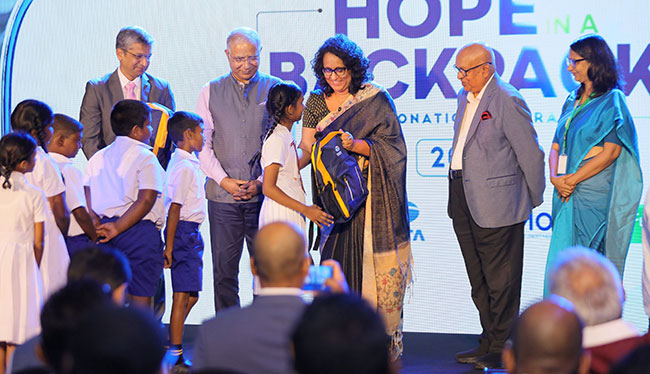
The Tata Group, in partnership with ChildFund and DIMO, has successfully implemented a humanitarian education support initiative for disaster-affected schoolchildren in Sri Lanka, reaffirming its commitment to helping communities recover from the impacts of Cyclone Ditwah and the subsequent floods.
Following a formal request for support from Sri Lanka, an on-ground assessment was conducted in December 2025. Recognizing the urgent need, several Tata companies joined forces to implement the response program.
As part of this initiative, the ‘Hope in a Backpack’ programme, which provides disaster-affected children with essential educational supplies, was launched by the Tata Group at Taj Samudra, Colombo, in the presence of the Chief Guest, Hon. Prime Minister Dr. Harini Amarasuriya; the Guest of Honour, Hon. Indian High Commissioner Santhosh Jha; Ranjith Pandithage, Chairman of DIMO; Chacko Thomas, Group Chief Sustainability Officer, Tata Sons; and Aditi Ghosh, Country Director, ChildFund.
This initiative is part of DIMO’s Social and Community Pillar, under the project theme ‘Lassana Hetak,’ which focuses on giving the future generation a helping hand towards a better future.
This collective effort was further strengthened by volunteers from Tata and DIMO, who actively mobilized on the ground to pack, distribute, and support affected communities. During the proceedings, specially invited schoolchildren received the backpacks with essential supplies as well.
Commenting on the partnership, Ranjith Pandithage, Chairman of DIMO, said: “DIMO is proud to collaborate on this meaningful initiative alongside the Tata Group and ChildFund as the local implementation and logistics partner. Our relationship with Tata spans more than six decades and has been built on a shared commitment to ethical business practices, trust, and creating lasting value for the communities we serve. These values have shaped our partnership over the years, extending beyond business to initiatives that make a meaningful difference in people’s lives.”
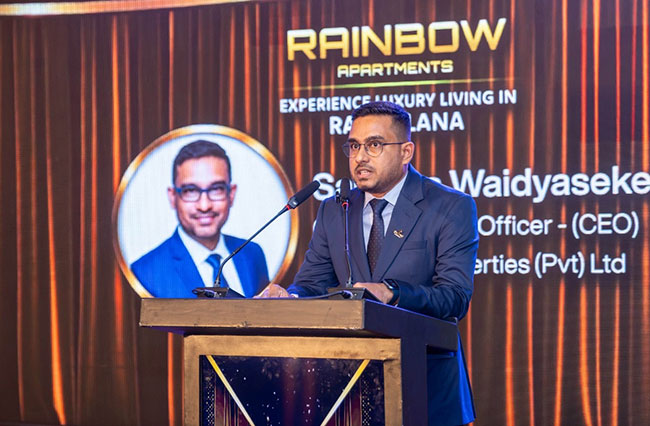
NovaNest Properties (Pvt) Ltd has officially launched Rainbow Apartments, a new residential development in Ratmalana. The announcement was made at an official launch event held at the Shangri-La Hotel, Colombo, marking the company’s latest addition to Sri Lanka’s growing apartment market.
The development is designed to cater to homebuyers seeking modern urban living, as well as investors looking for long-term value. Rainbow Apartments is located in Ratmalana, an area of increasing residential interest, and benefits from the suburb’s established social infrastructure, proximity to major transportation links, and accessibility to Colombo.
The project reflects NovaNest Properties’ commitment to delivering quality residential developments that combine contemporary design with practical living. Intended to satisfy the evolving lifestyle demands of today’s homeowners, Rainbow Apartments features thoughtfully designed living spaces supported by modern amenities. These include two infinity pools, a gym, fully functional workspaces, a mini theatre, stylish cafés, a mini-mart, and a children’s daycare. Additionally, it features a full time medical centre backed by Nawaloka Hospitals PLC Colombo, with a 24-hour ambulance service.
Commenting on the launch, the Chief Executive Officer of NovaNest Properties (Pvt) Ltd, Samitha Waidyasekera, said, “Today’s buyers are looking beyond square footage. In addition to providing long-term value, they want homes that are close to the places where they work, learn, and spend their time. With that shift in mind, Rainbow Apartments was created to bring together a strategic location, thoughtful design, and quality construction in a way that will continue to meet buyers’ needs for years to come. Through our promise of ‘Luxury Beyond Expectations,’ we are committed to delivering an elevated lifestyle experience that combines comfort, convenience, and modern living.

Anushka Sanjeewani, Vishmi Gunaratne return for Pakistan ODIs

Lennox stars again as New Zealand take series lead after West Indies collapse

Former IGP C.D. Wickramaratne found dead at his residence

Venezuela earthquake: Number of known dead rises to nearly 5,000 victims

A few showers may occur in the Western, Sabaragamuwa and North-western provinces and in Kandy, Nuwara-Eliya, Galle and Matara districts

Harmer, Markram and Wolvaardt win top honours at CSA awards

‘Dates have the highest sugar content to fight Coronavirus’

Sunday Island 27 December – Headlines

#SundayIsland 17th December – Headlines

Sunday Island – 28th March

Sunday Island Headlines – 21 March

Sunday Island – 21st February – Headlines
-

 Features5 days ago
Prison riots and politics: NPP’s biggest challenge and Sri Lanka’s biggest opportunity
-

 Editorial6 days ago
What’s the world coming to?
-
 Features2 days ago
Dirty Money
-

 Editorial5 days ago
Much ado about crime: Fish or cut bait
-

 Features5 days ago
More on Saudi Arabia: ARAMCO and beyond
-
 Latest News3 days ago
Oil prices hit 1-month high as US-Iran attacks dim Strait of Hormuz outlook
-

 Midweek Review2 days ago
The sordid tale of theft and tragedy at Finance Ministry
-

 Features4 days ago
Deepening Democracy – Constitutions and Constitutionalism